


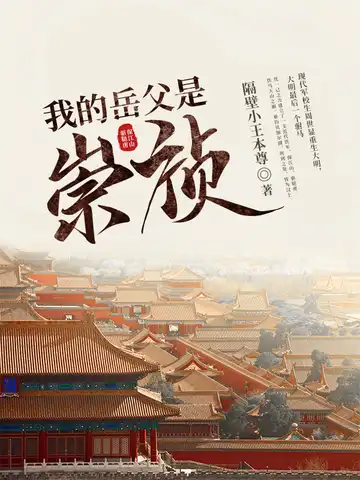
My Father-In-Law Is Chongzhen
我的岳父是崇祯
- Status
- Completed
- Length
- 2.0M Words
- Genre
- Historical
- Subgenre
- Historical Transmigration
- Updated
- 3y ago
- Source
- Qimao
Stats
All-time: Popularity, Must-read votes.
571Chapters
4.5MPopularity
4kReaders
118kMust-read votes
9.3Score
72.1kRatings
Tags
Synopsis
More by this author



In booklists 1


Readers also read
 Empire Food Phase
 The Counterattack of Ju San in the Late Ming Dynasty
 I, the Father-In-Law of the Empress, Turn a Deer into a Horse at the Beginning.
 Rise of Wolfthorn Empire
 My Strongest God of War in the Tang Dynasty
 Invincible Little County Magistrate
 From Son-In-Law to the Emperor's Favorite
 Tetsumoto
 Life Simulator: Fool the Old Eunuch at the Beginning
 Training the Southern Song Dynasty
 Princes of the Wei Dynasty
 Rebirth of the Deposed Prince: I Became a Genius in Civil and Military Affairs
 Summon Li Kui at the Beginning of the Three Kingdoms
 Ming Dynasty Master
 The First Warrior
 Datang: Take the Prince to Listen to Music at the Beginning
 Major General Xiaoyao
 Beautiful Mountains and Rivers
 A Humble Minister
 I Am Zhu Qizhen in Ming Dynasty
Reader comments 50
Google Translate
The whole book brought me a refreshing feeling different from that of urban novels, with a strong feeling of home and country. When I read it, I sometimes laughed, sometimes I was filled with righteous indignation, and most of all I was full of passion. It is common to see people making historical corrections in chapter reviews, but I don't think this is a reason to deny an excellent novel. Different from the rigor of historical documents, the novel is more of a dramatic story, and some settings have to be changed to achieve the effect of connecting the plot or being concise and easy to understand. Personally, I think this is where the author's true skill is shown, and it's a wonderful piece of writing. A common problem with historical novels is that they are easy to criticize, but don't forget, this is a novel. Being too obsessed with historical accuracy will make you lose the fun of reading novels. Isn't this putting the cart before the horse? All in all, a great book, come quickly! 😏👍
It is well organized, simple and clear, serious and compact, with a good grasp of historical details, and a firm grasp of the minds of people of that era. It's very good. I think this is the best historical novel besides "I Worked from 9 to 5 in the Ming Dynasty".
To be honest, I have read 100 chapters. It feels very good. This is the best historical novel I have ever read so far. Other time-travel novels use modern technology as soon as they are introduced, and the entire war is a thorough dimensionality reduction attack. They are just mindless and refreshing novels. This book is different and brings me different feelings. I actually feel a little excited. Moreover, the plot is also very consistent with history, with three correct views, respect for national heroes, respect for history, and good reviews!
I tried hard to portray every character, but no character was portrayed with flesh and blood. Don't even the sidekicks deserve to have IQ? You are a consort, and the whole Ming Dynasty listens to you? Take a look at the book Ten Kingdoms Emperors. Your book is really hard to read.
The book is very good, but there is one thing that makes me suffer from obsessive-compulsive disorder. One moment, the Ming Dynasty fell because of Chongzhen, another moment it was because of scholars, another moment it was the party and government, and after a chapter or two, it died because of poverty again... Change it in one or two chapters. Alas๑•́₃•̀๑! Annoying (눈_눈)!
Book title "My father-in-law's name is Onomatopoeia" Look, there are horses there. Look, there are horses there. The horses are "Herod", the carrier pigeons are "fluttering", the military camp is "hooting", the muskets are "bang bang bang", the cannons are "bang bang bang", the horses are running "tick".
I sleep in spring without waking up, The author travels everywhere. Not only is it not updated, There is still very little content. Book friends who read books, Do you know? Let the author update, Likes are essential.
When I saw the old man was given a gun, I gave up. It didn't matter how outrageous the previous one was. Who are you giving the gun to? Why don't you give it to an old man? Are there no young adults in the village? Are standard weapons given casually? Have you ever considered teaching people how to use a gun? You can tell me whether to load gunpowder or ammunition first. Guns also need maintenance. Forget about maintenance, let's leave that big gun.
I read a novel today, and it was very well written, because the overall plot is very carefully constructed, every detail is described very well, and the plot is very fascinating. All the cases seem to be within reason and beyond reason. It not only attracts people's imagination, but also makes people want to read on. This is really very attractive to me. The novel has a novel concept, unique subject matter, clear paragraphs, ups and downs, a clear main line, and is fascinating. It shows extraordinary literary skills in its plainness. It can be said that every word is precious and every sentence is a classic. What's so good about this book? 1. The beginning of the article is simple and appropriate. It uses the description of the environment to set off the mood of the characters, which is very artistic. 2. Be concise and to the point. 3. The beginning of the article is novel and has the effect of taking the lead. So that readers can have an impression of the characters as soon as they meet them. 4. The beginning of the article is engaging and attracts readers. ... The combination of points and aspects makes the article vivid, specific and appropriately detailed. 5. The language of the article is vivid and rich, and it is highly readable. 6. The beginning is extraordinary and attracts readers. 7. The beginning is touching and has real feelings. 8. The beginning of the article is very clear and plays the role of leading the whole article. 9. The article's selection of materials is novel and arouses readers' desire to read on. In history, the kings of subjugated countries were either fatuous, cruel, or puppets, and most of them had a bad reputation. It seems that only Emperor Chongzhen has received sympathy and even praise from future generations to a certain extent, saying that he was originally a ruler of the world, but he was born at the wrong time. "History of the Ming Dynasty" commented on Emperor Chongzhen: "He reigned for seven years. He was quiet, diligent and diligent, and governed with heart." Judging from the documentary records, Emperor Chongzhen was also quite satisfied with himself. He believed that during his reign, there were internal and external troubles, and the political situation was gloomy. The reason why the Ming Dynasty fell was because of the disloyalty of his ministers and the insubordination of his soldiers. Even before hanging himself, he uttered the exclamation "I am not the king of the subjugation of the country, but all the ministers are the ministers of the subjugation of the country." The reason why later generations have such an evaluation of Chongzhen is that he attacked the An Party at the beginning of his accession to the throne and rehabilitated a large number of landlords and literati from the Dongying Party. The fact that he died among rogue bandits increased their sympathy for him. But more importantly, the Qing Dynasty vigorously promoted him. Although the Qing Dynasty had always been an enemy of the Ming Dynasty and attempted to take over the Central Plains, after all, it obtained the country from Li Zicheng. After entering the Pass, the Qing Dynasty seized power from the peasant army under the banner of revenge for the Ming Dynasty. Therefore, they did not need to belittle the last-day rule of the previous dynasties like previous dynasties. On the contrary, the more Chongzhen's image is improved, the more he will be recognized by the Han landlord class. However, the true image of Emperor Chongzhen is far less glorious than what is described in the literature. Although his mediocrity was different from that of other subjugated monarchs, the collapse of the Ming Dynasty was also the general trend, and the return of the Ming Dynasty was not unrelated to Emperor Chongzhen's own mediocrity, incompetence, and inappropriate handling. We know that Chongzhen was a "frugal" emperor, which was not only reflected in his daily expenses, but also in spending money related to the country's livelihood. For example, in the second year of Chongzhen, he abolished the post stations in order to save hundreds of thousands of taels of silver, which made thousands of post workers unemployed and forced to rebel. Li Zicheng was one of them. In the fourth year of Chongzhen's reign, a large number of hungry people revolted and were recruited. Courtiers appealed to the court to provide relief. Emperor Chongzhen reluctantly approved a hundred thousand taels of silver for more than 100,000 hungry people. However, it was a drop in the bucket and to no avail. The hungry people who were recruited were unable to survive in the famine and had to rebel again. As for Emperor Chongzhen's embezzlement and arrears of military pay, which caused mutiny, there were even more incidents. But then again, during the reign of Emperor Chongzhen, the Ming Dynasty was indeed at the end of its rope. Taxes were increased every year and they took food from the farmers who were about to starve to death. Emperor Chongzhen also repeatedly called on the emperor's relatives and noble ministers to donate money. But he himself clung to his internal money and was unwilling to take it out until his death. Another fatal flaw of Emperor Chongzhen was his lack of responsibility. After he ascended the throne, he did not ignore government affairs like his grandfather Wanli and brother Tianqi, because he had a reputation for diligence. It is good for the emperor to be diligent in his duties, but if he is not capable but has to deal with both big and small matters, then it is better to ignore the government affairs and let the ministers handle it. Chongzhen's purpose is to grasp the power but not the responsibility. During Chongzhen's reign, many ministers took the blame for him, and many of them died unjustly. For example, Chen Xinjia, Secretary of the Ministry of War, secretly negotiated peace with the Qing Dynasty. Chongzhen put all the blame on him and broke off the peace negotiation in a rude manner. Because he always changes orders day and night, is irresponsible and blames others, he turns ministers into tactful bureaucrats who only sing high-pitched words and dare not put forward practical suggestions. Finally, let's talk about Chongzhen's death for his country. In fact, Chongzhen was not that strong and courageous. As early as when the peasant army crossed the Yellow River eastward, he wanted to move south and escape. However, he felt that abandoning the ancestral temple mausoleum would bring infamy, so he wanted the ministers to come forward to suggest moving south. The ministers all knew Chongzhen's character and were afraid of becoming a scapegoat in the end. Instead, they sang the high tune of "the emperor protects the country" and asked the prince to go to the south to supervise the country. The move to the south was delayed again and again, and the most favorable opportunity was lost. When the canal was cut off, it was no longer possible to move south. Even at this time, Chongzhen still did not give up his desire to survive. When Li Zicheng sent someone to persuade him to surrender, he never refused. It was just because he wanted to save face that he could not make up his mind. As a result, when the time limit expired, the peasant army invaded the inner city, and Emperor Chongzhen committed suicide at Meishan. Before he committed suicide, Chongzhen said, "I am not the king of a subjugated country, and all my ministers are ministers of a subjugated country." Firstly, he believed that the courtiers were shirking their responsibilities when things happened, but it is estimated that a large part of the reason was that they did not fully understand the emperor's intentions and could not take the initiative to take the blame for him in matters such as moving south and surrendering. It is okay to have sympathy for such an emperor, but it would be a big mistake to call him a promising emperor.
Personally, I think it's just so-so,