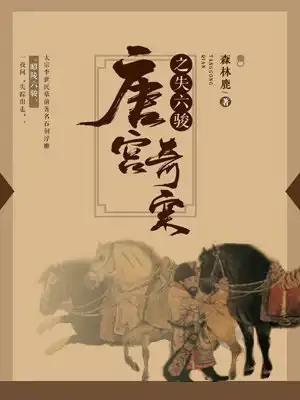
The Strange Case of the Tang Palace and the Lost Six Horses
唐宫奇案之失六骏
- Status
- Completed
- Length
- 850k Words
- Genre
- Historical
- Subgenre
- Alternate History
- Updated
- 5y ago
- Source
- Qimao
Stats
All-time: Popularity, Must-read votes.
171Chapters
26kPopularity
1.3kReaders
205Must-read votes
9.2Score
61Ratings
Tags
Synopsis
More by this author
Readers also read
 The Craziest Prince-In-Law in Daqian
 The Top Pick from a Poor Family: Twin Ladies Are Assigned at the Start
 Mythical Three Kingdoms
 An Old Man on the Frontier: The Stronger I Get After Marrying and Having Children
 Strong Qi
 Wealthy Lord
 Plan the World Clearly
 The Great Grandson of the Ming Dynasty Is Invincible
 Nephew Chongzhen, Forges a Bright Future That Never Sets
 Poor Lord
 A Noble Son-In-Law
 A First-Class Confucian Businessman
 The Best Crown Prince of the Tang Dynasty
 Start from Baihuguan
 The Great Qin Empire Summons the World
 Your Majesty, Please Stop Messing Around. I Am Really Not the Emperor.
 I Became the Prince in the Late Ming Dynasty
 Under Chongzhen, I Will Extend My Life for the Ming Dynasty for Five Hundred Years.
 The County Magistrate Starts, I Teach the Empress to Be a Corrupt Official
 Silk Road Tycoon
Reader comments 2
Google Translate
I watched the first part of "The Strange Case of the Tang Palace" "Blood Jade" on Stone Reading, and I also watched the second part "The Lost Six Horses" here. Also using "Strange Cases" as a carrier, "The Lost Six Horses" describes the "two saints coming to court" of Emperor Gaozong Wu, and against the background of the undercurrent of various forces, it is based on fictional characters. Sun Lang, as the protagonist, brings together a number of famous historical figures such as Wu Minzhi (He Lan Minzhi), Di Renjie, Shangguan Wan'er, etc., And interprets a true and false, false and true legendary story around the "Lost Six Horses", presenting a vivid, majestic and graceful picture of the Tang Dynasty. The author, Lin Linlu, has rich knowledge of the history of the Tang Dynasty. After breaking apart some historical fragments, he added his own imagination, and then combined them to form a unique family of royal secrets, hidden affairs in the court, palace romance, and wild history. This is also the beauty and interest of this type of "historical possibility novel". First, there are cases within cases, cases within cases, and the plot is compact and coherent. The main line of the story is very clear, which is the story of Taizong's grandson Changsun Lang looking for Ma Zhuan, the "incarnation of the six horses". But the main line has branched out into many sub-lines, and almost every sub-line is also a "strange case". Cases within cases, cases within cases, unfolding ups and downs along the way, exciting and exciting. The chapter opens with a thunderstorm night, and the six horses in relief on the stone wall of Zhaoling Mausoleum of Emperor Taizong of the Tang Dynasty suddenly and mysteriously disappeared. Is this witchcraft or a miracle? How did Wu Minzhi, who was given the main responsibility for the investigation of the Zhaoling Incident by the emperor, fall from the high echelons of the elite until his reputation was ruined? Prince Li Hong died suddenly shortly after taking in his concubine. Was it due to illness? Overmedicated? Or was he poisoned? What is the conspiracy behind the strange cat poison case? What is the truth behind the death of Princess Zhao? What role did the mysterious Ming Chongyan play in these events? Decipher it all in the joy of appreciating the text. Secondly, it popularizes science and complains at the same time, with a rigorous and joyful writing style. If you have read the previous film "The Strange Case of the Tang Palace: Blood Jade", you must have been deeply impressed by the author's distinctive historical research and gossip style. From the perspective of historical research, many carefully thought-out details make people feel immersed and realistic, such as the ceremony of the East Palace wedding, those thin guides, golden canopies, crown gowns, Qinglu tents... It can completely make up the image of a noisy and glorious aristocratic wedding in the Tang Dynasty. However, the most elaborate historical science popularization in this book is about Taizong's southern and northern campaigns for the founding of the Tang Dynasty. It can be said that around the title "Six Horses", the protagonist on the surface is Changsun Lang, and the protagonist behind it is Li Shimin. Changsun Lang's process of finding Ma Zhuan was a process of retracing Taizong's battle path and recreating the history of Taizong's military exploits. Baitiwu, Saluzi, Teqinpi, Qingzhui, Shifachi, Quanmaojun... Each divine horse corresponds to an important battle. Li Shimin rode them to fight Qianshuiyuan and Qingcheng Palace, annexed Fen, defeated Luoyang, fought in Wulao, and successively defeated Xue Rengao, Wang Shichong, Song Jingang, Dou Jiande, Liu Hongtao, etc., Becoming a generation of war gods. Whether it is finding a horse or solving a case, although it is a critical task with many obstacles and difficulties ahead, it should have been a tense and serious atmosphere. However, due to the continuous expansion of the protagonist group, characters of various personalities have joined one after another. In particular, many characters' inner OSs are embedded or the author directly comes to complain, which makes it appear united and lively, forming a pleasant and joyful reading experience. Thirdly, there is always a Brick Hunting Group to attract you. Look, the protagonist group with Chang Sun Lang as the core is coming towards us—— Changsun Lang, who digs graves when he appears and is struck by lightning, is a very lovable character. Although his education level is not high and his character is generous, he is a kind and loyal "bad boy". He has special luck and is a "chosen one". Shangguan Wan'er's character and image are not much different from those portrayed in previous literary and artistic works, except of course for the special experience in this book. This is a girl who is soft on the outside but strong on the inside, and extremely independent-minded. She has grown from a thin and helpless little maid to a literary and courageous Empress Wu, struggling to survive in the cracks. Although her relationship with A Lang has not yet come to an end, it is bound to be embarrassing. "Middle-aged fat official" Di Renjie, I almost thought he was the protagonist. After all, the first chapter is called "Di Renjie, what do you think?" Di Renjie's inner OS (no): I vaguely feel that the water is very deep here. The character Dee in this book has a bit of a comedic tone. One scene is when he was too fat to climb up to his room in Zhaoren Temple, and the other scene was when he was molested by Suo Qiniang after taking a concubine on official business, and he suddenly had the feeling of being an orange cat. The fierce and capable Suo Qiniang is not serious and chaste, and is completely the opposite of "virtuous and virtuous". However, she is really radiant, capable of doing things and managing things. The part where she saves people is very touching, and it's funny to control Di Pang. She is really a sister who rides the wind and waves! Su Weiwei, an infatuated foodie, not only knows how to eat and cook, but can also write poems and compositions. Every time the taste of Su appears, this book becomes a food article, such as raw fish, Chinese toon chicken, braised mutton, steamed sweet potatoes... "The Tang Dynasty on the tip of the tongue" can be found here. There are also two princes, Li Hong and Li Xian. The two brothers have completely different personalities. The former is a pity, and the latter... Is also a pity. Finally, I still have to add that although there are so many historical events and historical figures, this is a novel after all: if you take it seriously, you will lose.
The writing is very good, the plot is relatively flat, and the plot is a bit scattered.