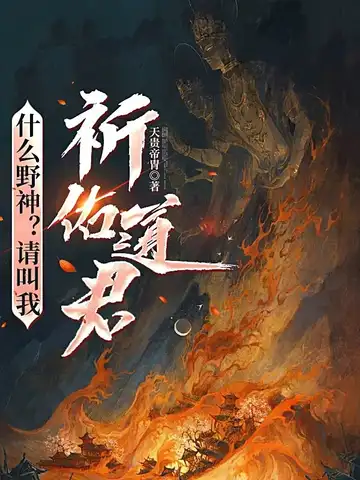
What Do You Mean, Wild Deity? Call Me the Dao Lord of Blessings!
什么野神?请叫我祈佑道君!
Stats
All-time: Popularity, Must-read votes.
149Chapters
79kPopularity
947Readers
516Must-read votes
9.1Score
197Ratings
Tags
Synopsis
More by this author
Readers also read
 There Are Gods in Chang'an
 God King of Ten Directions
 Holding the Book of Life and Death in My Hand, I Lead the Underworld to Control the Heavens
 Immortality Starts from the Source Pile of All Things
 Peerless Soul
 The Taoist Couple Is a Reborn Person, and I Overheard His Thoughts
 I Have a Book That Seals Demons
 Daxia Martial God
 Daqin Town Tiansi
 Hunyuan Wuji Emperor
 Burning God in Fire
 Ancient Swallowing Technique
 Beginning with the Marriage: I Am so Stubborn That I Am Invincible in the World
 Obtain the Lord's Artifact at the Beginning and Fuse the Blood of All Beasts
 Invincibility Starts from Drawing the Sword
 Heaven-Destroying Technique
 Martial Breaking the Sky
 Daliang Town Demon Division
 Supreme God of War from Another World
 All Heavens Work Part-Time to Become Gods
Reader comments 8
Google Translate
After reading dozens of chapters, the creativity is quite good, but I feel that the whole system is not very clear. 1. For example, how gods are created. Traditionally gods are canonized by heaven, but here they are canonized by the imperial court. So how do wild gods come into being? They also have no physical bodies. What is the difference between wild gods and ghosts? 2. The imperial court holds the power of life and death over the gods, so in theory the gods should obey the imperial court. Why did the emperor not seek help from the gods when he was seriously ill? 3. What is the lifespan of a god? If it is very long, then why don't those in authority canonize themselves as gods? Seeing that at present, Shinto seems to be just another form of immortal cultivators, which is completely different from the traditional Chinese concept of gods. So there should be a conversion relationship between monks, mortals, and gods. It seems that we need to find an opportunity to explain it. The existence of the royal family should also be explained. A group of people with only a few decades of life can manage gods and even canonize gods. So why don't they want to obtain such power? Even if it is just for immortality, it is attractive enough. Unless they are restricted by something, this should be explained clearly.
To be honest, the beginning of the novel is still a bit attractive. I want to see how the protagonist of the god transforms from a wild god who is not allowed by the court to be canonized and become a righteous god. But when I saw that the protagonist directly relied on plug-ins to advance to godhood and level, I lost most of my interest. Later, I saw that most of the gods in the entire county and even the entire country did not work or contribute, enjoying the incense of the people in vain, and there was no one to supervise them, which directly lowered the level of the gods. Finally, there is the issue of combat power. Mortals can kill ghosts with iron tools, but the monks of the sect who cultivate immortality are killed by ghosts indiscriminately. There is also the first-grade offering, which was accidentally bumped by a child who had just entered the tenth grade and almost fell down. . .
Among similar novels, this one is already considered the best. That's good. After all, the wisdom of the Three Views is normal. Not commonly used.
It sucks. Moreover, it is a Biaozi-ryu Shinto novel with great selfishness and justice on the surface. The more I read about it, the more I feel that the protagonist is not a good person.
It's a well-written book. If you get poor grades, it may involve Shinto. This kind of book involves some things.
The character description is vivid, the subject matter is novel, the protagonist has a distinctive personality, and does not digress from the topic.
Interesting, but so short
Very interesting setting, worth a look