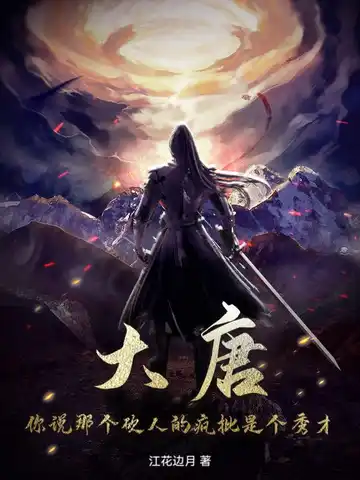
Datang: You Said That Crazy Guy Who Slashed People Was a Scholar?
大唐:你说那个砍人的疯批是个秀才?
- Status
- Completed
- Length
- 260k Words
- Genre
- Historical
- Subgenre
- Historical Transmigration
- Updated
- 4mo ago
- Source
- Qimao
Stats
All-time: Popularity, Must-read votes.
118Chapters
37kPopularity
1.3kReaders
216Must-read votes
8.8Score
17Ratings
Tags
Synopsis
More by this author
Readers also read
 Governor of the Ming Dynasty
 Start from the County Magistrate to Compete in the World
 Empress: at the Beginning, the House Was Confiscated According to the Order, How Could There Be Millions of Dirty Silver?
 Three Kingdoms: I Was Exposed When I Intercepted Hu Diaochan at the Beginning
 Muzi's Life in the Northern Song Dynasty
 Han Cavalry
 Start from Baihuguan
 From a Border Soldier to a Peerless Warrior God
 Rule the Ming Dynasty Alone
 Drunk and Sleeping in the Country
 Sir, I Need to Pay More.
 I'm Really Not an Expert from This World
 Rise from Humble Beginnings
 The Treacherous Son of the General
 My Wife Is a Vegetable Princess? I'm Crazy Happy!
 The Imperial Master Is a Trap
 I Have a Suite in the Late Ming Dynasty
 Late Ming Dynasty: Liaodong Lion
 Great Song Dynasty Haoerlang
 Great Song Dynasty Super Academic
Reader comments 5
Google Translate
There are many typos, the sentences are poorly read, and the common sense is written erroneously: Potatoes yield more than a thousand kilo per acre? Are you kidding me?
When a scholar picks up his sword, what kind of flowers bloom in the cracks of history? 1. The contrasting aesthetics of a "crazy criticizing scholar" The title of this novel itself has a unique "clickbait" temperament of online novels - "The mad critic who slashed people is a scholar". The seven words accurately captured the curiosity of the readers. But after reading the full text, you will find that this is not just a sensational gimmick, but the core tension that runs through the entire text: a scholar who should have no power to restrain a chicken turns out to be a ruthless man who can single-handedly defeat eight veterans of hundreds of battles and fight in and out of the Turkic camp. The reason why Lu Chuan is a lovable character is precisely because he breaks the readers' stereotype of "travelers". He is not the kind of traditional literary copycat who starts off by reciting poems and gaining fame by plagiarizing poems from later generations, nor is he Long Aotian who relies on modern military knowledge to cheat all the way. The sense of contradiction in him is three-dimensional - he is not only a talented man who can write "Why don't men bring Wu hooks and collect the fifty states in Guanshan", but also a warrior who can break the wrists of Turkic soldiers with his bare hands; he can save people's lives with blood transfusions, and he can also take the prince to Cheng Yaojin's house to slaughter cattle. In other novels, this kind of "both civil and military" may just be a pile of characters, but here, it is processed into an almost absurd sense of reality. The author repeatedly uses the label "white-faced scholar" to create contrast - when Yuchi Gong first met him, he thought "this guy has thin arms and legs", and the Turkic soldiers laughed at him as "the lamb of the Tang Dynasty", but every time, this "lamb" would show its fangs. The feeling of pleasure brought by this contrast is more layered than simply crushing with strength. 2. "Fan creation" in the gaps of history The time chosen for the novel is very interesting - in the ninth year of Wude, the Xuanwu Gate Revolution had just ended, Li Shimin had not yet officially ascended the throne, and the Turkic Jieli Khan took advantage of the opportunity. This is one of the most delicate moments in the history of the Tang Dynasty. The pain of internal power change has not subsided, and the crisis of external powerful enemies has arrived. The author inserted a "Lu Chuan" into this gap in history, and then watched him drop into the lake like a pebble, with ripples spreading out in circles. The "Weishi River Alliance" in the official history was rewritten as the "Jingshui River Alliance", Tuli Khan was captured in advance, Zhao Deyan was "sent" to the Turks to cause destruction, and the salt industry monopoly was implemented in advance... Each rewriting is logically self-consistent and serves a greater narrative ambition: to make this time traveler not just a spectator of history, but a participant. What is worthy of recognition is that the author did not ask Lu Chuan to "reduce dimensionality and attack" the ancients as soon as he came up. On the contrary, the ancients in the novel - whether they are top politicians such as Li Shimin and Fang Xuanling, or military generals such as Yuchi Gong and Cheng Yaojin - all show considerable wisdom and insight. Fang Xuanling was able to deduce the strategy of preferential treatment of prisoners from the four words "disintegrate the enemy army", Du Ruhui was able to think of using mutual trading to control the Turks, and Wei Zheng was able to write such an eternal masterpiece as "Admonition to Taizong Ten Thoughts". This treatment allowed for a real intellectual confrontation between the time travellers and the ancients, rather than a unilateral crushing. 3. The embarrassment and breakdown of the "system" It must be admitted that the setting of the "Tang Dynasty Warrior System" in this novel is an unavoidable point of controversy. System literature has long been prevalent in the online literature world, and the system here—giving strategy and force values, issuing telescope blueprints, and how to make penicillin—does have a bit of a "tool man" temperament. But what is interesting is that the author seems to be aware of this and has carried out a certain degree of self-destruction in the text. Lu Chuan's own attitude towards the system is disgusting: "Ah, what a dog system, selling dog meat with a sheep's head!" "The Tang Dynasty warrior system that I lied to myself, will reward him with literary points every day." This "official complaint" has alleviated the abruptness of the system to a certain extent. More importantly, the things the system rewards—telescopes, blood transfusions, penicillin, potatoes—are embedded in specific plot scenes rather than falling out of thin air. The telescope was used in the night attack on the Turkic camp, the blood transfusion method was used in the rescue of Cheng Shumo, the penicillin was used in Xiaosizi's fever, and the potato was naturally derived through the clues of the "overseas businessman" in his hometown and the old sow feeding the pigs. This "feeling of landing" makes the system rewards no longer cold props, but a key node that promotes the plot. 4. Group portraits: those historical figures who were "activated" The most brilliant part of the novel is actually not the protagonist Lu Chuan, but the process of "activating" the historical figures around him. Yuchi Gong: From the image of the door god in the official history, he has become a "Uncle Black" who will cry when Cheng Chumo is injured and secretly drink Lu Chuan distilled liquor. His respect when facing Father Lu, his tacit understanding when facing Cheng Yaojin, and his loyalty when facing Li Shimin all add up to the image of a flesh-and-blood military commander. Cheng Chumo, Qin Huaiyu, Luo Tong, and Yuchi Baolin: These second-generation soldiers are not just "followers". Each one has a distinct personality - Cheng Chumo's big brother demeanor, Qin Huaiyu's talkativeness, Luo Tong's straightforwardness, and Yuchi Baolin's recklessness. The process of them and Lu Chuan from strangers to sworn friends was written naturally and smoothly, especially the part where Mr. Lu recounted the past after being drunk. It was full of laughter and tears, and the friendship between the two generations was condensed in a few bowls of wine. Wei Zheng: This is one of the most surprising supporting characters in the book. The image of the "critic" in history has been deconstructed - he would drool over a handful of celery, secretly gorge himself when Pei was not at home, and would teach Lu Chuan a lesson while co-writing memorials with him. This kind of "de-sacralization" process makes Wei Zheng no longer a symbol in textbooks, but a person with quirks and warmth. Li Chengqian: The seven-year-old prince was written extremely brilliantly. He would carefully calculate the difference in salt prices to share his father's worries, hold his sister in his arms and reassure her not to be afraid, and nod heavily when Lu Chuan taught him to "let the people of the world have enough to eat." This kind of "sensible" is not a deliberate precocity, but the natural growth of royal children in a specific environment. Considering the tragic ending of Li Chengqian in history, this "White Moonlight" style of shaping only adds to the sadness. 5. Plot design and rhythm control The novel shows a good sense of rhythm in plot design. From the "soldier conflict" at the beginning to the "night attack on the Turks", from "blood transfusion to rescue Cheng Chumo" to "captive Tuli", from "salt industry franchise" to "rescuing little Sizi", there is a small climax almost every few chapters, and each climax serves the growth of the characters.
🤣 This is probably the most outrageous time traveler in the Tang Dynasty! Others traveled through time to become counselors and generals, but it was better for him - he was obviously a scholar, but he wanted to be a soldier! At the Jingyang Recruitment Office, the school captain Cheng Chumo looked at the scholar in front of him with "thin limbs and delicate features" and advised him kindly: "Sir, go to the staff office opposite. As a scholar, you can be selected immediately." Lu Chuan looked upright: "I only get fame from horses, my husband is really a hero!" Cheng Chumo: "..." However, the real reason is - the dog system said that if he does not become a soldier, he will not be a soldier for life! 💥 The soul of the special forces penetrates the Tang Dynasty, and it starts with high energy! A special soldier in his previous life, he is now a talented person. Eight people under siege? An elbow knocks down one of them, and the hand that separates the muscles and bones directly removes the arm, and the remaining one kneels down to beg for mercy. Yuchi Gong looked in the telescope and was dumbfounded: "You said that crazy guy who slashed people is a scholar?" Li Shimin personally inspected the battlefield and saw Lu Chuan chasing the Turkic cavalry to cut off the horse's legs. He was so distressed that he stomped his feet: "Bring that kid over after the battle! Next time before cutting off the horse's legs, let's see if the horse is worth anything!" 🏆 This scholar can drive faster than the Turkic cavalry horses! · Blood transfusion to save lives: Cheng Chumo was seriously injured and lost blood, and could no longer survive. He used blood transfusion on the spot to forcefully snatch the person back from the hands of the King of Hell. · Alcohol disinfection: Distillation and purification, turning Xinfeng wine into medical alcohol. Yuchi Gong and Cheng Yaojin ran away with a jar each on the grounds of "military secrets". · Penicillin: Xiao Sizi had a high fever, so he used the penicillin he had just made to save the princess, and asked Li Shimin to "be careful at night and don't get the queen pregnant again." · Presentation of potatoes: A treasure with a yield of more than a thousand stones per acre, found next to his pigsty - used by his mother to feed the pigs. · Snow salt: Coarse salt worth ten cents, processed into snow salt, sold for four hundred cents, directly overturning the Saga salt market. Li Shimin: "How many things do you have in your mind?" Lu Chuan (modesty): "I only know a few strange and obscene skills..." (In my heart: I am a time-traveler with a hook!) 👨👦 Do you think he can only fight? Still walking sideways in the court hall! Collecting the bones of the world, abolishing the palace maids, and easing the relationship between the Supreme Emperor and Li Shimin were all his ideas. Wei Zheng likes to eat celery? A bundle of vinegar and celery was done, and the two teamed up to write "Ten Thoughts on Admonishing Taizong", which made Li Shimin both loved and hated. "I originally wanted Wei Zheng to cure him, but the two of them got together and started teaching me how to be the emperor!" 😎 This is not a cool article, this is a cool article plus! The protagonist is not aggrieved, not a virgin, not ink-stained, he can be beaten when he needs to be beaten, he can be criticized when he should be criticized, and he can be promoted when he should be promoted. "Man, why don't you take Wu Gou and capture the fifty states in Guanshan!" Recite poetry with the front foot, and chop people with the back foot. This is the craziest scholar in the Tang Dynasty - Lu Chuan and Lu Shanhe. 🔪 Want to see how a scholar kills the Tang Dynasty and stirs up trouble in the court? 📖 Click to read "Datang: You said that crazy guy who slashed people was a scholar" Guaranteed you will laugh from the first chapter to the last!
One sentence review: I thought he was a weak scholar, but I didn't expect him to be a "crazy critic" who is capable of both literary and military skills. This book's anti-routine play is really good. Let me first talk about the most attractive point for me - the beginning of the chapter welds together the words "scholar" and "killing people", which are two irreconcilable words. The protagonist, Lu Chuan, travels back in time and is forced by the system to become a soldier. If he doesn't do it right, he will never be a soldier. This setting is cruel enough. Cheng Chumo, the lieutenant of the recruiting office, refused to let him go because he was a scholar. As a result, Lu Chuan said, "Believe it or not, I will knock you all down." Then he actually knocked down eight veterans. This contrast directly pushed me down on the chair. The fighting scenes are written very cleanly, without any fancy moves, just fast, accurate and ruthless. During the night attack on the Turkic camp, 50 people fought against a 100,000-strong camp, burning supplies and capturing prisoners. The rhythm was so tight that it made people breathless. The most incredible thing is that Lu Chuan captured two important figures, Ast Umedi and Tuli Khan, with his bare hands. The Turks probably still can't understand that a scholar could do such a thing. Besides being able to play, what surprised me most about this book was the "technical flow" part. Blood transfusion to save lives, distillation of alcohol, purification of coarse salt, offering of potatoes - each of them is closely related to the historical background, and it is not the kind of fun that comes out of thin air. Especially the part about blood transfusion to rescue Cheng Chumo made my palms sweat. There are also those second-generation soldiers - Cheng Chumo, Yuchi Baolin, Qin Huaiyu, and Luo Tong. Together they are a living treasure. The part where they collectively recognized Lu Chuan as their godfather made me laugh so hard that I slapped the table. It is currently tied, and the data is also going up. The 9.2 Points are not for nothing. If you like the background of the Tang Dynasty, light-hearted writing, and historical fan fiction, this book is worth a try. The only drawback is that it doesn't update quickly enough!
Book Review: This "Crazy Criticism of Scholars" Played New Tricks in the Tang Dynasty If you think this is another clichéd online novel about traveling through the Tang Dynasty and hugging someone's thighs, you are wrong. "Datang: You said that crazy guy who slashed people is a scholar" uses a very contrasting setting - the identity of a scholar, the soul of a special forces soldier, and being forced to join the army by the threat of "not being promoted" - it is full of excitement from the beginning. The greatest charm of this book lies in the pleasure of "dimensionality reduction strike". The protagonist Lu Chuan's poem "Why don't men wear Wu hooks" in his left hand conquered the generals. In his right hand, blood transfusion, penicillin, telescopes, hot air balloons, and gunpowder took turns, shocking the emperors and ministers of the early Tang Dynasty. What's even better is that the author integrates these "black technologies" into the plot: using distilled wine to knock down Yuchi Gong and Cheng Yaojin, using potatoes to stew beef brisket to subdue the prince, and using a hot air balloon to attack the Turkic royal court-everywhere is full of laughter and excitement. The characterization is equally brilliant. Yu Chigong is no longer a portrait of the door god, but an "Old Hei" who grabs wine and bursts into tears; Wei Zheng loses his temper when he sees celery; Li Jing's family raises Kunlun slaves and tigers... These famous historical generals have become vivid and amiable. The daily life of the protagonist and a group of second-generation soldiers who make jokes, cause trouble and perform extraordinary feats is even more eye-catching. In short, this is a refreshing novel that "does not emphasize martial ethics", but it is refreshing with brains, jokes, and warmth. Suitable for you who want to relax your brain but don't want to be fooled.