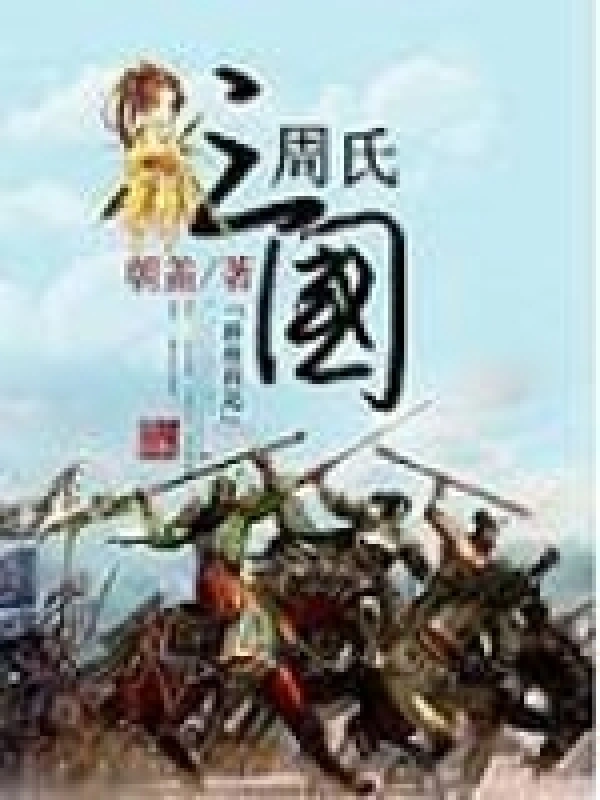
Zhou's Three Kingdoms
周氏三国
- Status
- Completed
- Length
- 920k Words
- Genre
- Historical
- Audience
- Male
- Subgenre
- Qin-Han & Three Kingdoms
- Updated
- 12y ago
- Source
- Qidian
Stats
0Monthly votes
8.5kRecommends
22.5kFans
314Chapters
Tags
Synopsis
Reader comments
Readers also read
 I Built a Cave in the Three Kingdoms
 Little Landlord of Ming Dynasty: I Am Really the Descendant of the Dragon!
 Traveling Through the Ming Dynasty, I, Zhu Gaoxu, Am Not a Chicken in a Crock Pot
 In the Red Mansion: Escort Daiyu to Beijing at the Beginning
 That Qiushi 1980
 The Most Powerful Soldier in the Three Kingdoms
 Mixed in the Three Kingdoms Fighting for the World
 America Started with Oil Growing Mold
 I Am in Dayu, Saving Ghosts and Becoming Immortals
 War of the Three Kingdoms
 Bashu
Bashu
 The Rogue Soldier King of the Three Kingdoms
 Prancing Horse Xiliang
This book is much worse than "Prancing Horses" and "Xiliang"...
[Comment] Boss, where did Er Xun go?
The protagonist still has fewer advisers than Cao Cao. Will he come to the protagonist? Before, I remember Zhou Jian said that if Er Xun went to the enemy, Xi Chang would get rid of him... Should Zhuge Jin, Ling Cao, Zhang Zhao, Zhang Hong, Lu Meng, Sima Yi, Zhao Yun, Wei Yan and others come out? I wonder how many the protagonist can get?
[Comment] Collection of good books
Collected good books🌹🌹🌹
[Single Chapter Review] Comment on "Chapter 48: Facing the Rebels"
Support your friends, shake hands and hug, make tea and read books, admire your friends' masterpieces, come on, Chongchong supports you!
The biggest problem is that killing Cao Cao in the early stage is useless. A half-dead Cao Cao is the best. We need Cao Cao to hold off the others, just poach his generals and civil servants as soon as possible
What's the relationship between pig's feet and Zhou Yu?
[Comment] Some experience of reading
Yesterday I saw some errors in Chapter 43, and I felt something about it, so I wanted to post a book review, but I couldn't find the time. So I just wrote it when I had time today. I didn't type a draft, so I just wrote whatever came to my mind. I have always been a science student. I majored in physics in high school and computer in college. My job is also computer-related. When it comes to history, apart from studying well in textbooks, I really don't know much about it. There have been more people writing novels since 2003, so I took the time to read them. It has been 11 years in a flash, and I don't know how many I have read over the years. Although most novels are made up, in terms of history, most of them are 3 fake and 7 true, which is relatively in line with the rules. If there are too many fakes, it will be a serious mistake. Some YY is too much. Of course, some authors may just regard YY as a selling point, so there will be more fabrications. Today I mainly talk about my experience, not specifically to evaluate this book. You can take a look. Although I don't write it myself, I have read too much and have some thoughts of my own. I think the most important thing for a good historical article is to live up to its name. As I said: There was a military general in the late Han Dynasty who was unparalleled in cavalry and fighting, superb in archery, and forgot all about righteousness at the sight of profit. Needless to say, everyone knows that he is Lu Bu. If I say that he is Cao Cao, a lot of people will probably criticize me. Similarly, if I want to say that a person writes and writes all day long and is unparalleled in benevolence and justice, and then I tell everyone that he is Lu Bu, I estimate that more people will criticize me than the people in the above situation. Therefore, I think it is important to live up to the name. Writing history is inseparable from the choice of dynasties. I would say it is the Han Dynasty, the Tang Dynasty, or the Ming Dynasty. Why? Clothing, food, housing, transportation, language, customs, economy, culture, political environment, and social conflicts. Of course, this is my own summary, which may not be comprehensive or appropriate, but I feel that once these ten aspects are written, this article will be good. If a person writes history, and after reading it, he can't tell the difference between dynasties at all, it all depends on where the author calls me which dynasty it is, then I think the article is bad. It is obvious that many people who write books are not professional history students and cannot cover everything. Therefore, if they can pick out a few aspects and write well, they are considered to be readable novels. If they are less, it means they have a poor attitude and are not prepared at all, so they write haphazardly. If you really feel that you don't understand anything and you really like writing historical articles, then use the Spring and Autumn style of writing, passing it over in one stroke, or simply leave it blank. As I said before, I am not a history major. I acquired a lot of historical knowledge from extracurricular books and other people's historical novels. I think there is some common sense that authors who write books should master. For example, there are unavoidable titles for officials, titles between friends, and titles for family members. In the Han Dynasty, officials were called by their surname + position, such as Liu Yuzhou, Liu Jingzhou, Sun Polu, etc. Calling officials "adult" was first used in Yuan dramas, and it was not popular until the Ming Dynasty, but it was not the mainstream. It was widespread in the Qing Dynasty. Therefore, in the early days, "adult" was mainly used to address father and mother, such as father and mother. Friends often call each other by names, so if someone doesn't tell you his or her name when introducing himself, it means to a large extent that he looks down on you and thinks you are not worthy of being friends with him, which is a very rude sign. If you are an ordinary friend, calling someone by their first name is also very rude and may seem provocative. There are exceptions. If they are relatively close friends, calling them by their first names means intimacy. For elders, when calling younger ones, they may use their first names or nicknames, which is also a sign of intimacy. In the Han Dynasty, brothers were not called eldest brother or second brother, but eldest brother, second brother, etc. The father's father was not called grandpa, but grandpa, and then he was called great-grandfather, while the female ones were called grandmother, great-grandmother. The Han Dynasty was still black, and the emperor's clothes were black with red edges. Anyone who has watched some TV dramas will know that the TV dramas of the Han Dynasty are much more reliable and more ethical than the braid dramas of the Qing Dynasty. The yellow robe as the emperor's attire originated in the Song Dynasty, and everyone knows that the yellow robe is added to the body. There is also the kneeling ceremony. Many people say that Li Shimin has Hu ancestry, so some of his habits are very different from those of the Han people. For example, the private lives of the concubines in the Tang Dynasty were all kinds of chaos. Another example is the living habits. At that time, Hu stools began to enter daily life. Before that, the habit of the Han people was to kneel down. Since everyone kneels down, it is natural to stand up when saluting. Most of them are bowing. In the Han Dynasty, the courtesy was high, and the robes were high. Most of them were elegant. You are the emperor.