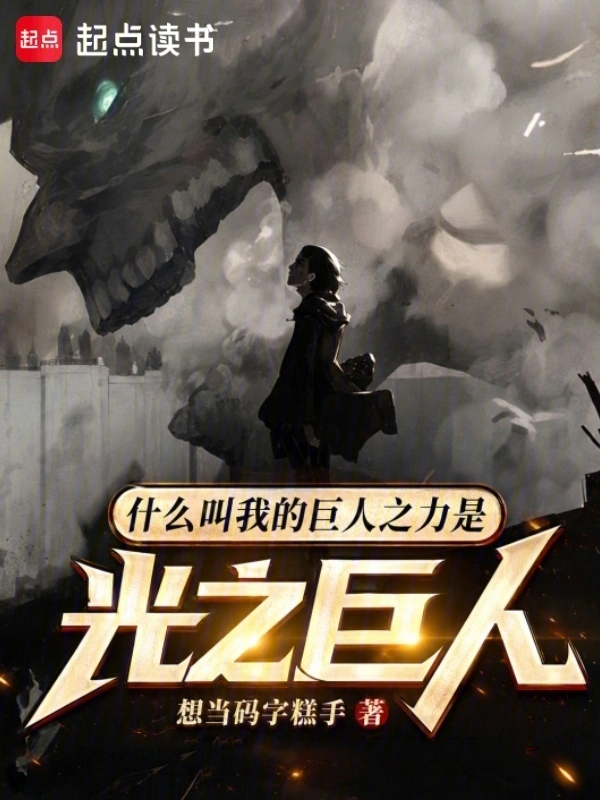
Giant: the Giant of Light Is Also a Giant!
巨人:光之巨人也是巨人!
- Status
- Ongoing
- Length
- 101k Words
- Genre
- Light Novel
- Audience
- Male
- Subgenre
- Fan Fiction
- Updated
- 3d ago
- Source
- Qidian
Stats
114Monthly votes
319Recommends
29Fans
45Chapters
Tags
Honours
Synopsis
Reader comments
Readers also read
 Ming Dynasty Manned Space Program
 Stop Destroying the Worldview
 No Matter What, Try Adding Them All Together
 Time Travel at the Same Time, Starting from the Mystery and Deciding the Eternity
 Life 1983
 Kazuma Kenzaki of the Moon World
 Naruto, What Do You Mean by Channeling Kaguya Otsutsuki?
 Starting from Chumaxian, He Stole His Throne and Became a God.
 Infinite Growth, I Have Level Ninety-Nine Superpowers
 One Piece: Taking Luffy's Body at the Beginning
 Weird Story: My Classmate Is Tomie
 I Popularize Zhou Rituals in Another World
 Infinitely Superimposed Skill Entries Starting from Tangmen
The protagonist doesn't deserve the power of light at all
Anyone who has watched Attack on Titan knows that the entire movie is about Titans, who are the real protagonists of this world. But the giants were slaughtered, expelled, and imprisoned! As a warrior of light, instead of fighting for the giant, they killed the giant together! He is simply unworthy of possessing the power of light! We should learn from the battles of our predecessors, such as "The first generation killed Jamila", "Seven killed Kielon Starmon", "Taro killed Shelta", "Gaia watched Tiguris being killed", "Tiga killed Gakuma", so what if the giant made a little mistake? You should kill all creatures that threaten the giant and protect the giant from harm!
The reason why the Ultraman series has been able to endure for more than half a century is precisely because it has long gone beyond the superficial pleasure of "fighting monsters". Its core has continued to evolve with the development of the times, and contains profound philosophical speculation and humanistic care. Taken together, the core of Ultraman is mainly reflected in the evolution of the following dimensions: 1. The philosophical sublimation from "external gods" to "inner light" The core philosophical discussion of the Ultraman series is the relationship between "divinity" and "humanity". * Early admiration: Ultraman from the Showa era came from distant outer space and was a "patron saint" from above. Human beings grow up under their protection, and it explores how human beings can emerge from infancy and overcome difficulties with their own strength. * The unity of light and people: By the Heisei era (represented by Tiga), Ultraman's divine power is no longer just alien technology, but comes from "the light in the human heart". Ultraman is both light and human. In "The Trial of the Devil", humans use flashlights and car lights to charge Tiga, which symbolizes that God is saving people and humans are saving God. Humanity and divinity have reached unity at this moment. * Thorough internalization: In the new generation works, Ultraman's power is embodied into various operable props (such as cards, medals). This seems to dissolve divinity, but in fact it coincides with a deeper logic: when "light" is completely internalized by humans, it no longer needs a secret identity to maintain its own specialness, but becomes a readily available force in human daily life. 2. Facing social pain points and reflecting on human beings themselves Ultraman is not only the embodiment of justice, but also a mirror of real society. Over the decades, it has explored the various crises faced by mankind in subtle or sharp ways: * Anti-war and historical scars: For example, "Swamp of Sorrow" exposed the brutal human experiments on biological and chemical weapons during World War II; "Hometown is the Earth" tells the tragedy of astronauts being abandoned due to the great powers' competition for space supremacy and turning into monsters due to radiation, which satirizes the strife within mankind. * Environmental protection and technology ethics: "Ultraman Gaia" repeatedly explores the balance between environmental protection and technology through the conflict between the earth and the ocean messengers; the digitization of Ultraman and the loss of control of the mechanical Ultraman in "Ultraman X" touch on the core anxiety of human beings in the 21st century about "loss of subjectivity". * Social and humanistic care: "The Decisive Battle between Red and Blue" focuses on the problem of empty nesters; in "Yitzhak with Silver Eyes", a tiger that was exterminated due to excessive hunting by humans turned into a monster, and its only fighting instinct is "to survive on this planet", which deeply reflects on human greed and arrogance. 3. From "lonely hero" to "equal partner" The relationship between Ultraman and humans has undergone a profound evolution. * Heavy dual identities: The human bodies of Showa and Heisei are often burdened with the heavy secret of dual identities, and they alone bear the tearing feeling caused by transformation. * Daily workers: The new generation of Ultraman has abandoned this tradition. Transformation is no longer an exception that tears apart daily life, but a part of daily life. The hero changed from a "lonely god" to an "ordinary worker who takes Ultraman to work." * Equal partnership: In works such as "New Ultraman", Ultraman is no longer a god, and humans should not rely too much on Ultraman. The two are equal partners, Ultraman can help, but the future of mankind must be created by mankind's own hands. 4. The eternal theme of pursuing the "Bright Future" The ultimate core running through the entire Ultraman series is the unremitting pursuit of "The Bright Future". Whether facing nuclear explosions, war, economic stagnation, or natural disasters, Ultraman has always represented hope, human perseverance, and free will choice. Just like the moment in the finale when children all over the world turned into light and resurrected Tiga, or when countless people raised their transformers, Ultraman's legitimacy ultimately fell on the choice of every ordinary person. The story of Ultraman is essentially a story about how the "other" is digested. It transforms destruction into protection, the external god into internal power. Generation after generation we have raised our arms, not because we were told to, but because the alien giant in the tights convinced us that we, too, could be light. Which era of Ultraman do you prefer? Showa, Heisei or the new generation, I can help you talk about the core works and themes of that era.
According to a normal novel, the protagonist is okay, but this is Ultraman, so I can only say that the protagonist is not good.
"Ultraman" and "Light" are inseparable soul bonds. From the setting at the time of its birth to the spiritual core conveyed in the plot, "light" is not only the source of Ultraman's power, but also the ultimate romance that spans the ages and connects the hearts of countless viewers. 1. The origin of race and the essence of life: born from light, returned to light In Ultraman's official setting, "light" is the cornerstone of their lives. Take the Kingdom of Light in the M78 Nebula as an example. 260,000 Years ago, the ancestors of Ultra Star built an artificial sun "Plasma Spark Tower" in order to cope with the crisis of the sun's destruction. This huge energy caused the original ordinary residents to "super-evolve" and turned into giants 40 meters in length. Their food is light, and they become light again after death. It can be said that Ultraman himself is a embodied life form of "light". 2. Source of power and bond: Light can awaken through the human heart With the development of the series, Ultraman is no longer just an alien visitor in a distant nebula, but has a deep soul resonance with humans. In the classic settings of the Heisei era, Ultraman's power often stems from the light within humans. For example, the core setting of Ultraman Tiga is that "light can awaken through human hearts", pushing the bond between humans and Ultraman to its peak. In "Ultraman Nexus", the power of light is passed down from generation to generation through many "fit people". As long as humans have a firm heart of justice and a belief in protection, they can continuously awaken and strengthen the power of the giant of light. 3. Spiritual Symbols and Beliefs: Become Light "Become Light" has become a highly resonant cultural symbol and ultimate romance among Ultraman fan groups. It represents the spirit of human beings who still choose to believe in hope and move forward bravely when facing despair, darkness and suffering. Whether it is the tragic story of the Nexus warriors who continue to guard the light in the darkness, or the majesty of Ultraman Noah as the "first light of the universe" silently guarding the universe, they all convey to the audience a belief: there is light hidden in everyone's heart, and as long as you don't give up hope, you can become a "light" that illuminates others. 4. Inheritance across eras: the epic of light from Showa to Reiwa Since Eiji Tsuburaya created the first Ultraman in 1966, this "light" has been shining for more than sixty years. From the classic showdowns of the Showa era, to the in-depth portrayal of human nature and bonds in the Heisei era, to the diverse fusion of youthful passion of the new generation, the Ultraman series interprets different aspects of "light" with each work. Whether it is the patriarchal responsibility of the father of Ultra, or the growth of new generation warriors such as Zero and Taiga, they are guarding the peace of the universe and the earth in their own way and passing on this light. In short, Ultraman is not only a special photography hero who "fights little monsters", but he is also the incarnation and transmitter of "light". They told generations of audiences that real power does not come from external transformers, but from inner courage, kindness and the belief to never give up.
Qidian has an AI dedicated to publishing book reviews
I remember that Qidian has an AI that posts book reviews and interacts with people. It keeps posting long reviews to attract authors. It feels like the author of this book has been targeted. The other authors who were targeted seem to be eunuchs.
Have you ever been a giant? Write it here
Has the author ever been a giant? Write here
The writing is very good, but it only weakens Tiga's ability for the sake of the story. Tiga's ability is enough to kill the giant in one second and then fly to the horse in another second to solve the rest.
The author's writing style is pretty good, and he wants to write his own stuff instead of following other people's opinions, which is good.
Should you consider changing to Ultraman? Because I feel that the people who read this book are not that obsessed with Tiga. Wouldn't it be fine as long as he is the Giant of Light? The protagonist uses a 20-meter Tiga, and then I checked and found that the round-winged Tiga is indeed 20 meters. This is related to the super ancient bloodline, and there seems to be no way to change it. Nexter's juvenile body is 10 meters, which is enough in the early stage of the giant world. Next, Nexter's youth body is 40 meters, Nexus is 49 meters, and Noah is 55 meters (with wings). There is a growth process. The 10-meter Nexter is an incomplete fusion with Noah's light. I feel that the protagonist can also fit this situation. But it seems that it would be okay if the later author gave a more reasonable solution to 53 Midiga? (Stacked Armor: I haven't watched Nexus and Nexter, but it just feels a bit appropriate. My understanding of the Nexus series is only that it protects the lights of thousands of families, so what else is there to be a real man?)
Could you please introduce the protagonist's abilities clearly? It doesn't matter if the activity only lasts three minutes. After the transformation, it takes a while to change. How long is the interval?
Although the Ultraman series is often misunderstood as a simple "sub-gongxiang" monster-fighting story, its true ideological core is full of profound humanistic care and serious discussion of social issues. Ultraman's ideological system can be understood from the following core dimensions: 1. Calling for peace and reflecting on war Since its birth, Ultraman has had a strong anti-war background. The hero's mission is not only to defeat monsters, but also to end war and call for peace. For example, Jamila, the monster in the original Ultraman, was actually an astronaut who was abandoned by the country during the Cold War space hegemony and mutated by cosmic radiation. He returned to Earth with attachment to his homeland, but was feared and attacked by humans. This story profoundly indicts the destruction and betrayal of individuals caused by war. In addition, dramas such as "Swamp of Sorrow" also exposed the brutal human experiments on biological and chemical weapons during World War II, expressing strong anti-war doctrine. 2. Reflection on Environmental Protection and Technology The Ultraman series has always maintained a profound reflection on the relationship between man and nature and the abuse of technology. "SOS from the Deep" in "Ultraman Tega" caused the birth of mutated monsters due to nuclear leakage that polluted the ocean, sounding the alarm to protect the environment. In "Ultraman Gaia", Ultraman Aguru, who represents the power of the ocean, even had the extreme idea of "eliminating humanity and protecting the earth" because he witnessed the selfishness of human beings and the evil nature of trampling on life. The series explores environmental protection, misuse of resources, and the possible negative impacts of rapid technological advancement. 3. Pay attention to social reality and vulnerable groups The Ultraman series explores various problems faced by human beings in social development in a subtle or sharp way. For example, "Goodbye Obik" in "Ultraman Tiga" reflects the destruction of traditional villages by commercial development; "Duel between Red and Blue" reflects the empty nest problem of elderly people living alone; "Requiem to the Underworld" explores the tragedy of individuals under excessive competition in society. Ultraman is not only a fighting hero, but also bears the social education responsibility of guiding, whipping and protecting. 4. The unity of human nature and divinity The Ultraman series conducted an in-depth analysis of "divinity" and "humanity". In the early days, Ultraman was regarded as a patron saint from outer space, but as the series developed (especially in the Heisei era), Ultraman gradually lost his divinity and showed his humanity. There is a classic line in "Ultraman Tiga": "Ultraman is both light and human." Ultraman's power does not come out of thin air, but comes from the light and faith in human hearts. In episodes such as "The Trial of the Demon", when Ultraman was in dire straits, it was the light gathered by all mankind that gave him the power to resurrect. This setting breaks the one-way relationship of "God saves people" and emphasizes that the brilliance of human nature is divinity. 5. From one-way protection to two-way redemption The relationship between Ultraman and humans has experienced a transformation from "Ultraman unilaterally protects humans" to "Ultraman and humans protect the earth together." "Ultraman Goss" is based on love and peace, trying to influence monsters instead of directly destroying them, breaking the irreconcilable binary opposition. In the finale of "Ultraman Tiga", humans all over the world turned into light and fought side by side with Tiga. Human beings are no longer small and helpless beings to be saved, but have become the main body of saving the world. To sum up, the core of Ultraman's thoughts goes beyond the simple opposition between good and evil. It explores justice and favoritism, survival and destruction, technology and nature, and ultimately ends with an inquiry into the fate of mankind: What is the most precious thing for mankind? What is truly worth protecting? Which work do you want to learn more about? 1. "Ultraman Tiga" - the philosophical core of "light is human" 2. "Ultraman Gauss" - the pacifism of "influence rather than destruction" 3. "Ultraman Gaia" - the extreme concept of Ultraman Aguru "to eliminate human beings to protect the earth"
Does the author have a harem?
Mikasa and the like, and old lady Ymir🙂
I feel like this look is more suitable for the world of giants
Hey, I feel tepid all the time
In fact, there is nothing wrong with the writing, and the writing is on point, but instead of following the boat, it is a plot spoiler. Then the title of the book is Giant of Light, which actually absorbs the volume. Not to mention how popular it is, at least it should be high-quality. Maybe it's because there is really no giant market in Qidian
Regarding Ultraman, some rumors refuted that the earth can be solved in 2 minutes and 50 seconds.
In fact, the attack on the Earth's administration paralyzed it, and the explosion of stars by miscellaneous soldiers was even more of a joke. The Ultra Brothers clearly stated that they had less light to explode stars. Who are some people in the comment area fooling? They didn't check the settings and came here to fool people.
Heroine
The current female protagonists seem to be Historia and Frieda (the ancestral giant, Historia's sister). I don't know if there is Pique. Although the car giant is not good-looking, Pique is quite good-looking. Even Pique seems to be quite arrogant, and he is also a pure-bred spiritual Marais.
Can Ultraman Tiga defeat the ancestor giant Ymir?
Might as well be set as a dark giant
Don't the awakened ones of the 9 giants only live to be 18 years old? What the hell is Grisha?
The progress is too fast and I feel like I can't write long enough.
It depends on how the author arranges it. Conflicts are resolved in the early and middle stages, while the middle and later stages feel more daily.
A few years ago, I saw a similar book somewhere on Tieba. It also featured Ultraman fighting giants, and the second part also included an anti-travel part.
Was the super giant killed when he came up?
It's only Chapter 10. I remember there aren't many giants. Will this book be followed by the Heavens?
It's rare to have a giant fan, I hope the author can finish it
Overall the writing is pretty good
The plot is mainly based on group portraits. The protagonist does not take care of everything. He mainly intervenes in important plot points of the original work. The difference from the original plot is quite big. As a fan, it is a very good category. Anyway, the direction so far has been completely different from the original work. As a giant of light, his combat power is not so low that he has to go back and forth with the nine giants. This is not bad, but the combat power is too high and I guess it will not be too long.
Ymir
All giants exist to enslave the original little girl