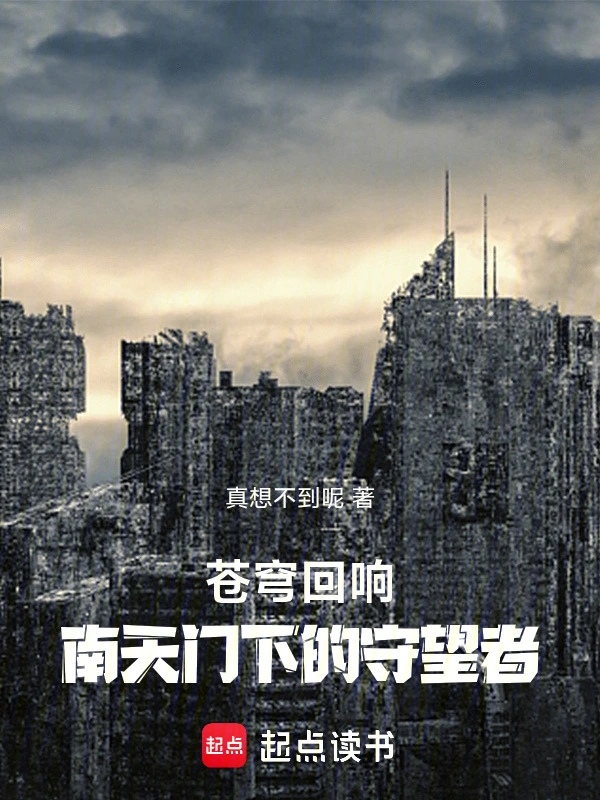
Echoes in the Sky: Watchers at the Nantian Gate
苍穹回响:南天门下的守望者
- Status
- Ongoing
- Length
- 167k Words
- Genre
- Sci-Fi
- Audience
- Male
- Subgenre
- Apocalypse
- Updated
- 22d ago
- Source
- Qidian
Stats
0Monthly votes
89Recommends
0Fans
56Chapters
Synopsis
Reader comments
Readers also read
 Oh Yeah! I've Seen Fake People
 Doomsday Convoy: My Sequence Unlimited Synthetic Upgrades
 My Low-Dimensional Universe Model
 Psychic Worlds: the Paladin Forges His Body into a Numerical Monster
 On My First Day at the Police Station, I Ate Imported Candy from a Police Beauty.
 Master Lin Jun
 Gao Wu: Is This Hex System Serious?
 What Should I Do If I Ascend to the Wrong World?
 My Girlfriend Cheated on Her and Got Pregnant, and I Ran Away Nine Months Later
 This Adventurer Has the Ability to Make Money
 When Nao's Flowers Fall
 From Martial Arts Examinee to Master of the Universe!
Watch the seedlings grow up slowly
From the first chapter to the present, this book "Echoes of the Sky" has given me a reading experience that I haven't had in a long time - not the kind of adrenaline rush, but a heavy dull pain, like something clutching my heart. Let's talk about the worldview first. It is already difficult to come up with new ideas when writing about the wasteland theme, but the apocalyptic construction of this book made my eyes shine. It is not the template ruins of "a scorched earth after a nuclear war", but a complete, breathing ecology with its own economic cycle and social logic. Water is the hard currency, the purification workshop is the heart, and the light of the rat oil lamp is the only warmth of this era - these settings are not just background boards, but are truly embedded in every plot, every transaction, and every character's survival decision. When Lin Zhendong went deep into the radiation zone for a few filter capacitors, I was not just watching an adventure, but feeling the weight of every screw in this era. Let's talk about the characters. Lin Zhendong is one of the most textured protagonists I have read this year. He is not that kind of omnipotent apocalyptic strongman, he is just a fifty-four-year-old veteran, wearing a broken armor that may break down at any time, and bringing a child who he has raised for twenty-three years but never let him call him "Dad". Every move he makes speaks of love, but every word he speaks avoids love. This kind of silent, restrained emotion expressed through actions rather than words is more powerful than any intense lyricism. And Amin - twenty-three years old, grew up in the wasteland, can disassemble energy cores, and can judge danger from the sound of footsteps. The most dangerous genetic sequence of mankind is buried under the barcode on the back of his neck. He is smart and keen, inheriting his biological father Lin Yuanshan's intuition for precision things, but he is also given the right to choose. "It doesn't matter if you don't do it" - this is what Lin Yuanshan left for him, and it is also one of the settings that touched me most in this book. A man who is designed to be a savior has the freedom to refuse to be a savior. Then there is Lao Wu. To be honest, it was only when I wrote the showdown in Chapter 3 that I truly realized how deep this old man had hidden himself. For twenty-three years, he buried his identity as Nantianmen liaison officer in the daily chores of the Warm Water Station, and used the pragmatic face of a settlement leader to cover up the sharpness of the person in charge of the intelligence network. When he said to Lin Zhendong, "You are not his father, but you are more like a father than any father," I watched it three times. These are words that can only be said by a person who has also lost a lot of things and has been guarding the wasteland for more than twenty years. And those supporting roles. Lao Zhao, who is missing his left arm but never screams on the operating table, Xiao Meng, who sleeps holding the iron pipe gun left by his father every night, and Xiao Rou, who uses mutated vines to extract anesthetics - they are not tool people, not backgrounds, but living people struggling, persevering and supporting each other in this cruel era. Speaking of writing skills, this book has a very unique technique that impressed me deeply - emotions are not conveyed by lines, but by actions, eyes and those "things that I wanted to say but didn't say". Lin Zhendong's hand hanging in mid-air at the door of the container is more powerful than any monologue. This is the silent aesthetics of the wasteland - in this era, people are not good at expressing emotions, but their actions are more honest than any words. What moved me most about this book was its spiritual core wrapped in an apocalyptic shell. Civilization is not a starship, it is not a high-tech weapon, it is not anything grand. Civilization is the act of bending down to plant a sunflower seed on the ruins. This image runs throughout the book, from the mushrooms on the roof of the heating station to the seeds in the hands of the children at the end, always responding to a core proposition: When we lose everything, why can we still be called "human beings"? Lin Zhendong gave the answer with his own actions - because there are people who are willing to protect another life, a plant, and a tomorrow in desperate situations. Not because tomorrow will definitely be better, but because protection itself is what distinguishes humans from beasts. Finally, I must mention the tone of this book. The wasteland is cruel. UEA's airship, the blades of the Red Scale Gang, and the deathly silence in the high-radiation zone all remind you of this; but it is not hopeless, because even in the deepest ruins, there are still people planting flowers. Lin Zhendong said "I am not his father", but everything he does is what a father would do. A Ming said "Lao Lin" and then changed his name to "Dad". These moments make me believe that no matter how cold the wasteland is, the light in people's hearts has not gone out. As an ongoing work, the opening chapter of "Echoes of the Sky" has built a solid and in-depth wasteland world, created a group of flesh-and-blood characters, and planted many foreshadowings worth looking forward to. From the daily life at the water heating station to the shocking secret behind the music box, from the silence of the father-son relationship to the cruelty of survival in the wasteland, every step is taken steadily and sincerely. Looking forward to Lin Zhendong's next journey, and also looking forward to A Ming's choice after knowing his life experience. More importantly, I look forward to seeing more people bend down and plant their own flowers in this ruins.
Good looking, please read "Chen Shang Sword Journey"!
Writing a book is not easy, so stay with me!