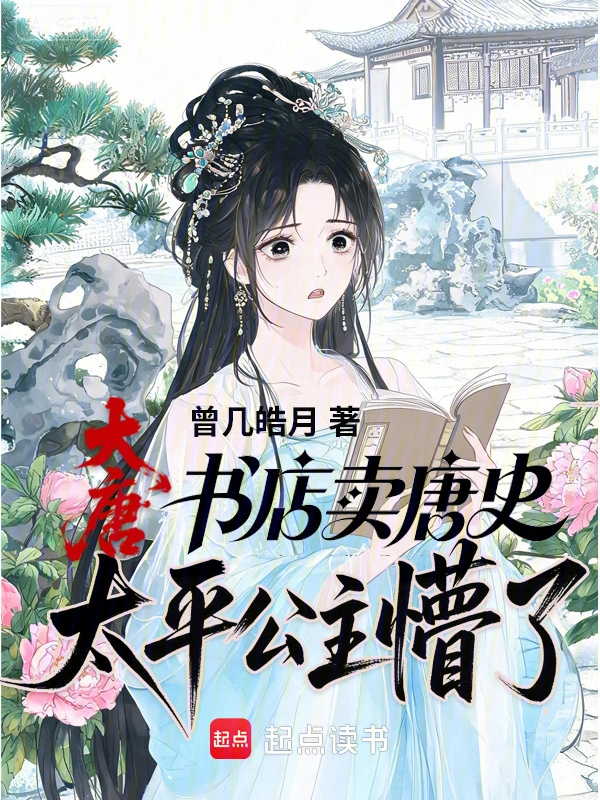
Tang Dynasty: the Bookstore Sells the History of the Tang Dynasty, and Princess Taiping Is Confused
大唐:书店卖唐史,太平公主懵了
- Status
- Ongoing
- Length
- 195k Words
- Genre
- Historical
- Audience
- Male
- Subgenre
- Jin-Sui-Tang Dynasties
- Updated
- 1mo ago
- Source
- Qidian
Stats
0Monthly votes
871Recommends
15Fans
89Chapters
Tags
Synopsis
Reader comments
Readers also read
 Red Mansion: All the Flowers in the Garden Are My Green Plums
 Chronicles of the Red Mansion
 In the Ming Dynasty, the Days When the Cows and Horses Turned Over
 I Asked You to Save Twelve Hairpins, but You Put Aside This Unlimited Explosive Force
 Ordinary People: Start from the Yanjiabao Branch
 I Open a Supermarket in Zhenguan
 Daming: the Beginning Takes Lao Zhu Through the Future
 I Made up Magic and Taught the World-Destroying Witch?
 Lucky Player
 The Imperial Preceptor of the Early Tang Dynasty Took in Xiao Wu Zetian at the Beginning
 Daming: Zhu Biao Was Reborn, Zhu Yuanzhang Cried
 Zhu Di: My Staff Come from the Future?
Another book that serves as a dog to the feudal dynasty.
He was a dog for the feudal dynasty again. People of that era had limitations of the times. Do you still have limitations of the times? Do you know how the next era will develop? Even if you know what to do to succeed, you are unwilling to do it.
You don't need to read it to know that your book is not long. No one can tolerate the second empress
The tri-colored glazed pottery of the Tang Dynasty is an underworld artifact, specially made for tombs. Are you giving this away?
Even if Princess Taiping doesn't become a Taoist priest, she will never be sent to get married in this life. She is a Taoist priest, not because she is afraid of marriage at all, but because she is using it as a decent excuse to hide her identity from others. 1. The background is ridiculously hard: Wu Zetian's only legitimate daughter - Mom is Wu Zetian, the actual person in power at the time - Dad is Tang Gaozong, the queen's biological eldest princess - Not a distant clan member, not a concubine, not an unwanted widow Among all the princesses in the Tang Dynasty, there is no one of this level. 2. Era: The peak of the Tang Dynasty, Tang Dynasty is the father Whether the dynasty is strong or not directly determines whether the princess wants to get married. When Princess Taiping was active: - The national power of the Tang Dynasty crushed the surrounding areas - Tubo, Turks, and Uighurs all begged the Tang Dynasty - The Tang Dynasty was the Khan of Heaven, so foreigners dared to ask Wu Zetian for a daughter? Court death. In the early prosperous period of the Tang Dynasty, the Tang Dynasty only married clan daughters to fool foreigners, and the emperor did not give away any of his own daughters. Princess Wencheng and Princess Honghua are both members of the clan, which is proof. 3. What does she do as a Taoist priest? It's not about hiding from the marriage at all Real history: Tubo did mention that he wanted to marry Princess Taiping. Wu Zetian directly: No! But I didn't want to fall out directly and hurt the relationship, so I came up with an excuse to become a Taoist monk: "My daughter believes in Taoism and wants to practice Taoism, so she can't get married." To put it bluntly: Refuse to get married with dignity, and pick a good son-in-law and take charge of it by herself. Later, Wu Zetian personally selected her consorts, Xue Shao and Wu Youji, who were all top-notch nobles and members of her own family, to consolidate the power of the Wu family. One sentence: A real princess with a strong national power and a tough background will never get married; A real princess with a weak national power, no one to care for, and no value is the one who is thrown into the marriage. Even if Princess Taiping did not practice Taoism, Wu Zetian could find a hundred reasons to reject Tubo, and she would not be able to marry far away.
Books of this type are all about science and technology, eating, drinking and having fun. For example, Changle has almost become a professional female protagonist. If you choose a bad time period and do bad things, you can cut Hu and Wu Zetian better than this, or you can just keep fighting. And Wufeng reviews are not very good. When writing history on male channels, try not to write about female emperors. There are people who argue about the imaginary female emperors, let alone the real ones in history.
What was written in the front was okay, but what was written after the back was reversed?
You're too cautious. Shouldn't it be your own territory that you decide? Besides, Taiping should ask for help from you.
After reading Chapter 57, the only feeling I have is that this is not a book about supporting the female emperor. It is about establishing a republic in the Tang Dynasty by transforming Taiping. I don't know if this book can be written to 500,000 words. 99% Of the time it is a rush.
I seem to have seen similar books with this title.
I remember reading a book about Chongzhen in a bookstore. I wrote it for a month and then cut it.
What an ancient way of writing? It's quite mentally retarded. The ancients could realize something was wrong. As the protagonist, I overthink it. No way. How is it possible? It's fake. It's crazy.
Princess Taiping as the heroine? The green prairie is given to you.
Let me say one thing: in ancient times, our current simplified characters were standardized cursive and running scripts. How should I put it? As long as you are not too well-educated, you can basically recognize someone.
1. In Tang Dynasty marriages, the true emperor's daughter almost never married a foreigner In the entire 289 years of the Tang Dynasty, there were only 2 real emperor's biological princesses sent to marry in the official history: 1. Princess Ningguo (the daughter of Emperor Suzong of the Tang Dynasty)—married to Huihe 2. Princess Xian'an (the daughter of Tang Dezong)—married to Huihe Just these two, the remaining Princess Wencheng, Princess Jincheng, Princess Honghua, Princess Yongle... They are all clan daughters, daughters of distant princes, and even temporarily appointed a palace maid as a princess to make up for it. 2. The one you are talking about who "killed several husbands, no one wanted them, and sent them to marry" is Princess Xian'an - Tang Dezong's biological daughter, the real daughter of the emperor - She married 4 Huihe Khans successively, remained a widow continuously, and killed her husbands. She had a very bad reputation in the country and no one dared to marry - In the end, she was packed up and sent back to Hehe to get married. She was married to the end and died outside the Great Wall You are talking about her exactly. 3. Why do the emperor's daughters rarely get married? The core is 3 points: 1. The emperor was reluctant to part with him: his daughter was the face of the royal family, used to marry into aristocratic families and win over powerful ministers, and was a top political resource 2. It was too hard outside the Great Wall and the mortality rate was high: most of the princesses in the family were short-lived, widowed, and remarried at will, which made the emperor feel distressed 3. Daughters of the clan and court ladies were the most cost-effective: giving a princess a title, you don't have to worry about your own flesh and blood, and you can still get by in terms of face 4. To sum up your point just now, it is absolutely correct The probability of the Tang Dynasty emperor's daughter being married: very slim Those who really want to marry a foreigner are basically: Daughters of distant clans / clan daughters that no one wants / palace maids with a bad reputation who cannot be married / widowed princesses that no one in the country dares to marry To put it simply: good daughters stay in the country to engage in politics, and those who are not wanted are sent out to marry.
I feel like this book is okay, keep up the good work
Why isn't it updated? It's very well written, don't listen to those little bastards, just follow your own pace.
Schematic diagram of the layout of Chang'an City and Daming Palace
In the book, Taiping Temple is located in Hongyefang, which is Dayefang in the picture. During the Shenlong period, Hongyefang was renamed Dayefang and is located in the south and east of Chang'an City.
Wu Zetian offended everyone who supported her to death, and those who supported her didn't get any benefits. Do you still want to support another empress? Hold your head?
Update soon, although the rhythm is a bit messy
It's obviously copied. I've seen it and it's exactly the same, except for the main character's name.
A review of the difficulty of Princess Taiping becoming emperor: - Her brother (normal male heir succeeds to the throne): Difficulty 1 - A powerful official usurping the throne (such as Li Yuan, Liu Yu): Difficulty 10 - Princess Taiping becoming emperor as a woman, an unorthodox heir, and having no military merit and foundation: Difficulty 100 Putting it in the original history of the Tang Dynasty - it is almost impossible, not because of lack of ability, but because the entire social structure, etiquette, army, gentry, and patriarchal consensus all blocked her. But as long as one variable is added: time traveler + technology all the strategies, etiquette, patriarchal laws, and the game of people's hearts will be completely null and void. When any problem encounters the variable of technology, all historical laws and political rules will become invalid. Why is it a dimensionality reduction strike: 1. Ancient power plays with information gaps, people's hearts, the army, food, and etiquette But as soon as technology comes in: - The simplest: gunpowder weapons → Noble private soldiers, forbidden armies, and feudal towns are all abolished, whoever controls the gunpowder controls the military power - Health, medical care, breeding, agricultural tools → Direct control of food, population, and life span, the court cannot do without you - Printing, basic education → Break the monopoly of the gentry, reshape the underlying ideology, and directly abolish the millennium consensus that "women cannot be emperor" 2. All power logics in history: blood, patriarchal clan, ethics, patriarchy In the face of industrial/technological logic, they are all low-level rules. In ancient times, emperors relied on "mandate of destiny", and technology directly created a new destiny; In ancient times, emperors relied on "male heir orthodoxy", and technology directly used strength, efficiency, and survival advantages to redefine orthodoxy. To put it simply: Strategy is a two-dimensional fight, and technology is directly upgraded to three dimensions. You are playing on the chessboard, and others just flip the table and change the rules of the game. So Princess Taiping herself is not good, but Princess Taiping, who travels through time and understands basic technology, let alone becoming an emperor, she can directly transform the Tang Dynasty into a brand new civilization. The difficulty is directly reduced from 100 to even easier than male heir succession.