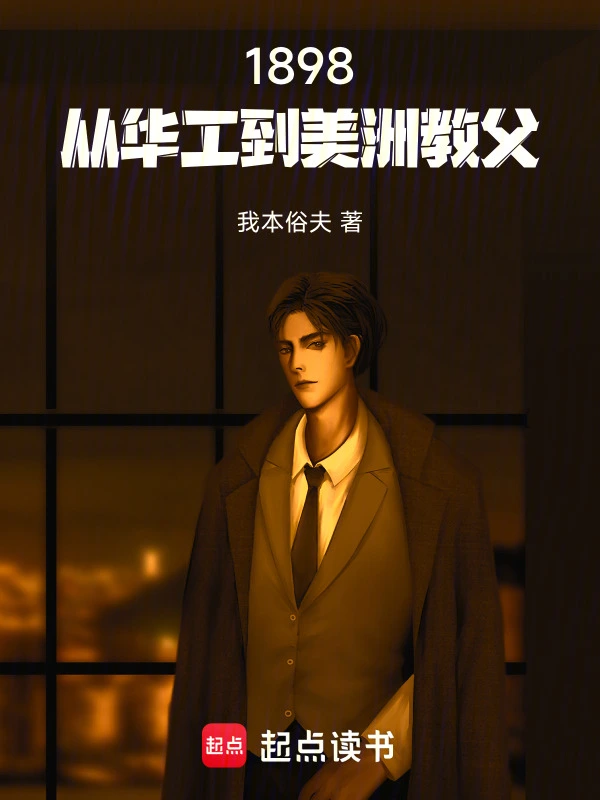
1898: from Chinese Laborers to American Godfathers
1898:从华工到美洲教父
- Status
- Ongoing
- Length
- 212k Words
- Genre
- Historical
- Audience
- Male
- Subgenre
- Alternate History
- Updated
- 1mo ago
- Source
- Qidian
Stats
0Monthly votes
887Recommends
145Fans
97Chapters
Tags
Synopsis
Reader comments
Readers also read
 Northern Qi, Sage Khan
 Fu Ming 1627
 Red Mansion: Start Escaping and Farming from the Equipment Bar
 After Lying in Bed for Three Years, He Was Forced to Help the Han Dynasty
 Criminal Investigation Notes 2: Buried Corpse in Songhu
 The Northwest Hero of Northern Myanmar
 The Republic of China: Rise from the County Seat
 The Black Witch's Journey to Another World
 Douluo Laid the Foundation, Waves in the Sky
 Late Ming Dynasty: Lion of East Asia
 Time Travel 04, I Am Fighting American Imperialism in the Middle East
 I'm an Emperor in Africa
It's a failure. I traveled through time and brought a main consciousness system, including invulnerability to the body, immortality, space, and ability transformation. The whole system would be meaningless in the colonial era.
Does the author know anything about American civilization? Can you support deaf Americans fighting for deaf rights?
The Peruvian Current (Peru Cold Current) has significant seasonal changes, and its flow direction and intensity will adjust with the seasons: Flow direction Summer (November to March): The Peruvian Cold Current flows northward and extends northward along the west coast of South America to near the equator, forming a compensating current system that brings cold water to the surface. Winter (May to September): The Peruvian cold current turns southward, moves southward along the west coast of South America, meets the equatorial warm water and then turns eastward. The Las Vegas Cultural Tribe settled in Ecuador 10,000 years ago. Agriculture and pottery production began in 7,000 BC and ended in 4,600 BC. The Valdivian culture came out and ended in 1500 BC. The subsequent Machalia culture began to produce pottery figurines. There are sites such as Caral in the Supe Valley in the Xiaobei region of Peru. It is also the first civilization in the South American Andes called the Xiaobei culture (also known as the Caral era). It was from 3000 to 1500 BC (the Xia Dynasty of East Asia was at the same time). There was no war. Archaeological discoveries unearthed very few weapons and no war-damaged remains. There are solid pyramids and ceremonial centers around which are used to control the cotton trade for religion and food. Cotton is woven into fishing nets to exchange seafood products with coastal fishermen, which also complements fishery and agriculture at the same time. In the Xiaobei Cultural Era (Karal Cultural Era), Karar was just a centralized trade of specialties from various places, and it was regarded as a trading market and religious ceremony center. Era of Kubisnik Culture, Era of Chavin Culture (war began in the Andes Civilization Circle). The gold necklace unearthed in Lake Titicaca two thousand years ago proves that gold, silver and copper began to be smelted, and agriculture began to grow quinoa, potatoes and grazing alpacas. It is the birthplace of Wari, the birthplace of the Incas. The Tiahuanaco culture (Aymara language of the Aymara people) near Lake Titicaca is named after its main site, Tiahuanaco. (Bolivia has large iron mines) Distributed in Bolivia and Peru, and expanded to Ecuador, Chile and northern Argentina. It dates from approximately the 5th to 10th centuries. The ruins of Tiahuanaco contain magnificent stone buildings. There is a foyer, square and altar built in front of the pyramid-style temple. Some of the stones weigh more than 100 tons. The metal processing industry of the Tiahuanaco Culture was relatively developed, and the gold, silver, copper and bronze products were very exquisite. It is generally believed that it inherited the Chawen culture and the Inca civilization, and played a role in the ancient Indian civilization of South America. The four countries in western South America from the 7th century to the 11th century! These four countries are already the bronze civilization circle in the Andes Mountains. They all have bronze swords, axes and spears, as well as bronze tools and agricultural tools. There are alpaca caravans of different sizes coming and going, and alpacas can carry up to 120 kilograms of stuff (goods). Sikan Kingdom in the north, Moche Kingdom in the central and northern parts, Wari Empire in the central and southern parts! The country of Diahuanaco is adjacent to the Amazon in the east. Around 750 AD, the environment in the area where the Moche people lived changed drastically. After the great flood, they encountered a severe drought with no rain for 30 years. Sandstorms caused a devastating blow to urban infrastructure, and canals and farmland were swallowed up by yellow sand. Coupled with rising seawater temperatures, fisheries are also affected. Natural disasters not only ruined the lives of the Moche people, but also destroyed their faith. A large number of people died, and the remaining people were forced to abandon their habitats. The Moche culture, which was flourishing for a while, also declined. The Kingdom of Huanca, from 1000 to 1450, north of Cusco, in the upper part of the Mantaro Valley, was actually just a loose alliance of chiefs. In 1450, the Incas destroyed Vanka. From 1200 to 1250, the Kingdom of Cusco in the center began to move to the Inca Empire. At the same time, the Kingdom of Chimu in the north began to destroy the Sican Kingdom in 1375, and was later destroyed by the Incas in 1470. (In the 11th century, the Indians established the "Kingdom of Quito" here. At the end of the 15th century AD, it became the political, economic and cultural center of the Inca Empire) In Colombia, the ancient Indians also invented a higher-level lost-wax casting technology. The wax mold is wrapped with a mud core, so that the casting is hollow, which saves a lot of metal than a solid casting and reduces the stress effect of the casting. Many ancient Indian gold casting artifacts were made using this unique lost wax method. The Inca oxidation gold plating and casting process was adopted by the Europeans. The Incas were good at metal smelting and processing, and were able to mine gold, silver, copper, tin, lead, platinum, mercury and other metals. The Incas mastered many metal processing techniques, such as casting, forging, molding, stamping, inlay, riveting, welding, etc. In the 16th century, the Peruvian Incas set up a post station at a distance of 8 kilometers along the well-built thoroughfare they built, and messengers ran to deliver messages. It is also called a post station for messengers and alpaca caravans to rest and stay. South America had no horses or vehicles before the Spanish colonists invaded. This kind of road for alpaca teams and messengers formed a network system extending in all directions from 1200 to 1530. It was a channel for the rulers of the Inca Empire to issue decrees, and it was also a transportation artery for the production, life and trade of the Inca people. At that time, the Inca rule ranged from central Chile in the south to Colombia in the north, including Ecuador and Bolivia. It was a large country with a population of more than 10 million. Corresponding road construction includes two north-south trunk lines: coastal stone road and plateau mountain road. The Aztecs built and maintained an efficient post road system to ensure the rapid flow of information, materials, and people within the country, and were able to send letters 320 kilometers (320 kilometers) within 24 hours. (Eight kilometers is one mile for eight kilometers, and 320 kilometers is 40 bars. On average, everyone has to run 8 kilometers in 36 minutes. If you multiply it directly to 10 kilometers, it will be 45 minutes. The standard for third-level athletes for 10 kilometers is 37 minutes, not to mention 36 minutes. It is easier to run 8 kilometers in 45 minutes than to run 10 kilometers in 45 minutes. ) Built a complete road system between various Central American city-states, and built a station every 14 kilometers (14 kilometers) beside the road. The army could travel about 28 kilometers a day. When a war breaks out, they will arrange a messenger every 5 kilometers (5 kilometers) to quickly deliver letters through relays. The records of captive bison in the Aztecs show that there was a public zoo on the outskirts of Tenochtitlan, the capital of the Aztec empire. There are already records of public display of bison in captivity: bison calves were paid as tribute by the Chichimec tribe in the north. They were escorted to the capital zoo after a 640-kilometer land transportation and were open to the public for exhibition. The ground beef patty technology of the tribes of the Great Plains of North America (dried bison strips, then chopped, added with cranberries and blueberries, and added beef fat to make a patty that can be stored for ten years!). A low-arsenic copper figurine was also found in the Atetelco courtyard at the Teotihuacan site, indicating that there was also a connection between Western Mexico and Teotihuacan, and that the practice of making copper was known to the Teotihuacan people before 600 AD. However, it is incredible that the bronze objects were not made into tools or weapons, but only human figures. Furthermore, the bronze artifact's date coincides with the collapse of the Teotihuacan polity and the formation of local petty polities. So some scholars see this as evidence of the restructuring of loyalties, alliances and trade networks. Around the 10th century AD, the Toltec Empire of the Nahua nation conquered the Maya and generally achieved the unification of Mesoamerica: Topilcen the Great, the greatest of the Toltec Empire who completed the conquest of the Maya, had Prince Daledo, The princess and Son-in-law Tobeyo, the first confidant Akatur (died in the first northern expedition against the Chichimecs), general Tobilkin (the second northern expedition was a complete victory, and a large number of Chichimeks were captured as slaves to build the Great Pyramid in the capital city of Tula). Spokesperson and general Wei Mark. In 1194, Mayapan monarch Hunac Kel used bronze weapons, bows and arrows to conquer Chichen Itza. In 1441, Mayapan died in a civil war, which meant the Mayan centralized power collapsed. The remaining Xiu family later defected to the Spanish and became Spanish aristocrats who still exist today. Kingdom of Xecora A kingdom established in the state of Nayarit, Mexico. Is 1350-1722, located in the Sierra Madre. On the Yucatan Peninsula, there are still some small Mayan states remaining. In 1526, a Spanish expedition (banditry) tried to use violence to establish a Spanish colony and enforce the Christian faith. The Mayans who refused to surrender launched a guerrilla war that lasted for more than a hundred years. A large number of Mayans fled to the south and joined the Kingdom of Peten Itza or its old enemy the Kowoh people, still not under Spanish rule. In the 17th century, Peten Itza even went as far north as the present-day Quintanaro state and sacked the Spanish colonial town of Bacalar. By 1696, it was even able to swagger into the frontline fortress set up by the Spaniards to conquer them. Unfortunately, the last star snake king of Peten Itza (Kan) Ek') was a determined capitulator. This indigenous kingdom, which once lasted more than a century and a half longer than the Aztecs, was finally captured by the Spanish in 1697, but this was enough to prove the tenacity of the Mayans. Also in 1697, the last Mayan city-state (The Kingdom of Itza in Peten Lake) was destroyed by Spanish artillery fire. (At that time, the last king of Itza, the Black Snake King, only had 300 canoes and 2,000 samurai soldiers. The population of 60,000 was due to the massacre and plague after the country's subjugation, and only 6,000 people survived.) The Great Lake of Peten in the Tulum area is the location of Peten Itza, the last kingdom of the Mayans, and the last Mayan city to die. It is said that this is the best-preserved Mayan ruins and the only one built on the seaside with the most beautiful scenery. However, the resistance of the Mayans is far from over, and guerrilla warfare is still going on in the jungle. In addition, in 1761, there was an uprising that threatened colonial rule. A Mayan leader, Jacinto Can Aike (also called Cinto Uque, whose name was borrowed from the last king of the Peten Mayan regime), announced in the name of the Blessing of the Blessed Mother that he would liberate the Mayans from Spanish enslavement. However, this uprising was eventually suppressed by the Spanish. Shan was the founder of the Mayan Republic in 1847. The Yucatan Caste War was a racial conflict between the Mayans and the white people. The war began in July 1847. In 1893, Britain promised Mexico to formally stop aiding the Mayan Republic. By 1901, Mexican federal troops occupied the Mayan capital Santa Cruz, General Ignacio surrendered, and the war officially ended. In this war, the Mayans killed 250,000 white people at a cost of 50,000. In May 2021, Mexican officials announced that they would officially forgive the Mayan people for their history of caste wars. Mayan guerrilla groups have existed in modern Mexico to this day. On November 4, 1780, Tupac Avaru II, a descendant of the Inca royal family, launched the Inca Restoration Uprising. Initially 6,000 rebels grew to 50,000 by December. In ancient times, corn was stored whole (without threshing), wrapped in corn leaves and hung in the sun to dry, which was a common practice among farmers. The threshed corn was sun-dried and sealed in large and small clay pots, and the granaries were strictly required to be moisture-proof and ventilated. This allowed the priests, nobles, merchants and other classes to build good granaries. After harvesting and threshing the corn, the Mayans boiled the corn in alkaline plant ash water or lime water. The alkalized corn is easier to grind, can also remove mold and release B vitamins that are beneficial to the human body. The processed corn kernels are crushed by stone grinding discs, and after adding water and stirring into a paste, they can be processed into corn tortillas that the Mayans eat every day. Women repeat the same work day after day: use three stones to support a pottery plate with a slightly raised edge, burn a fire in the middle of the stones, heat the pottery plate, apply cornmeal batter, and bake it into pancakes. This method is a bit like our pancakes. Sometimes cornmeal is also mixed into dough to make pancakes. Staple foods: corn, potatoes (unique to South America), breadfruit (unique to the Maya), cassava (unique to Cuba and Haiti), red rice and wild rice (North American wild rice), acorns and acorns (Canada) states, North America), mesquite pods (drought-resistant and sand-fixing in northern Mexico, and can be ground into cakes), sweet potatoes (South America), quinoa (South American Andes) Meat: (can be farmed) fish, river shrimp, sea snails Cattle, turkeys, muscovy ducks, rabbits, peccaries, armadillos, iguanas, (obtained from hunting) tapirs, bullfrogs (from southern North America to Central America), deer (caribou and moose, Central American white-tailed deer, South American deer and Andean red deer) ), crocodile, bison (North American ox), musk ox (northern Canada, Greenland and Alaska), alpaca (South America), guinea pig (South America), capybara (South America, Amazon river), ostrich (South America including Bolivia) Livia, Brazil, Argentina), snow sheep (North American Rocky Mountains from Alaska southward to Oregon, Idaho and Montana in the United States, inhabiting steep slopes and cliffs above the tree line), wilderness argali sheep (Canada), pronghorn antelope (northern Mexico to southern Canada), Eggs: turkey eggs, duck eggs, ostrich eggs Vegetables: pumpkin, black beans, kidney beans, amaranth, amory (California) Wild onions from Nigeria to Mexico, eaten raw and used as soap for laundry, taste like sweet potatoes when roasted), capuin (like garlic eaten raw, also wild garlic, in California, Central America), peanuts (South America), Inca beans (ice cream beans in the Amazon rainforest), maca (Inca radish originated in the Andes of South America) Fruit: fig, avocado, egg yolk, papaya, sapodilla (made by the Mayans for oral use) Gum), guava, tomato (tomatoes from South America), dragon fruit, peach (green fruit), white persimmon (Mexican apple is sweet and milky), black persimmon (Mexican green peel, brown and black flesh, sweet and cocoa taste), walnut (North America), chestnut (North America), passion fruit (Central America squeezed into passion fruit juice), cranberry (North America), blueberry (North America), grape (North America and Canada), strawberry (South America), pineapple (Brazil and Paraguay), peach brown (Amazon, red orange can be ground into powder), Brazil nut (Amazon nut), ginseng fruit (melon eggplant, Colombia to Peru), machi fruit (Patagonia Plateau, Mapuche people eat medicinal drinks), cherry (Chile cherry) Sugar: honey, maple sugar (North America, maple sap is drilled from maple trees and cooked into maple sugar, maple sap and corn are cooked into sweet pudding), olive fructose (California's An olive-shaped fruit produced by a bush with dense leaves. Pick the ripe fruit, separate the pulp from the core, and then put the pulp into a basket and press it. After drying and forming a suitable hardness, it is made into sugar cubes. Alpaca butter, alpaca dairy products), peach palm wine, macchi wine Container: gourd, deerskin pot, alligator skin pot, cowhide pot Beverages: coconut (Central America, South American Amazon rainforest), honey water, honey cocoa, spicy cocoa, cactus juice, fruit juice, coca tea (South America), yerba mate (South America), yerba mate (South America), Carolina tea (Southeastern United States, evergreen shrub holly leaves),
Recommend
Pretty good. The protagonist is brave and resourceful. Highly recommended.
Pure dreaming, no logic at all. It is better to rely on the system to unify the world. Chapter 1. The Founding of the Antarctic Nation Chapter 2. Unify the world Chapter 3. Out of the Earth
During this period, the Chinese are very dreamy and can only imagine through the system.
As long as North America controls the Great Lakes region and completes industrialization, it has the potential to unify the entire North America. It is difficult to say that the western United States does not have large-scale coal mines and iron ore gathering areas and does not even have the most basic industrial resources. At this time, the United States has completed industrialization and is still the world's largest industrial country. At this time, Jianguo is seeking death. With this method, yellow people cannot be called human beings, and they can't even build a Chinese state. What strength do you have? The West was not industrialized at all. When the West developed, at least it did not develop slowly until the Great Depression in 1929 and after Roosevelt. Before that, there were not many industries that were basically raw material production areas. It can be said that the founding of the nation in North America is purely conjecture. If you don't say anything else, just look at the ocean immigrants. Does the East Coast of the United States have an advantage, or does the West Coast have an advantage? Is the east coast more potential or the west coast more potential? The real essence of the United States has always been the Great Lakes region and the Mississippi River. These places accounted for 80% of the American industry before World War II. There is no hope for the Chinese to establish a nation in North America, but Southeast Asia is still possible.
I feel like the protagonist is just a brainless and reckless guy, a badass hero. Is he worthy?
I've finished reading Chapter 16. It's a rubbish novel, and the protagonist is kind enough to let the white-skinned savages go.
Yes, I want to see people who can be united by unity. The founders of the Americas or the warlords separatist countries.
Chinese workers in North America in the 19th century could earn dozens of grams of gold a month. It is equivalent to ten times the salary of Qing people at the same time. The so-called selling piglets means that people who want to work overseas give their income for a period of time to the shipowner as shipping fees.
Author
The heroine means a beautiful woman who can be taken away. Can you answer that?
Come to think of it, there are no female characters in this book
Author
Do all the novels you open have multiple female protagonists?
Your book is really a wrong investment. If you regard it as the urban section of Times Literature Investment, even if it doesn't take off, you still have a chance to give it a try. The fictional history of the twentieth century has no flow.