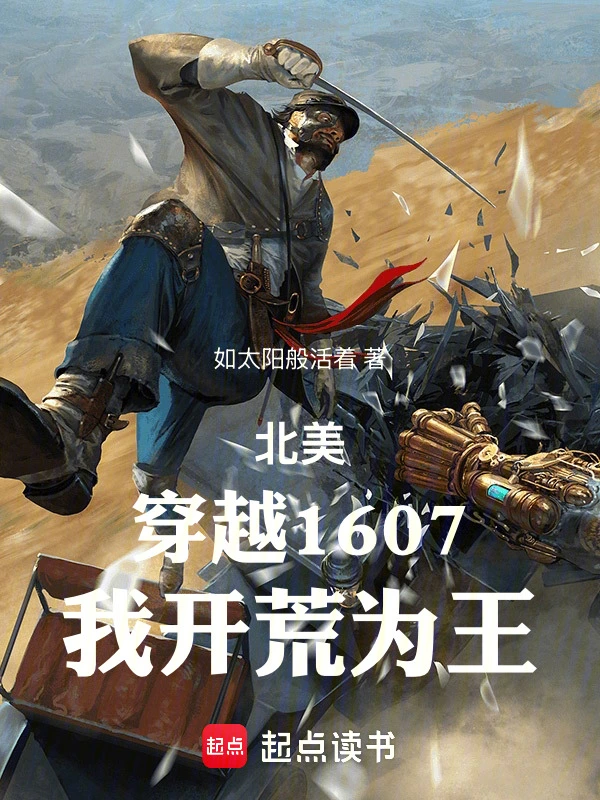
North America: Traveling Through 1607, I Pioneered the Wasteland and Became the King
北美:穿越1607,我开荒为王
- Status
- Ongoing
- Length
- 618k Words
- Genre
- Historical
- Audience
- Male
- Subgenre
- Foreign History
- Updated
- 1d ago
- Source
- Qidian
Stats
156Monthly votes
418Recommends
29Fans
254Chapters
Tags
Synopsis
Reader comments
Readers also read
 After Lying in Bed for Three Years, He Was Forced to Help the Han Dynasty
 Fu Ming 1627
 Red Mansion: Start Escaping and Farming from the Equipment Bar
 Northern Qi, Sage Khan
 On My First Day at the Police Station, I Ate Imported Candy from a Police Beauty.
 Gongtang
 Late Ming Dynasty: Lion of East Asia
 My Girlfriend Cheated on Her and Got Pregnant, and I Ran Away Nine Months Later
 During the Republic of China, I Baoguowei Huangpu Phase I
 Traveling Through 1570: the Rise of South America
 Late Ming Dynasty: Conquer Nurhaci at the Beginning
 Gravedigger of Empire
In the early 17th century, this time point was too early. In another 50 years, there would only be tens of thousands of Europeans in North America. At that time, few people in Europe were willing to go to North America. In the entire 100 years of the 17th century, only 200,000 people from Europe arrived in North America. Without enough Europeans, it would be impossible to develop in the New World. There is simply no way to solve it with the help of the Indians, who are not civilized. It will take a very long time to change the bad habits of the Indians and educate them, at least 100 years. It is estimated that the time it took for the protagonist to civilize the Indians could not keep up with the rate of death of the Indians. In that era, there were various infectious diseases and the medical conditions were extremely poor, and the protagonist could not prevent them no matter how powerful they were.
Write what you want to write, and you will not regret it. I will be responsible for my own book. There are many shortcomings, please bear with me. Thank you to my brother who has been pursuing it. I am not good at hydrology.
I was speechless when I saw the introduction. I came to improve farming when I was short of food. I would have starved to death already. The protagonist starved to death and the whole book ended?
In fact, I have thought about the scene of white immigrants establishing a country, Persians or Jews, Germans, and Italians moving to Australia to establish civilization 🤓. After all, too many people died from famine and massacre.
The plot is very interesting, it's not the kind of mindless novel, but can there be more updates? It's a bit lacking, it's too grinding 😰
Can we first recruit Powhatan's deaf-mute children to train as soldiers? Can the protagonist invent Korean, Japanese, Annanese immigrants?
At present, the 99 white people are all able-bodied, but the protagonist will have an in-depth exchange with King Powhatan next year, see the deaf-mute Indian hunters, and understand that North American Sign Language is shared by Indians of all ethnic groups, and meet the deaf-mute priests. In the future, the protagonist will meet the deaf-mute scribes of the Aztec remnants from the Kingdom of Silcora, the deaf-mute Mayan priests, and the small deaf-mute Mayan city-state in Guatemala. Mayan Sign Language A 2023 Johns Hopkins University study found that the visual cortex of congenitally deaf people is 15% thicker than that of hearing people, and their dynamic visual acuity is three times higher than normal. This provides a scientific footnote for "seeing ghosts": deaf people can indeed capture subtler changes in light and shadow. The wizard's spell has long since dissipated, and the stigmatized ability to "see ghosts" is being reborn in laboratory data in the form of neuroscientific codes. From the "deaf vision" symbol drawn in ink on Mawangdui silk books to the eyes of Xiangxi Nuo who see the world behind the scenes. —This spiritual tradition, which has been deliberately erased by mainstream history, actually contains the eternal exploration of the boundaries of human perception. The visual ability of deaf-mute people has significant neural compensatory enhancement. Cambridge University experiments have confirmed that the signal transmission speed from retinal ganglion cells to the lateral geniculate body in deaf-mute people is 23% faster, and the synchronization of neuron discharge is higher. Captures 1/100th of a second moment (only 1/60th of a second for hearing people) Chinese deaf badminton player Lin Fang can clearly see the deformation of the opponent's racket strings and predict the path of the ball at the moment of smashing the ball. The density of retinal rod cells is 12% higher, and the clarity of object recognition under 3 lux illumination (approximately equal to moonlight) is 40% higher than that of normal hearing people. Hearing people: hearing accounts for 35% of nerve resources, vision accounts for 45% Deaf and mute people: vision accounts for 75% of nerve resources, and touch accounts for 20% Traditional Chinese medicine's "five orifices balance" theory: it is believed that deaf people have "eyes and orifices that connect to the spirit", and hearing people have "ear orifices that can connect to the spirit" Mayan civilization murals show that the priest team must include deaf-mute and hearing people, who are responsible for observing the stars and interpreting thunderstorms respectively. Especially the advantages in rituals. There is no noise interference during sacrifices, and the concentration is far beyond ordinary people. Archaeological evidence from the Ice Age shows: Tribes with intact hearing rely on sound to warn predators, with a survival rate of 65%; Deaf-mute tribes rely on vision to monitor snow reflections/branch vibrations, with a survival rate of 72%; The two sensory configurations form a dynamic balance in extreme environments. Mayan Sign Language Sign Language Used by Mayan Communities in Mexico and Guatemala Mayan Sign Language (Spanish: Lengua de señas maya or yucateca) is a sign language in Mexico and Guatemala, used by Mayan communities with an unusually high number of deaf residents. In some cases, sign language is available to both hearing and deaf people in a village. It has nothing to do with the national sign languages of Mexico (Mexican Sign Language) and Guatemala (Guatemalan Sign Language), as well as the local Mayan languages and Spanish. Maya sign language, Aboriginal people. . . Maya Sign Language Native to Mexico, Guatemala Region Isolated village in south-central Yucatan, highlands of Guatemala Native Speakers 17 Deaf People in Chikan (2012) 400 Hearing signatories Chican (1999); others unknown 639-3 msd Glottolog yuca1236 Help Yucate Mayan Sign Language Close Yucate Mayan Sign Language Yucate Mayan Sign Language, used by the hearing-impaired and deaf rural Maya people in the Yucatan region. It is a natural and complex language that is not related to Mexican Sign Language, but may have similarities to the sign language of nearby Guatemala. With hearing villagers able to master sign language, deaf residents appear to be well integrated into the community - a stark contrast to the marginalization of deaf people in the wider community, and to the highland Mayan sign language. [Citation Required] The spoken language of this community is Yucate Mayan. Highland Maya Sign Language In the highlands of Guatemala, the Mayans use a sign language that belongs to the "Sign Language Complex" and is called Meemul Ch'aab'al and Meemul Tziij, the "Silent Language" in the local Keiche language. Researcher Erich Fox Tree reports that this sign language is used by the region's deaf rural Maya, as well as by some traders and traditional storytellers. These communities and Fox Tree believe that Meemul Châaabâal belongs to an ancient family of Mayan sign languages. Fox Tree claims that the Yucate Maya sign languages are closely related and largely mutually intelligible. Baidu New Historical Chronology of Deaf People in China "Oracle Bone Inscriptions Collection" The word "Sheng" is indeed composed of "ear" and "mouth", but the origin of "big ear", the word "Sheng" (holy) in Oracle Bone Inscriptions, has an amazing sacred connection with the deaf and mute people. (Deaf-mute people from ancient times to the Xia and Shang Dynasties could read in sign language and become saints) The burial jade is engraved with the "ear" part of the oracle bone inscription "𦔻", which is actually decoding a subversive historical truth: incompleteness was once the ladder for human beings to approach divinity. (Holy) character, attesting to the high status enjoyed by the deaf-mute priests. The three-stage transformation history of "Sheng" Oracle bone inscriptions "Sheng" (𦔻) = extraordinary big ears + closed mouth Bronze inscriptions "Sheng" (𦔻→Sheng) = ear + mouth + person Official script "Sheng" (Sheng) = ear + mouth + king Yinfu Jing by Huangdi : "The blind person is good at hearing, and the deaf person is good at seeing. With one source of absolute profit, the number of teachers is ten times; with three anti-day and night, the number of teachers is ten thousand times." "Book of Rites: Jiao Te Sheng" records: "The deaf person guards the door", but archeology reveals a higher-level function - among the Zhen people's skeletons unearthed from the Fuhao Tomb in the Yin Ruins, three showed congenital atresia of the ear canal. Sanxingdui Zongmu Mask, testing shows that the mask's copper material has the same origin as the bronze from the Yinxu Zhenren Tomb. It is suggested that the deaf and mute priests of the two places share cultural symbols. "Zhou Li" clearly states that "Gu Meng" and "Deaf Dia" were responsible for music rhythm and divination respectively. Carbonized bamboo sticks were found in the oracle bone pits in Anyang, with diagrams of dance movements on them, presumably for the use of deaf and mute priests. The special role of deaf people in the religious system of Shang and Zhou dynasties. The bones of priests with pierced ears were unearthed from the Yin Ruins, and there is a saying in the academic circles that "self-mutilation can lead to the gods" "Customs and Meanings·Sacrificial Code", this record reveals the special status of the deaf and mute people in the witchcraft belief in the Han Dynasty. Behind it is the continuation and development of the ancient "sensory compensation" witchcraft concept. The "Picture of Avoiding Soldiers" depicts Fang Xiangshi (a ghost exorcist) with "big ears and blind eyes". His ears are deliberately blackened, and the word "deaf sight" is written next to it - proving the ritual function of deaf people to exorcise evil spirits. The celestial portrait stone in the Han tomb in Nanyang, Henan Province shows the image of a deaf shaman wearing a three-ear crown (symbolizing extraordinary vision) and holding a compass to observe star ghosts (the ancients believed that comets were "demon stars" that were ridden by ghosts). "Baopuzi" contains: "Deaf and blind people should go into the mountains to practice Taoism to avoid ghosts and monsters", which transforms the ability of deaf witches into resources for cultivating immortals (there is a scene of "Deaf Taoist Watching Ghosts" on the mural of Qi Lourui's tomb in northern Shanxi). "Mingxiang Ji" said that "deaf people slandered the Buddha in their previous lives" "Shu Lun" compiled by Confucius in the Spring and Autumn Period; "Manu Jing" written by Mozi in the Spring and Autumn Period; "Shu Hua" written by Huang Fumi, a deaf miracle doctor in the Jin Dynasty; "Shi Shuo", an educational work of the Tang Dynasty, contains the hand language of deaf teachers; "Hand Language Record" was written by Yang Xin, a deaf general of the Song Dynasty; "History of Paganism" was written by Xu Ji, a deaf state official in the Song Dynasty. "Writing a Teacher" and "Personal Appearance" were written by He Shitai and his son, a deaf educator of the Ming Dynasty, for He Fengsheng, the chief minister of deaf people in the Chongzhen period; (Sicong Lu summarizes the experience of the deaf education system from Confucius and Mozi's creation of deaf sign language to the Song Dynasty. It is not only used as a deaf education sign language textbook but also contains instructions on how to educate children. The book, a teacher's chapter, tells how to be a teacher to educate students, and records ancient military sign language command methods in human form.) "Deaf History" was written by He Fengsheng, the chief minister of the deaf in the Ming Dynasty, who compiled the history of ancient deaf people; These books are currently known ancient Chinese deaf education sign language books. Tibetan Buddhist Mute "Ajie Drum". "Similarities and Differences between Sign Language and Ancient Writings" "Study on Unearthed Slips and the Disabled Population in Qin and Han Dynasties" Huang Di's deaf official and war general Na Confucius's deaf disciple Xia You Qin State's deaf warrior general Jing Nan Zhao State's deaf prime minister He Guanzi Han Dynasty Deaf The Prime Minister Xu Pi The deaf noble concubine of the Han Dynasty, Madam Gou Yi, Zhao Jieyu The famous deaf minister Du Wei of the Shu Han Dynasty, one of the Three Kingdoms The deaf miracle doctor Huang Fumi of the Jin Dynasty The deaf minister of the Jin Dynasty and the founder of Xiliang Zhang Gui The two deaf generals who fought against the Hu in the Five Husties were deaf and dumb The deaf princes of the Southern and Northern Dynasties and the Southern Liang fought against the Hu Baling Yin Wang Xiao Baoyi (Deaf Prime Minister of the Southern Qi Dynasty - Xiao Baoyi) Southern and Northern Dynasties Nanliang Deaf Prince Anle Wang Xiao Renya Deaf anti-Hu hero Du Taiqing (Deaf counselor in the founding of the Sui Dynasty) Sui Dynasty deaf civil servant Cui Wei Sui Dynasty deaf prince Yang Liang Tang Dynasty deaf civil servant Xu Anzhen, a first-class official Du Fu, a deaf poet of the Tang Dynasty Li Song, the deaf-mute emperor of the Tang Dynasty Zha Wenhui, a deaf minister of the Southern Tang Dynasty in the Five Dynasties Yang Xin, a deaf super-genius military strategist who was one of the founding generals of the Song Dynasty Xu Ji, a deaf state official in the Song Dynasty Pang Anshi, a deaf miracle doctor in the Song Dynasty Deaf-mute Taoist Priest of the Southern Song Dynasty Wu Datong Ming Dynasty Deaf anti-Yuan hero writer and painter Yang Zhongkai Ming Dynasty Deaf anti-Yuan hero and famous minister and counselor Lu Bufu Ming Dynasty deaf doctor Wang Min Ming Dynasty deaf civil servant Yang Mao Ming Dynasty deaf civil servant Yu Tai Ming Dynasty deaf writer Qiu Shixiang, master of painting Ming Dynasty deaf martial artist Cheng Ya Li He Shitai, the deaf Minister of Rites in the Ming Dynasty He Fengsheng, the deaf prime minister of the Ming Dynasty Li Jun, a deaf literary giant in the Ming Dynasty who fought against the Qing Dynasty Zhu Da, a deaf prince in the Ming Dynasty who fought against the Qing Dynasty Li Biheng, a deaf person who fought against the Qing Dynasty Lu Zhonglin, a deaf person who fought against the Qing Dynasty Du Yiming, a deaf businessman in the Manchu and Qing Dynasty Manchu Qing Dynasty The famous deaf doctor Wang Zhizheng in the period Zhai Dakun, a deaf painter in the Manchu and Qing Dynasties Peng Zhaozhen, a deaf painter in the Manchu and Qing Dynasty Ge Zun, a deaf painter in the Manchu and Qing Dynasty Liu Xiling, a deaf Taoist priest in the late Qing Dynasty and the early Republic of China Twenty mute scholars in the Qin Dynasty of the Qin Dynasty; Fifty silent scholars in the Han Dynasty; Jin Dynasty There were 100 Congshi of the Chao Dynasty and 3000 mute soldiers; 3000 ghost troops of Liu and Song Dynasty in the Southern Dynasty; The Peruvian Current (Peru Cold Current) has significant seasonal changes, and its flow direction and intensity will adjust with the seasons: Flow direction Summer (November to March): The Peruvian Cold Current flows northward and extends northward along the west coast of South America to near the equator, forming a compensating flow system that brings cold water to the surface. Winter (May to September): The Peruvian cold current turns southward, moves southward along the west coast of South America, meets the equatorial warm water and then turns eastward. The Las Vegas Cultural Tribe settled in Ecuador 10,000 years ago. Agriculture and pottery production began in 7,000 BC and ended in 4,600 BC. The Valdivian culture came out and ended in 1500 BC. The subsequent Machalia culture began to produce pottery figurines. There are sites such as Caral in the Supe Valley in the Xiaobei region of Peru. It is also the first civilization in the South American Andes called the Xiaobei culture (also known as the Caral era). It was from 3000 to 1500 BC (the Xia Dynasty of East Asia was at the same time). There was no war. Archaeological discoveries unearthed very few weapons and no war-damaged remains. There are solid pyramids and ceremonial centers around which are used to control the cotton trade for religion and food. Cotton is woven into fishing nets to exchange seafood products with coastal fishermen, which also complements fishery and agriculture at the same time. In the Xiaobei Cultural Era (Karal Cultural Era), Karar was just a centralized trade of specialties from various places, and it was regarded as a trading market and religious ceremony center. Era of Kubisnik Culture, Era of Chavin Culture (war began in the Andes Civilization Circle). The gold necklace unearthed in Lake Titicaca two thousand years ago proves that gold, silver and copper began to be smelted, and agriculture began to grow quinoa, potatoes and grazing alpacas. It is the birthplace of Wari, the birthplace of the Incas. The Tiahuanaco culture (Aymara language of the Aymara people) near Lake Titicaca is named after its main site, Tiahuanaco. (Bolivia has large iron mines) Distributed in Bolivia and Peru, and expanded to Ecuador, Chile and northern Argentina. It dates from approximately the 5th to 10th centuries. The ruins of Tiahuanaco contain magnificent stone buildings. There is a foyer, square and altar built in front of the pyramid-style temple. Some of the stones weigh more than 100 tons. The metal processing industry of the Tiahuanaco Culture was relatively developed, and the gold, silver, copper and bronze products were very exquisite. It is generally believed that it inherited the Chawen culture and the Inca civilization, and played a role in the ancient Indian civilization of South America. The four countries in western South America from the 7th century to the 11th century! These four countries are already the bronze civilization circle in the Andes Mountains. They all have bronze swords, axes and spears, as well as bronze tools and agricultural tools. There are alpaca caravans of different sizes coming and going, and alpacas can carry up to 120 kilograms of stuff (goods). Sikan Kingdom in the north, Moche Kingdom in the central and northern parts, Wari Empire in the central and southern parts! The country of Diahuanaco is adjacent to the Amazon in the east. Around 750 AD, the environment in the area where the Moche people lived changed drastically. After the great flood, they encountered a severe drought with no rain for 30 years. Sandstorms caused a devastating blow to urban infrastructure, and canals and farmland were swallowed up by yellow sand. Coupled with rising seawater temperatures, fisheries are also affected. Natural disasters not only ruined the lives of the Moche people, but also destroyed their faith. A large number of people died, and the remaining people were forced to abandon their habitats. The Moche culture, which was flourishing for a while, also declined. The Kingdom of Huanca, from 1000 to 1450, north of Cusco, in the upper part of the Mantaro Valley, was actually just a loose alliance of chiefs. In 1450, the Incas destroyed Vanka. From 1200 to 1250, the Kingdom of Cusco in the center began to move to the Inca Empire. At the same time, the Kingdom of Chimu in the north began to destroy the Sican Kingdom in 1375, and was later destroyed by the Incas in 1470. (In the 11th century, the Indians established the "Kingdom of Quito" here. At the end of the 15th century AD, it became the political, economic and cultural center of the Inca Empire) In Colombia, the ancient Indians also invented a higher-level lost-wax casting technology. The wax mold is wrapped with a mud core, so that the casting is hollow, which saves a lot of metal than a solid casting and reduces the stress effect of the casting. Many ancient Indian gold casting artifacts were made using this unique lost wax method. The Inca oxidation gold plating and casting process was adopted by the Europeans. The Incas were good at metal smelting and processing, and were able to mine gold, silver, copper, tin, lead, platinum, mercury and other metals. The Incas mastered many metal processing techniques, such as casting, forging, molding, stamping, inlay, riveting, welding, etc. In the 16th century, the Peruvian Incas set up a post station at a distance of 8 kilometers along the well-built thoroughfare they built, and messengers ran to deliver messages. It is also called a post station for messengers and alpaca caravans to rest and stay. South America had no horses or vehicles before the Spanish colonists invaded. This kind of road for alpaca teams and messengers formed a network system extending in all directions from 1200 to 1530. It was a channel for the rulers of the Inca Empire to issue decrees, and it was also a transportation artery for the production, life and trade of the Inca people. At that time, the Inca rule ranged from central Chile in the south to Colombia in the north, including Ecuador and Bolivia. It was a large country with a population of more than 10 million. Corresponding road construction includes two north-south trunk lines: coastal stone road and plateau mountain road. The Aztecs built and maintained an efficient post road system to ensure the rapid flow of information, materials, and people within the country, and were able to send letters 320 kilometers (320 kilometers) within 24 hours. (Eight kilometers is one mile for eight kilometers, and 320 kilometers is 40 bars. On average, everyone has to run 8 kilometers in 36 minutes. If you multiply it directly to 10 kilometers, it will be 45 minutes. The standard for third-level athletes for 10 kilometers is 37 minutes, not to mention 36 minutes. It is easier to run 8 kilometers in 45 minutes than to run 10 kilometers in 45 minutes. ) Built a complete road system between various Central American city-states, and built a station every 14 kilometers (14 kilometers) beside the road. The army could travel about 28 kilometers a day. When a war breaks out, they will arrange a messenger every 5 kilometers (5 kilometers) to quickly deliver letters through relays.
Author
Will you start reading novels about the Three Kingdoms and Water Margin in the future?
I see this book every day, and I want to read it every time I see it, but there is too little written about it.
Author
Will you start novels with multiple female protagonists in the future?
Gentlemen, stop raising books. I want to test the waters. Please give me some follow-up data 🙏🙏🙏
Author
Do all the novels you open have multiple female protagonists?
Dear viewers, if you think you can still watch it, please vote for a monthly ticket and collect it. It will be updated steadily. Please feel free to read.