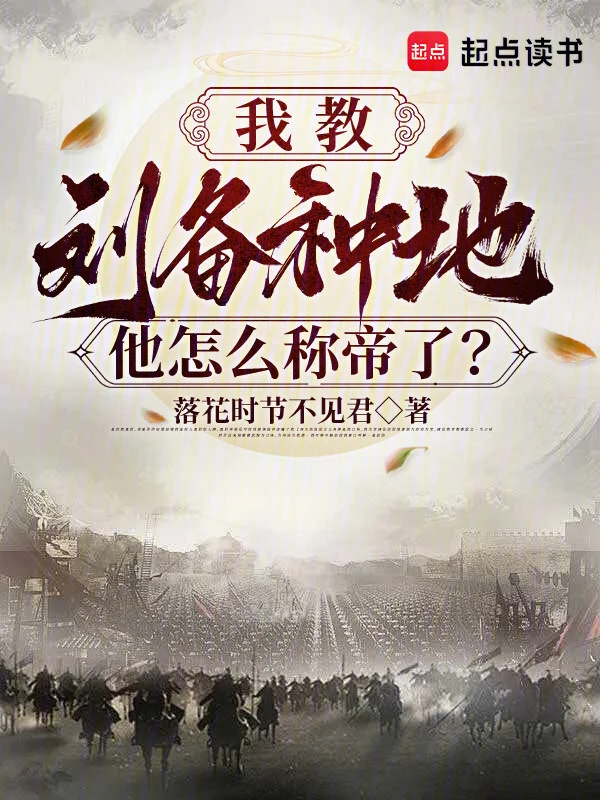
I Taught Liu Bei How to Farm, How Could He Become Emperor?
我教刘备种地,他怎么称帝了?
- Status
- Ongoing
- Length
- 1.6M Words
- Genre
- Historical
- Audience
- Male
- Subgenre
- Qin-Han & Three Kingdoms
- Updated
- 1d ago
- Source
- Qidian
Stats
326Monthly votes
39.6kRecommends
120.9kFans
241Chapters
Tags
Honours
Synopsis
Reader comments
In booklists 2




Readers also read
 After Lying in Bed for Three Years, He Was Forced to Help the Han Dynasty
 Northern Qi, Sage Khan
 Red Mansion: Start Escaping and Farming from the Equipment Bar
 Fu Ming 1627
 From the Third Position to Xuzhou, He Began to Assist Liu Bei.
 Three Kingdoms: Ji Han Concealed His Position and Conquered the Central Plains
 Three Kingdoms: Starting from Believing in Science and Conquering the World
 Revealing My Identity, I Was the Deputy Emperor in Jihan
 I Originally Wanted to Vote for the Wei Dynasty, but Why Did I Return to the Han Dynasty?
 Three Kingdoms: My Father Xuande, the King of Guanzhong Is Here
 Three Kingdoms: Ji Han, the Great Physiognomist
 Three Kingdoms: Starting from Changbanpo to Help the Han Dynasty
 Three Kingdoms: Zhao Lie Plotted the Master Plan, and Yan Han Prospered Three Times
Is this how the National University of Defense Technology is awakened? If you don't go to the Taiping Army, go to Liu Bei.
The top priority now is not to let the author continue to watch Groove's New Three Kingdoms
Just looking at the introduction, what level of civil servant is the protagonist? 1. Food production triples 2. Soldier combat effectiveness increases 10 times 3. Full map field of view In ancient times, he was considered a T1-level civil servant, right?
It's actually pretty good, but the female characters are a bit strange. Farming is so exciting, suddenly a life story is inserted, or fighting and killing, farming is suitable for you, the author is great.
I read dozens of chapters. The Three Kingdoms was also blown up
First, the main reason for the turmoil in the Three Kingdoms at the end of the Han Dynasty was that during the Little Ice Age, grain production was not enough to feed so many people. The yield per mu was less than 200 kilograms. Without food, people would starve to death. Moreover, increasing production requires soil and photosynthesis. Under such circumstances, it is impossible to double the production. Second, the merger of aristocratic families and land. The aristocratic family has control over promotion, and the poor, or landlord class, who cannot be promoted anymore, will rebel and turmoil. Such as Xu Chu, Li Dian family. Not much to say about land annexation. Third, aristocratic families compete against each other. Each region has its own school. Such as the Yingchuan School, east of the river and west of the river. Talents cannot come because of you, and you can make multiple bets to protect your own interests. Like Zhuge, you come from a poor family and have no family support. At most, people like Guan Hai, although they have the ability, can only rebel. Although you have joined Liu Bei's disciples. But Liu Bei's subordinates are not necessarily those he can directly control. The Three Kingdoms are somewhat similar to a dual monarchy. Look at the Su brothers who sent horses to Liu Bei in the early stage. There is no sound in the later stage. If you make the cake bigger, but there is no interest group, then the most likely thing is that you will be killed with a knife. Fourth, it is not the military commanders and counselors in history who are the most powerful. And because other people don't have the resources that those who are famous do. Such as the Yellow Turban Army. Everyone who writes about the Three Kingdoms feels weak. In the early and mid-term, the Yellow Turban Army defeated Cao Cao, Liu Bei, Sun Jian, Lu Zhi, and Dong Zhuo. Do you think this would be weak? They have the resources behind them, and they can win only if they keep fighting.
Everything else is fine, except that the plot of the female character is very weird. I spent a lot of time writing about Xing'er, Liu Bei's daughter and Diao Chan. As a result, Xing'er disappeared after the White Sugar Factory, Liu Bei's daughter also disappeared when she came back from Gongsun Zan, and Diao Chan has no follow-up.
The dialogue is neither clear nor clear, which is a bit tiring for a modern person. I have to translate a sentence in my mind to understand it clearly. I know you may want to restore the way the ancients spoke. But not all book friends who read the book are well-informed and can understand all the dialogues you wrote.
I read a chapter that was too abstract, and I wondered if you weren't writing about the Han Dynasty and the Three Kingdoms? Why does it smell like Ming and Song dynasties?
If you are so capable and traveled so early in time, why don't you stand on your own and become someone else's dog?
When it becomes clear
I asked the author whether he was referring to the Romance of the Three Kingdoms or the Romance of the Three Kingdoms. He said that he was referring to the New Three Kingdoms.
This is the most rigorous title in Three Kingdoms I have ever seen
Many current Three Kingdoms novels, I don't know whether the author lacks common sense or is intentional, like to use epithets very much. If they don't refer to the Three Kingdoms, even some unknown generals have to add their own epithets to refer to them. The misuse of epithet is particularly serious. The author of this novel should have a good foundation in ancient Chinese. At least there is no problem with the title. There is no such erroneous title as "I Guan Yunchang swears to kill the old thief Cao Mengde", which is very embarrassing. He claimed to use his name but not his position. The author made no mistakes throughout the article. The writing is concise, the plot is reasonable, and the details are well handled. There is no funny writing such as "picking up a cup of sweet tea", and there is no famous counselor or general who bows to him when he sees it. There is also no other author who always emphasizes Guan Yu's squinting eyes and his hands in the Spring and Autumn period. The talents Liu Bei recruits are all those who joined him in the original novel (except Guan Hai). The plot is quite compact, there are no trivial plots, and there are no common enemies in time travel novels. The enemies are always very powerful, always have no shortage of money and food, and have many soldiers. However, I am always short of food, soldiers, and money. As we all know, there is rarely a unilateral food shortage in the Romance. In the Cao-Lv War, everyone was short of food. The result was that everyone would discuss a truce and fight again when food was available. Generally speaking, apart from the bad point of mixed white and white prose, it may be that the author prefers to use more ancient writing methods, but is afraid that readers will not like it. After all, now is the market for cool writing, and there is no market for ancient writing methods. Many people are not used to reading and switch back and forth. Although there are flaws, other aspects of the novel still look very comfortable. At least it does not skip pages when reading, or I don't know what will happen next. At present, there is a refreshing flow in the Three Kingdoms literature. I hope it will not be eunuch.
The author suggests replacing all female protagonist entries with female supporting characters
A heroine needs a lot of plot to support her. A heroine who only emerges in several pictures and who doesn't participate in the main plot should be a supporting actress.
The article is not on topic. The title and introduction of the book give the impression that it is about logistics. After reading it for a long time, I became a generalist who has done everything.
Well, how about the development, how to write later, the talent belongs to you Liu Bei, others can't beat it, can't this go on? Are there still Three Kingdoms? How to write Prime Minister?
Diao Chan
The clouds on the temples lightly hold the moon and feel ashamed, and the stars are about to turn and lose their tranquility. Looking at the flowers in the city without saying a word, looking at the water in the country again with sadness. The wind helps the weak willows and the spring is difficult to determine, and the dew moistens the new peaches that have not been harvested at night. There is no way that beauty is empty, but the true color here is the most beautiful.
Tianshui Jiang Boyue
If you have seen a pair of eyes like that, you will understand what the ultimate romance is. Those are Jiang Wei's eyes. Inside, the last afterglow of the entire Shu Han burned. He was originally a young man from Tianshui with high spirits, but he abandoned his homeland overnight just to chase the phantom called "Reviving the Han Dynasty". When Zhuge Liang handed him his life's fire, he may not have thought that this fire would burn up a person's life, but it failed to light up the long night after all. From then on, Jiang Wei lived as a lonely watchman. Above the court, Huang Hao wields power, and his colleagues are jealous; outside the court, the country's power is declining, and the people are tired and the soldiers are tired. Everyone advised him: "Forget it, it's destiny." But he just didn't believe in destiny. He put on armor and went into battle again and again, making nine expeditions to the Central Plains and eleven expeditions to the North. Like a stubborn child, he insisted on creating a crack in the copper and iron wall called "Destiny". The world laughs at him for being crazy, laughing at him for being crazy, and laughing at him for not knowing how to adapt. But who knew how painful he felt in his heart while sitting alone in the military tent late at night, looking at the shrinking territory on the map? It's not that he doesn't understand, he just doesn't dare to stop. Because he knew that once he put down the sword in his hand, the dream about the "big man" would really be shattered. The most heartbreaking thing was the last moment. Chengdu has surrendered and its master has been captured. The edict was sent to Jiange, ordering the three armies to disarm. At that moment, the world was silent. All the efforts, all the sacrifices, all the blood were in vain. If it were an ordinary person, he would have cried bitterly or committed suicide in anger. But Jiang Wei didn't. An almost crazy light flashed in his eyes. Since the right path is gone, let's take a dangerous path! He pretended to surrender to Zhong Hui in an attempt to instigate civil strife in Wei. In this desperate situation, he tried to fight for the last chance of survival for his motherland. This is an old man who is using his remaining life to make a huge gamble that is destined to fail. When the plan failed, the rebel army surrounded him. A sixty-year-old veteran, his beard and hair were all white, but he still held a long sword and killed several people with force. Until he collapsed from exhaustion, he looked up to the sky and roared: "If my plan fails, it is destiny!" That roar was extremely sad, but also extremely heroic. The Wei people cut open his chest and saw that he was as bold as a fight. That's not a physical miracle, it's the crystallization of an idealist's lifelong courage and passion. Jiang Wei died, and the man's last backbone was broken. But what he left behind was more than just a story of a tragic hero. He lets us see that in this utilitarian world, there are really people who can burn everything they have for a belief. Even if they know it is like a moth flying into the flame, they still want to shine the most dazzling light at that moment. He was the last general of the Han Dynasty and the most extreme romantic in history. His romance does not lie in the love between his children, but in the loneliness of "Thousands of people will leave for me", and in the persistence of "knowing that it is impossible and doing it". Whenever it is late at night, it seems that I can still see that lonely figure, standing at the end of history, facing the sky, saying softly: "As long as I am still standing, Han will not die."
I have always been curious about one thing. Will a time traveler really have a common language with those ancient people? Our education is very different, which leads to our logical thinking being different. If there were real time travellers, I guess it would be difficult to adapt to them in ancient times. Even if I could adapt, I still wouldn't be able to tolerate them!
Author, Liu Bei's daughter Liu Qiong in your book is written according to the template of Mi Zhen in Shensan III. Good guy, the sense of déjà vu is a bit too strong.
Da Qiao
The beauty of Jiangdong Qiao is incomparable, and her beauty and beauty are treasured in the world. When I first met Sun Lang Qingguo, they made an oath to become united by the mandarin duck. The spring breeze is warm and gentle, and the moonlight window is full of smiles and kisses. There is no doubt that beauties are destined to have a bad fate, and Jiangdong's story belongs to this person.
Shocking introduction
Coming from the previous book, I like the book written by the author and believe in the author's ability, but I just feel that the introduction is a bit awkward and may dissuade newcomers.
It is recommended to write less about science and technology, because as soon as you start to study science and technology, you will find that as long as you have a certain base, science and technology can solve all problems, which completely turns into a farming novel. If you write about science and technology in the early stage and don't write about it later, it will appear that the protagonist is mentally retarded. I haven't read the novel. Can Shen Nong tell me about the content?
Red Cliff in the Strait of Hormuz
It is said on the Internet that Red Cliff is in the Strait of Hormuz. What do you think?
Cao Cao surrendered to Liu Bei?
After accepting Cao Cao and Sun Ce, do you want to make Yuan Shao the boss? 🙂
It is worthy of being written by Liu Bei. It is much better than other Three Kingdoms novels on the market. The plot is first-rate and fascinating.
Don't keep books, gentlemen
The most important thing in the new book period is to follow up on reading. Keeping books will feed the author to death 😭. Tomorrow I will start playing PK. The competition in PK is to follow up on reading. If you can help me rise to the top, I will be kind to Hua. I am like a parent. Thank you!
A word to the newcomers
The author really has a 4 million high-quality book, and it won't hurt to add a bookshelf.
Sun Yu
When Sun Lang was young, his energy was as bright as a rainbow, and his feathers flew at full speed to Dingyuan Rong. Being both civil and military, he is also a national scholar, a hero with a strong commitment to Hua Song. Jinlan vows to cut Xu Yuanzhi, fish and water follow Xuande Gong. Chivalry and loyalty support Ji Han, and he will stand for thousands of years to praise his extraordinary achievements.
Liu Xuande, Emperor Zhaowu of Ji Han Dynasty
In the history of the Three Kingdoms that was soaked in intrigue and iron-blood, Liu Bei was a unique existence. He is not as sharp as Cao Cao, nor is he like Sun Quan who dominates the southeast. He comes from a humble background, but he has embarked on the most difficult and touching path of counterattack in troubled times. He is not the "benevolent and weak lord" who often sheds tears in the novel, but a true hero who is silent, persevering, affectionate and righteous. Liu Bei, courtesy name Xuande, was a native of Zhuo County, Zhuo County. He was the queen of King Jing of Zhongshan in the Western Han Dynasty, but his family fortune had long since declined. When he was young, he and his mother lived in poverty by weaving mats and selling shoes. However, there was always a fire burning in his heart. There is a tall mulberry tree in the southeast corner of the house, with branches and leaves stretching like a car cover. The young Liu Bei once pointed to it and said: "I must ride in this Yubao-covered car." This child's words are not arrogance, but a boy from a poor family's unwillingness to fate and persistence in his ideals. He doesn't like reading, but he likes to associate with heroes. He is seven feet five inches tall, with his hands above his knees. He can care for himself and his ears. He has a strange appearance but carries a majestic appearance. He is taciturn and expresses his emotions and anger, but he is generous to his servants and sincere to his friends. It is this "human touch" that makes heroes like Guan Yu and Zhang Fei willing to accompany him in life and death. The friendship in Taoyuan is not only a symbol of deep brotherhood, but also a grassroots hero's initial commitment to the word "righteousness". His life is a true portrayal of "perseverance". From suppressing the Yellow Turbans to starting out, to relying on Gongsun Zan, Tao Qian, Lu Bu, Cao Cao, Yuan Shao, and Liu Biao, he suffered repeated defeats and was displaced. Xuzhou was gained and lost again, his wife and children were separated, and he even lived in Jingzhou for many years. Because he had not been riding a horse for a long time, the fat on his thighs regenerated, and he lamented that "the fat on his thighs has regenerated, but his achievements have not been accomplished." But he never gave up. His tenacity is not expressed through tears, but through silent persistence. After every failure, he could stand up again, like a tree growing in the cracks of rocks, stretching stubbornly towards the sun. His real charm lies in the practice of "benevolence" and "righteousness". In the thirteenth year of Jian'an, Cao Cao marched south, and Liu Bei withdrew from Fancheng south. His subordinates advised him to abandon the people and go quickly, but he said: "Fu Ji's important affairs must be based on people. Now that people belong to me, how can I bear to abandon them!" He took more than 100,000 people with him and traveled only ten miles a day. Finally, he was overtaken by Cao's army at Dangyang Changban, and almost all his troops were annihilated. This is not stupidity, but a politician's persistence in "people's hearts" in troubled times. He knew that the one who conquers the world is not with more soldiers, but with unity of heart. He paid courtesy to the virtuous corporal, visited the thatched cottage three times, and finally got Zhuge Liang to come out of the mountain. That is not a show, but the reverence for wisdom from a monarch who is eager for talents. He trusted Zhuge Liang as he trusted his own brothers. Baidicheng Tuogu, he held Zhuge Liang's hand and said: "If the heir can assist, assist him; if he is not talented, you can take it yourself." This is not a tactic, but a father and a monarch's final delivery of ideals and trust at the end of his life. He valued love and righteousness. Guan Yu was defeated in Maicheng and his head was missing. He ignored the dissuasion of his officials and insisted on attacking Wu. In the Battle of Yiling, the camp was burned down and the Shu Han's vitality was severely damaged. People say that he abandoned public service for personal reasons, but who can understand that it was a big brother's determination to avenge his brother? It's not that he doesn't know the pros and cons, but he would rather pay the price for "righteousness". This kind of bloody spirit of "dare to love and dare to hate" is the most touching thing about him. He is not perfect. He has impulses, obsessions, and irreversible regrets. But he never turned into a cold-blooded politician. Before he died, he warned Liu Chan: "Don't do evil because it's small, don't do good because it's small." This is not only a family motto, but also a portrayal of his life - in troubled times, insist on doing the right thing, no matter how small, even if no one sees it. In the third year of Zhangwu, Liu Bei died of illness in Baidi City at the age of sixty-three. He did not complete the great cause of unification, but he completed the sublimation of personality. He spent his life proving that true strength is not about never failing, but about sticking to faith despite failure; true benevolence is not about slogans, but about using actions to protect everyone worth protecting. Thousands of years later, when we look back at that turbulent era, we will still be moved by this man who was a mat weaver and shoe seller. He doesn't have Cao Cao's talents or Sun Quan's machinations, but he has the most precious thing - a warm and tough heart. He is not the cry-loving Uncle Liu Huang, he is the Liu Bei who always straightens his back in the wind and rain - a silent benevolent man, a burning brave man, and a real person.
Even if I write about the harem, I still attract fujoshi
The previous one was okay, but this one is a bit lame.
Mainly history, supplemented by romance
This book is mainly based on history, supplemented by romance. However, the content of the novel used will not affect history. For example, the book assumes that Liu, Guan, and Zhang are still Taoyuan brothers. Although there is no sworn brotherhood in Taoyuan in history, Guan Yu and Liu Bei "vow to live and die together." Zhang Fei treated Guan Yu as a brother. Therefore, even if the Taoyuan friendship setting is adopted, it will not affect the historical perception too much. All the romance content used in this book is basically the same. Therefore, whether you are a historical research party or a romance party, you can watch it with confidence.