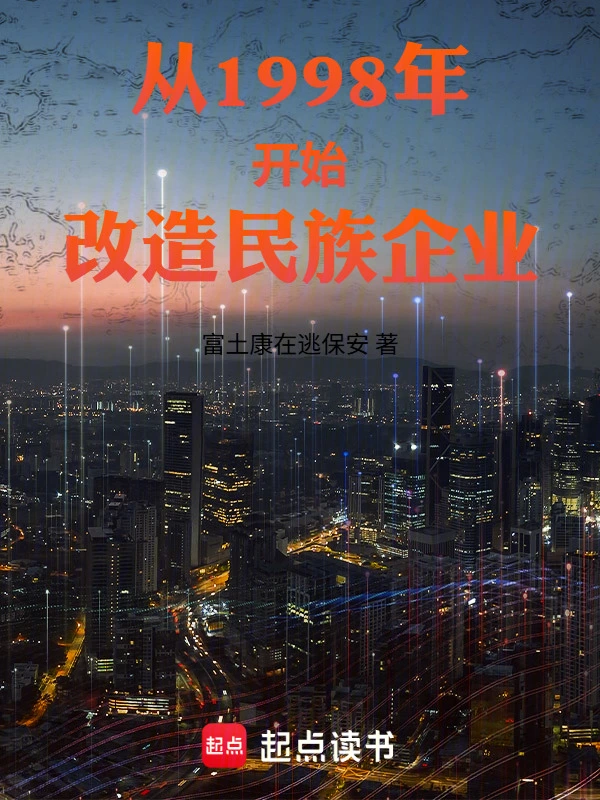
Transformation of National Enterprises Began in 1998
从1998年开始改造民族企业
- Status
- Ongoing
- Length
- 1.3M Words
- Genre
- Urban
- Audience
- Male
- Subgenre
- Business & Workplace
- Updated
- 3d ago
- Source
- Qidian
Stats
505Monthly votes
15kRecommends
45.6kFans
362Chapters
Tags
Synopsis
Reader comments
In booklists 1



Readers also read
 Department of Abnormal Pathology
 China Entertainment: This Top-Notch Character Is Too Stable
 Stranger!
 Evil Gourmet: This Person Has a Very High Food Quotient!
 Criminal Investigation Notes 2: Buried Corpse in Songhu
 Reborn in 2010, Domestic Cars Are Going Crazy
 The Rise of Great Powers Starts with New Energy Vehicle Manufacturing
 Leader
 The Black Witch's Journey to Another World
 Rebirth of the Millennium: Rise from Internet Cafe Godfather
 Wild Times: I Was Diagnosed as an Industrial Giant
 Rebirth: from Cross-Border E-Commerce to Big Country Intelligent Manufacturing
 American National Enterprise
 Start Extracting Black Technology from a Million-Dollar Debt
 The Goddess Mother Who Refuses to Be a Bitch and Confesses Her Love to the School Beauty
In 1998, you took your laptop and logged into the Internet in a foreign-related hotel. It was no problem, but you were a little bit sci-fi. In 1998, domestic websites were basically text-based websites, and you couldn't open pictures. The unified recognition of the first year of China's Internet is 2000. And what you are looking at is an academic website. In 1998, domestic academic websites were basically internal LAN sites. You are exaggerating.
Who still remembers the hand-grinding immortals in China in the last century? Buy foreign chips, then polish off the logs, and say they are self-developed. As a result, chip grinding still needs to be outsourced, and the outsourcer is a decoration company.
I have never seen such a high-profile person finish the book. I hope the author will work hard
Let's learn from Chen Yansen, that is the people's entrepreneur. You're just a fool, have you been brainwashed by the Internet's propaganda about Huawei?
In the absence of a system cheat, who gave the protagonist the courage to short American Airlines stocks before 9/11? Are you afraid of having too little trouble? Do you want to add a little more challenge? It is obvious that because of too many assets, it has been scrutinized by Americans countless times. You dare to do this. I really think you are hiding it so well that no one can find it. You are not cheating. Can you hide it?
Don't treat other business leaders as fools
Xiao Baiwen treats other business leaders as fools.
In the last century, I remember that our country had a computer system, which was built by the whole country, and finally became a waste product, and no one cared about it.
The protagonist is so rich, but he doesn't hire a bodyguard team? The government doesn't send anyone to protect, monitor and observe...
It can only be said that it is a daydream that ignores all social realities.
Don't you feel awkward if you localize that foreign chat software? It is simply impossible to achieve, no matter how good it is, it is impossible to achieve. You have said it yourself. You can't control this company in the future. You can't control it anymore. How can you localize it? Or even if you localize it successfully, so what, you will be more dangerous The core setting of "create social software in the United States and then introduce it to China for localization after success" has a fundamental contradiction in business and geopolitical reality. The main problems and a more feasible idea are as follows: 1. The two "dead ends" of the original setting Loss of control after listing, and loss of strategic autonomy: the protagonist, as the founder, will have his equity significantly diluted after the company goes public. All key decisions such as whether to enter China, how to manage Chinese data, and whether to cooperate with local censorship will be voted on by the U. S. Board of directors and shareholders (who are subject to U. S. Law). They are under no obligation to compromise their global legal compliance or shareholder interests for the special requirements of the Chinese market, particularly strict data localization and content censorship. The protagonist will be unable to promote any real "localization", which may eventually lead to the project being unable to adapt and exiting like Google. Unresolvable national security risks (fatal injury): Even if the software is "localized", as long as its legal subject is a US company, it must abide by US laws. When U. S. Intelligence agencies rely on laws such as the Cloud Act to require companies to provide data or force their engineers to reserve backdoors in their code, companies have no legal possibility to refuse. This is not a management or technical problem, but an irresistible national force. This means that, fundamentally, the "information security" of this software in China cannot be guaranteed in any credible way. This is in direct conflict with China's basic regulatory red lines and is destined to be difficult to survive. 2. A more realistic and smarter alternative: "China-foreign partition" A more operational and tense setting is that the protagonist does not introduce overseas products into China, but uses the successful overseas experience, funds and reputation to return to China and create a completely independent and pure Chinese company and Chinese products from scratch. The benefits of this are: Completely solve the compliance and security dilemma: As an independent legal entity, a Chinese company's servers, data, and code are completely governed and protected by Chinese law, fundamentally isolated from the long-arm jurisdiction of foreign laws, and able to meet the most stringent data sovereignty and national security review requirements. Founders have firm control: In the domestic financing and listing environment, it is easier for founders to maintain absolute control over the company through equity structure design (such as AB shares), so that they can unswervingly implement long-term strategies that are in line with national conditions. Maximizing business value: Overseas companies: It can be used as a pure "cash flow" or "technological frontier" project, enjoying high valuations in the US stock market. The protagonist can gradually cash out, or only retain influence. Chinese companies: They can be deeply tied to the local market, create a super ecosystem similar to WeChat, and be listed in China or Hong Kong as an independent "unicorn" to achieve another huge success.
The difference in data in this book is due
The author actually ate tofu curd and sugar
Why doesn't the protagonist hand over all the company's shares?
I remember there is a book called Millennium Semiconductor Survival Guide which is pretty good, the author can give it a look. The same person who lived in the United States sold his shares in an Internet company and then returned to China to engage in semiconductors. Unfortunately, he was targeted later and every chapter was stuck. The author became blue-tailed.
The first economic short-selling is understandable; the second time, why should we take the risk of short-selling? The funds growing in technology far exceed the benefits of short-selling, and there are also hidden dangers.
If you almost write him as a saint, it will become false and empty.
In 1998, what you want to transform is not the enterprise but the people's hearts
The author is just talking nonsense
The protagonist does not hand over the company's shares to the people, but still talks about national enterprises, borrowing the name of national enterprises, but does not want to assume the responsibilities of national enterprises. Isn't this a hooliganism?
Private enterprise: How many beatings do you have to take to become a corner player? How many beatings do you have to take to make money?😭😭😭😭
Too much business
It's much worse than the one that started with the Internet. Business still has to match beauty, write about business, write about entertainment, and walk on both feet
*Yes, you are far ahead🖐️😭🖐️, have you jumped? Have you cried? Lawyer's letter warning.
Is this the novel that brought back billions of dollars from the United States?
I give it all to you, please give me more!
After reading more than a hundred chapters, there is no big problem, and the article is very enjoyable, but please pay attention to the time of the author, or the time of riding a horse. Reading a word quickly, you can finish it in one day if it takes a month, or you can finish it in two or three months if it takes five, six, ten years. The same goes for those rival companies. It seems that everyone is cheating all of a sudden.
I read more than a hundred chapters in one go, it was so cool
Come on, update soon
Don't go too fast
Slow it down, the speed is too fast, and the gun is usually turned over quickly 😏 Otherwise, there is no content to write behind. The author should be a post-80s generation. In 1998, we used the Internet for 5 yuan an hour, and it was still a local area network. We watched others play stand-alone games.
There are only a few more chapters in one day. I will update a chapter today. I don't have to update it tomorrow. Please update it quickly.
Mainly state-owned scientific research institutions and university institutions focus on different directions. The first is professional title, as well as papers, positions, benefits and benefits, and technology is the least important. In reality, companies build their own R&D team research institutes, and the cooperation with schools is only for the theoretical part, and technology transformation is carried out by their own R&D teams. State-owned institutions of higher learning are not short of money at all. What advanced technologies have they developed over the past few decades?
The author should add the above article as an extra
🙂It's very nice, all ordered.