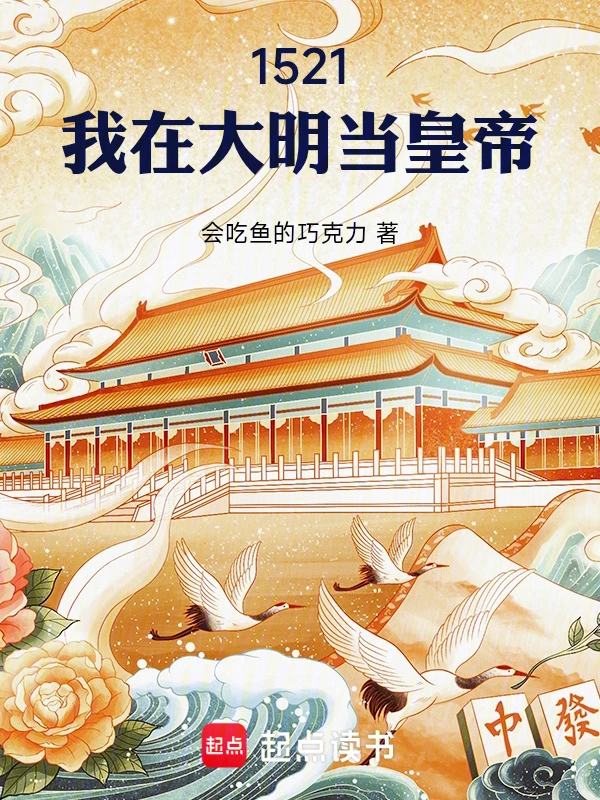
In 1521, I Became Emperor in Ming Dynasty
1521,我在大明当皇帝
- Status
- Completed
- Length
- 789k Words
- Genre
- Historical
- Audience
- Male
- Subgenre
- Song-Yuan-Ming Dynasties
- Updated
- 23d ago
- Source
- Qidian
Stats
12Monthly votes
1.6kRecommends
2.2kFans
257Chapters
Tags
Synopsis
Reader comments
Readers also read
 Northern Qi, Sage Khan
 Red Mansion: Start Escaping and Farming from the Equipment Bar
 Fu Ming 1627
 After Lying in Bed for Three Years, He Was Forced to Help the Han Dynasty
 Criminal Investigation Notes 2: Buried Corpse in Songhu
 Daming: I, Zhengde, Am the Taoist Emperor!
 I Am Song Shizu
 Leader
 The Black Witch's Journey to Another World
 What's Wrong with Me, Zhu Changluo, Being a Bit Shabby?
 Daming: Emperor Chenghua Is Here to Ascend the Throne First!
 Jiajing Mingjun
Except for a few monsters, they really can't compare to the original version.
Many people couldn't figure out where the southwest was in the Ming Dynasty, so they started arguing. To put it bluntly, it was the four provinces of Yunnan, Guizhou, Sichuan and Guangxi today. The Qin State conquered Sichuan in 316 BC; Guizhou was established by Emperor Wu of the Han Dynasty in 111 BC; Emperor Wu of the Han Dynasty established a county in Yunnan in 109 BC, and Zhuge Liang of the Three Kingdoms touched upon it; Guangxi established Guilin County during the reign of Qin Shihuang. What the Ming Dynasty did was to truly solidify the land that had been laid down by the past dynasties, converting the land back to the countryside, garrisoning troops to farm, and immigrating to establish schools, so that they could be transformed from a land of restraint into a part of the Han Dynasty. Shi Bangxian, a native of Kaili, Guizhou, was a famous general during the Jiajing period of the Ming Dynasty. He guarded the junction of Guizhou, Sichuan, and Huguang provinces for decades, fought hundreds of battles, and defeated the rebellious chieftains. History books say that he was "powerful in the southwest", and the local people called him "Southwest Gancheng", which is the shield and city wall of the southwest. After his death, he was posthumously named the crown prince's Taibao, which is the highest honor a military commander can receive. But he is not the only one who is awesome in Guizhou. Sun Ying'ao, a native of Kaili, Guizhou, was a Jinshi during the Jiajing period and was promoted to minister of the Ministry of Industry. He was also a famous thinker in the Ming Dynasty. He returned to his hometown to give lectures and trained a large number of students. Zhang Jian, a native of Chishui, Guizhou, was the first Jinshi after Guizhou was established as a province in the Ming Dynasty. He became an official in Fujian and participated in politics. It was he who broke the history of no one in Guizhou becoming a Jinshi. Xie Sanxiu, a native of Guiyang, Guizhou, was a famous poet in the late Ming Dynasty. He was called "the handsome poet in central Guizhou" by the literary circles in the south of the Yangtze River, proving that Guizhou's culture can be on an equal footing with that of the Central Plains. The reason why these people emerged is because the Ming Dynasty truly brought Guizhou into the national orbit, establishing a province, running schools, and holding imperial examinations. He scolded the Ming Dynasty for oppressing the Southwest, so how did these people come out? Did it come out by toasting fire? The southwest produced not only civil servants, but also a large number of military generals who made great achievements for the Ming Dynasty. They also entered the stage of history through the system of the Ming Dynasty. Guizhou: Shi Bangxian, a native of Kaili, Guizhou, guarded Guizhou, Sichuan, and Huguang during the Jiajing period. He fought more than a hundred battles, suppressed the chieftain rebellion, and shocked the southwest. He was called the "Southwestern Gancheng" by the people at the time. Yunnan: The Mu family has guarded Yunnan for generations. Although they have a foreign surname, they are actually the same vassal king. From Mu Ying to Mu Tianbo, they have protected Yunnan for more than 200 years. When the Ming Dynasty fell, Mu Tianbo still fought with Emperor Yongli in Burma, and the family was full of loyalty. Sichuan: Qin Liangyu, a native of Zhongzhou, Sichuan, was a famous female general in the late Ming Dynasty. She led the "white pole soldiers" to go north to King Qin and guard Shanhaiguan. She was named the crown prince's Taibao and first-grade royal wife by Emperor Chongzhen. She is the only heroine in Chinese history to be recorded in official biographies of generals. Guangxi: Mrs. Wa, a native of Tianzhou, Guangxi, was a chieftain of the Zhuang ethnic group. During the Jiajing period of the Ming Dynasty, she led the "Wolf Soldiers" to Jiangsu and Zhejiang to fight against the Japanese. Wang Jiangjing became famous after the victory in the battle, and was named the "Second Grade Lady" by the court. She was the pride of the Zhuang people. Which of these people is not bleeding blood for the Ming Dynasty? They are not the oppressed, they are the generals of the Ming Dynasty, the children of the southwest, and the heroes who guard the country's borders. That man scolded the Ming Dynasty for oppressing the Southwest, so why didn't he ask who these Southwest generals were fighting for? The Ming Dynasty conquered, defended, and slowly nurtured the southwest. It was the first Han Dynasty to truly bring the southwest under the direct control of the central government. It relied on a three-pronged approach of conquering, colonizing, and reforming: quelling the rebellion, garrisoning the fields, and returning the land to locals, allowing the Han people to take root in the southwest, and turning the chieftain territories into imperial prefectures and counties. As a result, the southwest changed from a land of control to a part of Han Dynasty, with immigrants, imperial examinations, and villages. This was construction from scratch. The Qing Dynasty continued to take charge of the southwest and continued to reform, but it changed the logic. It took over the foundation of the Ming Dynasty. Although the reform was more thorough, the methods were more violent (such as suppressing the Miao border areas) and the policies were more divided (the Han people were not allowed to enter the cave, and the barbarians were not allowed to leave the country). The purpose was to maintain stability rather than integrate. As a result, the southwest has indeed become stable, but ethnic barriers have also deepened. The biggest difference is who is in charge: the Ming Dynasty treated the southwest as its own backyard, and left Han villages and Confucian schools after the war; the Qing Dynasty treated the southwest as a frontier, and left behind the green barracks and isolation policy after the war. To say that the two are the same is to either fail to understand history or to deliberately muddy the waters. The Ming Dynasty changed the land and returned it to the southwest, turning the chieftain territory into imperial prefectures and counties, leaving an administrative foundation for future generations; the Manchu and Qing Dynasties "shaved their hair and changed clothes" to the Central Plains, interrupting the Chinese clothes and hats, which was completely different in nature. Without the Ming Dynasty's three hundred years of immigration, farming, and schooling, the Southwest would still have been a foreign land. The National Army would not have been able to establish its capital in Chongqing, and the Red Army would have nowhere to fight during the Long March, let alone the subsequent suppression of bandits in New China. The Ming Dynasty managed the southwest by converting wasteland into their own fields, while the Manchu Qing Dynasty ruled the Central Plains by occupying other people's homes and changing their own surnames. To say that the two are the same is to either fail to understand history or to deliberately muddy the waters. Where did the Manchu Qing come from? The ancestors of the refugees who came from Tunguska in Siberia lived in the Far East of Russia today, fled to the Northeast, and took advantage of the civil strife of the Ming Dynasty to break into the Central Plains. What's even more ironic is that they were able to survive because the Ming Dynasty took them in. The Ming Dynasty set up Nuergandusi in the Northeast, gave them official positions, food, and territory, and raised them as their own. As a result, I got fat and bit back. People who say the two are the same either don't understand history or are deliberately muddying the waters.
I read the latest chapter, why did I block this novel and keep reading until it's blurry in my face?
We should improve and restore the Ming Dynasty's health schools and other systems, so that they are not as bad as they were during the Chongzhen period. Weixue (Weixue School) in the Ming Dynasty was the school set up by the guards. It was a public school opened by Zhu Yuanzhang for the children of military households. It was found in every guard. Moreover, the proportion of military households passing the Jinshi examination is second only to civilian households. In the 13th year of Yongle's reign, the proportion of children from military households in the imperial examination reached 15.4%. After Jingtai, it remained around 30% for a long time, and even reached more than 40%. Xia Yan, Cao Nai, Li Dongyang, Gao Gong, Zhang Juzheng, Zhao Zhigao, Huang Shijun, Mao Ji, Wan'an, Liu Ji, Liang Chu, Zhai Luan, Zhang Siwei, Wang Jiaping, Ye Xianggao, Fang Congzhe, Han Xu, these are all chief assistants from military households, and they are not just a few examples. The establishment of martial arts has been since the Hongwu period when Daning and other Wei Confucian schools were established to teach the children of military attachés. In the orthodox tradition, Zhu Yong, the Duke of Cheng, selected fifty-one brave military commanders and other officers, and one hundred junior officers skilled in riding and shooting, and ordered the two capitals to establish martial arts schools to train them. Those whose children are over ten years old and who should be attacked by the Ming Dusi or Wei Suo, will be sent to martial arts by the academic officials. Those who have no martial arts will be sent to Wei Xue or nearby Confucianism. In Chenghua, the imperial department took the year-end examination to enroll martial arts students. Those who have been unable to study for more than ten years will be sent to the camp for training. During the Hongzhi period, Ma Wen, the minister of the Ministry of War, was promoted to Yan, and the "Seven Books of Martial Arts" were published to disperse the martial arts and Yingshe people in the two capitals. During the Jiajing period, the martial arts school in the east of the capital was moved to the abandoned temple in the west corner of the imperial city, so that the children of military attachés and newcomers to the lord could study there and be taught by important civil and military ministers. Health education is not limited to military attachés, military households in the health institute can also attend school. First of all, a military household is usually a large family, because the Ming Dynasty law prohibits military households from dividing their families. As long as one male in a military household can serve as a soldier, the rest of the males can make a living on their own, and it is not a problem to go to school. "Study on Military Households in the Ming Dynasty Guards" written by Zhang Jinkui, it clearly stated that the political status of military households in the Ming Dynasty was higher than that of civilian households, and that after the mid-Ming Dynasty, military households could change their registration, sell their own land, and gain free time by paying taxes and grains. At the end of the book, the essential difference between military households in the Ming Dynasty and those in the Wei and Jin Dynasties was particularly emphasized. Military households in the Ming Dynasty had no personal dependence.
Start feeding book friend Akaashi
When the author wrote this latest chapter, he must have felt that he was awesome, and he just hummed after finishing it.
Even Yang can't handle more than 100 pictures.
The author should be a group of Da Luoluo and others.
Author
Can you answer the previous question?
Maritime ban and Japanese pirates
The purpose of the so-called "sea ban" in ancient times was to restrict and eliminate rebel forces, combat piracy and smuggling, and ensure social stability. The "Sea Ban" was only promulgated when there were Japanese pirates. Rather than "sea ban" first, there will be Japanese pirates. Don't reverse the causal relationship. Sea ban and seclusion are two different things. The direct cause of the Japanese rebellion was the civil strife in Japan. In order to make a living and seek wealth, the feudal lords, samurai and ronin who failed in the war organized into armed gangs and went to China's coastal areas with pirate merchants to carry out armed smuggling and robbery and other criminal acts Ming Dynasty literature is actually quite strict about nouns. Pirates, sea pirates, Japanese pirates and Japanese slaves all refer to completely different groups. Japanese pirates are divided into slave thieves and sub-thieves. The Ming Dynasty called these people differently. If they were pirate merchants, they were called pirates. If they are Japanese, they are called Japanese pirates. There is a clear distinction. For example, the Ming Dynasty court and the local chronicles of Zhejiang Province distinguished between Japanese pirates and pirate merchants who colluded with Japanese pirates. Wang Zhi was the largest pirate merchant on the southeast coast at that time. He raised a large number of Japanese pirates to cause trouble, but the record about him clearly stated that he was a pirate merchant, while the Japanese he raised were recorded as Japanese pirates. They have never been mixed together The Japanese can be divided into two types. One is the pirate group headed by Wang Zhi who has inextricable interests with the Japanese pirates. The other is the pirate group whose wives and children were held hostage by the Japanese pirates and forced to attack the town The Japanese pirates are the Japanese pirates as described in Jixiao's new book Military Training Records. The Japanese pirates are Japanese pirates. Forced Japanese pirates were classified as rescued people, while pirate groups were classified as rebels. They were not confused with each other The main force, logistics, bases, and channels for selling stolen goods were all provided by Japan. And the disappearance of coastal Japanese pirates had a great relationship with the changes in Japan. Since the establishment of the Tokugawa shogunate in 1603, the Warring States Period in Japan ended, and vassal states from all over the country collected troops and put them into the treasury. Ma Fang Nanshan Soon after, the Tokugawa shogunate issued a lock-down order. Japanese citizens were not allowed to run around. They stayed at home, men farmed and women weaved, and the economy was restored. Then look at historical data. Starting from 1603, the Japanese rebellion in the late Ming Dynasty began to slowly decrease. The last Japanese pirates seen in history books invaded the coast of Fujian in July of the fourth year of the Apocalypse (1624). From 1633 to 1639, the Tokugawa shogunate issued five consecutive lock-down orders. The Japanese pirates are completely extinct The direct cause of the Japanese pirate rebellion is the civil strife in Japan. At the end of the Yuan Dynasty, Japan split into the Northern and Southern Dynasties, and wars between the two sides continued. In order to make a living and seek wealth, the feudal lords, samurai and ronin who failed in the war organized into armed gangs and went to the coastal areas of China with pirate merchants to carry out armed smuggling and robbery and other criminal acts. Because the main force came from Japan, they were called Japanese pirates at the time Japanese pirates Ancient name) Japanese pirates (bandits or foreign invaders of national borders) Japanese pirates refer to the Japanese. Chinese people want to be Japanese pirates unless they have Japanese household registration. The Japanese pirates are composed of Japanese samurai ronin, Japanese pirates, and Japanese merchants Sea bans have been in place since the Song Dynasty😲😲 The "Book of Taizong" in "History of the Song Dynasty" records that Zhao Guangyi "banned sea merchants" in September of the second year of Yongxi (985). According to the "History of the Song Dynasty·Shihuo Zhi", Zhao Guangyi stipulated private trade with overseas countries in the early years of Taiping and Xingguo (976) Anyone who trades for more than 100 coins will be sentenced, and those who trade for more than 15 coins will have their faces tattooed and be exiled to the island. In other words, Zhao Guangyi not only completely banned overseas trade, but also completely banned land trade with foreign countries. He did not do it on a whim, but implemented it as a long-term national policy. In the fifth year of Chunhua (994), the ban was specifically reiterated, and the punishment laws were also very harsh. It was a crime to have more than 100 guan, and if the amount exceeded 15 guan, one would be tattooed on the face and sent to an island. Later, it was stipulated that those with more than 4 guan would be sentenced to one year in prison, and 20 guan would be sentenced to local service with tattoos on the face. The "History of Song Dynasty: The Benji of Emperor Gaozong" records that in the seventh month of the fourth year of Jianyan (1130), he "banned shipping merchants from Fujian, Guangzhou, Huaihe and Zhejiang to Shandong, and was considered to be the guide of Jinren Township". Not only that, he also issued an edict in August of the second year of Shaoxing (1132) to confiscate the ships of the coastal people and replace them every year to guard the dangerous sea lanes. In essence, it was not much different from the sea ban. According to the "History of the Song Dynasty·Shi Huo Zhi", Emperor Gaozong of the Song Dynasty established a market in the twelfth year of Shaoxing (1142), so he took wax tea as the basis of the market. All the crotch, cut, piece and collar, regardless of how high or low they were, were scrutinized by the officials, and smuggling into the sea was strictly prohibited." That is to say, the overseas trade of wax tea was prohibited.
There are two types of tribute: regular tribute and partial tribute. The partial tribute is the main one and has a huge bilateral transaction volume. The amount of positive tribute is generally very small, and tribute trade is a very high-end and cheap alliance system. The Ming Dynasty tribute was not a loss-making transaction. For details, please refer to the Ming Dynasty Huidian. You are wrong to think of losing money, because in the Ming Dynasty Huidian, the price of the Ming Dynasty's own cloth was a hundred times that of others' tribute, so there is a saying that the Ming Dynasty returned dozens of times the tribute, because the pricing power rested with the Ming Dynasty. During the Hongwu period, North Korea was allowed to pay tribute, and a large number of war horses were sucked up by the tribute. North Korea was the horse-raising area designated by the Yuan Dynasty. In the early Hongwu period, North Korea had a large number of troops and war horses. Japan's trade with the Ming Dynasty was a steady loss. Japan's tribute was swords and armor, and the Ming Dynasty paid tribute in the form of cloth, bowls, and pots. Japan has detailed tribute trade records. The copper ore sent by the Japanese contained high silver content. The Ming Dynasty bought it at a slightly higher price than ordinary copper ore, so that a lot of silver could be extracted. Then the copper ore was minted, and then the copper coins were used to settle Japan (even treasure banknotes were used to settle Japanese goods🤣🤣). The Yongle Tongbao copper coins of the Ming Dynasty were originally needed, such as trade sanctions, etc., The Ming Dynasty also played it According to the calculations of modern Japanese scholars, Japan imported 200 million taels of silver to the Ming Dynasty through trade for more than two hundred years Even the pricing power is still in the hands of the Ming court, making crazy money 😉 As a result, there are still people Talk about making money at a loss There is also the Indochina Peninsula, which has provided gold and silver lessons to the Ming Dynasty for nearly two hundred years. It is not enough if you don't pay. The Tusi copper, gold and silver mines in the southwest often breed the Ming army. The Ming army levied high mineral taxes to supplement the finances of Yunnan, Guizhou and Sichuan, and at the same time, it made three announcements and six peace treaties in the southwest of Yunnan, Guizhou and Sichuan over the past two hundred years. Countless Rebellions In the tribute trade (prospecting trade) between the Ming Dynasty and Japan, the Ming Dynasty did realize the hidden plunder of Japanese silver through the combination strategy of "high silver-containing copper mines + minting rights + treasure banknote settlement", causing Japan to lose a large amount of silver in the long-term trade. This point has received more and more attention in economic history research in recent years. In particular, calculations by Japanese scholars show that Japan exported as much as 200 million taels of silver to the Ming Dynasty in the 16th and 17th centuries (accounting for about 1/3 of Japan's silver production). The Ming Dynasty achieved low-cost seizure of Japanese resources through sophisticated currency and trade methods.
Bore explosion problem
Bore blasting was a global problem at the time, especially in Europe, where the metallurgical industry was immature. The gun blasting rate was actually very high, and it also caused serious accidents. In 1574, the Governor of the Spanish Netherlands ordered 300 cast iron cannons from the Liege Cannon Foundry. However, due to the lack of casting iron technical support, although these iron cannons were delivered on time, after testing, all of them exploded and no one was spared. Wathier Godefrin, the director of the cannon foundry and the cannon caster, was also arrested and imprisoned because of the failure of the cannon casting. Source Colin J. M. Martin—"Full fathom five wrecks of the Spanish Armada" The cast iron cannon artifacts from three periods, including the Inmarill Rose that sank in 1545; Gustav's leather cannon, and the Batavia that sank in the Netherlands in 1629, all have obvious traces of splicing. Most of the extant European wrought iron cannons from the late Ming Dynasty have barrels that are level with the barrel, and traces of gaps in the iron bars are clearly visible. This is irrefutable evidence that can be found online. European wrought iron cannons even mentioned in their own documents that they could not be loaded with high-pressure granular gunpowder, and they often exploded and the real King of Scotland was killed on the spot. The ratio of saltpetre to carbon to sulfur was 7.5:1.5:1 In the nineteenth century and 5:1:1 in the sixteenth century. Additionally, powder made in France and Italy at least up to the end of the sixteenth century was not grained.'' Morin "Morphology" Powdered gunpowder burns slowly and produces a lower chamber pressure. The energy of granular gunpowder is 1.5 Times that of powdered gunpowder, and the burning rate is 3 times that of powdered gunpowder. , As a result, Western European wrought iron cannons only used low chamber pressure powder gunpowder, and the chambers repeatedly exploded. It was still possible to replace them with granular gunpowder. During the British expedition to Cadiz in Spain in November 1625, due to the greed and embezzlement of military contractors, and the lack of management experience of state officials, who knew nothing about military logistics support, the British expedition not only lacked food and clothing, but also used shabby weapons. There were even many matchlocks that did not even have fire holes, so they could not be fired at all. The country invested a lot of money, but there were too many moths, which ultimately led to the failure of the war. During the Battle of Oudenaarde on July 31, 1667, 600 French heavy matchlock guns exploded on the battlefield in one day (Source: "Un probl ème opé rationnel du "the prac tife of a rtillerie" In 1621, Spain cast 150 new bronze cannons within two years. Due to the poor skill of the gunsmiths, these cannons were not cast well. Among them, 20 of 36 cannons were damaged when they were tested for the first shot. Although the British cast iron cannons in the 17th century had a temporary monopoly in Europe, unfortunately it was only in the early 17th century that there were records of the British adding limestone to blast furnace smelting, and it was not until the fall of the Ming Dynasty that they began to use coke for smelting. Fortunately, the British's high-quality low-sulfur and low-phosphorus iron ore helped them a lot. Otherwise, with their metallurgical technology, the iron cannons they cast would not be much better than those of Spain. Also, the Hongyi artillery introduced in the early days of Chongzhen exploded in front of all civil and military officials during the first test firing in the capital, and the remaining unexploded parts were sent to the Liaodong battlefield for use. European science and technology has also developed step by step. Some people think that Europe has been advanced for three to five hundred years or even longer because of its advanced science and technology in modern times. How is it possible that real life is not an instant improvement across eras by clicking "Upgrade" in a video game?
Ming Dynasty Metallurgical Forging Technology
There are two major types of artillery popular in the world from the 14th to 17th centuries: "forged cannons" and "cast cannons" The wrought iron cannon technology popular in the 15th to 16th centuries, based on all existing Western European artifacts and comparison with the cultural relics of the Ming Dynasty, the Ming Dynasty's wrought iron cannon technology was stronger than that of Europe at the same time until its demise. I would like to emphasize that the real impact of the Franco machine on the Ming Empire was its breech-loading gun's design for rapid reloading, which was similar to that in Europe at the same time. It was horizontal to the barrel and had clear gaps in the iron bars. It can be seen that the Ming Dynasty did not like the forging technology at all (it was simply shoddy). This kind of forging method could not withstand the high pressure of granular gunpowder, and it was extremely easy to explode the chamber The biggest difference between the Ming Dynasty's forged iron cannons was that the production method was detailed in the "Arms and Arms". The biggest feature of the forged iron cannons forged by this method was that there were no gaps and a flat and smooth bore. Even by the end of the Ming Dynasty, the only country in the world that could mass-produce various types of seamless wrought iron cannons was the Ming Empire. This also made the Ming Dynasty's wrought iron cannons superior to those in Europe in terms of charge capacity and projectile weight. European wrought iron cannons were unable to solve the seamless process of wrought iron cannons until the middle of the 17th century. The cast iron cannons from three periods, including the British Mary Rose that sank in 1545, Gustav's leather cannon, and the Batavia that sank in the Netherlands in 1629, all have obvious traces of splicing. And all the existing large, medium and small wrought iron cannon cultural relics of the Ming Dynasty, whether they are various types of Weiyuan cannons, Fran machines, and captive-killing cannons, are all seamless. The seamless bamboo shell type wrought iron firearm technology of the Ming Dynasty was widely used as early as the Hongzhi Dynasty. This is ironclad evidence that Shandong cultural relics have been preserved, and it has nothing to do with Westerners. The detailed manufacturing method of a heavy wrought iron general cannon is recorded in Volume 14 of "Synopsis of Armaments". It can be seen that the craftsmanship of Chinese forged iron cannons is different from that of the West from the beginning. This method of burning red iron sheets and wrapping large and small ones can not only make the cannon without traces of splicing, but also greatly reduce blisters in the barrel and obtain a smooth barrel with a unified caliber. 😊😊😊😊 On the basis of the Hongyi cannon (cannon), the Dingliao General Bronze Cannon is superimposed with two layers of BUFF BUFF 1: The casting method is more advanced The craftsman introduces cooling water into the hollow model. By solidifying the iron barrel from the inside out, the durability of the cast cannon is increased by five times or even dozens of times😊 BUFF 2: Using the "Iron Core Copper Body" casting method The melting point of copper is lower than that of iron. The "Iron Core Copper Body" cannon has thinner tube walls, lighter weight, and less cost. This casting method was not used in the West until the American Civil War, more than two centuries later than the late Ming Dynasty. On March 6, 1627, the Governor of Portugal and India reported to the king that the Governor of Macau, D. Filipe Lobo, had found "two casting masters" and was on his way to Goa. The two Chinese iron-smiths were not accustomed to using cast iron from Goa, so they made no progress in making cannons and returned to China. On March 14, 1632, the Portuguese King approved the Portuguese and Indian Governor-General to use Macao Chinese masters to cast iron cannons in Goa. Monsoon Book, Lisbon National Archives, Volume 30, Page 166. Chinese artillery was also sold to Europe "Selected History of Old Colonialism" quoted the record in Volume 24 of "Philippine Islands" and mentioned that the Spanish obtained copper cannons through Chinese merchants: Two documents in 1574 and 1576 said that the goods shipped to Manila by Chinese merchants included flour, barley flour, sugar, various dried and fresh fruits, steel, iron, tin, lead, red and white copper, fine porcelain, various silk fabrics and various small items. What's especially important is that there are "a large number of bronze cannons that are very well cast, as well as various military supplies." It was always discovered that overseas Chinese invented a new cannon-casting process and ordered fifty of them to be cast at one time. The raw materials used by Spanish bandits to make weapons and ammunition, such as steel, iron, copper, lead, tin and nitrate, were supplied by China. He also imported cannon from China. Captain Diego de Artieda reported to Philip II in a letter in 1573: "They have all kinds of weapons that we have. Their cannons, according to what I came to inspect, the "verso" cannons shipped from China, are very good" and are better smelted (fundida) than ours. … Every city and province has an armed army. " ("The Philippine Islands - Volume 3" "The Philippine Islands, 1493-1803") (PS: The "verso" artillery in the original Spanish text can refer to "1/2 Culebrina or Verso (Berço)" is a "half-long cannon" (clearly called a hair cannon); it can also refer to a "base" cannon, which is a "France cannon") ] "They (Chinese businessmen) brought a large number of well-made bronze cannons "bronze artillery" and various military supplies. Luzon was very suitable and convenient for trade with China; men could reach the mainland from this island because it was so close. " (Documents of "Philippine Islands" 1569-1576) The Spanish clearly recorded it in the "History of the Great Chinese Empire" published in 1585: In a letter to our master, the king, Captain Alda said after talking about other things: "... The weapons used by the Chinese are the same as ours, and the artillery is of good quality. On some ships, I saw with my own eyes that the cannon body was well-proportioned, the casting process was better than ours, and it was stronger than ours. Every city has a cannon-making factory, which is constantly manufacturing every day. " In the 17th century, the Ming Dynasty was the world's leader in metallurgical technology. The quality of its self-produced red cannons quickly caught up with the support of local technology. "History of Technology" Oxford University's European masterpiece "The Complete History of the Chinese Empire" wrote that Spanish officers lamented that "cannons are better built than ours and more threatening" "Firearms" "Times" (written by Portuguese East Asian historian Tonio) evaluated the Ming Dynasty's imitation Hongyi cannon as one of the best artillery in the 17th century (This is where the Ming Dynasty's artillery truly took the lead) In the nearly one hundred years before and after the demise of the Ming Dynasty, new firearms developed in Europe were stronger than the Ming Dynasty, but the metallurgical forging technology was not as good as the Ming Dynasty.
Strengthen authority, rule and clan management
Only reducing the benefits of clans has limited effect. If there are more clans in the future, they can arrange to form the "Zhu Family Army" (the lower-level clans in the fifth server have the least risk, and let the clans pay blood tax to reduce some of the population burden). Zhu Yuanzhang had a similar idea. As a result, because of Zhu Di and Zhu Yunwen, the Ming clan cannot be used later. It is a pity that these are all human resources! (Big In Volume 17 of the Ming Huidian, officials and gentry paid taxes as one, and even the vassal kings had to pay taxes. It was illegal to donate and annex land. Once someone reported that the whole family was exiled, the land was distributed to the surrounding people. However, later supervision and restrictions were relaxed, and it was useless to reduce the treatment of the clan in history. The Ming Dynasty finally died of poverty.) The clan could take the imperial examination, which was restored in the Wanli Dynasty. Even if you don't go to war, you can recruit workers in factories🏭, set up the Internal Revenue Service, and let the lower-level clans serve as violent tax collection teams. You can also set up a royal academy for clans to study astronomy, geography, mathematics, medicine, physics, chemistry, machinery, art... And contribute to human civilization. In the future, if there are more clans, you can also find these distant relatives to serve in corvee. , The most important thing is not to give 💰💰💰 Let the clan make money and be filial to the emperor😎 It's rare to be an emperor in time travel. If you can't make the capitalists jealous, the emperor will be in vain (remember to let the clan establish a country overseas) The so-called "civilian group" is essentially a group of representatives of the interests of different regions competing for power in the court. They are not monolithic. In the middle and later stages, party strife will only occur when the emperor's authority and control declines. If these groups of scholar-bureaucrats are divided, they can use the share dividends of some factories and chambers of commerce to win over them. "We must make many friends and few enemies." It can be improved. The status of the three ancestor gods Xuanyuan Huangdi, Fuxi, and Nuwa enhances the legitimacy of the protagonist's authority (the three ancestors are the protagonist's predecessors😏) and increases the cohesion and assimilation ability, which provides justice and legitimacy for the complete incorporation and assimilation of surrounding ethnic minorities. On the high ground of faith, we not only need local Taoism and other philosophical sects, but also have ancestral beliefs as firewalls😎, and they will not go astray as easily as religions🔥 In China, ancestral beliefs are very important. It is related to the legitimacy of the court, the authority of elders and parents, and the consensus of the people😊 Even if the feudal dynasty, Confucianism, and religion are gone in the future, the people of China can be reunited.
Author
Can you answer the previous question {"NickName":"Book Friends 20260227131304441","UserId":490567113}
If you write well, you can make money right from the beginning. Like Da Ming 1627, newbies can get rich by writing about Da Ming.
It's still a eunuch. I was looking forward to this book at the beginning, but then I became more and more disappointed. After it was released, I subscribed to a few chapters, and finally decided to keep it for now. I will decide whether to read it after finishing the book. Haha, as expected, it turned out to be a eunuch.
The writing is still too narrow-minded.
If the protagonist can be able to conquer the generals and seal the wolf to Juxu, expand the territory and sail around the world, whatever the protagonist wants to do after these achievements, the ministers below will help to achieve it. It doesn't matter whether the etiquette is big or not. The big etiquette can be left alone for now. If you want to ask about the legitimacy of the emperor, then ask the army and the royal guards. At this time, the protagonist becomes the ancestor and establishes the Ming Dynasty in the east and the Ming Dynasty in the west.