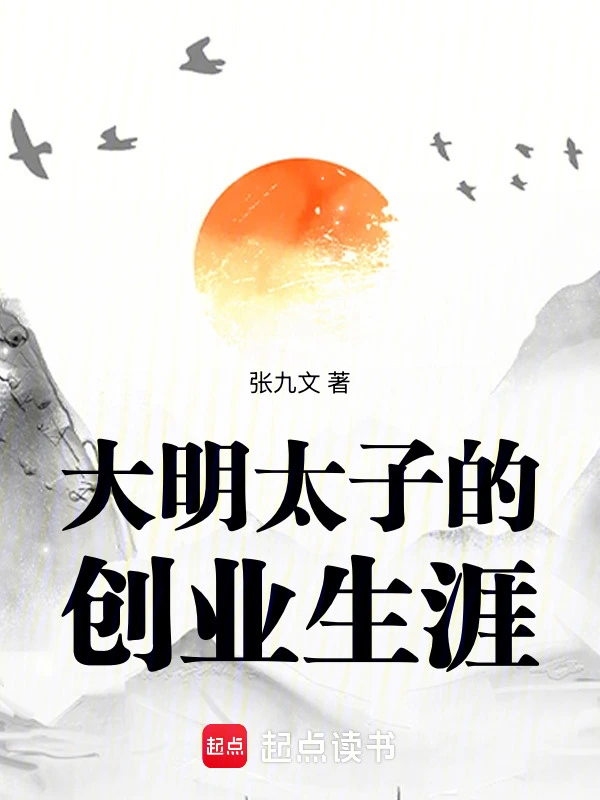
The Entrepreneurial Career of the Ming Prince
大明太子的创业生涯
- Status
- Ongoing
- Length
- 1.1M Words
- Genre
- Historical
- Audience
- Male
- Subgenre
- Song-Yuan-Ming Dynasties
- Updated
- 3d ago
- Source
- Qidian
Stats
Tags
Honours
Synopsis
Reader comments
In booklists 11

Tianji Library
Introducing some books that I have read and found good

🔥Highly Recommended New Books
Recommended level: [Heavenly King's Assets/Great God Level]>[Wanjun's Assets]>[Exquisite Assets]>[Books in the Wilderness to Read]>[Niche Articles] The owner of the new book list that has not yet been put on the shelves will predict whether Sanjiang will be available. They are all books that I am reading or that are good, high-quality online articles, and the quality is guaranteed. Mainly promote new books, no ads! Prediction of the list of twelve kings in 26 years: "Gou Becomes a Saint in th
History Book List
History bookworms, share this with friends who are book-hungry. If you think it's okay, come back and give it a like, thank you!
Writing Style and Feelings Are Both Indispensable.
If the Jade Emperor asked about the affairs of the world, articles in troubled times would be worthless.
Seedlings Chasing
Like a single name in a book~
Historical Archives
The long river of history flows endlessly; the thousand-year scroll is full of ups and downs.

Suiyuan Food List
An omnivorous book list, without classification or sorting. Each book is guaranteed to appear on the book list only after reading it. It is dynamically updated.


Guess, Guess, Tap, Tap, Tap, Tap, Tap, Tap, Tap, Tap, Tap, Tap, Tap, Tap, Tap, Tap, Tap, Tap, Tap, Tap, Tap, Tap
Color


Personal Reading List
Books currently being read or read
Reading the Book List
Reading list

Book List for Self-Use-Mainly Keeping Books
Personal reading list
Readers also read
 Fu Ming 1627
 Red Mansion: Start Escaping and Farming from the Equipment Bar
 Northern Qi, Sage Khan
 After Lying in Bed for Three Years, He Was Forced to Help the Han Dynasty
 On My First Day at the Police Station, I Ate Imported Candy from a Police Beauty.
 Let the Tang Dynasty Fly
 This Kid Has Been Destined to Be an Emperor Since He Was a Child!
 What Should I Do If I Ascend to the Wrong World?
 My Girlfriend Cheated on Her and Got Pregnant, and I Ran Away Nine Months Later
 Datang: They Force Me to Be Emperor, Right?
 Spring of the 14Th Year of Wanli
 Daming Straw Bag Exploring Flowers
 The Leisurely Life of Qin People
 The Leisurely Life of the Tang Prince
The writing is quite good, and the book is not out of the bag at all. Although it is set as a time traveler, it is not like other similar themes, such as "Records of the Ming Dynasty" and "History of the Ming Dynasty". More than 90% of the book uses events to promote the plot, and does not make introductions or explanations of a prophetic nature. It is a very excellent type of historical writing. Using events to promote the plot and character creation, the author can be a little clearer. Although from the perspective of historical research, it is a good historical perspective to leave merits and demerits for future generations to judge. We do not directly judge what kind of person a person is (make a descriptive evaluation). For example, the shaping of Li Shanchang, Hu Weiyong and others is more about writing out their actions, rather than directly writing about why they did what they did and what kind of people they were. Even if there is, it is recorded in history books and other people's evaluations of them at the same time. But this is a novel, and the motivations for their actions can be properly pointed out. For example, Li Shanchang is from the standpoint of a noble family and a scholar-bureaucrat. In this case, the character creation may be clearer. Book friends who do not have much historical foundation can also read it more relaxedly, and the presentation effect will be much better.
Historical travel daily writing
This writing style feels very good, and it is also quite interesting. It's more of a daily-oriented historical time travel story, which has a magical feel to it. As for the details, I don't know, I just know that it's not a drama. Furthermore, whether it is logical or not is largely irrelevant. That's good. Refreshing feeling
Do you have a group number 😁😁😁
The king calls himself: Song, Yuan and Ming call themselves "I" or "I". Before the Qing Dynasty, few people called themselves "this king". Starting from the Kangxi year of the Qing Dynasty, it was common for people to call themselves "this king". Those who are called Wangjue by subordinates; Song Dynasty: King/a certain king. Yuan: Your Majesty/Your Highness. Ming: Your Highness / A certain king. Qing: Prince, a certain prince/a certain county king. Before the Ming Dynasty, the emperor was almost never called "Emperor". In the Ming Dynasty, the emperor began to be called "Emperor" occasionally, and in most cases he was called "Your Majesty". After Kangxi of the Qing Dynasty, people began to be generally called "Emperor". The emperor calls officials; before the Qing Dynasty, most people called them official positions or Qing, and Aiqing was rarely used. In the Qing Dynasty, Aiqing began to be used extensively. In ancient times, women called themselves: "nujia" was a modest name for women after the Song Dynasty. Women in the Han and Tang Dynasties more often called themselves "concubine", and noble women could call themselves "I" and "I". Before the mid-Ming Dynasty, most dynasties used copper coins for daily transactions, with very little gold and silver. It was only in the mid-to-late Ming Dynasty that silver became the mainstream currency. In the late Ming Dynasty, "meeting votes/deposit checks" appeared among the people. There were no unified rules. Most of them were deposits and withdrawals/exchange receipts from acquaintances or local circulation, and were not legal currency. In the early years of Daoguang in the Qing Dynasty (1823): Rishengchang Bank was established, and private banks began to issue standardized banknotes, focusing on long-distance exchange. They were only circulated in the Shanxi merchant trade circle and major commercial ports, and were not yet popular. In the third year of Xianfeng in the Qing Dynasty (1853): the official issued the Ministry of Revenue official banknotes (official banknotes), which were forced to circulate nationwide. At the same time, the network of private banknotes expanded to the whole country, and official and private banknotes ran parallel. The use of banknotes entered an explosive period and became the "starting point of popularization." The memorial system was only established during the Kangxi period of the Qing Dynasty. Officials in the Tang and Song Dynasties used "memorials", "tables" and "statements" to submit memorials, while in the Ming Dynasty they used "titles" and "memorials". There is no such thing as "memo" or "zhezi". "Please say hello" is a unique etiquette in the Qing Dynasty. It was mostly used between subordinates to superiors and juniors to elders. During the Tang and Song dynasties, people often crossed their hands and bowed to greet each other when meeting, and there was no such thing as "say hello". Before the Yuan Dynasty, subordinate officials rarely called superior officials "adult". In some dynasties, subordinates called eunuchs "adult", and in some dynasties, they called their parents and elders "adult". Beginning in the Yuan Dynasty, lower-level officials would occasionally call officials of second-rank and above "sir". From the middle and late Ming Dynasty, only officials of third-rank and above would be called "sir" by their subordinates. Officials with lower ranks could not be called "sir". However, in the late Ming Dynasty, there began to appear a few cases where officials above the fourth rank were called "adult". Before the mid-Qing Dynasty, following the rules of the Ming Dynasty, only officials of third rank or above would be called "adult". Starting from the mid-Qing Dynasty, calling officials "adult" gradually became common for lower-level officials. Attention! ! ! What is mentioned above is that lower-level officials refer to higher-level officials. No matter which dynasty, it is absolutely impossible for higher-level officials to call lower-level officials "sir". Some novels even write about emperors or nobles calling other officials "sir". This is simply contrary to Tiangang! ! ! Finally, let's talk about the problem of civilians calling officials Before the middle and late Qing Dynasty, civilians in various dynasties and generations called officials differently, and most of them called them "officials" and "masters". From the middle to late Qing Dynasty, civilians also called officials "adult". {"NickName":"Supervision and Restriction","UserId":406440657}
The most comfortable episode
As the title states, Zhu Yuanzhang was one of the few emperors in the history of China who did not guard against the crown prince. In a real sense, he wanted to be on the hot bed with his wife and children. To put it bluntly, except for Zhu Biao, the other princes are not considered sons. Zhu Biao is Zhu Yuanzhang's only heir. Zhu Yuanzhang is eager for Zhu Biao to ask for power.
Compared with the author's first novel, Li Chengqian's situation, Zhu Biao's book is simply as difficult as the plot mode. Are Zhu Yuanzhang, Empress Ma, and Li Shimin on the same level? Li Chengqian might have to pee after looking at him. If the next book is about Prince Wei, I will be so jealous
Many people couldn't figure out where the southwest was in the Ming Dynasty, so they started arguing. To put it bluntly, it was the four provinces of Yunnan, Guizhou, Sichuan and Guangxi today. The Qin State conquered Sichuan in 316 BC; Guizhou was established by Emperor Wu of the Han Dynasty in 111 BC; Emperor Wu of the Han Dynasty established a county in Yunnan in 109 BC, and Zhuge Liang of the Three Kingdoms touched upon it; Guangxi established Guilin County during the reign of Qin Shihuang. What the Ming Dynasty did was to truly solidify the land that had been laid down by the past dynasties, converting the land back to the countryside, garrisoning troops to farm, and immigrating to establish schools, so that they could be transformed from a land of restraint into a part of the Han Dynasty. Shi Bangxian, a native of Kaili, Guizhou, was a famous general during the Jiajing period of the Ming Dynasty. He guarded the junction of Guizhou, Sichuan, and Huguang provinces for decades, fought hundreds of battles, and defeated the rebellious chieftains. History books say that he was "powerful in the southwest", and the local people called him "Southwest Gancheng", which is the shield and city wall of the southwest. After his death, he was posthumously named the crown prince's Taibao, which is the highest honor a military commander can receive. But he is not the only one who is awesome in Guizhou. Sun Ying'ao, a native of Kaili, Guizhou, was a Jinshi during the Jiajing period and was promoted to minister of the Ministry of Industry. He was also a famous thinker in the Ming Dynasty. He returned to his hometown to give lectures and trained a large number of students. Zhang Jian, a native of Chishui, Guizhou, was the first Jinshi after Guizhou was established as a province in the Ming Dynasty. He became an official in Fujian and participated in politics. It was he who broke the history of no one in Guizhou becoming a Jinshi. Xie Sanxiu, a native of Guiyang, Guizhou, was a famous poet in the late Ming Dynasty. He was called "the handsome poet in central Guizhou" by the literary circles in the south of the Yangtze River, proving that Guizhou's culture can be on an equal footing with that of the Central Plains. The reason why these people emerged is because the Ming Dynasty truly brought Guizhou into the national orbit, establishing a province, running schools, and holding imperial examinations. He scolded the Ming Dynasty for oppressing the Southwest, so how did these people come out? Did it come out by toasting fire? The southwest produced not only civil servants, but also a large number of military generals who made great achievements for the Ming Dynasty. They also entered the stage of history through the system of the Ming Dynasty. Guizhou: Shi Bangxian, a native of Kaili, Guizhou, guarded Guizhou, Sichuan, and Huguang during the Jiajing period. He fought more than a hundred battles, suppressed the chieftain rebellion, and shocked the southwest. He was called the "Southwestern Gancheng" by the people at the time. Yunnan: The Mu family has guarded Yunnan for generations. Although they have a foreign surname, they are actually the same vassal king. From Mu Ying to Mu Tianbo, they have protected Yunnan for more than 200 years. When the Ming Dynasty fell, Mu Tianbo still fought with Emperor Yongli in Burma, and the family was full of loyalty. Sichuan: Qin Liangyu, a native of Zhongzhou, Sichuan, was a famous female general in the late Ming Dynasty. She led the "white pole soldiers" to go north to King Qin and guard Shanhaiguan. She was named the crown prince's Taibao and first-grade royal wife by Emperor Chongzhen. She is the only heroine in Chinese history to be recorded in official biographies of generals. Guangxi: Mrs. Wa, a native of Tianzhou, Guangxi, was a chieftain of the Zhuang ethnic group. During the Jiajing period of the Ming Dynasty, she led the "Wolf Soldiers" to Jiangsu and Zhejiang to fight against the Japanese. Wang Jiangjing became famous after the victory in the battle, and was named the "Second Grade Lady" by the court. She was the pride of the Zhuang people. Which of these people is not bleeding blood for the Ming Dynasty? They are not the oppressed, they are the generals of the Ming Dynasty, the children of the southwest, and the heroes who guard the country's borders. That man scolded the Ming Dynasty for oppressing the Southwest, so why didn't he ask who these Southwest generals were fighting for? The Ming Dynasty conquered, defended, and slowly nurtured the southwest. It was the first Han Dynasty to truly bring the southwest under the direct control of the central government. It relied on a three-pronged approach of conquering, colonizing, and reforming: quelling the rebellion, garrisoning the fields, and returning the land to locals, allowing the Han people to take root in the southwest, and turning the chieftain territories into imperial prefectures and counties. As a result, the southwest changed from a land of control to a part of Han Dynasty, with immigrants, imperial examinations, and villages. This was construction from scratch. The Qing Dynasty continued to take charge of the southwest and continued to reform, but it changed the logic. It took over the foundation of the Ming Dynasty. Although the reform was more thorough, the methods were more violent (such as suppressing the Miao border areas) and the policies were more divided (the Han people were not allowed to enter the cave, and the barbarians were not allowed to leave the country). The purpose was to maintain stability rather than integrate. As a result, the southwest has indeed become stable, but ethnic barriers have also deepened. The biggest difference is who is in charge: the Ming Dynasty treated the southwest as its own backyard, and left Han villages and Confucian schools after the war; the Qing Dynasty treated the southwest as a frontier, and left behind the green barracks and isolation policy after the war. To say that the two are the same is to either fail to understand history or to deliberately muddy the waters. The Ming Dynasty changed the land and returned it to the southwest, turning the chieftain territory into imperial prefectures and counties, leaving an administrative foundation for future generations; the Manchu and Qing Dynasties "shaved their hair and changed clothes" to the Central Plains, interrupting the Chinese clothes and hats, which was completely different in nature. Without the Ming Dynasty's three hundred years of immigration, farming, and schooling, the Southwest would still have been a foreign land. The National Army would not have been able to establish its capital in Chongqing, and the Red Army would have nowhere to fight during the Long March, let alone the subsequent suppression of bandits in New China. The Ming Dynasty managed the southwest by converting wasteland into their own fields, while the Manchu Qing Dynasty ruled the Central Plains by occupying other people's homes and changing their own surnames. To say that the two are the same is to either fail to understand history or to deliberately muddy the waters. Where did the Manchu Qing come from? The ancestors of the refugees who came from Tunguska in Siberia lived in the Far East of Russia today, fled to the Northeast, and took advantage of the civil strife of the Ming Dynasty to break into the Central Plains. What's even more ironic is that they were able to survive because the Ming Dynasty took them in. The Ming Dynasty set up Nuergandusi in the Northeast, gave them official positions, food, and territory, and raised them as their own. As a result, I got fat and bit back. People who say the two are the same either don't understand history or are deliberately muddying the waters.
Chased from Da Qin
I have always liked the author's style in writing Fusu. It's just so impersonal that I haven't read a single chapter of the new book this time. I can't bear it anymore, too little is not enough
Li Chengqian, Fusu, and Zhu Biao have all been written. The next version should be written about Liu Zhi 😊
Compared with the previous novels by the author, this one is the one that I can keep reading the most because the protagonist seems human through the interaction with the Chang family and his family. Although the previous novels also interacted with others, it was more mechanical because it was required for the task, not for trivial matters like now, which makes the protagonist like a human being.
From Li Chengqian in the Tang Dynasty, to winning Fusu in the Qin Dynasty, and finally to Zhu Biao in the Ming Dynasty
Qin Shihuang Ying Zheng, Han Wu Emperor Liu Che, Tang Taizong Li Shimin, Ming Taizu Zhu Yuanzhang, the four emperors could not find a crown prince who would succeed him.
In the Ming Dynasty, it should be possible to climb the technological ladder and start the first industrial revolution.
Great book!
It still tastes the same! Just like this, he was calm and talkative; in the calm days, there was a strong smell of fireworks, and the family's feuding and the court's intrigues were intertwined... What a good story! Great book!
People on the Internet say that Zhu Biao is the most stable prince. But the good thing is that Zhu Biao and Zhu Yuanzhang share the same team. The bad thing is that he does not have his own team. During the period of supervision, all decisions are made without the right to dispose, only the right to make suggestions.
Is this book still worth eating?
If the protagonist still eats it every day, I would like to ask the author to change a snack. Thank you for recommending Xi'an's delicious steamer cake in the book, but you really can't eat this thing every day, it's too boring.
Plain and simple is the truth
There are not many books in which the protagonist's words and great principles can make others confused. I live a very ordinary life, from running in the morning until I fall asleep at midnight. Of course, I am also working towards a better life for the people of the world. At present, there are no bad guys in the absolute sense. Li Shanchang and Hu Weiyong give people a silly and cute temperament. The characters in it all show a simple side, as well as the insight and wisdom of the characters at that time. If most novels are live broadcasts with characters 0.5 Meters away from the camera, then this book is a documentary about 5 meters away from the camera. It's less about psychological fluctuations and more about the narrative of specific characters' actions. I just discovered this book too early and it was a bit unreadable.
The Tang Dynasty, the Qin Dynasty, and the Ming Dynasty. That's great😆
I didn't read the previous Da Qin, mainly because I felt that Qin was not as "interesting" as Han. The first impression of Qin was that it was old-fashioned, strict, and depressing. In the early Han Dynasty, it was not surprising that any big job came out.
Lao Zhang, I've almost raised my life, so I just want to make a suggestion, let the damned people die on time, really. Sometimes it's not just good to be alive all the time.
Grass jelly
It's really well written and beautiful. I love reading it. I'll send you a monthly pass. Come on.
Come on more
(^~^)
The real supreme god of China is the Emperor of Heaven, also known as Haotian God and Huangtian God. The word God is originally one of the titles of the Chinese Emperor of Heaven and is not an imported word from abroad. Even the Taoist Jade Emperor has the title of God (because the two main design reference prototypes of the Jade Emperor are Haotian God and Xuanyuan Huangdi) 😊😊 Haotian God is also what we call the "Old God" among the people. In ancient times, the belief in Haotian God was monopolized by the emperors and courts of ancient dynasties, and folk belief and worship were prohibited. Therefore, at least part of the reason that indirectly led to the birth of the Jade Emperor belief is that the people have always regarded the Jade Emperor and the Haotian God as exactly the same existence. After all, the common people also have the need to worship the supreme god. The ranking of God Haotian has always been enshrined in the Temple of Heaven in Beijing, even in the Qing Dynasty😊😊😊 The gods in ancient China were complicated😊 Fuxi, Nuwa, and Xuanyuan Huangdi were one. The Queen Mother of the West, Lu Wu, Kaiming, and Xuanniao (the prototype of the Nine Heavens Xuannv). Donghuang Taiyi, Yunzhongjun and Xiangjun are from the same line. Shen Nong, Emperor Yan, Xing Tian, and Chi You are in the same line. Dijun, Xihe and Chang Xi are of the same lineage (Dijun is the main god in the northeastern region of northern China, although some of the prototypes come from the great-grandson of Huangdi Xuanyuan, "Di Ku, whose surname is also Ji. His mother was unaware that he was born with supernatural powers and said that his name was Kui"). Although it cannot be said to be completely correct, at least it is more reliable than the Honghuangliu novel The emergence of Haotian God has solved the situation of "co-ruling by all emperors" in Chinese mythology, allowing China to have a situation where "monotheism and polytheism" coexist. So much so that it influenced the later Taoist construction and design of the heaven, and formed a form in which Chinese society is dominated by the belief in ancestor gods and supplemented by religious gods (after all, the Taiping Road was destroyed, and Zhang Jiao's failure in the first place prevented China from turning into the European Dark Middle Ages😅Zhang Jiao is one of the few comparisons in ancient times) People who care about the people, but the threshold for religion to control secular rights is lower than that of secular society. After all, ancient Europe has proven the terrible consequences of religion's control of secular rights.) A society dominated by ancestral beliefs is not as easy to follow Western religious civilizations. Even if there is no feudal dynasty, the people of China can reunite together😊😊😊
Very pretty
Plainness is the real thing. At least it's still very comfortable to read more than 20 chapters now. Hold on, write 3 million words, and vote for a monthly vote to support it.
Start the IRS and start taxing businesses, otherwise where will the money come from?
Get it
By the way, will the author write about mainland China in his next novel? Can you write something about foreign countries? There are too many books written about the mainland, almost three of them, and if you write about foreign countries, you can also write about things we don't know about the mainland, such as the Qin Dynasty, the Bright Moon, and the Tang Dynasty. Everyone knows this history, isn't that it?
Strengthen authority, rule and clan arrangements
Only reducing the benefits of clans has limited effect. If there are more clans in the future, they can arrange to form the "Zhu Family Army" (the lower-level clans in the fifth server have the least risk, and let the clans pay blood tax to reduce some of the population burden). Zhu Yuanzhang had a similar idea. As a result, because of Zhu Di and Zhu Yunwen, the Ming clan cannot be used later. It is a pity that these are all human resources! (Big In Volume 17 of the Ming Huidian, officials and gentry paid taxes as one, and even the vassal kings had to pay taxes. It was illegal to donate and annex land. Once someone reported that the whole family was exiled, the land was distributed to the surrounding people. However, later supervision and restrictions were relaxed, and it was useless to reduce the treatment of the clan in history. The Ming Dynasty finally died of poverty.) The clan could take the imperial examination, which was restored in the Wanli Dynasty. Even if you don't go to war and recruit workers in factories, you can set up the Internal Revenue Service and let the lower-level clans serve as violent tax collection teams. You can also set up a royal academy for clans to study astronomy, geography, mathematics, medicine, physics, chemistry, machinery, art... And contribute to human civilization. In the future, if there are more clans, you can also find these distant relatives to do corvee service. The most important thing is that you don't have to give 💰💰💰 Let the clan make money and respect the emperor😎 It's rare to be an emperor in the future. If you can't make the capitalists jealous, the emperor will be in vain (remember to let the clan establish a country overseas) The so-called "civilian group" is essentially a group of representatives of the interests of different regions competing for power in the court. They are not monolithic. In the middle and later stages, party strife will only occur when the emperor's authority and control declines. If these groups of scholar-bureaucrats are divided, they can use the share dividends of some factories and chambers of commerce to win over them. "We must make many friends and few enemies" It can be improved. The status of the three ancestor gods, Xuanyuan Huangdi, Fuxi, and Nuwa, enhances the authority and legitimacy of the protagonist and suppresses the status of religious gods (the three ancestors are the protagonist's predecessors😏) and increases the cohesion and assimilation ability, which provides justice and legitimacy for the complete incorporation and assimilation of surrounding ethnic minorities. On the high ground of faith, we not only need local Taoism and other philosophical sects, but also have ancestral beliefs as firewalls😎, and they will not go astray as easily as religions🔥 In China, ancestral beliefs are very important. It is related to the legitimacy of the court, the authority of elders and parents, and the consensus of the people😊 Even if the feudal dynasty, Confucianism, and religion are gone in the future, the people of China can be reunited.
Give me a serious update on my teeth
As shown in the picture
I'm a bit greedy, Zhu Biao is the book I most want Zhang to write. I kind of hope that the next book will be about Cao Ang, and I hope it will be about him taking care of his brothers. I just recently read that Cao Pi actually took care of Cao Qian, and he lived to be 46. This feels incredible
Urgent update!
I really like this kind of daily historical farming flow!