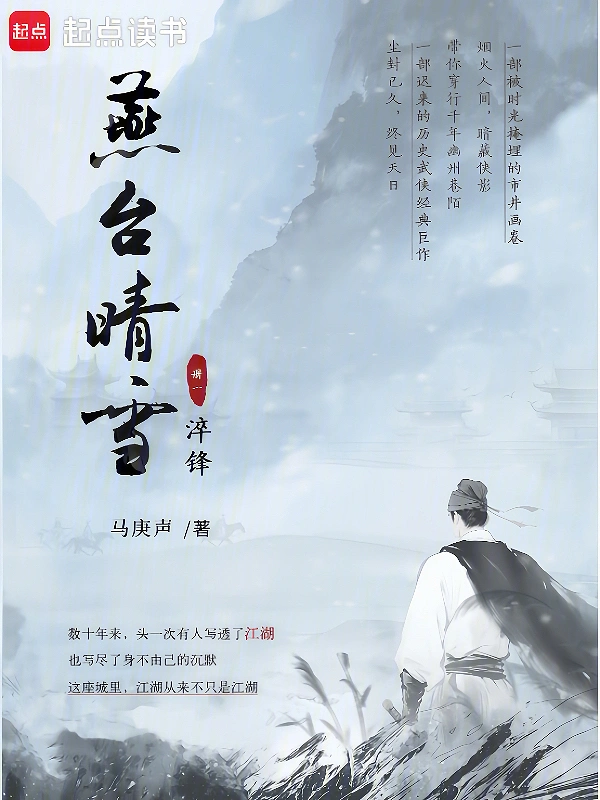
Yantai Qingxue
燕台晴雪
- Status
- Completed
- Length
- 348k Words
- Genre
- Martial Arts
- Audience
- Male
- Subgenre
- Traditional Wuxia
- Updated
- 6mo ago
- Source
- Qidian
Stats
0Monthly votes
44Recommends
0Fans
25Chapters
Synopsis
Reader comments
Readers also read
 Entry Copying, Starting from the Abduction of Wang Yuyan
 Flower Monk Starts from Jiumozhi Template
 Pretending to Be a Postman, He Gained the Power of Four Dragons and Four Elephants at the Beginning!
 Become Invincible in the World from the Eighteen Palms of Subduing the Dragon
 Things About the Two Song Dynasties
 New Century Underworld Cows and Horses
 Anshi Rebellion: Crossing the Tang Dynasty Bow to Shoot Jackals
 Countryman's Ambition
 Prime Minister Is on Top
 The Gods Are Not in the Temple
 All Things Hope
 Overturning the Jin Dynasty: a Comeback
Seeing splendor in jail - a collection of poems from "Qingxue on Yantai", which is the young hero's spiritual breakthrough
If you read too many contemporary historical novels, you will inevitably feel bored. The heroes in too many works are trapped in the stereotype of "only talking about heroes with swords and horses", as if as long as their sword skills are fast enough and their archery skills are accurate enough, they can support the character of the entire book. It wasn't until I turned to the paragraph in "Qingxue on Yantai" where Qin Jin was imprisoned and connected with a collection of Tang Dynasty poems that my eyes suddenly shined: the true chivalrous spirit is not only in the light of the sword, but also in the literary spirit in the bones and blood. With only a few strokes, there is no ostentation or preaching, and the author's bottomless classical poetry skills make Qin Jinzhi completely break out of the flat template of a knight in the world, making the entire work's context and chivalry the most touching fusion. "Two orioles chirp in the green willows, The sound of insects penetrates the green window screen. Butterflies carry red pistils and bees carry powder, Flowers fly everywhere in the spring city." The genre of collection of sentences is called "the clothes of hundreds of families" in classical literature. It looks like it is spliced together from the previous poems, but in fact the threshold is frighteningly high. It originated in the Jin Dynasty and flourished in the Song Dynasty. If you want to write it well, you must first be familiar with the poems of the past dynasties. Secondly, you must be proficient in the rhythm and antitheses of the oblique and oblique lines. The most difficult thing is to "collect without separation". Even if the two poems are written by different poets who are separated by hundreds of years, they must have a coherent artistic conception and a coherent spirit, and they must fit the current mood and situation. Otherwise, they will be just a collection of stiff words without any sense of literary beauty. In "Qingxue on Yantai", Qin Jinzhi collected sentences to amuse himself in prison, and wrote this difficult matter in a light and easy way, which is extremely wonderful. At that time, Qin Jinzhi was trapped in the darkest moment of his life. Trapped in jail, life and death hang on a thread, and the people outside Zhiji Hall are watching eagerly. His future is uncertain, and the road ahead is full of fog that cannot be seen clearly. In other novels, the main character would probably be hysterical and angry, or blaming others for his depression. Even worse, a long psychological monologue would be needed to break up his struggles and show them to the readers. However, "Qingxue at Yantai" only contains a single stroke, describing how he was bored in prison, so he used a collection of Tang Dynasty poems to form a couplet, word by word, to relieve his loneliness and calm his mind. With just a few strokes, the prejudice that "the world and poetry are incompatible" has been shattered to pieces. We always think that Jianghu Xia Shao Shao should be a rough guy who drinks a lot of wine and eats meat in big chunks, but Qin Jinzhi is not that. He read Tang poetry with Lu Jinshi since he was a child. Swords and arrows were his ability to survive in troubled times, but Tang poetry was the place where his soul rested in the wind and rain. Even if his body is imprisoned in a small prison, even if his life and death are in the hands of others, he can still find a sense of calmness and self-control from the poems of the Tang Dynasty written thousands of years ago. The generosity and chivalry of the land of Yanzhao and the romantic romance in Tang poetry grew together perfectly in this young man. What's even more rare is that this piece of writing is not a "private product" used by the author to show off his skills. Many authors write protagonists who recite poems and write poems, always with the selfish intention of showing off their own skills, and have nothing to do with the characters or plot. When reading, they just feel like they are drama. But Qin Jinzhi's prison sentences completely follow the characters and are a natural revelation of his character and growth trajectory. His growth has always been more than just getting better at swordsmanship and becoming more sophisticated in tactics, but also a little bit of enrichment in his spiritual world, with his knowledge constantly growing and his cognition constantly improving. From an errand boy running around in the market to the owner of the Qin Club in charge of one side, he has not lost any of his literary spirit. The collection of sentences in prison is not about boredom, but his spiritual breakthrough in a desperate situation. The tighter the body is locked, the more the spirit can go wider and further through Tang poetry. The myriad phenomena in Tang Dynasty poetry became his weapon against hardship and loneliness. This kind of character creation is more memorable than writing ten hearty killing scenes, and it also allows readers to better understand the flesh and soul of this young man. The most touching thing about this detail is that it quietly restores how vivid Tang poetry was in that era. In our impression, Tang poetry is a test topic to be memorized in textbooks, an elegance in the literati's study room, and a pastime among the gentry circles of the Southern Dynasties. But in the land of Youzhou where Hu and Han blended together, Tang poetry had already crossed the high walls of class and status. It can be a pastime for the queen and aristocratic women in gambling games, it can be a tune sung by the Goulan Vasheli singers, or it can be a way for a prodigal to calm his mind when he is in prison. The author did not say a word of preaching or make a blunt science popularization. With just this one detail, we can understand: Tang poetry is not a classic that is shelved in the closet, but a cultural bloodline that lives in every Chinese person's life. There are too many historical novels nowadays, which are full of swords and swords, palace battles for heirs, and power reversals. After watching the excitement, you close the book and forget it in the blink of an eye. The pen and ink of the sentences in prison in "Qingxue on Yantai" have become the most unforgettable and magical strokes. It makes us understand that a real chivalrous man not only has the courage of an ordinary man, but also has a literary spirit and character hidden in his flesh and blood; a truly good historical novel not only has a gripping plot, but also has the confidence to be deeply rooted in the classical context. This short paragraph of a collection of sentences from prison shows not only the author's thorough familiarity with Tang poetry, his precise grasp of the collection of sentences, but also his profound understanding of the characters and his awe of the historical context. It is precisely this kind of detail that makes "Qingxue at Yantai" break out of the stereotype of cool writing, and have a unique literary quality, and a moving part that can withstand repeated sucking.
Worth reading
It has a realistic style and a rare theme of Youzhou in the Liao Dynasty. It may be the first novel about Youzhou, with rich fireworks and vivid characters. It writes deeply about human nature and social reality. Ximen Donghai chose to die in full name, while Qin Jinzhi chose to swallow his anger in order to preserve Xinyi Hall. Everyone has their own limitations. 😥
"A masterpiece that subverts the traditional martial arts" - reproduced from a netizen's morning coffee
"Snow on Yantai" is suitable for reading on a sunny afternoon, brewing a pot of tea and sinking into a comfortable rocking chair. Following the text, I walked into Youzhou City a thousand years ago. I glanced at the low houses and the bluestone alleys that were deeply scarred by mule carts. I watched the wine flags fluttering in the wind and listened to the whispers of idle people at the end of the alleys. Unknowingly, I followed the young swordsman named Qin Er and plunged into the world of this city. Before reading it, I thought it was a traditional martial arts novel. After reading it, I realized that it is not so much a martial arts novel as a folk legend rooted in history. Its temperament is closer to the historical novels of Gao Yang and Ma Boyong, rather than the adult fairy tale about pleasure and revenge that we are familiar with. The arena of traditional martial arts is located in famous mountains and rivers, in sects isolated from the world, while the arena of "Qingxue on Yantai" completely falls into the world of fireworks. It is not in the lush forests in the distant mountains, in the shouting in front of the shops on Qipan Street, in the ambush at Lin Qingxuan Tea House, in the bustling flow of people in the North City, or in the life and death choices in every ordinary alley. The author has thoroughly written about the essence of the world in troubled times: there have never been any decent knights from famous families who hide in the mountains and dense forests. There are only a group of ordinary people who fight for survival, territory, and the remaining faith in their hearts. The conflicts among the societies here are not for martial arts secrets or treasures, nor for being the best in the world. They are just for the sake of earning a living in the corrupt Youzhou City where the Han and Han people are mixed and governed by officials. The brotherhood here includes Qin Jinzhi's care for his brothers, his unwillingness to let his brother Yuan die young, and his backstabbing in order to seek advantages and avoid disadvantages. The coexistence of passion and coolness is the most touching thing in people's hearts. The most rare thing is the author's control of historical details, which is quite Gao Yang's style. The features of Youzhou in the late Tang Dynasty and the Five Dynasties are described in detail, and the folk customs are well documented and meticulously written. When I read it, I always felt that I was not reading a fictional story, but actually standing on the streets of Youzhou a thousand years ago, watching the prosperity and turmoil of the city, and listening to the noisy voices of the Tibetan and Han people. The author's words are gorgeous, and it can be seen that he was deeply influenced by Gao Yang, while his ordinary and humorous aspects are based on Jin Yong's example. The liveliness of Mr. Jin Yong's writing is hidden in the lines of the work. The growth line of the protagonist Qin Jinzhi is the most touching part of the book. He is not a born hero. From a young swordsman in the Qin Society to the leader of the Qin Society, his growth has never been about rapid advancement in martial arts and mastering peerless magical skills. On the contrary, the fighting scenes in the whole book are all on point, which is similar to the treatment method of "Twelve Hours in Chang'an" and "Fifteen Days in Two Capitals". There is never a lengthy fight to slow down the pace, and the swords and swords only serve the plot and characters. His growth is a result of his changing understanding of the world, people's hearts, this city, and this troubled world amidst the separation of brothers and the conflicts of the world. He once thought that faith could withstand all difficulties, and he never wanted to get involved in the world. He saw the undercurrent in Youzhou City, and he felt that Yanshe was about to move, but what could he do? From him, readers can experience the powerlessness and perseverance of individuals in troubled times, and empathize with them. The tempering of this sword has never been the blade, but the heart.
The collection of poems "Snow on Yantai" is the young hero's spiritual breakthrough
After reading all the historical martial arts novels, the easiest creative rut to fall into is the image of the knight-errant as a reckless man who "only considers the sword and horse as a hero" - as if a knight-errant only needs to have superb swordsmanship and superb archery skills to support the character of a work. One of the most amazing features of "Qingxue on Yantai" is the detail of Qin Jinzhi using Tang poetry to form a couplet when he was in prison. With just a few strokes, there is no ostentation or preaching, but the author's bottomless classical poetry skills make the character of Qin Jinzhi jump out of the flat template of a knight-errant, making the entire work's context and chivalry the most touching fusion. Collecting sentences into one body has always been the most expressive and powerful genre in classical literature. It is known as "the clothes of a hundred schools of thought". It began in the Jin Dynasty and flourished in the Song Dynasty. It seems to be a splicing of lines from the previous poems, but in fact the threshold is extremely high: those who are not familiar with the poems of the past dynasties can't do it, those who are not proficient in flat and oblique rhythms and antitheses cannot be masters. What's even more difficult is that "Gathering without separation" - although the selected poems are written by different people, they must be integrated in artistic conception and coherent, and they must fit the current mood and situation. Otherwise, it will just be a pile of rigid words without any literary beauty at all. In "Snow on Yantai", the couplets of Qin and Jin in prison turn this "difficulty" into the "wonderfulness" of character creation and narrative expression. Two orioles sing in the green willows, The sound of insects breaks through the green window screen. Butterflies hold red pistils and bees hold powder. There are flowers flying everywhere in Spring City. At that time, Qin Jinzhi was in jail, with his life and death uncertain. Outside, Zhiji Hall was pressing on him step by step, and inside, there was uncertainty about the future. It was the darkest moment in life when life was most difficult. The author did not write about his hysterical resentment, nor his blaming decadence, nor did he use long psychological monologues to dismantle his struggles. He only wrote about him in prison, bored out of his mind, using a collection of Tang poetry as a couplet to relieve his loneliness and calm his mind. This writing, first of all, broke the stereotype of "the opposition between Jianghu and poetry" - Qin Jinzhi was not just a reckless man who only knew how to fight and kill. The Tang poetry and context he had learned from Lu Jinshi since he was a child had already been engraved in his bones and blood. Swords and arrows were his ability to settle down, and Tang poetry was the place where his soul rested. Even if he was in a prison, even if his life and death hung on the line, he could still find a spiritual calmness and self-control from the poetry of the Tang Dynasty. The generosity of the Yanzhao knights and the romantic charm of Tang poetry were perfectly combined in this young man. What is even more impressive is that the plot of this collection of sentences is not a "show-off" forced by the author to show off his poetry skills. It completely serves the characters, fits the narrative, and is a natural reveal of the character's personality and growth trajectory. Qin Jinzhi's growth is not only the improvement of swordsmanship and archery, the maturity of political intrigues, but also the continuous enrichment of the spiritual world. From a boy working in the market to the owner of Qin Club, he has never lost the poetry and literary spirit in his heart. The collection of sentences in prison is his spiritual breakthrough in a desperate situation: the tighter the physical confinement, the wider his spiritual territory. The myriad scenes in Tang Dynasty poetry have become his armor against hardship and loneliness. This characterization, far better than ten hearty killing scenes, allows readers to remember this boy with flesh and blood, bones and soul. The preciousness of this detail lies in the fact that it quietly restores the true vitality of Tang poetry in that era. We always think that Tang poetry is exclusive to the literati's study rooms and is an elegance among the nobles of the Southern Dynasties. However, we forget that in the land of Youzhou where Hu and Han mingle, Tang poetry has already transcended the barriers of class and status. It can be a pastime for gambling games between queens and aristocratic women, it can be a tune sung by Goulan Vasheli singers, or it can be a spiritual pillar to calm the mind of a gangster boy when he is in prison. The author did not preach a word or popularize science. Only the details of this collection of sentences in prison allow us to understand: Tang poetry in that era was never a classic that was shelved in the closet, but a cultural bloodline that lived in everyone's life. In a group of historical novels that only rely on the flash of swords and the reversal of power to attract attention, the writing in "Qingxue at Yantai" can be called a stroke of genius. It allows us to see that a true chivalrous man never only has the courage of an ordinary man, but also has a literary spirit and character hidden in his flesh and blood; a truly excellent historical novel never only has a wonderful plot, but also has a literary foundation deeply rooted in the classical context. The short length of the collection of sentences in prison not only shows the author's thorough familiarity with Tang poetry and precise control of the collection of sentences, but also the author's deep understanding of the characters and his awe of the historical context. It is precisely such details that make "Snow at Yantai" break out of the stereotype of cool writing and gain unique literary quality and moving power.