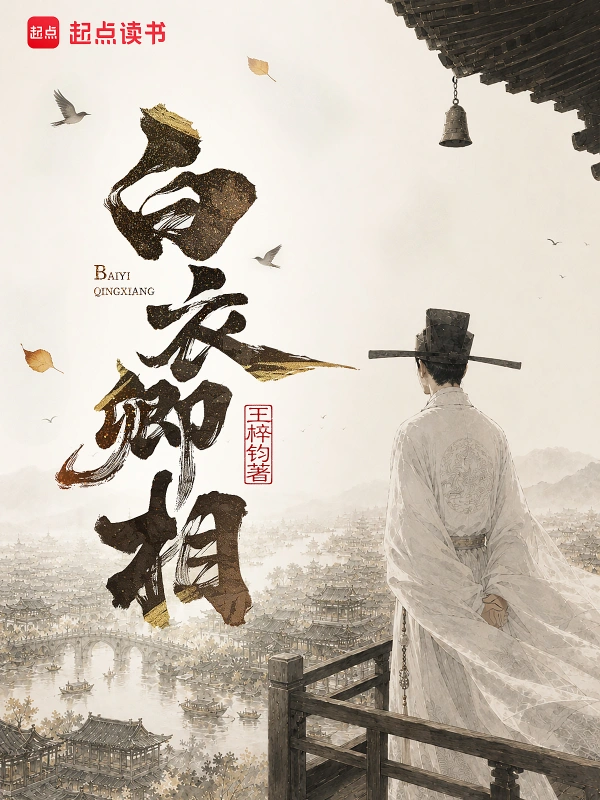
Prime Minister in White
白衣卿相
- Status
- Ongoing
- Length
- 776k Words
- Genre
- Historical
- Audience
- Male
- Subgenre
- Song-Yuan-Ming Dynasties
- Updated
- 3d ago
- Source
- Qidian
Stats
Tags
Honours
Synopsis
Reader comments
In booklists 52
Explore more →


A Long Review List Focusing on Seedlings
Self-recommendations will be deleted, but those who are interested will basically try the poison. In addition, I will not help with reviews, so don't force it, thank you.


Choose from Thousands of High-Quality Products: Volume 5
Wan Ding's works are all based on his ability: some are uncanny in imagination, some are magical in plot, some are sophisticated in writing, or some are compact in rhythm. All of them can bear the word "Wan Ding".

Gold List Title: June Monthly Ticket Soaring List
The monthly ticket is like a pen, and love is the ink. In the list release season in June, the monthly ticket also ushered in its own "gold list title."



New Products Released in Early Summer: May's Monthly Vote List Soared, Powerful Players
There is a kind of happiness called "I have chased you for a long time", and there is a kind of regret called "how did I discover it" - potential masterpieces, new books by great masters, high-quality dark horses... I have the book list in hand, I have the masterpieces!



Yuelaiyuhao, You Deserve It
Really recommend good books


A Good Article with Outstanding Characters
This book list selects and recommends works with excellent interaction between characters and characters. The characters depicted are very memorable for us and will be our favorite collections and readings.
Good Historical Records
History Book ListDedicated to History Mainly, I recommend some good historical books and high-quality seedlings to everyone! There are many storms on the list, but they are all indifferent. Guys, do you feel familiar looking at the books in this list? I only recommend high-quality history books! Dear readers who like historical articles, please come in. If you like it, please give it a like, add a follow, and add it to your bookmark list. Please click "Pentagram⭐️" below to bookmark this boo

🔥🔥🔥🔥🔥🔥🔥🔥🔥🔥🔥🔥
🔥🔥🔥🔥🔥🔥🔥🔥🔥🔥🔥🔥🔥🔥
Group Portrait, War, Civilization, History, Exploration
Group portrait war genre, science fiction, historical civilization world exploration, if you like it, please save it and read it.

New Book Express
Seedling's new book requires everyone to collect it and invest in reading it in order to get rich.


[Long Commentary List, Continuously Updated]
Selected serial best-sellers, popular sacred books, and completed classics from 2018 to 2026. 👍 If you like the books in this book list, you can "click the red ⭐️ below to collect this book list". Please like and follow the book list to support it! Adding to this book list is based on the following seven points. 1. How many fans are subscribed to? 2. This chapter talks about how popular it is 3. How many times do you support the reward? 4. Lots of positive reviews in the book review area 5. Bre
The Golden Book Recommender's Library
This book list recommends complete works of various types.

I Have Been Looking for Good Books and Never Stopped.
[Miscellaneous Book List] Specially recommends various works Once you enter the sea of books, you will miss your life, and you will hold on to the book without any guidance in your heart. When the prosperity has faded and I look back at dusk, only poems and books remain in the world. The world is so big, knowing each other means being destined. This book list brings popular new books, serialized masterpieces, and complete classics to all readers. <<<Collect, collect, ask for collection>>>> Say
Writing Miracle
Based on the best-selling and reading volume of the book, select books and add them to the book list. Everyone is welcome to recommend high-quality seedling books in the comment area.
Works Worth Staying up Late to Read
The desire for updates cannot be satisfied. Must-see works are updated every day. I recommend them to everyone. I hope you can go and see them if you like them.
Book List Updated Daily
These are the works that I miss and want to see every day. I introduce them to you. I hope you like them too.
Sincerely Recommend Good Books and Bid Farewell to the Book Shortage
Recommend good books of various types. If you like it, give it a thumbs up and bookmark it.
Speed Express
It's too late to say anything. The speed is too fast. Get in the car quickly. I understand everything.
Good Books Highly Recommended
👊If you like it, please bookmark it and take a look

Shennong Who Tasted Hundreds of Herbs
It focuses on niche products and fairy grass seedlings. If you have any interesting articles, you can also recommend them.
[Evaluation, High-Quality Products and Unpopular Products]
A big thumbs up to those writers who are working hard on the road to becoming gods.
History
Historical literature


Serialized Fairy Grass🌱
Serialized fairy grass🌱 Recommended serials, great books with potential I hope to bring you good books You are also welcome to leave your book title in the comment area Thanks for the support


The Captain Feels Good
As always, focus on martial ethics
Readers also read
 Fu Ming 1627
 I Am a Tyrant in Nanming
 At the Beginning, Please Ask Chongzhen to Abdicate!
 Red Mansion Xiaoke
 Daming: Attack, Emperor Yongle!
 Kuo Jin
 Jiangzuo Puppet Lang
 I Get a New Character Every Week
 Transform into Tang Monk and Become Stronger Starting from Covering the Sky to Obtain Scriptures
 Everlasting Ming Dynasty
 Beiyang Dream
 Seizing the Direct Descendants in the Jiajing Dynasty
 Dreaming Back to the Great Spring
 I
I
 Restart Life
 Guide to Traveling Through the Northern Song Dynasty
 Rebirth of the Wild Age
This book does not lack skill, but lacks heroism.
I was attracted by the many Douyin videos promoting books. Those videos criticized the books of Grenade and Mike, and they said this book was good. Anyone who works in business knows that planting grass in advance is intentional. I read it out of curiosity and thought that this book was powerful and well-founded, but it was too unheroic. Where there is oppression, there is compromise on the part of the protagonist. Even if you risk your life as a fellow villager, you must strive to repay the favor to the court. I feel quite uninterested. It's not that the book is boring, it's that the people are boring. How can I still touch Porcelain Grenades and Mike's books? Save it, ah
Northern Song Dynasty [Issue Collection Fee] [Xie Enyin] Examination
According to the "History of the Song Dynasty·The Annals of Shenzong": In the third month of the third year of Xining's reign in Jihai, he began to make plans to become a Jinshi, and stopped writing poems, poems and essays. Renzi, the Ministry of Ceremonies reported the names of Jinshi, Mingjing and the 829th person. In September Yisi, I will personally encourage the virtuous and upright people. Among them, the "Election Chronicles" says: In the third year of Xining, he personally took the imperial examination and began to focus on policies, limiting the number to a thousand words. Celebrities from the old special music tried to discuss it, but they also made strategies. The emperor said to the governor: "The countermeasures are not enough to fully utilize the talents, but it is better to recruit people with poems and poems." In the old system, when Jinshi entered, they were thanked for a hundred taels of silver, and then they stopped [Translation: it stopped in this year] Three thousand money was still given to collect fees for a period of time. [Translation: Still giving three thousand money as collection fee] [Summary]: Xie Enyin stopped collecting money only three years after Xining, Shenzong of the Song Dynasty. According to this document, it can be seen that three years before Song Shenzong Xining, the emperor had an old practice of giving money to new scholars to collect their writing fees. [If according to this sentence, it is indeed possible that during the Song Renzong period, the court had already given money to new scholars as period fees] However, the problem arises here. In the "Election Chronicle", "Three thousand dollars will still be given, and fees will be collected for a period of time". The author has not found the photocopied original document. In view of the fact that "isolated evidence cannot be established", it will not be adopted for the time being. On the contrary, the author found the following record in "General Examination of Literature - Volume 31": ----------------- Teaching disciples the law, often hundreds of them. There is the law school, one of the six schools. Later, the Jin gentry was often ashamed of this school. Those who understand one subject of Dharma and can only recite its text can hardly understand its meaning. Those who are about to fill the official position in the near future must gather together and try it. This is to see the punishment. In the old system, Jinshi people collected money every period based on the A-level rate. The poor were called loans. In this year, they were given three thousand coins to collect fees every period. The new Jinshi under the old system enter Xie and receive a hundred taels of silver to express their gratitude. In the eighth year, Wang Anshi's poems and Zhou Liyi were awarded to the academic officials, which was called the new meaning of the Three Classics. First, Anshi presented the official examination essay, and said that the literary works of Li, Dong, and Zhang E were superior but contrary to the classics [The photocopied version of the original document is as follows]: ---------------- There is no era number in this text, but if you read it page by page, there are clear era number records that can be traced back to the past. For example, in the first 6 pages of this page, there is the following record: [A person who is famous for his academic performance may not necessarily be a gentleman. If you think that writing literary poems from afar is not as good as those who traveled to the capital to study, it is easy to see that the legacy is like Ou Zeng and Su Gong who are famous for their articles. All those who have high rankings but have to travel to the capital and then study literature and art are plagiarists and imitators, and they are not original or unique people. In the second year of Xining, Shenzong, discussed more tributes and laws, stopped writing poems on various subjects of Ming classics, and discussed policy based on the meaning of the classics. At the beginning of the imperial examination, Wang Anshi believed that the selection of scholars in ancient times was all based on learning, so he invited people to be inspired...] Contact the context, this is the sixth year of Xining, Shenzong of the Song Dynasty. If we follow this passage of literature: It can be seen that—— [This is the year when three thousand coins of money were given, and the fees were collected for a period of time]. The same can be seen - [New Jinshi under the old system enter Xie, and they will give up a hundred taels of silver to thank them, and then give up]. In other words, it was only in the sixth year of Xining, Shenzong of the Song Dynasty that the court began to give money as regular collection fees, and the practice of paying Xie Enyin was only abolished in this year. And regarding this record in "Wenwen Tongkao", there are also many supporting evidences: "Miscellaneous Notes of the Government and the Country since Jianyan-Song Dynasty-Li Xin Biography-Volume 13" "Yuhai-Song Dynasty-Wang Yinglin-Volume 16" "Yan Yiyi Mou Lu-Song Dynasty-Wang Li-Volume 5" "Continued Zi Zhitongjian Changbian-Song Dynasty-Li Tao-Volume 243" The details are as follows: ----------------- ———————— "Miscellaneous Notes on the Government and the Country since Jianyan-Song Dynasty-Li Tao-Volume 13" Ren Yuling heard about it. In the sixth year of Xining, new scholars were given three thousand coins to collect fees for a period of time. From Yuzhong, they were also given one thousand seven hundred coins after crossing the river, and this became a story. The old and new Jinshi were given a hundred taels of silver to thank them for their kindness, and they gave up in the sixth year of Xining. Now the new Jinshi is called the Tuansi, and the bureau is set up in the Gongyuan of the Ministry of Rites. He will go there on the day of release. There are more than a hundred people in charge of the table, the names of the supervisors, the guests in charge of ceremonies, the use of various utensils, the food, wine and fruits, etc., And they still have the names and surnames of the people they have assigned. Huang Jia, who lived in the Gongyuan of the Ministry of Rites in the same year, set up mattresses in the east and west of the hall. [The photocopied version of the original document is as follows]: ----------------- "Yuhai-Song Dynasty-Wang Yinglin-Volume 16" In the eighth year of Kaibao (Yusi Sect), the official was not ordered to solve the problem first. In the second year of Xingguo (Lu Mengzheng), King Wu started paging Qizhao from Cai Qi. In the sixth year of Xining, the new Jinshi was given three thousand coins to collect fees for a period of time. After Yu Zhong began to cross the river, he was given one thousand seven hundred coins. The new Jinshi was thanked in the second year of Chunxi. In the old system, the banquet of Qionglin Garden and the Dharma House were given to Piyong, and Xuanhe was restored to the old state. In the eighteenth year of Shaoxing, a banquet was first given to the Gongyuan of the Ministry of Rites. In February of the second year of Xianping, he tried it in Taichang Temple. The trial was held in the first month of the third year of Jingde... [The photocopied version of the original document is as follows]: ----------------- "Yan Yi Yi Mou Lu-Song Dynasty-Wang Li-Volume 5" At the beginning of the dynasty, he went to the south of the Yangtze River and set up two water and land transportation envoys to transport grain from the south of the Yangtze River to support the capital. Later, because the land route was inconvenient, we had to take the water route. In April of the fourth year of Yongxi's reign, the order was issued for water and land transportation to be one road, with Wang Jisheng in charge and Dong Yan in charge. From then on, it remained unchanged until Xuanhe. In the early days of the Republic of China, Jinshi gathered together, and they collected money and made small records based on the rank of the first class. They traveled to Yan, and they were either rich but low in rank and had little to show for it, or poor and high in rank, like a fake beggar. In March of the sixth year of Xining, Geng Shen issued an imperial edict to grant Jinshi and his title 3,000 coins, and 700 coins for all subjects, to collect fees for a period of time. For a moment, Xinyan thought it was a grand event, so she held it next time. In March of the ninth year of Xining, Wuyin... [The photocopied version of the original document is as follows]: ----------------- "Xu Zizhi Tongjian Changbian-Song Dynasty-Li Tao-Volume 243" Renxu, Yu Jiying Palace, was awarded the title of Jinshi Mingjing and various subjects. Yu Zhong and below were born in the same class, with classmates, a total of 596 people, and they were from Changzhou. Three thousand coins will be given to new and third-ranking scholars, and seven hundred coins will be given to each subject, and fees will be collected for a period of time. Jinshi various subjects, in the old days, the poor were collected at a high and low rate, or loaned to others, and then they were given (money began to be given only this year). You Zhengyan Zhi Jixianyuan and Tianzhang Pavilion gave advice The director of the academy, Gou Guozijian, Changzhi, dismissed the ministers of Tianzhang Pavilion and remonstrated with the request of the court. At the beginning of the period, he was exempted from studying the daily notes. After a while, he stopped begging and went to beg. The superior said: Fang Lai Qingde... (Contact the context, this book The paragraph refers to the matters recorded after the sixth year of Xining, that is, the reign of Song Shenzong) [The photocopied version of the original document is as follows]: —————————————————— [In summary]: The author believes that the old practice of [Xie Enyin] [issue collection fee] in the Northern Song Dynasty should have been reformed in the sixth year of Xining by Song Shenzong, not during the period of Song Renzong. (I suddenly became interested and did a little research. If there are any mistakes or omissions, please don't be offended.)
I think the biggest problem with Yu Jing's plot is that most readers think that the author will find a way to save Yu Jing, but the author does nothing and just lets Yu Jing die. There is a feeling of being fooled like "I thought you were going to trick me, but you didn't trick me. Aren't you tricking me?"
Thanks for this event
Thanks
This feels right, I still have to draw the cover myself
Jise Building
Starting today, brothers witness
I came in through Qidian Advertising and thought it had 300,000 words. Look carefully, 30 words!
Return of the King
How could Lao Wang not have idioms for Solitaire?
The Big Three of the Historic District
Grenade cart wheel talk, Mai Ke tried his wife many times, Lao Wang doesn't know how to fight🤡🤡🤡
Idiom Solitaire Tower
Please give me some advice from all the talented men and women.
Cover generated by GPT
Created a cover using GPT
Lao Wang, update quickly! ! !
Lao Wang, update quickly! ! !
Teacher evaluation Wang Anshi
On September 6, 1915, he wrote a letter to his friend Xiao Zisheng. (Xiao Zisheng (1894-1976), courtesy name Xudong, was a native of Xiangxiang, Hunan. He was a good friend of the teacher when he was studying at Hunan Provincial First Normal School.) In this letter, when the teacher talked to Xiao Zisheng about the relationship between majors and Ph. D. S, and the importance of general knowledge, he put forward his views on Wang Anshi: "Wrong This is bound to fail. For example, Wang Anshi, who wanted to carry out his ideas and rely on ancient times, annotated "Zhou Li" and wrote "Zhuo", and his articles were also proud of the Han and Tang Dynasties. It can be said that there are specialized scholars, but those who fail have no general knowledge and do not fully understand the society, so they implement inappropriate policies. " June 20, 1965. In the morning, I talked with Professors Liu Dajie and Zhou Gucheng of Fudan University. The talk included academic discussions, the history of Chinese literature, modern Peking Opera, educational reform, "Cihai", etc. Regarding academic debates, the teacher said: Don't be afraid of criticism. Only by having criticism can we make progress. It is not that we ask others to criticize you (referring to Zhou Gucheng - editor's note), but that the masses spontaneously criticize you. I criticized you this time, which is good for everyone. For now, you should take your time writing articles. When they stop criticizing you, you can take a good look at their articles and do some research. You should accept what they say is right and do some self-criticism; if you think you can argue with them on some points, you can write an article to argue with them. In the debate on logic issues, I agree with your opinion that dialectics and formal logic should be distinguished, but I do not agree with the argument that the two are confused. Formal logic is about form, that is, the rules about the form of thinking. The teacher told Liu Dajie that he wanted to read his "History of the Development of Chinese Literature" and said that if you publish another book in the future, you must give me a copy. Liu Dajie asked the teacher some questions about literary history. The teacher said: Han Yu's articles in the Tang Dynasty were okay, but they lacked ideological quality. Han Yu's poems are a bit strange. Han Yu's ancient prose has a great influence on later generations, and he should not be underestimated when writing literary history. Liu Zongyuan's article is more ideological than Han Yu's, but it is more difficult to read. Qu Yuan wrote "Tian Wen", and it took a thousand years for Liu Zongyuan to write "Tian Dui", which was very courageous. At best, Liu Zongyuan can be said to have some elements of simple materialism. Liu Yuxi did not write many articles. He wrote three articles on "Lun of Heaven", advocating the theory that "the heaven and man interact with each other to win and use each other." He was against superstition. Liu Yuxi can be said to be a simple materialist. The most valuable thing about Wang Anshi of the Song Dynasty is that he put forward the idea of "people's words are not enough." During the Song Shenzong era, he carried out reforms. At that time, many people attacked him, but he was not afraid. Feudal society was no different than today. Public opinion could kill people, but he could hold on. This was not easy to do. We must learn from Wang Anshi's spirit, not to be afraid of criticism, but to dare to express and stick to our own opinions.
Xu Lai's reforms
Xu Xingzhi's seeking truth from facts is the foundation of public security for all ages I, Xu Lai, said this to me: I heard that since ancient times, when emperors governed the world, seeking truth from facts has always been the foundation of public security for all ages. There is no idle talk about governance, and there is no empty talk about peace. Failing to notice the shortcomings and not correcting them after observing the actual situation will lead to microcosm and chaos. Even though it has a century-old foundation, it is still stuck in the obscurity of the rules. The founding of the Song Dynasty lasted for a hundred years, and the laws of the ancestors lasted forever. The land was rich and moist, and the world was rough. However, as the peace lasted for a long time, the customs gradually relaxed, the officials were covering up their weaknesses, the finances were exhausted, the military and government were weak, and the people were exhausted. Both the government and the public tend to stick to the past and be old-fashioned, not pragmatic in name, whitewashing the appearance of peace and covering up the reality of danger. Externally, there are barbarians on the outside, money and wealth are squandered, and internally there are powerful mergers and acquisitions, and public and private shortages. It seems like nothing is happening, but in fact it is riddled with all kinds of diseases; it seems to be peaceful, but in fact the foundation has been shaken. The security of the world for all eternity lies not in the vanity of whitewashing, but in the actual merits of correcting abuses. I dare not follow the popular trend or talk about the current ills. I would like to seek truth from facts and lay out the crux of the world's problems and long-term policies for public security, so as to provide His Majesty with plans for long-term governance. Those who seek truth from facts do not blind their ears and eyes to the truth, do not muddy the old traditions of their ancestors, and do not confuse superficial theories. If you see a shortcoming, correct it; if you find it practical, then implement the policy. Governments that conform to the people's sentiments, laws that follow the trend of the times, and things that are effective are the reason for the prosperity of past dynasties and the reason for peace in all generations. The disease of the Song Dynasty today can always be attributed to the inconsistency between name and reality, and the inversion of reality: officials have the name of serving, but have no reality of managing things; soldiers have the name of garrison, but have no reality of defending against enemies; wealth has the name of annual income, but no reality of replenishing the treasury; laws have the name of regulations, but no reality of benefiting the people. The false reputation is growing day by day, and the actual power is declining day by day. This is the root cause of poverty and weakness. First, the administration of officials is not true, so the court has no bones and the counties and counties have no government. The power of the country depends on the officials; the welfare of the people depends on the common officials. Today's official style has the biggest disadvantage. Imperial examinations are all about flashy rhetoric. Scholars spend all their time sculpting poems and talking about rationality. They don't even know the hardships of people's livelihood, the pros and cons of money, food, punishments, names, and government affairs. Once you stand in Langmiao or Linmin Prefecture or County, you are helpless and at a loss. You can only follow the old rules and avoid things. There are too many officials and too many vacant positions. One official has several people, one thing is ignored, powers and responsibilities are confused, and merits and demerits cannot be distinguished. Examinations do not seek actual performance, but only complete documentation and thoughtful flattery. The officials who are close to the people have no sympathy for the people, and the ministers in office only want to keep themselves safe. The superiors blame the subordinates with false documents, and the inferiors bully the superiors with false documents. They are whitewashed layer by layer and perfunctory everywhere. If the administration of officials is weak, everything will be in vain, and the country's discipline will be weakened. If you want peace and security for all time, you must first clarify the reality of official governance. We should put aside the glitz and useless learning, and promote the real talent of running the world and benefiting the people; eliminate redundant officials and empty posts, so that everyone has a full-time job and have responsibilities for everything; we should also set the prefecture and county examinations to take the reclamation of fields, stable household registration, equalization of taxes and servitudes, and the settlement of prison cases as real merits, and eliminate false reputations and focus on actual results. If officials do not dare to cheat or pretend to be false, and they seek truth from facts and implement everything, then the government will be clear and upright. Second, the finances are unrealistic, so the national treasury is empty and the public and private sectors are exhausted. The wealth of the world is generated by the people, gathered in the country, and used for the public. The disadvantage of today's financial management is that it does not know whether to verify or adapt to changes. The wealthy and powerful households occupy vast areas of fertile land, hide their acres, evade taxes, and enjoy wealth without losing a penny to the public; the poor and small households have little land and little income, but are forced to do heavy servitude and heavy taxes, and are exhausted year after year. There is inequality between rich and poor, and tax sources are false. The imperial court's redundant officials and soldiers were wasted year by year, and nameless expenses, extravagance and useless use emerged in endlessly. Wealth and profit are scattered in private households and wasted in vain, public funds are becoming increasingly scarce, and national funds are being wasted. Whenever the imperial court encounters border police, floods and droughts, it is always at a loss what to do, trying to collect money, taking it from the people without spending money, and using it for the country without any real purpose. If the finances are not accurate, the country will have no reserves and will not be able to respond to crises. How can it ensure peace and security for all time? I ask you to manage finances in a pragmatic manner, increase revenue without depriving the people, and reduce expenditure without abolishing the government. Firstly, the equal taxation of every square field was carried out to check the acres of land all over the world, so that the real number of fields and taxes were real, and to put an end to the hidden power of powerful people and the partial suffering of small people; in the second period of the Qing Dynasty, the government cut useless expenses and eliminated useless construction, and all expenses were written off according to the actual situation; then the law of equalizing the losses in the market was established to connect the world's products and suppress the hoarding of merchants, so that the benefits would belong to the public and the benefits would belong to the people. If the use of wealth is pragmatic, the national treasury will be full, the state's needs will be inexhaustible, and the country will be rich and solid. This is the foundation of public security. Third, the military and political affairs are not realistic, so the army is weak, the pay is poor, and the border preparations are not solid. The purpose of raising troops in a country is to defend against foreign aggression and secure the internal territory. The biggest disadvantage of today's military administration is that there are too many soldiers but not enough elites, and their pay is generous but useless. The system of recruiting soldiers for a hundred years has been redundant and excessive, and all the old, weak, weak, and lazy in the market have been enrolled in the military. They occupy empty troops, waste food and pay, do not practice battle formations or drill diligently on weekdays, and only sit and eat as their occupation; once they face the enemy, they will be defeated and unable to fight. Soldiers and generals are not familiar with each other, their orders are incompatible, the system is stagnant, and rights and responsibilities are separated. The imperial court only has the name of raising troops, but has no actual ability to strengthen them. The world's vast wealth is spent on raising useless soldiers, the borders are empty, the military preparations are depleted, foreign enemies underestimate us, and the borders are repeatedly harassed. If the military administration is not realistic, the country will have no armor and soldiers to rely on, no ability to defend, foreign aggression will not end, and the country will not be strong. To maintain peace and order for all time, we must implement a realistic strategy to strengthen the army. Verify the military status, eliminate redundant and weak troops, remove the soldiers with false reputations, and retain the usable soldiers; strictly establish military training, focus on actual combat, abolish the rituals of false performances, and establish the ability to win decisively; reform the military system and clarify the general authority, so that soldiers and generals are familiar with each other and will obey orders. It is not about the number of troops, but the actual use of them; it is not about the appearance of the army, but the strength of its defense. In fact, the military and political affairs ensure that the border is safe and the country is strong. Fourth, the four people are not true, so the people's livelihood is poor and the country's foundation is unshakable. Scholars, farmers, industry and merchants are the four roots of the world. If the four people are safe, the world will be safe; if the four people are poor, the world will be in danger. Governance based on seeking truth from facts is ultimately based on peace of mind for the people. Today's intellectual style is unrealistic. They talk empty talk but ignore practical work. They cherish false fame and practice shamefully. They live in office and live in vain. They have no intention to help the world and no skills to calm the people. We should correct the ostentatious habits and advocate the pragmatic style, so that the scholars can use everything they learn and be accountable for everything they do. They should establish themselves with practical learning and serve the country with practical administration. Today's agricultural roads are unreliable, with powerful mergers and acquisitions, lack of water conservancy improvements, exploitation of loans and interest, and uneven taxes and servitude. Farmers work hard all year round, despite the endless cold and heat, but it is difficult to keep grain and wheat, and have difficulty in having enough food and clothing. When floods and droughts occur, they are homeless and in distress. Agricultural administration should be vigorously promoted, water conservancy should be repaired, corvées should be eliminated, fishing should be banned, farmers should be encouraged to cultivate mulberry trees, and farmers should be settled so that the fields are free of waste and the people have support. Today's craftsmanship is unreliable, official services are disorderly, demanding and unpredictable, craftsmen work without pay, and their skills are not permanent. The skills are difficult to perfect and are artificial and perfunctory. The work system should be regulated, the people's power should be cherished, nameless conquests should be stopped, and unwarranted disturbances should be avoided, so that all industries are safe and the utensils are high-quality for the country's use and the people's livelihood. Today's business is not real, either heavy taxation embarrasses merchants, or indulgence in profiteering. Those who hoard goods manipulate prices, and those who are greedy for profit and disregard the law exploit the poor people. We should consider the benefits of trade and the disadvantages of banning trade, balance the circulation of goods, and balance the prices of goods so that business does not harm the country, benefits the people and does not harm the people, public and private interests are facilitated, and agriculture and business prosper together. If the four peoples are safe and fulfill their duties, then the customs of the world will be honest and honest, the people's livelihood will be prosperous, and the people will be able to rely on for peace and security in all ages. Looking at the governance of chaos in ancient and modern times, I can see that empty words are enough to harm the country, but practical policies are enough to stabilize the country. The laws of our ancestors are not bad, but they will lead to disadvantages over time; the rules we follow are not unreasonable, but they should be changed as time changes. Not hiding the disadvantages of the times is the courage to seek truth; changing the system according to the times is the wisdom of public security. Today's reform does not seek the name of changing, but seeks the reality of eliminating disadvantages; it does not seek temporary fame, but seeks eternal peace. If we seek truth from facts to regulate officials, the court will be clean; if we seek truth from facts in managing finances, the treasury will be sufficient; if we seek truth from facts in military administration, then the borders will be peaceful; if we seek truth from facts to bring peace to the people, then the people will be harmonious. Your Majesty is talented and wise, has the ambition to be prosperous, is concerned about common government, and thinks of peace. May Your Majesty stay away from vain opinions and stay close to practical policies, break the old habits of conformity, and establish new rules for running the world. Whenever government orders are issued, their effectiveness must be considered; whenever measures are implemented, their implementation must be ensured. Don't be anxious for short-term success, don't be fooled by empty talk, use real things to govern the country, use real things to secure the people, and use real things to consolidate the foundation for eternity. Securing peace and security in the world for all eternity can only be achieved by seeking truth from facts. I would like to report my ignorance to death.
I think that compared to rebelling and becoming an emperor, being a prime minister is more difficult to write. I rarely see books about prime ministers and puppet emperors. I might as well not read them. However, being a prime minister will have more constraints. If you don't write to your satisfaction, you will have to be scolded. Unlike rebellion, which is easier, as long as you conquer the country.
Solitaire of famous poems and lines
Rules: 1 Famous lines in poems and songs; 2 Can have the same pronunciation but different words. Throw jade to attract jade: Don't listen to the sound of beating leaves through the forest, why not scream and walk slowly
"Three Words and Two Shots"
It is not expensive to be an official for a thousand years, and it is very rare to be over seventy. Who knows after the false name? All-in-nothing game. Don't indulge in youthful debauchery, and don't be greedy for cheap flowers and wine. Get rid of the worries of right and wrong, and be at ease and contented. This poem, named "Xijiang Moon", is to advise people to stay within themselves and have fun as they please. Don't worry about the four words "wine", "color", "wealth" and "qi", which will damage your spirit and conduct. When you seek happiness, you are not happy, and when you gain something, you lose something. When talking about those four words, the word "color" is always indistinguishable. The eyes are the matchmaker of love, and the heart is the seed of desire. When I started, I was worried; when I left, I was in despair and ecstasy. If you are a wallflower and willow, by chance, it will do no harm to your affairs; if you are deliberately designed to be immoral, just for your own temporary happiness, but regardless of the centuries-old kindness of others - if you have a lovely wife and a concubine, and someone else molests you, how will you feel? The ancients had four good sayings: People's hearts may be unclear, but the way of heaven remains unchanged. I don't commit adultery with other people's women, and people don't commit adultery with my wife.
A good marriage is a bad marriage, don't blame others and don't blame God. I hope Xiang Ping[1] gets married early and spends the rest of his years in peace. These four sentences advise people to pay off their children's debts as soon as possible. As the saying goes: "It is better for men to get married than for girls. If you don't get married, you will make a fool of yourself." There are many families with daughters who just have to choose a family, and they are too worried about the low price, and they delay their marriage. When love comes to an end, who can endure it? The man went to have an affair with Haoyuan, and his daughter's family was unsure of the fixed star, so she was about to go astray. How could she regret it at that time! Xiang Chang, courtesy name Ziping, was born in the Eastern Han Dynasty. He lived in seclusion and was not an official. After his children got married, he stopped doing housework and traveled around the famous five mountains. Later, he did not know where he ended up. Therefore, the marriage of children is commonly known as the wish for peace.
Don't be too outrageous in the comment section by boasting that people in the Song Dynasty lived well!
The taxes in the Song Dynasty were not as heavy as usual. The Song Dynasty inherited all the exorbitant taxes and miscellaneous taxes of the previous dynasties, and even invented many of them. I'm afraid you don't know that the Song Dynasty collected poll taxes twice! Take a look at the records of the literati of the Song Dynasty for yourself "Jian Yan's Miscellaneous Notes on the Wilderness": the people's power was ten times more than that of the Tang Dynasty, and the people were safe and not sleepy. "Zhu Ziyu Lei" The ancient method of carving and peeling is all available in this dynasty. "The Four Noble Truths of Life" If the people have children, they must receive extra money, and the annual salary is millions. The people are poor and have no way to lose the official position, so all the children will drown! "Song Hui Yao Compilation Manuscript·Food and Goods" Huzhou's Dingjuan is the heaviest, and it is not used until the birth of a child (killing a child) "Yinian Yaolu since Jianyan" The people are rich in money, and they are not used until the child is born. "Self-Police Chapter: Helping People" The people of Zhejiang lose their lives with a small piece of silk at the age of 10. The people's livelihood will be discarded immediately, and when they are older, they will be killed. One of the official taxes of the Song Dynasty, the "Shen Ding Qian", that is, the head tax, inherited the Tang tax. However, under the Tang's two tax law, the head tax had been allocated to the summer and autumn taxes. The Song Dynasty followed the two tax law, which already included a poll tax. However, another tax was levied here, from 20 to 60 years old. In some places, children as young as several years old are even recruited to the dead! This is the Song Dynasty that you Song Chui Chui is talking about!
As of Chapter 203, Xu Lai's road to promotion
Secretary Supervisor Zhengzi → Secretary Supervisor Shulang → Cheng of Dali Temple → Zuo Lang → Secretary Provincial Supervisor. ps. From the starting point of image upload, the image quality is expected to drop a lot.
"Three Words and Two Shots"
The world is spinning like a wheel, and the misfortunes before us are not yet real. Please see Jiujiu Mingmingying, how has heaven ever failed a good person? I heard what the old men said from generation to generation, and I don't remember which state or county it was. I just said that there was one person, whose surname was Jin and whose name was Xiao. He was old and unmarried. There is only one mother in the family, and she sells oil to make a living. One day, I was carrying a load of oil and went out. I was suffering from tenesmus on the way, so I went to the toilet to relieve myself. I found a cloth wrapped around my belly[2], and there was a bag of silver in it, about thirty taels. Jin Xiao was overjoyed, so he transferred his burden back home and said to his mother, "I have found a lot of silver today." When she saw it, her mother was surprised and said, "Did you do something evil to steal it?" Jin Xiaodao said, "How often have I been used to stealing other people's things? But it's such a shame! The neighbors never heard of it. I don't know who lost this belly bag. I was so happy that I saw it first and picked it up. Is it easy for us poor brokers to make a profit tomorrow? Isn't it better to sell oil on credit? "My son, as the saying goes: 'Rich or poor are all determined by fate. ' In my opinion, you are not born to carry oil." , Although this money was not obtained by any intention, nor was it earned by hard work. I am afraid that this money belongs to a local, a guest from afar, or it was borrowed from you? You know. I heard that the ancient Pei Du also brought Ji De. You went to the place where you picked up the silver today. If you saw someone coming to look for it, you would bring him back the original thing. It is also a good act. The emperor will not let you down. " Jin Xiao was a man of duty and was taught a lesson by his mother. He kept saying, "That's right, that's right." He put down his silver bag and ran to the toilet. I saw a noisy crowd surrounding a man, and the man was shouting angrily. Jin Xiao stepped forward and asked why. It turned out that the man was a guest from another country. Because he went to the east, he lost his money and could not find it. I just unloaded the latrine and called some rogues [10] to come, and I was about to go down to dig around. People on the street crowded around and watched. Jin Xiao then asked the guest: "How much silver do you have?" The guest responded casually: "Forty or fifty taels." Jin Xiao was honest and said: "Can I have a white cloth to wrap my belly?" The guest grabbed Jin Xiao and said: "Exactly, exactly. It was you who picked it up and returned it to me, willing to give me the reward." A quick-talking person among the people said: "According to logic, it is appropriate to divide it equally [11]." Jin Xiaodao: "I really found it. Leave it at home. You can just go with me." Everyone thought: If you find money, you wish you could hide it from others. Who has ever seen this person go to find the owner to return it to him? It's also strange. When Jin Xiao and his guests set off, the group followed them. When Jin Xiao arrived at home, he took out the belly wrap with both hands and handed it back to the guest. When the guest took out the silver bag and looked at it, he knew that the original items were intact. He was afraid that Jin Xiao would ask him to pay the reward, and he was also afraid that everyone would ask him to share it equally. Instead, he was deceived and relied on Jin Xiao, saying, "I originally said I had forty or fifty taels of silver, but now I only have this. You have hidden it." It's half, but you can pay it back to me in the future!" Jin Xiao said: "I just found it back, and I was forced to go out to find the original owner and pay him back. How did you touch the guest Lai Ding? The guest was so strong that he lifted up Jin Xiao's hair like a little chicken, put it on the ground, and twisted his fists to beat him. Jin Xiao's seventy-year-old mother also rushed out the door and complained. Everyone was a little dissatisfied and started shouting like a killing array. It happened that the county's Prime Minister Yin was passing by on this street. When he heard the noise, he got out of his sedan chair and ordered the officials to bring him for interrogation. Everyone was afraid of trouble and scattered away. There were also a few bold ones who stood nearby to see how the county minister Yin would end this official matter. But he said that the businessman brought the guest and Jin Xiao's mother and son to the county magistrate, knelt down in the street, and told each other their feelings. One side said: "He stole the villain's money and hid half of it without giving it back." The other side said: "The villain listened to his mother's words and repaid him with kindness, but he turned to rely on the villain." The county Yin asked everyone: "Who will bear witness?" Everyone came forward to report: "The guest took off his silver and was waiting for him. He couldn't find it at the toilet, but Jin Xiao came to admit it and lured him back. This is for everyone to see. The amount of money is unknown to him. "The county magistrate said: "You don't have to argue, I have a reason." The county Yin ascended to the hall, and everyone knelt below. The county magistrate brought the belly wraps and silver, distributed them to the treasury officials, and exchanged the silver accurately [15] for a reply. The treasurer replied, "There are thirty taels." The county master asked the guest again, "How much money do you have?" The guest said, "Fifty taels." The county master said, "Did you see what he picked up, or did he acknowledge it himself?" The guest said: "He actually admitted it himself." The county leader said: "If he wanted to rely on your money, why didn't he take it all? But he hid only half of it and recognized it himself? If he didn't admit it, how did you know? It shows that he didn't rely on your money. I'm in love. The silver you lost was fifty taels, and what he lost was thirty taels. This silver is not yours, it must have been lost by someone else." The guest said, "This money really belongs to the villain. I would rather just take the thirty taels." "The county Yin said: "The amount is different, how can you pretend to recognize it? I will take this silver tael with Jin Xiao to support my mother; I will go and find your fifty taels." Jin Xiao was very grateful and helped my mother go. The guest has been officially dismissed, how can he dare to fight? I had to leave with tears in my eyes. Everyone was happy. This is called: If you want to benefit others, you will lose yourself. You are ashamed and others are happy. [1]Lao Lang - This is a term used by artists for their seniors in the industry. [2] Baodu—that is, Dudu. In the Song Dynasty, the waist scarf was called belly wrapping. [3] It was early-fortunately. Sometimes it is also interpreted as already being or originally being. [4] Shaolishi - Burning paper to offer sacrifices to the God of Good Luck. [5] Set one's mind - be intentional, scheming, and deliberate. [6]Search - search. [7] Lost picture - lost, lost. [8] Pei Du also brought Ji De - When Pei Du was not yet prosperous in the Tang Dynasty, he visited Xiangshan Temple one day and picked up two jade belts and a rhinoceros belt. These three belts were borrowed by a woman from others to rescue her father who was in prison. After Pei Du asked, he returned the belt to the owner. According to superstition, he accumulated virtue because of this incident, so he later became prime minister. [9] Dengdong - the toilet is called Dongsi and Dongshi. Dengdong is to solve the problem. [10] Thug - scoundrel, hooligan. [11]Half-half-half, half. [12] Qiao advocates - Qiao is hypocritical, funny and pretentious, and it also contains the meaning of arrogance. In fact, he has nothing to do with it or has no right to intervene, but he comes to call the shots and let Qiao advocate. [13] forced - the same as forced. [14] Fangfan - knock over, fall down. [15] Dui Zhen - Weighing gold and silver on a scale is called Dui. If it is correct, it is said to be accurate.
Search "Nine Temples of the Emperor"
The emperor's ancestral temple system does not have a fixed nine temples. There are two main forms: the "seven temples of the emperor" and the "nine temples". "Eternally immortal" refers specifically to the founding emperor (Taizu) and emperors with special achievements (such as Zhu Di, the founder of the Ming Dynasty). However, Zhu Di's "unruly" status was the result of the political game in the Ming Dynasty and was not automatically given by the ritual system. 1. The "Seven Temples" and the "Nine Temples" of the Emperor's Ancestral Temple 1. The "Seven Temples" of the Zhou system are the basis of etiquette According to the "Book of Rites·King System", the Emperor's Ancestral Temple system is based on the "Seven Temples" as the core: the ancestor is in the middle, Sanzhao (father, grandson, great-grandson) and Sanmu (son, great-grandson, great-grandson) are arranged in order. This system emphasizes that "the ancestors must move out of the main temple (the temple) except for the ancestors, and only worship them briefly during the joint sacrifice." - Exception: Because of their founding achievements, King Wen and King Wu of Zhou established the "Wenshishishi" and "Wushishishi" even though they were beyond the limit of kinship, which became the source of the "unrespected" system in later generations. 2. "Nine Temples" is the evolution of the etiquette system in later generations The ancestral temple in the Tang Dynasty once increased to nine rooms. In the Song Dynasty, ten rooms were formed to honor the four ancestors. In the Yuan Dynasty, it was designated as "Ten Rooms for Seven Generations". In the Ming Dynasty, the Imperial Ancestral Temple in Beijing was nominally nine temples, but in fact, it exceeded the number of people through the "same hall and different rooms" (one temple with multiple rooms) and worshiped more than nine emperors. - Key point: "Nine Temples" is not the original intention of Zhou Rites, but a modification of the ritual system under the strengthening of imperial power. 2. The conditions and controversies of "Bulai forever" 1. The ritual connotation of "Buru" "Buru" means that the god will never move out of the main hall of the Imperial Ancestral Temple. Its application conditions are strict: - Taizu: the founding emperor (such as Zhu Yuanzhang), who will never change for a hundred generations. - Those with special merits: such as King Wen and King Wu of Zhou, or those who were posthumously regarded as "the ancestors" in later generations (such as Zhu Di). 2. The political nature of Zhu Di's "unrequited" status Zhu Di was originally "Taizong" and should be moved according to his lineage. In order to make way for his biological father (Ruizong), Emperor Jiajing upgraded his temple title to "Chengzu", thus gaining the privilege of "not being honored". This move is essentially the product of the political struggle of the "Great Ritual Discussion", rather than simply the implementation of rituals. - Result: Zhu Di and Zhu Yuanzhang were both dead, and his son Zhu Gaochi, Renzong of the Ming Dynasty, was moved out of the Ancestral Temple. 3. The interaction between etiquette and imperial power The ancestral temple system has always served the construction of the legitimacy of imperial power: - Instrumentalization of etiquette: For example, during Wang Anshi's political reform in the Song Dynasty, he forcibly revised the rules of Qianqian in order to respect ancestor Xi, which triggered fierce opposition from Confucian officials such as Sima Guang. - Political game carrier: The Jiajing Dynasty in the Ming Dynasty not only consolidated its own orthodoxy, but also resolved potential challenges to Zhu Di's achievements by adjusting temple names and the order of sacrifices. Summary: The core of the ancestral temple system is "respecting the ancestors" and "respecting relatives and respecting the respected". However, specific practices such as "nine temples" and "no temples" were often reshaped by the imperial power and became political symbols to maintain the legitimacy of the system.
Yuanfeng restructured official positions
Reprinted, the source is shown in the lower left corner of the picture. There are related videos
In this book, the harem is still a single girl, but the single girl slipped away. It is most annoying for historical texts to write about single girls and no girls. There is no logic at all.
I thought it was the lady in white clothes who came in.
Every time I see the Northern Song Dynasty bureaucrats quarreling, I feel extremely irritated.
Goods received!
😍
The failure of the young crop method
Did not only use Wang Anshi to participate in political affairs, and Anshi to be the emperor who said that the world's wealth should be opened up and dispersed, the emperor agreed and established three departments of regulations. Anshi asked Lu Huiqing, who edited and edited Jixian's Book Box of Works Zuo Lang, to prepare the system and examine the detailed text. He therefore focused on establishing a new system and wanted to implement the method of young seedlings. Su Zhe sent a letter to the famous official, summoned the right person, and also removed the regulations department to examine the detailed text. The Dharma of Anshi Produces Young Plants shows this, and Zhe said: "It is not for profit to lend money to the people so that the interest can be divided into two. However, when cashiers are paid, the officials are treacherous, and although there is a law, it cannot be prohibited; money comes into the hands of the people, even though they are good people. Unreasonable expenses are inevitable; even if the people are rich, they will inevitably violate the limit. If this is the case, the state and county will be troubled. Liu Yan in the Tang Dynasty was in charge of the national affairs, and there was no such thing as a false loan. Yan said: "It is not the blessing of the country to make the people get money by chance; it is not the convenience of the people to make officials rely on the law to supervise their duties. Although I have never made false loans, there are good fortunes and bad luck in the world. I know that if there is a low, there will be money, and if there is a noble, there will be money." Biao, how can you use loans to deal with the disease of being neither rich nor humble? "Yan Zhiyuan said that the Han Dynasty has always been fair and honest, and Yan's achievements can be established immediately." Anshi has been silent for more than a month.
Add more😡😡😡😡😡
Lao Wang, I would like to see more