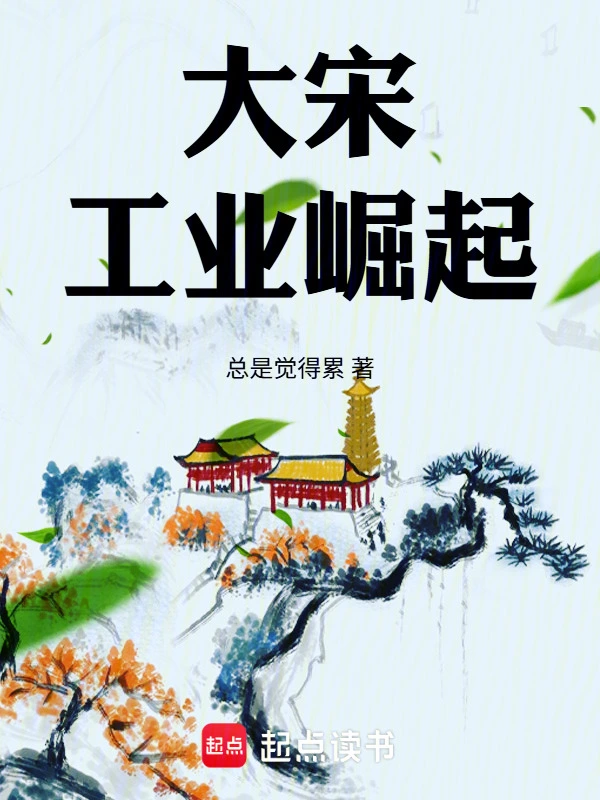
The Rise of Industry in the Song Dynasty
大宋工业崛起
- Status
- Completed
- Length
- 934k Words
- Genre
- Historical
- Audience
- Male
- Subgenre
- Song-Yuan-Ming Dynasties
- Updated
- 22d ago
- Source
- Qidian
Stats
44Monthly votes
1.5kRecommends
2.1kFans
468Chapters
Tags
Synopsis
Reader comments
In booklists 1


Readers also read
 Corpse Disaster 1916
 Chronicles of the Red Mansion
 In the Ming Dynasty, the Days When the Cows and Horses Turned Over
 An Important Town in the Residual Tang Dynasty
 I Am Unparalleled in Troubled Times
 Gongtang
 Traveling Through 1570: the Rise of South America
 Ordinary People: Start from the Yanjiabao Branch
 I Made up Magic and Taught the World-Destroying Witch?
 Becoming an Industrial Godfather from Beiyang
 Late Ming Dynasty: Lion of East Asia
 No One Knows How to Save Daming Better Than Me
 I Open an Underground Hospital in the United States
 Rebirth of the Industry in the 1980S
 Bonanza
The first capitalist in history? Dude, you don't understand history. Capitalists are negative. Their essence is exploitation and monopoly. They compete with the government for food and extract oil from the people. The Ming Dynasty is just a bunch of capitalists. It's exactly what you said. They train a lot of spokesmen, don't pay taxes, and support barbarians. To put it bluntly, you are creating a Shanxi merchant, a southeast. Well, someday barbarians will turn your skull into a drinking vessel.
You cannot become a capitalist by relying on fists, feet, guns, sticks and cold weapons. You can only become a capitalist by relying on steel, machines and muskets. Only this kind of capitalist can have the power to break the feudal production relations.
Don't you think that doing business makes you a capitalist? You have to be able to keep your job and still have status before you can be called a capitalist
I'd rather open a plug-in than play with gunpowder! Since it is a blacksmith shop, you should study more on iron-making and steel-making. When you travel through ancient times, you don't want to rely on advanced knowledge to defeat others. You want to play with others with fists and cold weapons, play with others in intrigues, and use a few weaknesses to defeat the enemy's strengths.
Well written, but has two shortcomings
First, time travel is already a huge advantage, but if it's not enough, add another system; second, Pig's Foot can travel through time and add a system. Pig's Foot can settle down but rely on Pig's Foot's personal force. Are readers reading your history book just to watch you compete with the ancients in brute force? In summary, the author's historical genre is more like martial arts and fantasy. Only in the martial arts fantasy genre will pig's feet's personal force be regarded as the first, or even the only, means for pig's feet to solve the dilemma. Therefore, although the writing and plot are acceptable, the shortcomings are in the overall idea and story logic, and no matter how good the writing is, it cannot make up for it.
Capitalists are never born naturally, not by rewards from emperors, but by defeating feudal lords with iron and blood.
Capitalists are never born naturally, not by rewards from emperors, but by defeating feudal lords with iron and blood. The British Glorious Revolution required the beheading of King Charles and the victory over Cromwell's restoration. France needs to chop off the head of Louis XVI and also needs to defeat so many sieges by the anti-French alliance. Even the United States needed to rely on the Civil War to eliminate the slave-owning forces.
Looking at industry, a lot of words and ink are used on martial arts competitions and the like. It feels a bit like martial arts and martial arts, and is a bit off topic.
You capitalist, please develop some national attributes. Pure capital like squid is disgusting as hell.
This kind of article is actually a guide for ordinary people to travel back in time. Those who traveled back in time and played tricks with the ancients and played ruthlessly with the system were actually using their own shortcomings to compete with the strengths of the ancients. It feels fake to be able to survive for 5 episodes.
The more I watch, the more boring I become. I meet the master repeatedly, and the brothers come to see me when they have something to do -> the protagonist comes up with technology to solve it -> encounters a problem again -> comes up with another technology... The villains in the book and the protagonists are not happy with each other. Is it a script for children to kill each other while drinking wine? ! Abandoned!
Silly hi, Lu Buwei, Shen Wansan...
Forage+, it just lacks a high-level perspective, or the enemy's perspective, resulting in a lack of historical participation, so it doesn't feel very satisfying. The same goes for the latter. Although killing is exciting, it is also because of the lack of the enemy's perspective and the feeling is not enough, otherwise it would definitely be regarded as fairy grass. I hope the author can finish the book🙂
I don't know which chapter I need to read before I can get attached to the capitalist side.
Calling the Song Dynasty a coward is a weakening of the Chinese national culture! !
I read Chapter 266. The book is quite good, but there is a point where the protagonist wants to change history. He can't do it without his own army. Don't always support a water bandit and hide behind to develop technology. It's useless. In the end, it belongs to others. I hope the author can change it later, otherwise I won't be able to read it.
The most commonly used weapons in the Song Dynasty were guns and sticks. Why think about it for yourself,
Author
Will Li Shishi and Zhang Zhenniang please take it away?
Author
Do all the novels you open have multiple female protagonists?
You are not mistaken about all-iron hoes. They are all made of iron. Then there are all-iron hoes. Salt and iron are all government-run and the output is very small. Who has the luxury to make all-iron hoes?
In the future, the author should pay attention to the paradoxes of the alternation of hot and cold weapons.
Now that firearms are on the rise, firearms will be the main force in killing enemies in the future. The more firearms there are, the fewer spearmen and sword and shield men there are to cover them. This also means that the cavalry will be vigorously developed for a long time. And it must be the traditional charging cavalry. And it is not the mounted archer cavalry, nor the musketeer revolving cavalry that emerged in Europe at this time. Rather, it is a pure cavalry charge. Firearms are so efficient in killing people. This forces everyone to choose this way. The best way to deal with cavalry is cavalry. In this era of alternating hot and cold weapons, it is the most difficult era and the most challenging era for generals. The dawn of a new era has emerged. The era of firearms is bound to come. However, the darkness before dawn is the darkest. Polish charging cavalry, Ottoman hot and cold mixed troops, and even Persian armored cavalry can still blast those troops that use pure firearms at this time. Including the servants of the Ming Dynasty, the old camp of the Chuang Army, and the Bagara of the Donglu, most of the firearms troops who can still fight are not recognized by the mother. Before the problems of flint guns and bayonets, fire rate and cost are solved, there will be only matchlock guns in the era of alternation of hot and cold weapons, and the logic of raising troops will be different. The flint gun is equipped with a bayonet and can be used to pull cannon fodder. Disaster victims are perfect manpower. In this era of alternating hot and cold weapons, ordinary people without three to five years of off-the-job training cannot defeat those professional samurai servants. For ordinary generals and officer corps, the command ability, pure flintlock, bayonet, is actually lower than the requirements in the alternating era of hot and cold, and can be copied. Famous generals and geniuses are the same in every era. In the era of alternation between hot and cold, if the dawn never breaks, then, to a certain extent, the correct solution is to use the military household soldiers of Ming Taizu, or even the Eight Banners soldiers of Donglu, or to regress to the Tang Dynasty soldiers. It can even be said that at this time, the small aristocrats who have returned to cold weapons, the off-the-job soldiers who brought their own land and tenants, and the tens of thousands of armed aristocratic soldiers like Mulan will be more capable in field battles than the pure firearms soldiers who are just hobbling. But now that the light before dawn has been seen, the travelers have no choice but to go on. Now, a single pure infantry battalion must coordinate musketeers, spearmen, and heavy infantry. You need to train spearmen, you need to train musketeers, you need to train heavy armored infantry, none of them can be missing. There is only one marching shooting. In order to solve the problems of the size of the matchlock gap, the burning of gunpowder on the soldiers due to open flames, and misplaced shooting during the march, people who died due to gunpowder being ignited by the matchlock during training had to be in their fifties or sixties to figure out the best gap and alternate drum beats. These are just filler lines. What is more needed is an elite field force with cold weapons to protect these premature babies in the new era through the most difficult first years of life. Cavalry is needed. Heavy armored soldiers are needed. Requires martial arts melee combatants. Without these, any radical army reformed into a phalanx system with six rows of deep arquebusiers and a firearm ratio of 70% to 80%... The field battle will be defeated. In fact, if we talk about the unit that most resembles the Agricultural Corps at this time, it is actually the Eastern Tatars. Heavy artillery, heavy armored infantry, heavy armored cavalry... These are all things that only a powerful farming empire can afford, but instead they were created by a group of fishermen and hunters. But the uprising troops of the farming people turned into nomadic regiments. Very black and helpless. Donglu is now attacking cities like Jinan and Kaifeng, and has summarized a complete set of experience in infantry and artillery coordination. After completing preparations such as trenching and blockade, a city like Kaifeng has enough heavy artillery. After the siege, the siege officially begins, and it usually takes three or four days to capture it. The city wall is very thick and cannot be blown down. But why bombard the city wall? If Donglu comes to attack, they will finish digging trenches to blockade them. The first step is to forcibly requisition the people, coats, etc., Weave wicker baskets, fill them with earth, and build forts. The wicker basket is filled with soil and can well buffer the shelling from the opposite side. The second step is to set up artillery positions and select a point on the battlements of the city wall, assuming it to be point B. The city wall cannot be blown open, but the battlements are very thin, and soldiers need the protection of the battlements on the city wall. Donglu will choose to gather heavy artillery, bombard point B, destroy the battlements, forcing the defenders to lose their foothold and disperse to both sides. At this time, select point A fifty feet away to the left, and select point C fifty feet away to the right. Destroy all the battlements from A to C so that the defenders cannot have cover on the city wall. The third step is to assemble heavy artillery and bombard point B. Block A and C. It is not necessary to blast open the city wall, but to break the bricks of the city wall into pieces so that the rammed earth inside breaks up and slides down, forming a sloping earth slope on the city wall instead of a vertical city wall. The artillery provides cover, the musketeers approach and shoot to suppress it, and the heavy armored infantry rushes to capture point B and ascend the city. End. From Songshan to Yangzhou and then to Guangzhou, the routine is almost the same: the artillery bombards the infantry and rushes forward. But now, the invading army is like a nomadic army. It lacks heavy armor, heavy cavalry, and heavy artillery. There is little that can be done against a big city like Kaifeng. In the age of firearms, nomadism could not defeat farming. Take the Battle of Tongguan as an example, which truly determined the fate of surrender and the rise of Tartars. Before the heavy artillery arrived, the Chuang army and Donglu stared at each other's camp, neither of them able to chew it down. After the heavy artillery arrived, the barracks of the intruders could no longer hold up, and a gap was quickly opened. No. 11 Blasted the gap. Under such circumstances, the Shun army was still able to use heavy armor against heavy armor, cavalry against cavalry, and counterattack with 300 heavy cavalry to block the gap. So much so that Nikan, Geng Zhongming, Shang Shan and others had to counteract the attack of the three hundred cavalry. At the same time, the Shunjun infantry can still flank and attack behind to cover the retreat of the main force. In the confrontation with cold weapons and heavy armor, the Chuang army relied on counterattacks to stabilize the situation. The Donglu did not pass the Shun army's camp until the next day. At that time, the main force of the Shun Army had already retreated in an organized manner without any great losses. This also corroborates the performance of the previous battle at Shanhaiguan where Guan Ning's army was basically defeated in one day. But because of this, it left a psychological shadow on Li Zicheng: if he defended the city, he would not be able to defend it under the heavy Tatar artillery. He wanted to fight mobile warfare, but sadly found that even the mobile march, which he was best at, could not outrun the Tatars. The next day Ma Shiyao wanted to learn from Meng Da, and the reason was the same as the reason why he assumed Kaifeng: as soon as the heavy artillery arrived, Tongguan could not hold it at all, and as soon as the field camp outside retreated, Ma Shiyao had no choice but to surrender if he wanted to succeed. Not just the Chuang army, even the Western army, Zhang Xianzhong was shot by an arrow and bled. Before the blood dried up, he commanded the troops to counterattack and defend, but still did not let the Donglu take advantage of the chaos to break into the camp. He did not bleed out until the situation was stabilized and died. The quality of its subordinate troops is very good. The heavy infantry and cavalry of the Chuang army will not be bad. Moreover, there were many generals in the Chuang Army who could command heavy infantry, heavy cavalry and other cold weapons. Li Dingguo was capable of fighting in the Western Army, but he could not defeat He Zhen, the Chuang Army. He Zhen was not the most capable fighter in the Chuang Camp. That's why Zuo Liangyu would chase Zhang Xianzhong and try his best not to fight Li Zicheng. He would run and slip away when he could. The problem is that times have changed. At first glance, it sounds like a scene from a fairy tale. The Nascent Soul's powerful nails and hair fall off into the mortal world and become magical weapons for practitioners. It seems that a 33-fold Kofilin cannon found on a shipwreck in Western Europe has greatly changed the shape of warfare, offensive and defensive models, and city defense systems in East Asia. Actually not. The overall cultivation levels of both sides are similar, but their ideas are different. Actually, this is another [because advanced, therefore backward], which is contrary to the Tao. Because the handmade textile industry is too advanced, the mechanical textile industry lags behind. Because the steam engine is too advanced, the internal combustion engine is lagging behind. Because the internal combustion engine is too advanced, the electric era lags behind. Because the technology for building city walls was too advanced, the ultra-thick model of rammed earth walls was adopted hundreds of years before the bastion era. Therefore, heavy artillery must fall behind. Because it was useless in the early days, it was not the stone masonry wall in Western Europe. As for the Nanjing City Wall built by Emperor Hongwu to a high height, with bricks wrapped in rammed earth, and a layer of rammed earth tens of meters behind, it would be useless if you asked Urban to bomb it until it exploded. If the main threat is nomads, how about building four oxen to pull heavy artillery that can travel ten miles a day to build wool felt tents? Or build a 130-pound Weiyuan cannon that can be carried on horseback for marching? The stone fortress greatly stimulated the development of high-pressure heavy artillery technology. Rammed earth walls and the threat of unarmored nomads will lead the development of firearms in the direction of low-pressure spray guns. High-caliber heavy artillery in front of rammed earth walls and nomads is completely inferior to using small-caliber spray killing mode. It is impossible to focus on this aspect in terms of technology. There may even be another way, which is easier and faster to develop in the early stage. When these two routes intersect at a certain threshold, a gap inevitably appears. Just like at a certain moment, the rolling steam train finally surpassed the carriage that could only flatter before.
I was criticized for using the author's great point of view😥😥Who can help me reply