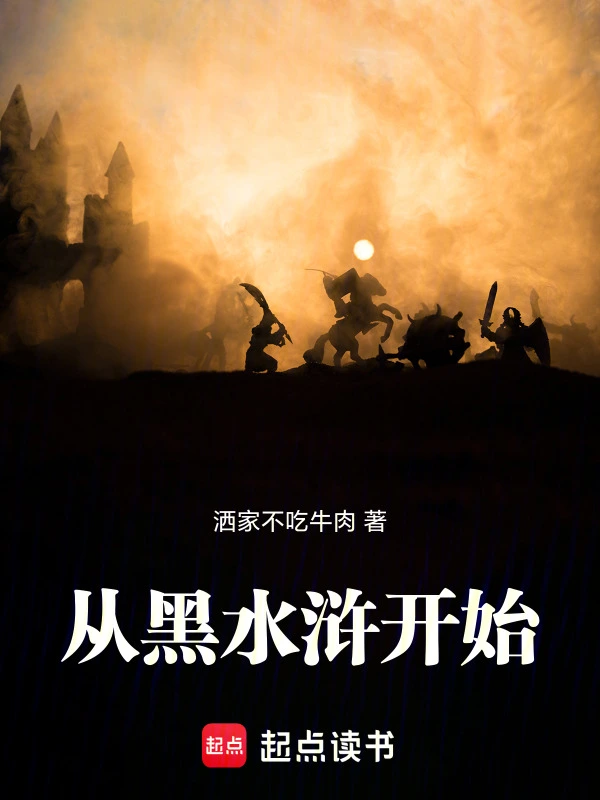
Beginning with Blackwater Margin
从黑水浒开始
- Status
- Completed
- Length
- 1.0M Words
- Genre
- Historical
- Audience
- Male
- Subgenre
- Song-Yuan-Ming Dynasties
- Updated
- 2mo ago
- Source
- Qidian
Stats
0Monthly votes
37.5kRecommends
90.5kFans
388Chapters
Tags
Synopsis
Reader comments
In booklists 1

Readers also read
 Talker in the Song Dynasty
 1914 Begins with the Rejection of the Schlieffen Plan
 Please Call Me Your Majesty the Tsar
 In the Red Mansion: Escort Daiyu to Beijing at the Beginning
 Never Walk Alone!
 The Most Ruthless Person in Water Margin
 Gao Wu's Water Margin
 Daming: Have I Become Wanli's Portable Grandfather?
 I Am Drawing a Hot-Blooded Episode in the Zhiyu Episode!
 The Republic of China: Entering Taoism from Shen Da
 Conferring Gods: Starting from the Princes of the Princes
 Journey to the West: Became the Chief of Fangcun Mountain
 Journey to the West: Three Burials of the Sui Dynasty
 Hades!
In fact, the writing behind Water Margin is quite good! You can write about fighting for global hegemony later! It's really not worth it to open a new world and just become an eunuch.
The ancient Song Dynasty's theory of bright strength and dark strength compared to the bragging of the Republic of China is also awesome.
Chapter 3 is the logic that normal people can have? A slap in the face for the sake of a slap in the face? Liu Gao was afraid of thieves, so how could he have the courage to question the male protagonist who had eliminated the thieves?
It's so ordinary, those conflicts are so disgustingly written. If you don't know how to write about conflict, don't write about it. If you write about conflict, then oh, the opposite person is Lu Zhishen, and the opposite person is Wu Song, and you just say in a lowly manner that there is a misunderstanding, what happened? What happened to Lu Zhishen? What happened to Wu Song? Why not kill him?
Is the author from Black Water Margin? Just write it out and take it for granted.
No matter which version of Water Margin, Hu Sanniang must be dealt with, why can't we change the routine?
It feels like it's not interesting anymore. If you encounter Tiangang Earthly Evil, you can kill them. You can accept them. There is no need to recruit them deliberately. Just follow the trend. If you only need to recruit a few people to conquer the world, then how low the gold content of the world will be.
What a man, what a dung fork dipped in dung, Lu Bu is reincarnated! !
I laughed when I saw that Zhujiazhuang had trained tens of thousands of militiamen! What the hell is this novel about? Your village has tens of thousands of households? Do you know how to send troops? No matter how militarily aggressive one is, one male laborer must remain in each household, let alone a militia! The government doesn't even dare to conscript all the men! If your village needs 10,000 militiamen, it may not require 20,000 or 30,000 households... This is already a city, why don't you give it back to the village? ? ? No brains
The protagonist's golden finger and strength are obvious. He can rob, rely on himself, or give favors in exchange. He has to use strategies, get to know others, and rely on cleverness, coincidence, and worldly connections to get what he wants. He procrastinates. Doesn't this give you the golden finger and strength in vain?
Martial arts
I often see stories about Ultraman practicing martial arts, and I just can't figure it out. A civilization that basically achieves immortality still learns the methods of a civilization that worries about food and drink. 😜
It's time for the author to give the protagonist a nickname. It's so uncomfortable to be in the world without a nickname.
It's almost 200 chapters. Except for a few people, they are all the original team of Liangshan. Why don't you go to find the powerful people of Tian Hu and Wang Qing, and are you going to rely on the people of Liangshan?
I haven't read it yet, but what's going on in this comment section? If you don't discuss the plot, scroll down. A few people say that Pan Jinlian White Lotus is even better than modern women. Is there such a difference? Maybe Pan Jinlian was the epitome of feudal oppression of women in the early stage. , But the poisoning of Wuhan University in the later period cannot be washed away (of course, Pan Jinlian in real history was a good wife, I am talking about Water Margin). This kind of whitewashing is meaningless, right? Two people committed a crime, one is serious and the other is minor. In comparison, it is equivalent to not committing a crime?
God is hopeful
Among all the Water Margin novels I have read, it is the most enjoyable to watch.
I saw what a buddy said, don't put too much value in it and focus on the story itself. If the protagonist wants to change the world, just do it. Don't make a long speech with emotion.
King Dung Cha, Wang Yu, I'm sure
The protagonist is in the rhythm of King Shitcha. He is a pirate king and a bandit king. He is really not as fun as King Shitcha.
What a motherfucker, what kind of overt and dark energy did the Song Dynasty do, even if it was Qi and blood?
I personally don't like Lin Chong
When Lin Chong divorced his wife, he actually gave her away.
It's so petty. It's been a hundred or two hundred chapters and it hasn't really conquered the territory yet. Various small teams are running around.
Why don't you fuck 108 cute girly girls?
I hope the heroines include Liu Huiniang, Chen Liqing and Hu Sanniang
It's a bit of a trap that only the protagonist can plunder the talents if he kills them, and you can't get the kill every time. It can be changed to make it so that no matter who kills, the protagonist can plunder the talents. Otherwise, wouldn't it be a loss if you don't get all the complete sets? Then keep the good ones and kill the bad ones with looting talents. You can also change the previous ones.
What can eight hundred people do?
The "Eight Hundred" Elites in the Qin, Han and Three Kingdoms Periods Huo Qubing's Eight Hundred Cavalry Enfeoffed Marquis: In 123 BC, the 18-year-old Huo Qubing, as the "Jiao Yao Lieutenant", led eight hundred elite cavalry to break away from the main force of the Han army and raid hundreds of miles deep into the hinterland of the Xiongnu. He beheaded and captured more than 2,000 people, including the Xiongnu Prime Minister and Shan Yu's uncle. This battle not only earned him the title of "Champion Marquis", but also created a precedent for the Central Plains Dynasty's long-range cavalry attack tactics, which greatly shocked the Huns. Xiang Yu's 800 cavalry broke through: After the Battle of Gaixia, Xiang Yu was trapped in a tight siege, and only led more than 800 cavalry under his command to successfully break out of the siege at night, showing his amazing fighting power in a desperate situation. Although he failed to reverse the defeat in the end, this breakout has become the final touch of his heroic legend. Qu Yi's eight hundred "first climbs" defeated the White Horse: In the Battle of Jieqiao in the late Eastern Han Dynasty, Yuan Shao's general Qu Yi led eight hundred "first climbs" dead soldiers, supplemented by thousands of powerful crossbows, and used ambush tactics to defeat Gongsun Zan's prestigious "White Horse Yi Cong" cavalry, establishing Yuan Shao's dominant position in Hebei. Zhang Liao's eight hundred warriors shocked Xiaoyaojin: In the Battle of Hefei in 215 AD, Wei general Zhang Liao recruited eight hundred warriors who dared to die at night, and raided Sun Quan's tenth army in the early morning of the next day. The central army of tens of thousands of troops was once killed under Sun Quan's command, causing the Wu army to lose its strength, which laid the foundation for the subsequent repulse of Sun Quan with 7,000 defenders, leaving behind the allusion of "Zhang Liao stopped crying". The "Eight Hundred" changes from the Northern and Southern Dynasties to the Ming Dynasty Hou Jing's eight hundred remnant troops rebelled against Nanliang: In 548 AD, after the rebel general Hou Jing was defeated in the Northern Dynasties, he only led 800 remnant troops to flee to Nanliang. He took advantage of the Liang Dynasty's internal conflicts and lax border defenses to outwit Shouyang, an important town in Huainan. Using this as a base, he finally launched the "Hou Jing Rebellion", which seriously damaged the vitality of the Liang Dynasty. It can be called an extreme case of using a small to win a big and leveraging the foundation of the empire. Li Shimin's Eight Hundred Mansion Soldiers Defeat Xuanwumen: In 626 AD, during the Xuanwumen Incident, King Qin Li Shimin relied on more than 800 carefully selected soldiers from the Prince's Mansion of Qin to ambush and defeat the guards of Crown Prince Li Jiancheng and King Qi Li Yuanji, successfully seizing the throne and starting the "Reign of Zhenguan". Yue Yun defeated the Jin army with eight hundred troops on his back: In the Battle of Yingchang in 1140 AD, Yue Fei's son Yue Yun led eight hundred elite cavalrymen "Bei Wei Army", and repeatedly charged and killed Jin Wushu's main cavalry, and cooperated with the defenders to defeat the Jin army. This was a famous battle in the history of the Southern Song Dynasty's fight against the Jin Dynasty in which a small number defeated a large number. Zhu Di's 800 close soldiers launched the Jingnan campaign: In 1399 AD, when King Zhu Di of Yan raised troops to "Jingnan" in Peiping, the initial core armed force was only 800 close soldiers. Based on this, he gradually developed and expanded through surprise attacks and control of Beiping City. It took him four years to finally seize the throne and become the founder of Ming Dynasty. The deeds of other 800 people More than 800 people in Daze Township at the end of Qin Dynasty: Under the leadership of Chen Sheng and Wu Guang, they held the Daze Township Uprising, igniting the raging fire that overthrew the violent Qin Dynasty, and helped the birth of the glorious civilization of the Han Dynasty for four hundred years. 800 people in Tiance Mansion in the early Tang Dynasty: Under the leadership of Li Shimin, the Xuanwumen Revolution was launched. After King Qin came to power, he worked hard to govern, creating an unprecedented governance in Chinese history, creating a Zhenguan rule that will forever shine in the annals of history, and creating a soul-stirring Zhenguan song. 800 people in the Yan Palace in the early Ming Dynasty: Under the leadership of Zhu Di and Yao Guangxiao, Fengtian Jingnan helped King Yan become the only emperor in Chinese history to have a vassal ascend the throne. After Zhu Di came to power, he made seven voyages to the West, five expeditions to Mobei, moved the capital to Beijing to guard the country, built the Forbidden City, built the Yongle Grand Ceremony, and created the Yongle era! At that time, all the nations came to court, and the country was in great prosperity. It is true that the Yongding Gate, the Forbidden City, and the Yongle Bell will ring through the ages. Two 800 people in Jinggangshan: 800 people from Chairman Mao's Autumn Harvest Uprising and 800 people from Commander-in-Chief Zhu's Nanchang Uprising went to Jinggangshan together, gathered and developed into a powerful Red Army, and eventually established New China and ushered in today's prosperous age. Guo Jingyun's Wuga River Blockade (1940): He led more than 800 people to defend the Wuga River Bridge, repulsed a Japanese regiment (about 3,000 people), and successfully covered Wuyuan's siege. Baosenguo Riverside Ambush (1942): Led 800 Eighth Route Army troops to annihilate an entire puppet army regiment and defeated its group headquarters. The Battle of Zhu Di's Jingnan (1399): There were only 800 soldiers when he raised the army, and he finally seized the throne, but this was a long-term process, not a single battle. Huo Qubing defeated the Xiongnu with 800 hussars: In 123 BC, 17-year-old Huo Qubing led 800 elite cavalry deep into the hinterland of the Huns, killed more than 2,000 people, and captured Shanyu's uncle. He won the first battle and was awarded the title of "Champion Marquis". Zhang Liao's 800 dead men shocked Xiaoyaojin: In 215 AD, during the battle of Xiaoyaojin in Hefei, Zhang Liao led 800 warriors to raid Sun Quan's army in the early morning and charged directly under Sun Quan's command, which demoralized the Soochow army. Qu Yi (Ju Yi) ascended 800 first to defeat Gongsun Zan: In the Battle of Jieqiao in 191 AD, Qu Yi led 800 elite troops to ascend first, supplemented by powerful crossbows, and defeated Gongsun Zan's cavalry, helping Yuan Shao establish hegemony in the north. Xie Jinyuan's "Eight Hundred Warriors" Guarded the Sihang Warehouse: At the end of the Songhu Battle in 1937, Xie Jinyuan led more than 400 people (known to the outside world as the Eight Hundred Warriors) to defend the Sihang Warehouse in Shanghai for four days and nights to revive anti-Japanese morale and was hailed as a "national revolutionary model". Encyclopedia Zhu Di launched the "Battle of Jingnan" with eight hundred soldiers: In the early Ming Dynasty, King Zhu Di of Yan rose up with eight hundred soldiers and launched the "Battle of Jingnan". After four years of war, he finally seized the throne. Li Shimin's eight hundred soldiers launched the Xuanwu Gate Incident: In 626 AD, Li Shimin led eight hundred soldiers to set up an ambush at Xuanwu Gate, killed Li Jiancheng and Li Yuanji, quickly took control of Chang'an, and laid the foundation for his succession to the throne. Yue Yun led the Wei army with 800 soldiers on his back to defeat the Jin army's "Iron Buddha": In the Battle of Licheng in the Southern Song Dynasty, Yue Yun led the 800 soldiers on his back to charge and defeated Jin Wushu's heavy cavalry "Iron Buddha". Wang Jian's eight hundred warriors defended Diaoyu City: During the defense battle of Diaoyu City in the Southern Song Dynasty, Wang Jian led eight hundred warriors to defend the Diaoyu City, resisting Meng Gehan's hundreds of thousands of troops and defeating the Mongolian cavalry. Su Dingfang's 800 cavalry attacked the Turkic tent: During the Tang Dynasty's campaign against the Western Turks, Su Dingfang took advantage of the morning fog and led 800 cavalry to raid the Gili Khan's tent, shaking the foundation of the Turks. Li Sheng led 800 elite troops to quell the "Zhu Si Rebellion": When the Zhu Si Rebellion was quelled in the middle of the Tang Dynasty, Li Sheng led 800 elite troops as the vanguard to break through the rebel defense lines and help the Tang army regain Chang'an. In addition, there are other examples in history: Hou Jing triggered the "Hou Jing Rebellion" with 800 remaining soldiers, Xiang Yu Gaixia led 800 cavalry when he broke through, and Zhang Xun's 800 elite troops guarded the outer city in the Battle of Suiyang.
The early stage is okay, but in the mid stage, it's boring to get old friends, and the details in the later stage are lacking. Dry food
🍅There is a similar book, you can read it
I want to see the protagonist fight the Holy Grail War when his legend is high
Let me go, this is also old, the navigation is all old goods
Who knows, my eyes went dark when I saw the title of this book, and I clicked on it with a taste of salt 👏👏