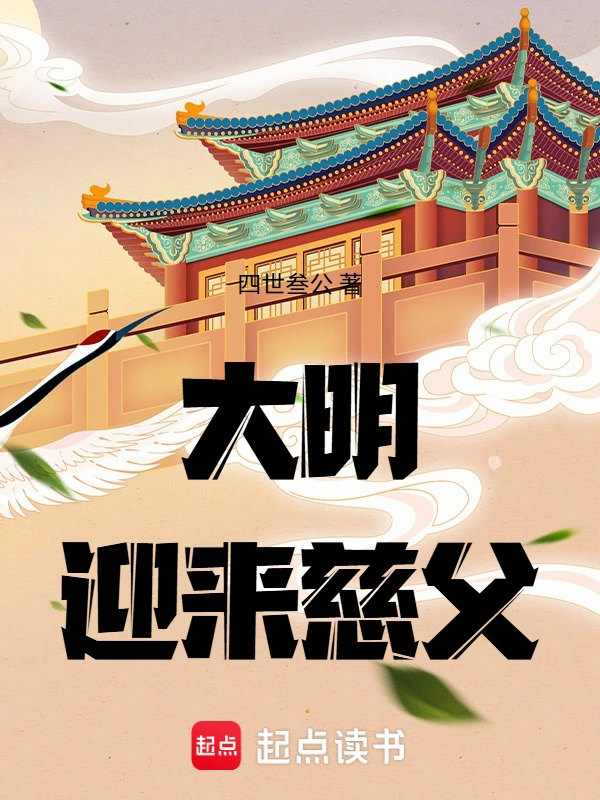
Ming Dynasty Welcomes Loving Father
大明迎来慈父
- Status
- Ongoing
- Length
- 110k Words
- Genre
- Historical
- Audience
- Male
- Subgenre
- Song-Yuan-Ming Dynasties
- Updated
- 12mo ago
- Source
- Qidian
Stats
0Monthly votes
639Recommends
4Fans
45Chapters
Tags
Synopsis
Reader comments
Readers also read
 Red Mansion: Start Escaping and Farming from the Equipment Bar
 Northern Qi, Sage Khan
 After Lying in Bed for Three Years, He Was Forced to Help the Han Dynasty
 Fu Ming 1627
 Datang: They Force Me to Be Emperor, Right?
 Daming: Emperor Chenghua Is Here to Ascend the Throne First!
 Chongzhen: I Will Operate in Reverse and Revitalize the Ming Dynasty
 Northern Song Dynasty: Spoiler of the Future, Zhao Kuangyin Collapsed
 Daming: I, Yan Maoqing, Really Smoked
 What's Wrong with Me, Zhu Changluo, Being a Bit Shabby?
 At the Beginning, Please Ask Chongzhen to Abdicate!
 Daming: I, Zhengde, Am the Taoist Emperor!
 I Am Not a Phase, but a Photo
Can the Ming God of War be the protagonist?
Is it really a Walaru bandit? Maybe not. It's very possible that the border troops set up an ambush. After reading the first two chapters, I feel that so many troops were really wiped out by Wala. How is that possible?
The writing is so bad, the front is forced to be sensational. The author is moved by himself, so he thinks that the soldiers will be moved? Can you fight?
The author writes a book promotion post or a book recommendation post to promote it.
It's hard to admit that the protagonist is not Nurgle
It feels like the characters are written based on historical stereotypes. Wang Zhen is a capable and ambitious eunuch who can kill him anytime he wants, but at this time, how can he kill someone who is definitely his confidant to establish his authority? Emperor Jing of the Han Dynasty killed Chao Cuo because he was rebelling in the name of Chao Cuo. What you wrote seems to be that all the noble officials and civil servants are good people, and the eunuchs are bad people. If I kill this bad person, should you good people stand with me? You, a time-traveler, in this historical event where all records are conflicting, are not familiar with everyone, dare not trust them, and kill people who are at least absolutely loyal to you?
Strengthen authority, rule and clan arrangements
Only reducing the benefits of clans has limited effect. If there are more clans in the future, they can arrange to form the "Zhu Family Army" (the lower-level clans in the fifth server have the least risk, and let the clans pay blood tax to reduce some of the population burden). Zhu Yuanzhang had a similar idea. As a result, because of Zhu Di and Zhu Yunwen, the Ming clan cannot be used later. It is a pity that these are all human resources! (Big In Volume 17 of the Ming Huidian, officials and gentry paid taxes as one, and even the vassal kings had to pay taxes. It was illegal to donate and annex land. Once someone reported that the whole family was exiled, the land was distributed to the surrounding people. However, later supervision and restrictions were relaxed, and it was useless to reduce the treatment of the clan in history. The Ming Dynasty finally died of poverty.) The clan could take the imperial examination, which was restored in the Wanli Dynasty. 🙂🙂🙂🙂🙂 Remember to entrust clan members overseas, and the Weisuo system is very suitable for colonization or in border areas. Even if you don't go to war and recruit workers in factories🏭, you can set up the Internal Revenue Service and let the lower-level clans serve as violent tax collection teams. You can also set up a royal academy for the clans to study astronomy, geography, mathematics, medicine, physics, chemistry, mechanics, art... . Contribute to human civilization 😏 In the future, if there are more clans, you can also find these distant relatives to perform corvee service. The most important thing is that you don't have to give 💰💰💰 Let the clan earn money and respect the emperor 😎 It's rare to be an emperor in time travel. If you can't make the capitalists jealous, your job as emperor will be in vain. The so-called "civilian group" is essentially a group of representatives of interests from different regions competing for power in the court. They are not monolithic. In the middle and later stages, party strife will only occur when the emperor's authority and control declines. If these groups of scholar-bureaucrats are divided, they can use the share dividends of some factories and chambers of commerce to win over them. "We must make many friends and few enemies." It can be improved. The status of the three ancestor gods Xuanyuan Huangdi, Fuxi, and Nuwa enhances the legitimacy of the protagonist's authority (the three ancestors are the protagonist's predecessors😏) and increases the cohesion and assimilation ability, which provides justice and legitimacy for the complete incorporation and assimilation of surrounding ethnic minorities. On the high ground of faith, we not only need local Taoism and various philosophical sects, but also have ancestral beliefs as firewalls 😎 and they will not be as easy to get carried away as religions 🔥 In China, ancestral beliefs are very important. It is related to the legitimacy of the court, the authority of elders and parents, and the consensus of the people 😊 Even if the feudal dynasty, Confucianism, and religion are gone in the future, the people of China can be reunited.
The subject matter is okay, but the forced sensationalism in the first few chapters hurts the perception.
Reading this kind of book is an insult to people.
The details written are very good. It's not like a novel that is either black or white. No brains.
We should improve and restore the Ming Dynasty's health schools and other systems, so that they are not as bad as they were during the Chongzhen period. Weixue (Weixue School) in the Ming Dynasty was the school set up by the guards. It was a public school opened by Zhu Yuanzhang for the children of military households. It was found in every guard. Moreover, the proportion of military households passing the Jinshi examination is second only to civilian households. In the 13th year of Yongle's reign, the proportion of children from military households in the imperial examination reached 15.4%. After Jingtai, it remained around 30% for a long time, and even reached more than 40%. The establishment of martial arts has been since the Hongwu period when Daning and other Wei Confucian schools were established to teach the children of military attachés. In the orthodox tradition, Zhu Yong, the Duke of Cheng, selected fifty-one brave military commanders and other officers, and one hundred junior officers skilled in riding and shooting, and ordered the two capitals to establish martial arts schools to train them. Those whose children are over ten years old and who should be attacked by the Ming Dusi or Wei Suo, will be sent to martial arts by the academic officials. Those who have no martial arts will be sent to Wei Xue or nearby Confucianism. In Chenghua, the imperial department took the year-end examination to enroll martial arts students. Those who have been unable to study for more than ten years will be sent to the camp for training. During the Hongzhi period, Ma Wen, the minister of the Ministry of War, was promoted to Yan, and the "Seven Books of Martial Arts" were published to disperse the martial arts and Yingshe people in the two capitals. During the Jiajing period, the martial arts school in the east of the capital was moved to the abandoned temple in the west corner of the imperial city, so that the children of military attachés and newcomers to the lord could study there and be taught by important civil and military ministers. Health education is not limited to military attachés, military households in the health institute can also attend school. First of all, a military household is usually a large family, because the Ming Dynasty law prohibits military households from dividing their families. As long as one male in a military household can serve as a soldier, the rest of the males can make a living on their own, and it is not a problem to go to school. "Study on Military Households in the Ming Dynasty Guards" written by Zhang Jinkui, it clearly stated that the political status of military households in the Ming Dynasty was higher than that of civilian households, and that after the mid-Ming Dynasty, military households could change their registration, sell their own land, and gain free time by paying taxes and grains. At the end of the book, the essential difference between military households in the Ming Dynasty and those in the Wei and Jin Dynasties was particularly emphasized. Military households in the Ming Dynasty had no personal dependence.