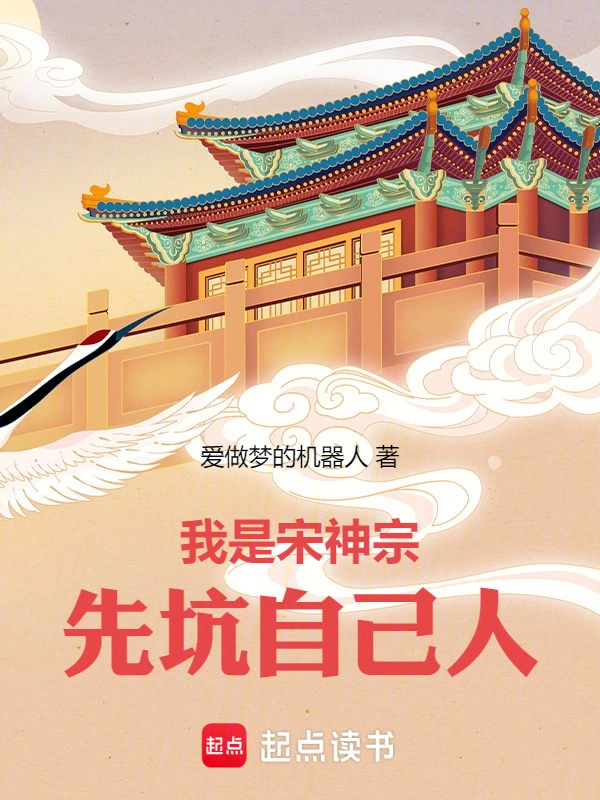
I Am Song Shenzong, I Will Trick My Own People First
我是宋神宗,先坑自己人
- Status
- Ongoing
- Length
- 137k Words
- Genre
- Historical
- Audience
- Male
- Subgenre
- Song-Yuan-Ming Dynasties
- Updated
- 1y ago
- Source
- Qidian
Stats
0Monthly votes
1.7kRecommends
19Fans
63Chapters
Tags
Synopsis
Reader comments
Readers also read
 Red Mansion: Start Escaping and Farming from the Equipment Bar
 After Lying in Bed for Three Years, He Was Forced to Help the Han Dynasty
 Northern Qi, Sage Khan
 Fu Ming 1627
 If You Are Already an Adventurer, Who Should Work Hard on Your Own?
 What's Wrong with Me, Zhu Changluo, Being a Bit Shabby?
 Daming: Emperor Chenghua Is Here to Ascend the Throne First!
 The Artist Begins in Prison
 Traveling at the Same Time: Great Love to the Heavens
 Damn It, I Will Become the Ling Emperor of the Han Dynasty
 Why Were the Civil Servants in the Northern Song Dynasty so Bad?
 I Am Song Shizu
 The Great Song Dynasty
There is no difference between reform and dreaming in Daegu
You don't want to learn from Ming Shenzong, but you want to learn from Ming Shizong.
Wang Anshi's reform was too difficult and was destined to fail in the Song Dynasty.
The original intention of Wang Anshi's reform was correct, but many of his legal settings were problematic, his personnel were improperly employed, and he was full of mistakes in his pursuit of quick success. Therefore, the author should check the information and not accept everything. Take Qingmiao Lending, for example. Nowadays, social information is so advanced that it is impossible to handle a loan company, let alone ancient society. So check the information, don't be too lazy
During the Northern Expedition, Yue Fei distributed part of the land he acquired to his soldiers, but not all. After Yue Fei recovered his lost land, he implemented measures similar to the "land equalization system" and distributed the recovered land and the discovered hidden fields to his soldiers, landless farmers and refugees. For example, after the recovery of Xiangyang, Yue Fei allocated local government land to the military and civilians for farming. This approach has multiple meanings. It not only gathers the refugees, consolidates the newly recovered lost territory, but also enhances the combat effectiveness of the Yue family army. Those who were allocated land were eager to defend the fruits of victory and joined the Yue Family Army one after another, which made the Yue Family Army have sufficient manpower and increased combat effectiveness. However, Yue Fei will also use some land for farming. For example, after the Yuejia Army occupied the six counties of Xiangyang, they followed Cao Cao's example in setting up military and civilian villages, and distributed the land that had lost its owners during the war to soldiers and refugees, allowing them to cultivate it and collect land rent. The Yuejia Army achieved a high self-sufficiency rate in food through farming. For example, in the 11th year of Shaoxing (1141), its farming income could provide 80% of its own military grain.
Although Wang Anshi has a high moral level, his ability is too poor and he has no ability to unite the superiors and subordinates at all. He is surrounded by some lucky villains. His political level is not as good as that of Sima Guang, and he is far inferior to capable ministers like Fan Zhongyan.
All dynasties spent money to support idle people, but only the Song Dynasty spent money to support civilians (Xiang army) 🤭
There are obvious differences between the land systems of the Song Dynasty and the Tang Dynasty in terms of policy core and land distribution methods. The specific differences are as follows: Core of land policy - Tang Dynasty: The land equalization system was implemented. The core was that the state distributed the land it controlled to farmers based on population and restricted land sales to ensure the source of national taxes and corvee labor. -Song Dynasty: Implementing the policy of "no land establishment, no suppression of annexation", the state basically gave up interference in land distribution and allowed free land sales and annexation. Land Ownership - Tang Dynasty: Land is mainly divided into state ownership and small land ownership by farmers. The state controls a large amount of public land for equalization. Farmers have limited land use rights after receiving the land. The sale and purchase must be approved by the government. -Song Dynasty: Land private ownership became mainstream, the proportion of state-owned land dropped significantly, landlords and farmers had complete ownership and disposal rights over land, and land transactions were frequent. Land annexation - Tang Dynasty: In the early stage, the land equalization system inhibited land annexation. However, in the later period, with the growth of population, the relaxation of restrictions on land sales and the expansion of the power of the bureaucratic aristocracy, land annexation gradually intensified and the equalization system collapsed. -Song Dynasty: Due to policies that did not inhibit annexation, the phenomenon of land annexation was extremely serious. A large amount of land was concentrated in the hands of landlords, and the number of self-cultivated farmers decreased, forming a situation where "the rich have a field of hope, and the poor have no place to stand." Impact on society - Tang Dynasty: The equal land system promoted agricultural production and social stability in the early stage, and ensured national fiscal revenue. However, in the later period, land annexation led to an increase in refugees and intensified social conflicts, which became one of the reasons for the decline of the Tang Dynasty. -Song Dynasty: The free sale and purchase of land promoted the market-oriented allocation of land resources, promoted the development of tenancy relationships, and improved agricultural production efficiency. However, it also intensified the polarization between rich and poor and caused some social problems.
Book friends have no idea why it is said that reform is completely impossible in Datang. The most important thing is that this dynasty is born without bones, you know? Your emperors are all weaklings, weak and incompetent. No matter how powerful the generals are, what about the good ministers? Didn't the Song Dynasty have any strong generals? Are there no capable people in the Song Dynasty? Why can't I get up? This is weakness in the bones. If we want to reform in the Song Dynasty, we must kill all the Zhao family! It's ridiculous to say that the successor kings of so many dynasties were raised in the deep palace compound. No matter how hard they raised one or two talented ones, they only had big cowards, and all they raised were soft bones.
Zizhi Tongjian is a novel.
When I saw the protagonist looking for a businessman, I knew what level the author was.
In ancient times, wealth was either concentrated at the top or at the bottom. The emperor at the top took more, while the emperor at the bottom took less. This is because the wealth of the ancient dynasties was basically stable in one place. When the materials we created did not increase significantly, why did we spend so much money? Will it increase inflation? Even if the protagonist earns 100 million cans of money every day, the people at the bottom of the Song Dynasty have not grown more food, so is the money still valuable?
You said this is the tree that restores sight. Isn't that redundant? Isn't this name enough to pay? The name you understand is different from the name Sima Kong understands. That name is enough to pay, so what more should I pay? Pay more. That pear tree dog really can't survive.
Ahhhh! It's all in classical Chinese, so tiring to read!
This classical Chinese article makes my head hurt when I read it
What is the situation in the Song Dynasty?
How is the Song Dynasty? I think we need to talk about it carefully. Who are the officials? What can these officials do? What is the difference between an executive and an official? What are the differences between their interests? What conflicts did people from different places in the Song Dynasty have?
For those who are too good at reading, the classical Chinese is difficult to understand.