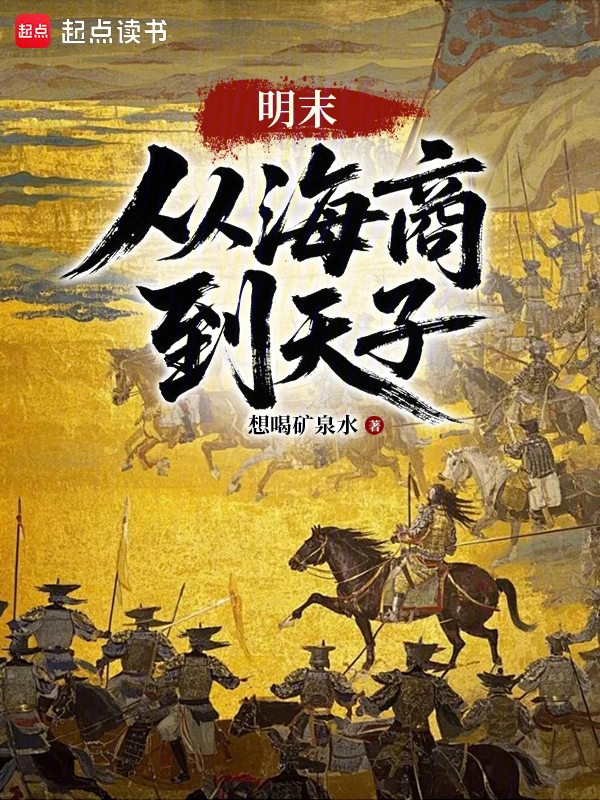
Late Ming Dynasty: from Maritime Merchant to Emperor
明末:从海商到天子
- Status
- Completed
- Length
- 302k Words
- Genre
- Historical
- Audience
- Male
- Subgenre
- Song-Yuan-Ming Dynasties
- Updated
- 1y ago
- Source
- Qidian
Stats
0Monthly votes
1.4kRecommends
40Fans
138Chapters
Tags
Synopsis
Reader comments
Readers also read
 In the Red Mansion: Escort Daiyu to Beijing at the Beginning
 Talker in the Song Dynasty
 1914 Begins with the Rejection of the Schlieffen Plan
 Please Call Me Your Majesty the Tsar
 Never Walk Alone!
 I Am a Great Power
 Traveling Through 1570: the Rise of South America
 Daming: Have I Become Wanli's Portable Grandfather?
 I Am Drawing a Hot-Blooded Episode in the Zhiyu Episode!
 The Wind Rises 1898: Becoming a Warlord from Nanyang
 Becoming an Industrial Godfather from Beiyang
 1912 Starting from Southeast Asia
A businessman cannot be an emperor.
The thoughts of a businessman are different from the characteristics of an emperor. Businessmen were even prohibited from serving as officials in all dynasties. It is because of the thinking of businessmen that it is a disaster for officials and governments, but for ordinary people. When a businessman becomes an official, he is a man who knocks his bones and sucks out his marrow, but politics pays attention to balance. Make do with stability. The end of a dynasty. It's because there are too many people in power. Reduced to become a businessman.
It's so boring. I don't know how it's written. Does anyone read it?
Maritime merchants in the late Ming Dynasty were all scum, traitors, pirates, Japanese pirates and Donglin lackeys.
Maritime merchants only go out for a few months, so how can they think about competing for world supremacy? These are two lines.
There is a reason for poor performance. In 2025, there will still be no market for Western-centric thinking. Productivity determines production relations. Without the thrill of British local white coal, it will be difficult to achieve major productivity improvements.
If you do maritime business in the late Ming Dynasty, you can't avoid Zheng Zhilong. The author should do some research. You can consider Jeju Island as a base in the north, which is outside Zheng Zhilong's sphere of influence.
Rebellion is not a story that is written in a cool way and lays out dozens of chapters of logic. Damn it, can it be popular?
When the two chiefs of Kang and Qian were in power, they repeatedly emphasized that riding and archery was the foundation of Manchuria, because Manchuria really relied on riding and archery to usurp the sun and the moon. Contrary to common understanding, Manchurian mounted archery can be combined or divided. To combine, one can shoot while riding a horse, and to separate, one can dismount from the horse and shoot while standing. In many cases, infantry and cavalry are Manchuria's biggest killers. When thrown collectively, the effective killing distance exceeds 100 meters, which is farther than the Ming army's muskets. The basic equipment of the Manchurian cavalry for expeditions is: a war horse, a riding horse, a pack horse, an aha, a riding bow, a foot bow, a set of light armor, and a set of heavy armor. Such well-equipped cavalry, even if there are only 10,000, can be invincible on the plains. The southern infantry has defeated the northern cavalry on the North China Plain, and there is no precedent for success. Therefore, it is logically impossible for the protagonist to defeat the Manchus. Since the protagonist's basic base is maritime business, why not make use of his strengths and avoid his weaknesses, go south to Australia, and rebuild China.
The pacing at the beginning was too slow. I only entered the sea in Chapter 16, so I almost gave up. However, after entering the main plot, the sense of anticipation came. So far, it seems that it is following the route of donating officials, farming and training, and the writing is relatively detailed and realistic.
There are systems and plug-ins, so a lot of materials and money can be seized by killing just one bandit. The newly recruited 500 recruits have such strong combat effectiveness after only one month of training. They did not panic at all when they faced the fierce bandits and saw blood on the battlefield for the first time. The newly recruited 500 recruits do not participate in the training themselves, do not communicate with the soldiers, eat, live and train together, but train by others. Delegate others to do everything. Being the boss behind the scenes, he just regards these new recruits as an asset for investment. It seems like this is going to be a Machiavellian route.
Why not just choose the Zheng family to start?
This novel is so well written, the author's mineral water is greatly encouraged. I also recommend a novel to everyone, "Ansai Military Household at the End of the Ming Dynasty". Friends who are short of books can take a look. The author is also writing it very carefully.
Check in!
The theme of maritime trade in the late Ming Dynasty is good, I hope this book will be successful!
Take some territory in Nanyang, Taiwan, and establish yourself as king, rebelling against Ming Dynasty in advance. Don't just wait for the Tatars to invade and destroy the world. Dai Ming should not die at the hands of the Tatars
The overall writing is good, the plot is novel and there are no clichés. Give Zhuji enough time to understand the family business, and then modify the family system under his own will, and take off step by step. I like it very much as a bookworm of twenty years
The author is great
Develop quickly:::: Don't have to do everything yourself:::: Start training talents::::: The fleet is too small and even hundreds of thousands of silver a year is not enough to support your subordinates
I've seen Chapter 12. The fleet should not implement the top body stock, but should use the Tang Army's three-horse distribution system.
Author
Are you writing about maritime business? 4 Ships in half a day? There are not dozens or hundreds of ships 🚢What kind of maritime business do you do?::::::::: The protagonist is a bit like a company boss who goes to a small factory to make screws.