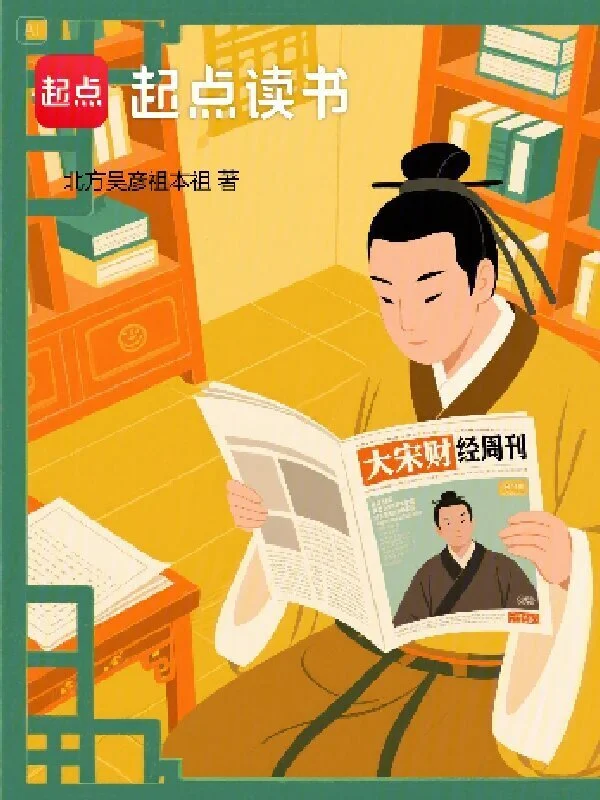
Dasong Financial Weekly
大宋财经周刊
- Status
- Ongoing
- Length
- 1.4M Words
- Genre
- Historical
- Audience
- Male
- Subgenre
- Song-Yuan-Ming Dynasties
- Updated
- 1mo ago
- Source
- Qidian
Stats
4Monthly votes
16.1kRecommends
41.1kFans
596Chapters
Tags
Synopsis
Reader comments
In booklists 3
Endless Aftertaste (*˘˘*). .:*♡
Books with comfortable writing It doesn't mean that a book that is a big hit can enter my mouth. Taste is tricky Don't recommend books to me, dear friends, I only recommend books based on fate Book title, introduction, three golden chapters
67Books33Follows1yUpdated
Not a Popular but Very Good Book
Not popular, but each has its own characteristics, worth a look☺️
39Books32Follows1yUpdated
Fat Masterpiece
"Myth Forbidden Zone" "How to Get Away with Murder" "Mecha Infantry" "Online Game: The Undefeated Sword God"
12Books2Follows7moUpdated
Readers also read
 After Lying in Bed for Three Years, He Was Forced to Help the Han Dynasty
 Gou Served as Sima Under Dong Zhuo
 Red Mansion: Start Escaping and Farming from the Equipment Bar
 Northern Qi, Sage Khan
 Siheyuan: Start by Picking up Attributes
 Tianqi: My Teacher Is a Mechanical Pioneer
 Let the Tang Dynasty Fly
 Beastmaster: I Can See the Evolutionary Path
 Immortal Who Seizes the Body
 Master, Gao Zai
 I Was a Literary Giant in Ming Dynasty
 Revealing My Identity, I Was the Deputy Emperor in Jihan
 Film and Television World: the First Mediator of the Siheyuan
Why is Da Song so cowardly?
The main reason for the Song Dynasty was that the emperor was not good enough. The eldest brother rebelled and started his career. The second son was a chariot god. After this, the emperors were afraid of war. This resulted in a lack of innate confidence, so they had a tacit understanding with the scholar-bureaucrats to rule the world, and also created a political tradition of guarding against military generals. Civil servants and military generals are all pretty good, and party struggles are common in every dynasty. The Tang Dynasty had the Niu-Li Party, the Yuan Dynasty also had it, the Ming Dynasty had the Donglin Party, and the Qing Dynasty also had it.
If the protagonist does not become the emperor, then the protagonist must carry out comprehensive changes that limit the emperor's rights. It is useless if the protagonist just copies the technology of later generations and adds a few reforms. If a country wants to produce a large number of original inventions and creations, it must carry out systematic changes in ideological foundation, political structure, legal system, social forces and other aspects. The reason why Britain was the first to enter the Industrial Revolution is that after experiencing the ideological changes of the European Renaissance, coupled with the British Glorious Revolution of 1688, the king's rights were further restricted. Britain established the framework of parliamentary sovereignty and the rule of law, and the bourgeoisie, the new aristocracy, and the king formed a check and balance, which allowed British civilians to gain unprecedented freedom. At this time, the degree of freedom of scholars, craftsmen, and farmers in Britain was higher than that of other European countries at the same time, and it was far more liberal than the civilians of China's Ming and Qing dynasties. The high degree of freedom of all British civilians fully inspired everyone's strength. The power of the Chinese emperor was not greatly restricted, and all officials, gentry and landlords were dependent on the imperial power. The freedom of civilians, who account for the vast majority of the country's population, is too low. This system inhibits innovation and hinders social development. China's Zhou Dynasty was a feudal system, and the central government could not control much of the local princes' affairs. The princes competed with each other. During this period, Chinese civilization truly allowed a hundred flowers to bloom. Most of the essence of Chinese civilization came from this period. During the Spring and Autumn Period and the Warring States Period, the "Mo Jing" recorded the principles of optics and mechanics, and the germination of geometry had emerged; the "Gan Shi Xing Jing" recorded astronomical observation data. But from the Qin Dynasty to the Qing Dynasty, there was almost no progress! The institutional innovation of the Spring and Autumn and Warring States periods stagnated after the Qin and Han Dynasties, lacking the ability to dynamically adjust. Since the Qin Dynasty, especially since the Han Dynasty deposed all schools of thought and only respected Confucianism, Chinese civilization has almost stood still and entered a dead end. The Zhou Dynasty and the Spring and Autumn Period and the Warring States Period were similar to the ancient systems of most European countries. They were all feudal systems. Even in successive years of war, less than 10% of the country's total population died directly or indirectly as a result of the war. But from the Qin Dynasty to the Qing Dynasty, every dynasty would kill half or more of the country's population due to war! What is even more tragic is that every time there is a change of dynasty, there is almost no progress in the system and culture! {"NickName":"Supervision and Restriction","UserId":406440657}
There is a sense of immediacy that led the May Fourth Movement in the Northern Song Dynasty
The subject matter is really good, and it is very immersive. The current of the times is surging forward, and characters from all walks of life have appeared. Pig's Knuckle is no longer just a dog in the field, but has the ambition to lead the trend, with the passion of young people, daring to think and do. It often makes me feel that Pig's Knuckle did not directly go to the Northern Song Dynasty, but went to study in the late Qing Dynasty and the Republic of China.
Personally rating grass jelly
1. The writing style is very good, the words, sentences, and rhetorical descriptions are very sophisticated, but the interspersed use of more jokes and jokes ensures fun. 2. The plot is a bit like the recently popular Guoshi style, which weakens the identity of the protagonist, the rationality and foundation of the behavior in the era, etc., Breaks into this time and space with a higher profile, and uses the advanced concepts of later generations to cause a dimensionality reduction blow to the indigenous people. But the author didn't want to write about the National Master style, so he chose to start the transition of the protagonist's early accumulation period directly from a few years later (the perspective of the novel is only a few years after the protagonist's time travel). He also inspired the geniuses of this era to lead them to make changes, so as to bypass the rationality that the time traveler lacked in that time and space. The only unavoidable bug is, could people in the Song Dynasty really accept this kind of ideological enlightenment so easily? The disputes over orthodoxy in the feudal era were not just dinner parties, they would also lead to bloodshed. Of course, the faults do not hide the faults. If the Song Dynasty could not accept ideological enlightenment, then other dynasties would be finished. Literary creation must always have some element of fantasy. 3. Storytelling, or whether it has that attractive feeling, my answer is too much. The language has a sophisticated writing style, as well as an organic combination of various jokes. The main and supporting characters have their own characteristics. The big characters with less ink can express their characteristics with just a few strokes. What I remember most vividly is the clan that the protagonist came out to oppose when he gave a public speech on "Tea and Empire". First, he used "the country has raised scholars for hundreds of years" to occupy the moral and legal high ground. After being refuted, he screamed that he would not participate in such a monstrous gathering and ran away. In the backhand, he made a report directly to the sky. The whole person's behavior was consistent and logical. As a clan member, he has a natural conservative stance and sufficient motivation. Although he appears rarely and does not even have a name, the whole character is very full. The above is just my personal reflection and summary after reading Chapter 51. Because my memory is not very good, some of the examples given are just rough and not the original text. Discussions and corrections are welcome. Finally, come on, author, I am very optimistic about you, you have a chance to become a great god
To be honest, the productivity of the Song Dynasty was still not as high as that of the Ming Dynasty. Historical circles have placed the emergence of capitalism in the late Ming Dynasty. This has a lot to do with the great voyages of the Ming Dynasty.
Regarding the theory of raising sheep to destroy the country
In fact, you don't have to wait for the sheep to turn into grass and eat up all the grass. You only need to degrease the wool and light up the textile technology, and then use this to cultivate a large number of pro-Song interest groups, then incite internal strife in Xixia to consume national power, and finally send out a large army to destroy it (still have to fight a war, after all, the truth only lies on the edge of the sword). Then the key to this plan is: 1. It is necessary to balance the relationship between Su Shi and the Shu forces represented by him and the Qin and Jin forces headed by Lu Dafang. This affects the Song Dynasty's policy towards Xixia (the Shu party advocated peace, because the money and grain for the war against Xixia was large). Basically, it is the burden of Shu. If there is discord in the northwest, the burden of Shu will become even heavier. This is why Su Zhe advocated the complete cutting of Xihe Road and all the achievements of border expansion when Yuan You was changed to please Xixia; Qin and Jin took charge of the battle, Because the main battlefield of Xixia's invasion was over there, millions of Qin and Jin's descendants died at the hands of Xixia, and the two sides basically had an undying feud. In addition, they had fought with Xixia for so many years, and the military exploits gained from fighting Xixia had long been "depending on the food and clothing of millions of workers." Once it stopped, it would be equivalent to cutting off other people's livelihoods, and taking away people and wealth would be like killing their parents. This is why Lu Dafang, a die-hard old party member, strongly opposed the cession of territories and peace talks). 2. How to deal with the relationship with the emperor. The strategy of Xixia basically cannot avoid the support of the Western Army. However, the Western Army has long formed a status quo of "constant internal fighting but loyal to the emperor" under the central government's many years of management. So how to ensure that the protagonist gets the support of the Western Army? It is important not to be feared by the royal family, but on the one hand, Song Shenzong is not a talented and strategic emperor like Emperor Qin and Han Wu. On the contrary, he is more like Song Taizong, who is extremely power-hungry and loves micro-management. On the other hand, the relationship between the protagonist and the emperor cannot be like that between Zhuge Liang and Liu Chan. 3. How to ensure that the Liao State does not interfere. The reason why Xixia has survived for so long is not only because the Song Dynasty is ridiculously good at food, but also because Xixia has a good location and is capable of making surprises. The interference of the Liao State is also a very important factor. Although the Liao Kingdom and the Song Dynasty were basically sleeping dragons and phoenixes, it could not stop the widespread "late-stage Liaophobia" in the court halls of the Northern Song Dynasty. As long as the Liao Kingdom used threats, there was no guarantee that the Song Dynasty would kneel down first.
People who write about the Song Dynasty always write about the losers who are particularly strong. I don't know why, but this author also likes to write about doormats. After looking through the history of the Song Dynasty, I really don't see what the likes of Wen, Han, and Fu have to boast about. Apart from losing their masters and humiliating their country, what achievements did they have?
If you eliminate all the nine squid tribes in the Song Dynasty, you will be rich.
Haha, Leziwen is interesting.
The writing is frivolous, and the style is not like that of the Song Dynasty. It can be done by imagining a dynasty.
The update is too slow, drag it out and kill it!
Good grass
The author's knowledge of history, economics and finance is very broad, and the plot and character creation are also very interesting. Although there are some poisonous points, such as being Jewish, being strict with his wife, and being a coward, but putting these aside, it is really interesting. This is the kind of Internet text where a hundred flowers bloom, with unique characteristics, not an assembly line studio text.
It's really well written, it's one of the few works that isn't pornographic in the fandom. It's a pity that no one reads it.
Don't do everything, do things first. Don't you write about things you do? You always write about other things. With so many chapters, you only finish the newspaper and the chef school. Everything else is just a beginning.
Jingjian Weekly of the Song Dynasty
It turns out that Liu Sheng came through time travel
Currently, the fairy grass article can be reviewed and it is worth reading.
The author is really powerful and professional in writing, and the protagonist is also very interesting.
After 6 years of reading experience, it is rare to see such a high-quality book, which has a vision and reflection, stands at the height of civilization, and contains practical theoretical information. It's not the cliche of taking power and opening a harem to anesthetize oneself.
Story author
After reading the beginning, I found the point of view very interesting. But the story is quite different. I hope the author can write the story one by one. Like this, jumping here and there, it looks too unsmooth.
The Best Servant is a new genre in the time-travel transformation genre. Deep foundation in economics and clever selection of historical nodes. Economic Weekly's gossipy writing style, sophisticated writing style, bragging-like development, good book, good book. 👏
Among the many French reform texts, I personally think it ranks third, even tied for second with "The Great Judge of the Northern Song Dynasty" and slightly behind "The Great Master of the Ming Dynasty". The only shortcoming of this article is that the author did not dare to write it in detail, and it is a little short of fun. It is a small paragraph, but it may also be the reason for catching up. Do you agree with my point of view? I welcome those who disagree and agree with my point of view to reply below. I also recommend other similar good books. There is a shortage of books. If you don't want the protagonist to be the emperor, how can you revolutionize your own life?
After reading the free chapter, I feel like the protagonist is still practicing conservative free market economics.
That's not right ૮₍°□°₎ა Did I skip the timeline again?
Two days ago, I was listening to the story about the early start of the shogunate era in Japan, where a group of people ceded territory and became vassals. Why can't I find these chapters now? ? ?
If you don't update, you won't update. No notification at all.
Author
Do all the novels you open have multiple female protagonists?
For the British Empire, national debt reform is indeed a good path.