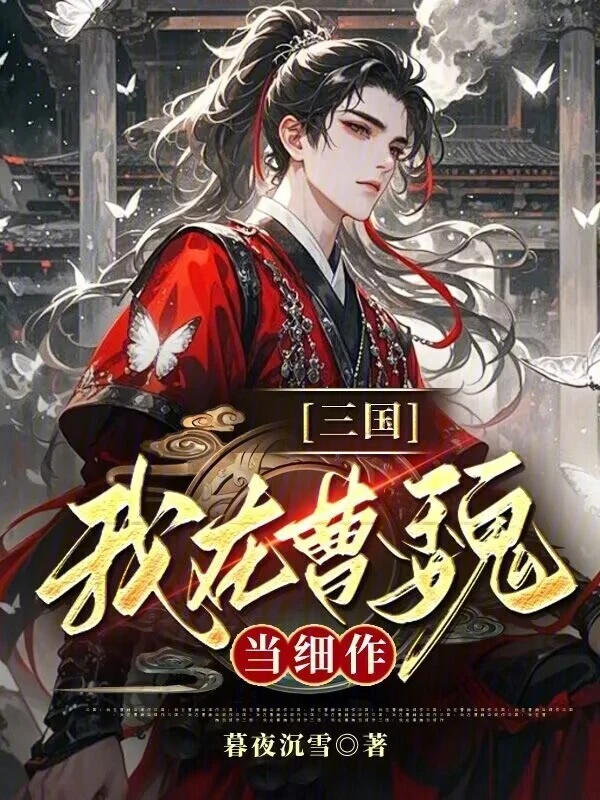
Three Kingdoms: I Am Working in Cao Wei
三国:我在曹魏当细作
- Status
- Completed
- Length
- 134k Words
- Genre
- Historical
- Audience
- Male
- Subgenre
- Qin-Han & Three Kingdoms
- Updated
- 1y ago
- Source
- Qidian
Stats
0Monthly votes
583Recommends
62Fans
58Chapters
Tags
Synopsis
Reader comments
Readers also read
 1914 Begins with the Rejection of the Schlieffen Plan
 Talker in the Song Dynasty
 Please Call Me Your Majesty the Tsar
 In the Red Mansion: Escort Daiyu to Beijing at the Beginning
 Never Walk Alone!
 Three Kingdoms: Ji Han, the Great Physiognomist
 Three Kingdoms: Angrily Denounced the Theory of Hatred for the Country, Saying That Jiang Wei Was an Amateur
 Daming: Have I Become Wanli's Portable Grandfather?
 I Am Drawing a Hot-Blooded Episode in the Zhiyu Episode!
 Three Kingdoms, Me? a Perfect Strategy?
 Three Kingdoms: Ji Han Concealed His Position and Conquered the Central Plains
 Why Were the Civil Servants in the Northern Song Dynasty so Bad?
In the original work, Xu Shu was also a high-ranking official in Cao Ying. Why didn't he say a word?
Xu Shu surrendered to Cao and became Yushi Zhongcheng. These are the three princes who supervise all officials and are directly under the jurisdiction of the emperor. His good friend Cui Zhouping was the Huben Zhonglang General in Cao Ying, and Meng Gongwei was the general who conquered the east. I feel that many people have been misled by the idioms
For the image of Zhuge Liang, we still have to ask Mr. Tang Guoqiang's version
The picture is authorized by Douyin Huazhiyun teacher, Douyin account Artyun8
I saw something funny, I don't mean anything else, I just think it's funny
The emperor's armor is combined! ! !
The author said he was going to kill me, I was so scared! Happy 521!
Brother, your typing was so fast and steady today. I feel that the quality of your writing is also very high. The small details are always correct and your eyes are so fierce. Is she going to have a 521 with someone else?
Big cheers for the author, don't collapse.
520 Happy
Brother, your typing was so fast and steady today. I feel that the quality of your writing is also very high. The small details are always correct and your eyes are so fierce. Is she going to have a 520 with someone else?
Guys, this book is a top-notch historical text. I believe that as long as you read it carefully, you will be attracted by the plot. Each person in the book has his or her own characteristics, the psychological description is rich, and the plot is coherent. It is worth reading.
This novel is so well written, thank you to the author Shen Xue. I also recommend a novel to everyone, "Ansai Military Household at the End of the Ming Dynasty". Friends who are short of books can take a look. The author is also writing it very carefully.
Highly recommended!
The writing style is steady and eloquent. As a historical text, the entry point is very novel, the narrative rhythm is smooth, and there is a little humor. In short, it is a rare masterpiece. The author works hard to update, Platinum Juice🐉🐉🐉
I finished reading it in one sitting and felt that it was more than enough.
I added a bookshelf and voted for it, so keep writing.
Must-see series
I finished reading the Three Kingdoms series in one go, it's very good!
Using pigeons to send messages is too natural.
How to tame it? How to call it As for the name of pigeons during the Three Kingdoms Period (AD 220-280), there is no direct record of the proper name in the available historical documents. However, combined with the evolution of writing and language from the Han Dynasty to the Wei and Jin Dynasties, we can speculate on its possibility from the following perspectives. 1. Tracing the origin of the word: the emergence of the word "Geve" - **Origin of the word "Geve"**: The word "Geve" was not included in Xu Shen's "Shuowen Jiezi" (written around 100 AD) of the Eastern Han Dynasty, indicating that the word may not have been popularized in the late Han Dynasty, or it may be regarded as a vulgar word. The earliest existing record: Lu Chen's "Zi Lin" of the Western Jin Dynasty (lost, cited in "All Classics Sound and Meaning" of the Tang Dynasty) first included the word "Geve", which was interpreted as "Dove". It is speculated that the official name of "Dove" may have begun in the Wei and Jin Dynasties, and during the Three Kingdoms period, it may still be generally referred to as "Dove". The mixed name of dove and pigeon: From the Han Dynasty to the Three Kingdoms period, pigeons may be classified into the broad category of "dove". "The Book of Songs, Wei Feng, Meng" already has the sentence "When the doves are whining, there are no mulberries to eat", but "dove" in ancient times generally refers to a variety of small birds, including turtle doves, pigeons, etc. - Lack of subdivided names: The classification of birds in ancient times was relatively rough. During the Three Kingdoms period, pigeons and turtle doves may not have been clearly distinguished, and they were collectively referred to as "doves" or "doves" (the word "dove" came later, and was mostly seen in Song Dynasty literature). - **Possibility of introduction from the Western Regions**: After Zhang Qian's passage to the Western Regions, species exchanges between the Central Plains and the Western Regions were frequent. Pigeons may have been introduced along with other rare birds and animals, but no clear transliteration of their names was recorded. - **Dialect common name**: There may be regional names among the people, such as " Pigeon" ("" refers to the color of feathers), etc., But such names are mostly found in Tang and Song Dynasty documents (such as "Tokyo Menghua Lu"), and there is no evidence during the Three Kingdoms period. The origin of "Fei Nu": "The Legacy of Kaiyuan Tianbao" of the Tang Dynasty records that Prime Minister Zhang Jiuling domesticated homing pigeons and called them "Fei Nu", which means "flying slave". This name has a literary flavor, and such an elegant title did not appear during the Three Kingdoms period. During the Three Kingdoms period, pigeons may be generally classified into the "dove" category, or there may be no proper name for them. Its specific name needs further research based on archeology and literature, but the following points can be clarified: 1. The word "geve" may not have been popularized during the Three Kingdoms period, and the official name may not have been finalized. 2. "Dove" is the most likely general name, but attention should be paid to its generality. 3. **After the Tang Dynasty**, names such as "Pigeon" and "Flying Slave" gradually became popular, keeping pace with the development of pigeon culture. If there are newly unearthed slips or inscriptions on artifacts from the Three Kingdoms that mention the name of pigeons, it may provide more direct evidence. In the current research, it is recommended to use the general term "dove" or "pigeon" with caution and indicate the historical background.
Well written, it's still good, don't cut it