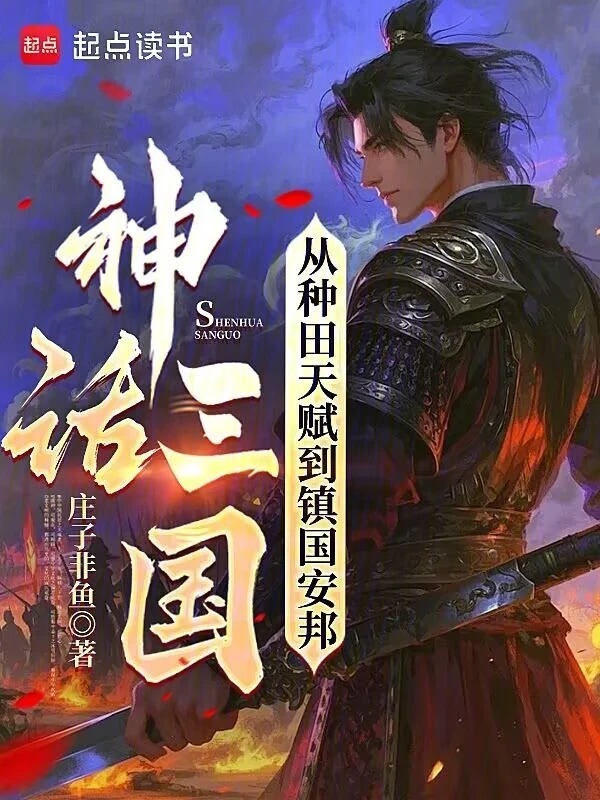
The Mythical Three Kingdoms: from Farming Talent to Guan Guan an Bang
神话三国:从种田天赋到镇国安邦
- Status
- Completed
- Length
- 796k Words
- Genre
- Historical
- Audience
- Male
- Subgenre
- Qin-Han & Three Kingdoms
- Updated
- 9mo ago
- Source
- Qidian
Stats
0Monthly votes
6.7kRecommends
14.4kFans
287Chapters
Tags
Synopsis
Reader comments
Readers also read
 In the Red Mansion: Escort Daiyu to Beijing at the Beginning
 Please Call Me Your Majesty the Tsar
 1914 Begins with the Rejection of the Schlieffen Plan
 Talker in the Song Dynasty
 Never Walk Alone!
 Conquer All Worlds Starting from the Mythical Three Kingdoms
 National Novelist: Starting from Writing About the Three Kingdoms in the College Entrance Examination
 Daming: Have I Become Wanli's Portable Grandfather?
 I Am Drawing a Hot-Blooded Episode in the Zhiyu Episode!
 Heavens, Start by Using Conceptual Techniques to Treat Tao Injuries
 Cube Magical Power: Immortality Begins from Refining Qi
 Why Does My Territory Have a Secondary Original Painting Style?
Refuting some comments: Does being able to farm mean you must conquer the world?
The protagonist's talent is that the more fields he owns, the more crops can absorb the essence of heaven and earth. And the author specifically said that there is no bonus to the growth of one's own force. Personally, I think he is a great farmer, and he is a talent that anyone who wants to be an emperor would want. It can be said that as long as the protagonist does not fight for hegemony or assassinate the master, he will still have a stable status even if the dynasty changes. In this case, if you go to fight for world supremacy, will your head hurt? If you look through the history books of the Three Kingdoms yourself, who are the people who can compete for hegemony? Look at the Eighteen Route Princes: In the first town, the post-general Nanyang Prefect Yuan Shu Yuan Shu, named Gongdao, whose family is the Runan family of the Fourth Generation and Three Dukes, the second son of Yuan Feng, the younger brother of Yuan Ji and Yuan Shao, was recommended as Xiaolian, and was transferred to Henan Yin and Huben Zhonglang General many times. In the second town, there was Han Fu, the governor of Jizhou. Han Fu, named Wenjie, was from Yingchuan County. He served as the censor Zhongcheng of the Eastern Han Dynasty and was later appointed as the pastor of Jizhou by Dong Zhuo. In the fourth town, Liu Dai, the governor of Yanzhou, Liu Dai, whose courtesy name was Gongshan, was from Mouping, Donglai. The governor of Yanzhou, a clan member of the Han Dynasty, the son of Liu Yu, the brother of Liu Yao, and one of the heroes in the late Han Dynasty. The fifth town, Wang Kuang, the prefect of Hanoi County, Wang Kuang, courtesy name Gongjie, was from Taishan County, Yanzhou. He was promoted to the prefect of Hanoi County. At first, he served as the governor of the general's palace under the general He Jin. After He Jin's death, he was worshiped as the prefect of Hanoi County. In the sixth town, Zhang Miao, the prefect of Chenliu, named Meng Zhuo, was born in Shouzhang, Dongping, and was the prefect of Chenliu. After the Battle of Bianshui, he surrendered to Cao Cao. Previously, because of his rift with Yuan Shao and his relationship with Lu Bu, Yuan Shao asked Cao Cao several times to kill Zhang Miao, but Cao Cao did not listen and became closer to Zhang Miao. Later, when Cao Cao led troops to attack Tao Qian, Zhang Miao and Chen Gong rebelled against Cao and welcomed Lu Bu as the shepherd of Yanzhou. Later, Lu Bu was defeated by Cao Cao. Zhang Miao followed Lu Bu and defected to Liu Bei. His whole family and his younger brother Zhang Chao were killed by Cao Cao in Yongqiu. Zhang Miao was killed by his subordinates on his way to borrow troops from Yuan Shu. The seventh town, Qiao Mao, the prefect of Dongjun. Qiao Mao, courtesy name Yuanwei, the governor of Yanzhou The eighth town, Yuan Yi, the prefect of Shanyang. Yuan Yi, courtesy name Boye. He is the cousin of Yuan Shao and Yuan Shu. In the ninth town, Baoxin, the prime minister of Jibei. Bao Xin was recruited by He Jin to recruit troops abroad. When he returned to Luoyang, Dong Zhuo came to Beijing. Bao Xin advised Yuan Shao to get rid of Dong Zhuo, but Yuan Shao disagreed. Later, Yuan Shao, Cao Cao and others raised troops to fight against Dong Zhuo, and Bao Xin also raised troops to respond. After the alliance broke down, Bao Xin advised Cao Cao to wait and see. The Yellow Turban Army in Qingzhou attacked Yanzhou, but Liu Dai, the governor, ignored Bao Xin's advice and went into battle rashly. He was defeated and died in the battle. Bao Xin welcomed Cao Cao as the shepherd of Yanzhou. During the battle with the Yellow Turban Army, Bao Xin unfortunately died in the battle to save Cao Cao. Cao Cao later recognized his achievements and bestowed the title on his son. In the tenth town, Kong Rong, the prefect of Beihai, was named Wenju. A native of Lu. He was a writer in the late Eastern Han Dynasty and one of the "Seven Sons of Jian'an". He had a rich family background and was the 20th grandson of Confucius and the son of Kong Zhou, the captain of Taishan. Kong Rong was a rare talent, diligent and studious, and was known as Pingyuan Tao Qiuhong and Chen Liubianjang. After Emperor Xian of the Han Dynasty came to the throne, he served as Zhonghou of the Northern Army, Zhonglang General of Huben, and Prime Minister of Beihai, and was called Kong Beihai at that time. During his six years in office, he built cities, established schools, promoted talents, and demonstrated Confucianism. Later, he also served as the governor of Qingzhou. In the first year of Jian'an, Yuan Tan attacked Beihai, and Kong Rong fought fiercely with him for several months before finally being defeated and fleeing Shandong. Soon after, he was recruited by the imperial court as a general and a master craftsman, moved to the Shaofu, and was appointed Taizhong doctor. He was a good-natured guest, liked to criticize and discuss current affairs, and spoke fiercely. He was later killed because he offended Cao Cao. In the eleventh town, Zhang Chao, the prefect of Guangling, whose surname is unknown, was born in Shouzhang, Dongping, the prefect of Guangling, and the younger brother of Zhang Miao. In the twelfth town, Tao Qian, the governor of Xuzhou, had the courtesy name Gongzu. A native of Danyang County, Danyang County. Tao Qian was originally a Zhusheng and served in prefectures and counties. He was promoted as a talented person and served successively as the magistrate of Shu and Lu counties, the governor of Youzhou, and Yilang. He had a strong character and great ambitions. Later, he followed the Zuo chariot general Huangfu Song to fight against Beigong Boyu and was appointed Yangwu captain. Later, he followed Zhang Wen to conquer Han Sui and Bian Zhang. In 188, when the Yellow Turbans rose in Xuzhou, Tao Qian was appointed as the governor of Xuzhou by the imperial court. He defeated the Yellow Turbans in Xuzhou, promoted farming, and restored production. Later, he followed the advice of Wang Lang and Zhao Yu and sent envoys to Beijing to pay tribute. He was granted the title of General Anton and Xuzhou Mu, and was granted the title of Marquis of Liyang. In his later years, due to Cao Cao's defeat in the war, most of Xuzhou was almost destroyed by war, and he died of overwork at the age of sixty-three. In the Thirteenth Town, Xiliang Prefect Ma Teng Ma Teng, named Shoucheng. A native of Maoling, Fufeng, a descendant of General Fubo Ma Yuan, the father of Ma Chao, Ma Xiu and Ma Tie. Ma Teng is more than eight feet long, has a huge body, a majestic face and nose, a virtuous and loyal character, and is respected by everyone. In the last years of Emperor Ling of the Han Dynasty, he was employed by the state and county offices in the army and took charge of his tribe. Tired of moving to the general position. After Geng Bi, the governor of Liangzhou, was killed by the rebels, Ma Teng, Bian Zhang, Han Sui and others jointly launched an uprising in Liangzhou. In the third year of Chuping's reign, he and Han Sui led the troops to Chang'an and were appointed as generals to conquer the west. In the first year of Xingping, Ma Teng tried to unite Zhong Shao and others to kill the powerful ministers Li Jue and Guo Si, but was defeated and had to return to Liangzhou. He was soon pardoned and worshiped General Andi. Later, he and Han Sui became brothers with different surnames. In the seventh year of Jian'an, he became a general in the southern expedition and opened his mansion. Later, they were at odds with Han Sui and attacked each other. In the 13th year of Jian'an, he was recruited as a former general. During the holiday, he was granted the title of Marquis of Huaili and settled in Huaili. In the 14th Town, Gongsun Zan, the prefect of Peking, was named Bogui and was a member of the Liaoxi Lingzhi. Gongsun Zan was born into a noble family. Because of his mother's humble status, he only became a minor official in the county. Because of his handsome appearance, loud voice, and eloquent wit, he was appreciated by the governor of Zhuo County and betrothed his daughter to him. Later, he gradually became a Zhonglang general, fighting against the northern nomads with a tough attitude, fighting bravely, and shocking the frontier. Gongsun Zan was warlike and at odds with his boss Liu Yu, who advocated a soft policy towards the Hu people, and the conflict between the two gradually intensified. In the fourth year of Chuping, Gongsun Zan killed Liu Yu and held the court envoy hostage. He received the authorization from the governor of the four northern states and became one of the most powerful princes in the north. He fought with Yuan Shao many times and had an advantage in the early stage. However, after the Battle of Longcuo, Gongsun Zan's energy suddenly weakened and he adopted a self-protection strategy. He gradually lost the trust of his subordinates and was defeated by Yuan Shao. Eventually he was trapped in a high-rise building and set himself on fire. In the fifteenth town, Zhang Yang, the governor of Shangdang, Zhang Yang, named Zhishu, was born in Yunzhong. At the end of the Eastern Han Dynasty, when the eunuchs had exclusive power, he returned to Bingzhou to recruit troops under the orders of General He Jin. Since then, he has stayed in Shangdang to attack the bandits. Dong Zhuo granted Zhang Yang the title of General Jianyi and Governor of Hanoi. Emperor Xian of the Han Dynasty fled to Hedong due to the rebellion of Li Jue and Guo Si. Zhang Yang led his troops to Anyi and was named General Anguo and Marquis of Jinyang. In the first year of Jian'an, Emperor Xian returned to Luoyang. Zhang Yang decided not to stay in Luoyang because he was the governor of a foreign county. He returned to Yewang and was soon named Grand Sima. In the second year of Xingping, Cao Cao besieged Lu Bu. Zhang Yangsu was friends with Lu Bu and wanted to send troops to rescue him but was unable to do so due to lack of strength, so he sent troops to Dongshi to respond. Soon, his general Yang Chou killed Zhang Yang in response to Cao Cao, causing Cao Cao to collect all his troops. The 16th Town, Wuchenghou Changsha Prefect Sun Jian, the ancestor of Wu Wu Lie Emperor Sun Jian, courtesy name Wentai, was a native of Fuchun, Wu County, and a descendant of the military strategist Sun Wu in the Spring and Autumn Period. A general and warlord in the late Eastern Han Dynasty, he was the founder of the Wu Kingdom in the Three Kingdoms. History books say that he had "extraordinary appearance, broad-minded character, and curiosity." He participated in the campaign against the Yellow Turban Army and the campaign against Dong Zhuo. Later he was killed in battle with Liu Biao. Because he was promoted to General Polu, he was also called "Sun Polu". His son Sun Quan became the founding emperor of Sun Wu. After Sun Quan proclaimed himself emperor, he posthumously named Sun Jian Emperor Wulie. In the 17th town, Yuan Shao, governor of Bohai, the Marquis of Qixiang, Yuan Shao, courtesy name Benchu, was born in Ruyang, Runan, and was the son of Sikong Yuan Feng. Yuan Shao was born in the "Yuan Family of Runan", a famous family in the Eastern Han Dynasty. Starting from Yuan Shao's great-grandfather, five people in the fourth generation of the Yuan family ranked third among the three Dukes. He himself also ranked above the Three Dukes. Therefore, his family was known as the "Four Generations and Three Dukes". In his early years, Yuan Shao served as the Colonel of the Central Military Commission and the Colonel of Sili, and once commanded the execution of eunuchs. In the first year of Chuping, he opposed Dong Zhuo and was elected as the leader of the Kwantung Allied Forces. In the process of the separatist regimes at the end of the Han Dynasty, Yuan Shao first occupied Jizhou, then captured Qing and merged two states. In the Battle of Yijing in the fourth year of Jian'an, he defeated the warlord Gongsun Zan who had separatized Youzhou, unified Hebei, and reached its peak of power. But he was defeated by Cao Cao in the Battle of Guandu in the fifth year of Jian'an. In the seventh year of Jian'an, Yuan Shao died of illness after putting down the Jizhou rebellion. In the 18th town, Cao Cao used the message to reach the counties. The proclamation said: "Cao and I would like to declare to the world with great righteousness: Dong Zhuo deceived the heaven and the earth, destroyed the country and killed the king; he was filthy and disorderly, and the palace was imprisoned, and he harmed the living beings; he was ruthless and unkind, and he was full of evil! Today, under the secret edict of the emperor, a large number of righteous soldiers have been assembled. I vow to wipe out the Central Plains and kill all the evil forces. I hope that the righteous troops will vent their public anger together, support the royal family, and save the people. When the day comes, we can implement the proclamation quickly!" After Cao sent the proclamation, all the princes in the back town raised troops to respond. Look, all the princes were either born as military generals with outstanding military exploits; or they were born as civil servants and descended from powerful families. Even Liu Bei is the queen of Zhongshan County, and he is full of charm, and his military force and political ability are at the forefront. Therefore, being able to farm is indeed a great thing, but no matter how great you are, others will only treat you as a talent and will not be loyal to you. After all, fighting for hegemony is not like playing house. Without background, charm, force, or intelligence, being able to farm is at most a mobile granary.
Do you understand the value of doubling the yield per acre? You still need to deliberately rely on others. Farm your own land to support thousands of dead soldiers. If you encounter someone you can't beat, just rely on the exchange of benefits to continue to grow bigger and stronger. That's it.
It's a bit like the mythical version of the Three Kingdoms. The protagonist feels like a low-profile version of Chen Xi plus a low-profile version of Cookie.
This is when he kneels down and licks Liu Bei right after he comes up. He's not trying to grow up and fight for hegemony on his own.
A big question, your protagonist is not the mastermind, but the lord. Although I like the setting of Shensan very much, there must be limits first, otherwise it will be overshadowed by the master's achievements. What is the use of Liu Bei here?
Don't say it, you really don't say it, just make sure you really have excellent farming talent. In China, with eight thousand years of history, you can be a yuppie in any era. As long as you don't seek death yourself, the only way to die is natural death 🤐🤐🤐
Since Lily wrote the mythical Three Kingdoms, there have been fewer and fewer books about the Three Kingdoms.
To put it bluntly, travelers feel a sense of isolation and uneasiness from the world, so they fight for hegemony. They naturally don't want to leave their lives to others to decide. Not everyone wants to fight for hegemony, but they only have the right to decide their own lives. No matter what others say when writing to help others, you will naturally feel uncomfortable inside.
Great, it's The Mythical Three Kingdoms, go to my bookshelf
The talent of the protagonist is strong in percentage. The more, the higher. . . . . It's just right to be a national teacher. Don't worry about anything.
As a dog?
Is it crazy to be a dog by adding plug-ins during time travel? And do you think it was so easy to be a dog in ancient times? Even if Li Shimin was the best boss, after his death, his descendants would kill you if they wanted to.
The brother who was recommended by Sister Lily, please say something.
Congratulations, the lucky winner of Qidian Three Kingdoms theme 🙂
Farming?
From the title and copy of the book, I thought farming was the main focus? What is the role of the protagonist? Is he the lord? Then you can dress up as Liu Bei's twins. With this ratio now, it's hard to say it's better for me to repeat the early stage of Shenzhou III
Please read, collect, comment, and vote monthly.
Thank you for reading. I hope you don't want to raise a book. The setting style of this book is biased toward God III, but the spiritual talent settings of each character will be very different. You can also make comments and other things, and the author will reply after seeing it.
Good.
After reading Chapter 8, I felt it was okay. Mainly because I read the mythical version of the Three Kingdoms, which was too familiar and affected my reading.
Who did the author learn this geography from?😵
If Liu Bei in history was a benevolent and righteous man, then Kou Feng would have something to say. How serious a crime did Liu Feng commit that he must die? He can save Guan Yu. If he can save Shu and Han, he will unify the Three Kingdoms. What does Liu Feng exist for? After Liu Chan is born, is it okay to let Liu Feng change back to Kou? And bringing people across the river is a complete joke. In ancient times, even if the city was massacred hundreds of miles away, who knew? It's not what the rulers propagandized. You have to know that in ancient times, population and land were equally important, and people were even more important. Who in ancient times really slaughtered the city for fun?
After all that, Cao Cao is not bad either.
Ah this
This book is not far off for free. When I encounter good-looking books, it's not the cost that's the problem, it's the fact that you update them too slowly. So try to update. We must unify and expand outward. Don't be like that Shensan. It's simply enough history. There is a large group of civil and military officials like Chen Xi. They actually went to work outside if they were not unified. The author is either a woman or ran away.
In order to maximize your talents, it is best to join the Eastern Han Dynasty. As long as the Three Kingdoms do not become independent emperors, they are all considered Han ministers. He has to wait for Cao Pi to become emperor.
Asking for more refinement
Say something casually
I came in after seeing the farming article, but found that I was not the main one. How should I put it, when you are the master, you have the subscription of being the master, and there should be no inappropriate subscriptions, as long as you can accept it. Come on
The first and middle stages are actually pretty good, but the ending is bad.
In fact, the writing is pretty good and I can read it, but the ending is too sloppy. To be honest, I'm a little sorry for the time and energy you spent on it, including those of you who are following me. I hope you can continue to work hard.
Author
Do all the novels you open have multiple female protagonists?
Even if you take refuge with a dog, you cannot take refuge with Liu Bei.
Where is my Lu Zijing? Please join Lu Zijing and Xu Gongming, please vote for me