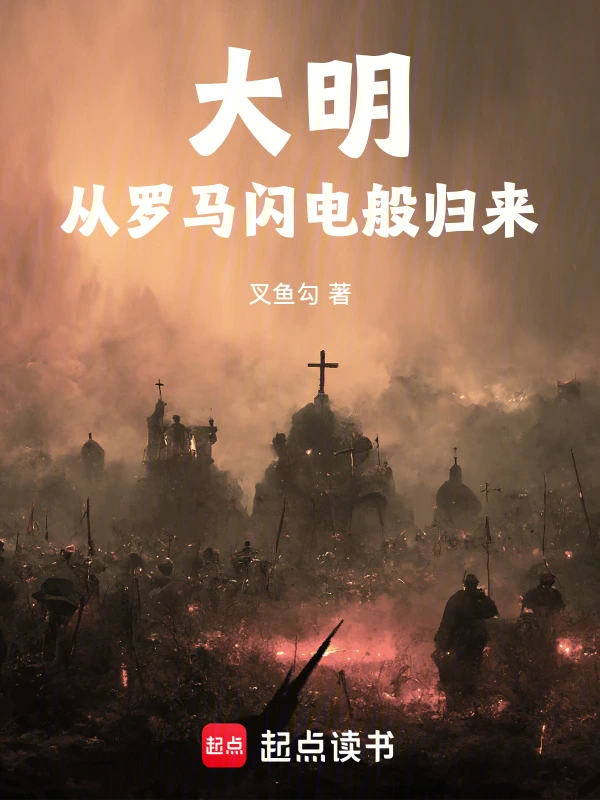
Ming Dynasty: Return from Rome Like Lightning
大明:从罗马闪电般归来
- Status
- Completed
- Length
- 1.1M Words
- Genre
- Historical
- Audience
- Male
- Subgenre
- Song-Yuan-Ming Dynasties
- Updated
- 1mo ago
- Source
- Qidian
Stats
1Monthly votes
6.9kRecommends
17.1kFans
350Chapters
Tags
Synopsis
Reader comments
In booklists 1
Readers also read
 Northern Qi, Sage Khan
 Gou Served as Sima Under Dong Zhuo
 After Lying in Bed for Three Years, He Was Forced to Help the Han Dynasty
 Red Mansion: Start Escaping and Farming from the Equipment Bar
 Siheyuan: Start by Picking up Attributes
 1853: Mein Kampf
 Destroy the Qing Dynasty
 Immortal Who Seizes the Body
 Devouring the Starry Sky: Infinite Opportunities to Hoard Treasures at the Beginning
 The Wind Rises in North America 1625
 Nanming, This Emperor Is a Bit Stable
 1914 Begins with the Rejection of the Schlieffen Plan
 Am I Really a Fairy?
This book is worth reading. The author is talented and worth reading.
Read the latest in one go, and say a few nonsense: The current tone is inevitably a bit heavy. The general trend is indeed against the wind, and the protagonist's spirit of martyrdom, sacrificing his own life for justice, and sacrificing his life for justice is burning. Before ushering in a major historical turning point, we may have to rely on burning the protagonist to promote development. Even if the protagonist succeeds in taking advantage of the situation, he will be dragged down by the chaotic politics of Nanming... Starting a new business may be an option, or is Zheng Chenggong the oversized one? The Southern Ming Dynasty is difficult to write about. During this period, the tentacles of the West have reached our doorstep. The Ming Dynasty does not have its own filters like the Han and Tang Dynasties, so it is difficult to "make things out of nothing" for "people". The perspective that the protagonist is an envoy to Europe is quite interesting. Starting from Europe, we look for opportunities in the drastic changes in the history of the East and the West. If this is a novel with a big hook for the protagonist, you can avoid various problems by not writing details to prevent readers from thinking about it, or some novels directly take advantage of the protagonist's success in Europe and start writing in Nanyang. If the author currently has his own ideas, it is worth reading.
The protagonist is too conscientious and can't bear to watch the protagonist's struggle, which may be the reason for the data loss.
The prerequisite for Wang Xuance to put out the fire is the Tang Dynasty behind him. The Ming Dynasty is less than three provinces behind the protagonist.
It's confusing to look at the resume. Ming's national power is very embarrassing after the Yongli Western Hunt. In this context, the protagonist wants to make a comeback. . . . Well, unimaginable
The protagonist really wants to bring reinforcements back to the Ming Dynasty? But at this time, the loss of ocean-going troop transport was extremely high. In the fifth year of Qianlong's reign, Britain sent a fleet led by George Anson to Southeast Asia to attack the Spanish fleet in the Philippines. This fleet of about 2,000 people was killed by the Spaniards, and about 1,500 people were killed by scurvy. Coupled with other reasons such as shipwrecks, only about 200 people returned to Britain alive. In the twenty-seventh year of Qianlong's reign, the British army attacked Havana, Cuba, and was severely hit by insufficient supplies and the epidemic of plague. The British mobilized 10,000 troops and navy. From June to October, 560 people were killed by the Spaniards and 4,708 died of illness. This was true in the 18th century, and it could only be worse in the 17th century. And even if they were transported, they still wouldn't be able to defeat the Qing army at this time. The Portuguese mercenaries that were so popular at the end of the Ming Dynasty were useless. They had to rely on Jiao Lian's northern Shaanxi cavalry as the main force to attack the green camp, let alone fight against the Eight Banners.
As a newcomer, it's too nb. I can say that newcomers are monsters. The diction and sentence construction are concise and not artificial, and it is completely readable As a work, although the main task has always been hidden in the dark, the protagonist's current actions can also feel that he is serving the ultimate goal. The work does not have the dryness of other foreign historical books, which makes people feel boring after reading it. In this book, the Eastern protagonist and the Western background are well integrated For now, it is very good
If the protagonist does not become the emperor, then the protagonist must carry out comprehensive changes that limit the emperor's rights. It is useless if the protagonist just copies the technology of later generations and adds a few reforms. If a country wants to produce a large number of original inventions and creations, it must carry out systematic changes in ideological foundation, political structure, legal system, social forces and other aspects. The reason why Britain was the first to enter the Industrial Revolution is that after experiencing the ideological changes of the European Renaissance, coupled with the British Glorious Revolution of 1688, the king's rights were further restricted. Britain established the framework of parliamentary sovereignty and the rule of law, and the bourgeoisie, the new aristocracy, and the king formed a check and balance, which allowed British civilians to gain unprecedented freedom. At this time, the degree of freedom of scholars, craftsmen, and farmers in Britain was higher than that of other European countries at the same time, and it was far more liberal than the civilians of China's Ming and Qing dynasties. The high degree of freedom of all British civilians fully inspired everyone's strength. The power of the Chinese emperor was not greatly restricted, and all officials, gentry and landlords were dependent on the imperial power. The freedom of civilians, who account for the vast majority of the country's population, is too low. This system inhibits innovation and hinders social development. China's Zhou Dynasty was a feudal system, and the central government could not control much of the local princes' affairs. The princes competed with each other. During this period, Chinese civilization truly allowed a hundred flowers to bloom. Most of the essence of Chinese civilization came from this period. During the Spring and Autumn Period and the Warring States Period, the "Mo Jing" recorded the principles of optics and mechanics, and the germination of geometry had emerged; the "Gan Shi Xing Jing" recorded astronomical observation data. But from the Qin Dynasty to the Qing Dynasty, there was almost no progress! The institutional innovation of the Spring and Autumn and Warring States periods stagnated after the Qin and Han Dynasties, lacking the ability to dynamically adjust. Since the Qin Dynasty, especially since the Han Dynasty deposed all schools of thought and only respected Confucianism, Chinese civilization has almost stood still and entered a dead end. The Zhou Dynasty and the Spring and Autumn Period and the Warring States Period were similar to the ancient systems of most European countries. They were all feudal systems. Even in successive years of war, less than 10% of the country's total population died directly or indirectly as a result of the war. But from the Qin Dynasty to the Qing Dynasty, every dynasty would kill half or more of the country's population due to war! What is even more tragic is that every time there is a change of dynasty, there is almost no progress in the system and culture! {"NickName":"Restriction and Supervision","UserId":417773267}
I heard that evidence of Donglin Party treason was unearthed from Qian Qianyi's tomb?
A few statements
First of all, a new book for a newbie, thank you all for your support. The second issue is about the setting of the protagonist, because the protagonist was a diplomat before time travel, and spent most of his time learning languages and diplomacy-related knowledge. As for history, he is just a lover; for technology, he only has some memories from before the liberal arts and sciences. Therefore, what the protagonist says is not necessarily correct (for example, the outrageous oxygen accounts for 1/3 of the air, and no one has discovered this problem yet). Note: This is done with reference to the author's own memory of physics and chemistry students. The author took 282 points in comprehensive science in the college entrance examination. I don't think a liberal arts student will be taller than me. As for the name of the protagonist, I have been thinking about it for a long time, Chen An or Chen Ande (especially Chen Ande, there is an extra word). As far as the protagonists are currently called "Anderson" in Europe, they still self-identify as Chen An. Of course, there are also interpretation methods in the French environment, Ann de Chen. In addition, the writing in the early stage was indeed a bit messy. A lot of things I wanted to express were not expressed, and the things I wanted to do were not laid out well, so it ended up like this. If forced to explain, it can be said that this is the protagonist's first time traveling, he has no experience, and he is a bit like a headless fly in a foreign country. Of course, if I have time and opportunity in the future, I will make modifications. I apologize to you for this. Finally, this book will refer to historical data as much as possible. If there are any missing or conflicting historical data, a more suitable creative direction will be chosen. Thank you everyone!
Make a suggestion
The author had better not keep talking about Chinese proverbs in Europe. There is a sense of inconsistency with an old Chinese saying. It looks very funny.
Do you really like being a paper framer?
The Ming Dynasty is dead, just start over, don't go back and get involved in Nan Ming's disgusting things, abandon the book! Obviously France and Spain have written quite well.
Meda's feelings
Constitutional monarchy, federal provincial autonomy, free market, lifting restrictions on population movement, parliamentary system, voting democracy, separation of powers
Have you ever been a diplomat? This is what you write 😏
It went so well
From the time he returned to his country until he saw his death, it was gratifying. The protagonist's journey was so smooth, it was a bit of a series of victories. Basically, the protagonist comes, fights, and then wins. The Tartars are just like the NPCs who are being cut while standing. It would be too boring if it stays like that later.
I personally think that one thing that may have lowered the author's data is the writing style.
The author's writing style is too montage, and the scene switching is too fast and too fast with some stream of consciousness. The beginning of the chapter in Paris is okay. When I arrived in Spain, the montage-style scenes changed too quickly, there were many images, many background descriptions, and the pace was fast, but I thought it didn't matter just to end the plot quickly. Then when we got to Nanyang, it was still the same. In fact, when you write about the Spanish plot like this, I can only say that I can probably understand what you mean. And firstly, the plot is free, and secondly, because I think it is to speed up, this is not the norm. I think after entering the mainstream plot of Nanyang, there are still a lot of montages and streams of consciousness. In a chapter, there is still a scene on the previous page, and then it switches again and adds some description of the scene. Many things are also expanded. Seriously, it's a waste of your brain, and it feels like motion sickness.
New readers' thoughts after reading
A unique entry point into the late Ming Dynasty, coupled with elegant and concise writing style, it is truly a unique reading experience. Even though my taste has been sharpened by Wan Ming and Iron-Blooded Can Ming, this book still fascinates me. I hope the author can persist in this unpopular track, and my subscription and monthly tickets will not be short 😁
About the system
I think there is nothing wrong with a constitutional monarchy. A constitutional monarchy is inherently designed to weaken the emperor, and the male protagonist is not named Zhu.
Unconventional
It is not formulaic, which is the greatest advantage of this work. It is worth watching.
It's very explosive. The ancients use Chen Ande and the readers use Chen An. Can't they be called uniformly? ? ? ? ? ? ? ? ? ?
You came here for the title Ming Dynasty, so why did you end up proclaiming yourself emperor? Isn't it okay to support a puppet emperor and act as a constitutional figure? Proclaiming yourself emperor is really a bit of a trick, isn't it?
Shennong Tasting
This book is very good, it has advantages and disadvantages. Disadvantages: There are some shortcomings that new authors often have. For example, it was cool, but the handling was very confusing, so I just explained it in a few words. I also like to write a lot of modifiers, which makes the whole thing look "prosperous and exaggerated". These are very different at the starting point, although they don't affect anything. The political struggle is more metaphorical, and the emotional line seems very empty. Although I can understand it, I personally don't think it is likable. The overall writing style is also a bit stream-of-consciousness. In some places, the author's brain waves need to be corrected. Although you can roughly understand it if you don't get it right, if you don't get it right, it will feel very literary. The advantage is that the protagonist has a distinct personality and each character is created with a sense of reality, although the protagonist's point of view is a bit confusing. The plot rhythm is also very stable, but many details are blurred due to the stream of consciousness. Most of the writing is about characters, but less about scenes. The writing in the West is pretty good at the moment. The author should have some knowledge of the Thai and Western countries in this period. However, this style is very good if you just write about Thailand and the West, but it may be a drama when you return to the East, but it depends on how the author arranges it. The overall feeling is not like the traditional historical text of Qidian, but it is interesting to watch. This book intends to rebel against the Qing Dynasty and restore the Ming Dynasty, and then work for the old Zhu family and become a Wuhou, or is it to restore the world and rebuild a new order or establish a new dynasty? Currently, the protagonist's goal is not visible, which is rare in current Qidian novels. Nowadays Qidian novels usually give the protagonist a clear goal, but the goal of the protagonist in this book seems to be just to bring people back to fight the Qing Dynasty, which is a vague concept. How to fight or how to build is not mentioned. Although it is true that these can only be done after going to the east, but it is also necessary to set the target first. It's okay to write down the specific details when you get to the East. At present, it seems that there is no current goal (such as wanting to recreate the Ming Dynasty or reshape China's dominance) This is all personal opinion, overall it is good, food and grass, recommended viewing
I see some people are pessimistic in the comment area, but I want to say, buddy, you must hold on, your writing is really awesome, but the front is a bit too confusing. I hope that when I write about Spain later, I can write more clearly, set goals clearly, and don't mess around. Again, let readers clearly understand what you are doing now and what use it will have for you in the future. What you wrote earlier was a little too confusing, but it's really great. Come on, you must stick to it. And if I can't continue writing this book, let's just write about Western Europe next time. I really like your writing about Western Europe😭😭😭
Well written
It is unique in the late Ming Dynasty It is a masterpiece in the fictional text From the perspective of the logical evolution of history, at least to my level, it seems to have no flaws and conforms to the objective laws, but it is also very enjoyable to read. The author has a good grasp of this point As of the current plot, the subsequent fight with Russia to conquer Siberia, pacify Mongolia and Tibet, and conquer Junggar, Tuwu will write these in detail, if it is not clear If I write in detail, I feel that the length is a bit short. If the author is financially capable, I suggest writing more just to practice writing. Finally, the separation between Europe and the Northern Expedition in the previous article is quite obvious. I have adapted to it myself, but it is normal. One is about diplomacy, which needs to be written in detail, and the other is about the Northern Expedition to establish the world, which needs to be written in a big way. The transformation during the period must be profound and natural. I hope the author will write well, Chen An will do a good job, and comment and support before he ascends the throne. I can be regarded as a minister of the Dragon, hahaha
I feel like the French chapter is the best, and the rest is a bit of a pure stream of consciousness.
And I feel that the pace is too fast. This book could actually be larger, and it would be no problem to write millions of words in detail.
Emperor Qin and Khan
Temujin has two mausoleums, one is the secret true tomb where his remains are buried. The first is the tomb where clothes and relics are buried. It is also the "White House" of the sweat tent where Temujin lived during his lifetime. Chen An was not wearing a dragon robe, but was wearing black casual clothes. The Tomb of Clothes, also known as the Babaishi, is a holy place for the Mongols. The Mongols believe that the soul of Genghis Khan lives here and protects them. The style here is very complicated. There are stone statues from the Central Plains culture and Tibetan prayer wheels from Tubo. Chen An and the generals moved forward and came to eight large tents, the middle one being the tallest one. It is also the so-called "White House". This White House is the tent where Genghis Khan lived during his lifetime. The first thing Chen An saw when entering the White House was a shrine, which enshrined a stone statue of Temujin. The Mongolian text on the throne reads: Mongolian leader, king of kings, conqueror under the sky, creator of the Great Mongolia, Emperor Taizu of the Yuan Dynasty, and the throne of Genghis Khan. Under the shrine is Temujin's throne. Next to it are several wooden shelves on which are placed the objects he used during his lifetime. Chen An felt a little emotional. Temujin, a man with various legends in his life, on the Internet before he traveled through time, some people verified that he might be a descendant of Liu Bang. Chen An didn't know if it was true, but he thought it was very likely. There were only a lot of Liu Bang's descendants, and the Central Plains dynasty continued to use troops against the nomads. These soldiers who go to war face various high-pressure environments all day long. If you meet a woman at this time, it is difficult not to have a one-night stand. Moreover, nomads would go south to plunder people from time to time. Some of these people died, and some were completely assimilated and became locals. "Temujin." Chen An said calmly. "You wouldn't have thought that there would be Han Chinese coming here." Although he only wore a black uniform, he still had the aura of looking down on the world. Without him, after sitting in this position for a long time, under the influence of power, some things came naturally. "From now on, everything you own and your Mongolia belong to my Great Qin, whether you want it or not." "The surrendered Mongols will become the subjects of my Great Qin. The Mongols who are enemies of the Qin Dynasty will be turned into powder. If you really have a spirit in heaven, tell them to obey the destiny and submit to the Qin Dynasty. Do it. A [good Mongolian] who is good at singing and dancing is also a blessing for them. After all, your Mongolians' methods of governing the country are really unflattering." Chen An walked out of the White House and said without looking back. : "The Qin Dynasty will take good care of your tomb. This is the magnanimity of the Celestial Empire." Li Dingguo looked at Temujin's shrine indifferently. In his opinion, Temujin was very similar to that slave chief Nuerha. Mongolia and Jiannu also brought massacre and destruction to the Central Plains. He really wanted to lead the soldiers outside to completely destroy this place. But he can't, otherwise the surrendered Mongolian tribes will probably make trouble again. "Humph." Li Dingguo chuckled, and his rich voice echoed in the tent: "Temujin, you are the hero in the hearts of the Mongols, but in my opinion, you are just lucky. Go to the divided Central Plains. If you don't meet the real hero of our Han family, your fate will not be any better than Jieli Khan. " The real hero of the Han family in Li Dingguo's words is naturally his son-in-law Chen An. He believed that if Chen An and Temujin were born in the same era, Mongolia would not be any better than the Manchus. Temujin will only be the most famous dancer in the capital in the memory of future generations. —————————————— ———————— PS: It's scrawled, some parts have been copied and corrected, so feel free to take a look.
A question about time sovereignty suddenly occurred to me
The current AD calendar is based on the birth of Jesus. How many years BC was it before the birth of Jesus, and how many years AD it was after the birth of Jesus. This is because most of modern times are dominated by the West. But the world in the book is unsurprisingly dominated by the Qin Dynasty. In this case, wouldn't it be inappropriate to use the Western calendar as AD? Chen An should be able to figure out his own AD chronology. For example, taking Qin Shihuang's unification of the world as AD, the year before Qin's unification was BC.
The scene transition is slightly abrupt
Just read four chapters. The author's writing skills are good, and the description and background are well grasped. The only problem is that the scene changes are too abrupt. There is a sense that it lacks a necessary twist. Well, it's like watching a short play.
Author
Will you start reading novels about the Three Kingdoms and Water Margin in the future?
Later Jin and Later Song 😥, or Sima Jin
It's well written, but it's too slow, making it a bit frustrating to follow.
Author
Can you answer the previous question?