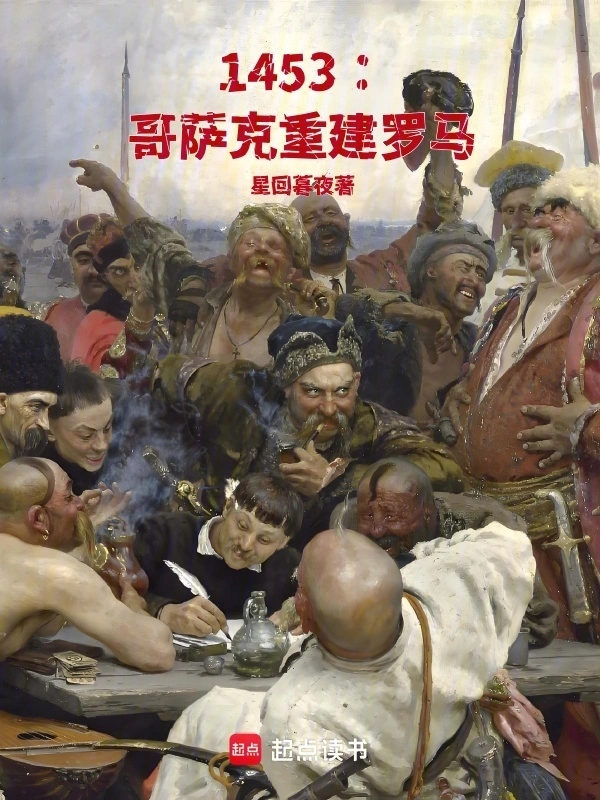
1453: Cossacks Rebuild Rome
1453:哥萨克重建罗马
- Status
- Completed
- Length
- 1.3M Words
- Genre
- Historical
- Audience
- Male
- Subgenre
- Foreign History
- Updated
- 3mo ago
- Source
- Qidian
Stats
1Monthly votes
3.6kRecommends
9.1kFans
619Chapters
Tags
Synopsis
Reader comments
Readers also read
 Red Mansion: Start Escaping and Farming from the Equipment Bar
 Fu Ming 1627
 After Lying in Bed for Three Years, He Was Forced to Help the Han Dynasty
 Northern Qi, Sage Khan
 Siheyuan: Start by Picking up Attributes
 Greece Recasts Rome
 Make Habsburg Great Again!
 Beastmaster: I Can See the Evolutionary Path
 Immortal Who Seizes the Body
 I Am a Daimyo in Japan
 Japan's Warring States Period: the Rise of the Wakasa Tiger
 Persian Empire 1845
Ukrainian Cossacks - a group of people without a home
Seriously speaking, the Ukrainian Cossacks are not a single nation, but a profession, or a special organization of some nature that was formed spontaneously. It is a group-warming organization composed of a group of exiled disadvantaged groups from neighboring ethnic groups. But their fate was to surrender to Poland first and then to Russia, but neither one was considered the motherland in the true sense. The Russians' attitude towards them was just to use and defend them, just like the Oroqen people in the Qing Dynasty who made great military exploits for the Manchus, but today, the population of the Oroqen people is only about 9,000. The same is true for the Cossacks. They are both used and defended by Russia. No one regards them as their true own. This led to the tragedy of their modern separation. And the consequences are there for all to see.
The protagonist can completely replace Russia's ecological niche, become the third Rome, and become the Tsar of the Slavs
Share some beautiful pictures
As title
This book was very interesting for about 300 chapters, but once I got involved in Burgundy and succeeded the Shinra Emperor, the level plummeted, which really reflects the protagonist's stubborn and arbitrary mentality of an old man in his sixties or seventies. I really want to know if the protagonist can remember what he was fighting for in the first place. He has become a very pure traditional feudal aristocrat.
Can the protagonist Cossacks revive Rome by relying on the economy of the steppes? In the Byzantium 1444 book next door, the protagonist earned a lot of money from maritime trade 😢 to have the national power to conquer the Balkans and Anatolia. The steppes were very poor, and the protagonist probably would not have the money to conquer Anatolia in his lifetime.
According to the evaluation, it is a bit rough. The biggest problem of the whole book is that the narrative is confusing. There is often a stick here and a hammer here and there. Although it can always be connected, the writing is insufficient and it seems very fragmented. As I read, I wonder, where is my protagonist? Where is the protagonist's wife? Where is my brother? What about the character I just met? How come you changed to a new role? Secondly, the identity of the protagonist is really confusing. Is he really the emperor? No matter how powerful a force is, it can step on it. For example, the grandson is under house arrest and the son is imprisoned. After reading this, I thought that finally, the Cossacks are going to go crazy, kill, kill, kill! I wanted to see blood flowing like a river, but after a few days of siege, the people were starving, so they released your son, and then carried out a painless disciplinary war... The king of France, why did the Sultan slaughter the city when he wanted to? Others are afraid when they think of them, but your protagonist and others are indifferent. Is this really a Roman emperor? Really the Cossack leader? Then there are the Cossacks. At the beginning, the author always emphasized that the Cossacks were free people, enemies of the nobility, and wanted to liberate the serfs. Then the protagonist became a co-emperor, and further became the Roman emperor. Okay, no problem, it makes sense, but the protagonist increasingly doesn't want to be a Cossack and relies more and more on Machiavellian tactics. Of course, it's cheap to use Machiavellian tactics to solve the problem, but you have to write it happily. It turns out that the French Machiavellian player is better than you, and you still play with him on the chessboard. Don't ask, asking is about farming, and your son has been assassinated. Hey, dad wants to farm, and there is nothing he can do... No, let's just say that you are the only heir, and you have been married to a wife for more than 200 chapters without showing your face. You are the only son, and even if you were assassinated, you would not even fart like a Roman emperor... Just keep farming 🤔 In the final plot, the writing of the war is very poor. Most of the supporting characters are fooled, fell into the trap, and the supporting characters kneel down... The key is that your own main character is the same. It was written in the 15th century, thinking about the 17th century. Was France that strong? France in the 15th century The Chinese dragoons dismounted and beat the Polish hussars to death. I would never dare to do this. This is the French army from World War I. Are the matchlocks so powerful? Two thousand hussars and even two thousand wild boars can defeat them... Summary, fictional historical article, you can read it if you are interested. Look, if you want to watch the Cossacks kill everyone, you can basically read the free chapter I still want to complain about the protagonist, the father of the Cossacks, the Emperor of Rome, the Emperor of the Holy Roman Empire, the leader of Eastern Europe, the destroyer of the Ottomans, the conqueror of Russia, and Caesar is still alive. Such an awesome character, how dare you kidnap his son and imprison his grandson. The child's mother didn't even show her face. His mother directly summoned the Cossacks to beat him. I thought it was well written, but it turned out that this person was not found... Barbarians fear power but not virtue. The protagonist has no majesty and moral character that is not admirable. At least the author did not show it.
My own review, purely personal understanding
The stereotype is too great. The chapter about the Ming Dynasty made me even more happy. It's no wonder it's the fourth child. In the comment section, it was said that Zheng He should support Rome, haha.
After reading a little bit, the federal constitution is really terrible. How could we do it without centralization of power in that era? It was time-consuming and labor-intensive.
It's quite curious. In the era of centralized monarchy and dictatorship, many authors thought of a constitutional republic and rebelled against Tiangang. I'm thinking that without enough productivity, you can't even make the bourgeoisie, let alone red. If you build a constitutional republic and give away so many rights, who will take them away in the end? Burghers and peasants? These two classes were not too weak compared to the nobles during this period. In the end, weren't their rights taken away by the nobles? A typical example of doing this in the Internet is Bo Li. If you want to be as brilliant as you want, you will end up on the roadside. I just don't understand it. I can understand your idea of federal enfeoffment, but I really don't understand your lack of centralization and autocratic monarchy. The emergence of absolute monarchy has its own reasons, whether in the East or the West. Autocratic monarchy and centralization of power are an absolute symbol of progress during this period. You are turning against Tiangang to establish a constitutional republic. So how do you achieve centralization? Don't you think about some ideas and things and consider the productivity structure at that time? Don't you think about the difference in power between classes? Many things are destined to come slowly and not in a hurry.
As shown in the picture Black Sea Rome😋😋😋
How's it going
When writing about Cossacks, don't insert Eastern history, which can easily lead to drama. You must write about the Cossacks' pursuit of freedom.
Cossack classic
rt
The king is under the law, which simply provides legitimacy for the emergence of powerful ministers.
When you spit it out of your embroidered mouth, you get half a Zaporozhye
What beautiful words😭
It starts to get better around chapter 20
The farming development in the front is a bit jumpy, and I can't immediately understand what the author wants to express. Later, when the protagonist enters the castle to defend the city, it is smooth and comfortable to watch.
Take care, brothers, take care Take care, brothers, stay alive Follow our leader, don't be sad
Share some maps
rt
Have some doubts
I quite agree with the promotion of military democracy. But when you write about Cossacks, can you please stop using Chinese units of measurement? From the moment you choose military democracy, your readership cannot be the traditional history department readers. Please figure out who your readers are. When I saw that you said you were promoting military democracy, I planned to read it, but the first five chapters were too dramatic.
Cossacks
Cossack Soldiers
Rough drawing
Pink represents the sphere of influence of the Cossacks
Mary of burgundy
Mary (French: Marie; Dutch: Maria; February 13, 1457 - March 27, 1482), Duchess of Burgundy, ruled many territories including the Duchy of Burgundy since 1477, which are now mainly located in France and the Low Countries. The only daughter of Charles the Bold, Duke of Burgundy, and Isabelle de Bourbon, Marie inherited the duchy when her father died at the Battle of Nancy on 5 January 1477. Because most of her territories were very prosperous and wealthy, she was also called "Rich Mary" In 1482, Lord Adolf of Ravenstein, who lived in Kasteel van Wijnendale, organized a forest falconry near the castle. Mary, who loved horseback riding, participated in the hunt accompanied by the court knights and her husband. But Mary's horse tripped on the way and she was thrown into a ditch, where her back was broken. A few weeks later, on March 27, Mary died of internal injuries, leaving a detailed will. On April 3, 1482, Mary was buried in the Frauenkirche in Bruges.
Cossack Ode
We are not soldiers, we are wildfire cut by the Don River; not subjects, we are riders chosen by the wind. The horse's mane is curled with snow, the scabbard is filled with moonlight, our family tree is written on the saddle - one line is towards life, the other is towards death, in the middle is the backbone that never bows its head. The Tsar gave us land? No, it was us who used machetes to dig out our homes from the frozen soil. The church gives us icons? No, it is us who use the ashes to draw our own gods on the church walls. "Obey!" – they said. We laughed, rolled the edict into a cigarette, lit it, and watched it turn into a gray butterfly on the bonfire. The Tatar's horsewhip The Poles' spear, The Turkish warship, Moscow's iron chain... They all wanted to tame this steppe wolf. But the Cossack's reins are tied only to the free neck. Today, some people call us the remnants, the ghosts of the old era. But as long as there are still people who say "no" in the face of power, who pull out the sword of sound in silence - Cossacks are not dead. Listen - That's not the wind blowing over the reeds, it's the hooves of a thousand-year-old horse, still galloping in the center of the earth.
Is there any reply from the Cossack classic?
I haven't watched much yet, I just want to ask if there is a Cossack Classics segment
😂The whole of Eastern Europe is basically integrated
However, the national strength of the Cossack Federation itself is still not enough. The protagonist only has actual control. Ukraine's population is seriously insufficient. The development of Ukraine itself cannot be accomplished in a few years or more. As for national integration, it is even more difficult.
I finally came across a book about Cossacks. I had thought about writing one myself, but ended up writing 10,000 words and couldn't finish it. The main reason is that it cannot describe the daily life of the people of that era.
Current situation of European countries
Workers have been oppressed and tortured
I've saved more than fifty chapters and it's time to eat 😆
So what is the protagonist's purpose?
Louis XII
Louis XII (Louis XII, June 27, 1462 - January 1, 1515), the eighth king of the Valois dynasty of France (reigned from 1498 to 1515), was born in Blois. Originally Louis II, Duke of Orleans, succeeded the throne of Charles VIII in 1498 and founded the Orleans line of the Valois Dynasty After Louis XII came to the throne, he reformed the judicial system and finalized the codification process of customary law in 1499: nearly 20 general customary laws were completed through the issuance of codification letters, drafting and review, and convening of three-level conferences. He was called the "Father of the People" for reducing taxes, but Machiavelli listed him as a typical failed monarch in "The Prince". In 1499, he conquered the Duchy of Milan, and in 1500 signed the Treaty of Granada with Ferdinand II to carve up Naples. In 1511, it was opposed by the "Holy Alliance" formed by Pope Julius II. In 1512, it defeated the alliance army in the Battle of Ravenna. When it attacked Milan the following year, it was defeated by Swiss mercenaries and withdrew from the competition for Italy. According to the rules of succession of the Salic Code, the throne was inherited by his son-in-law François I
Jeanne
Jeanne de France, Jeanne de Valois, April 23, 1464 - February 4, 1505, was the daughter of King Louis XI of France and Charlotte of Savoy. He suffered from a hunchback and limp due to spinal curvature in his childhood. He was educated by Francois de Lineres and his wife, and learned poetry, mathematics and religious knowledge. In 1476, under the coercion of his father, he married Louis, Duke of Orleans (Louis XII). When Louis was captured during the 1488 rebellion, Jeanne took charge of his territory and worked hard to rescue her husband. After Louis XII succeeded to the throne in 1498, he applied for an annulment of his marriage on the grounds of infertility, which was approved by the Pope; Jeanne was appointed Duchess of Berry. After retreating to the Principality of Berry, she founded the Sisters of Notre Dame and served as the first abbess. On May 28, 1950, he was made a patron saint by Pope Pius XII.