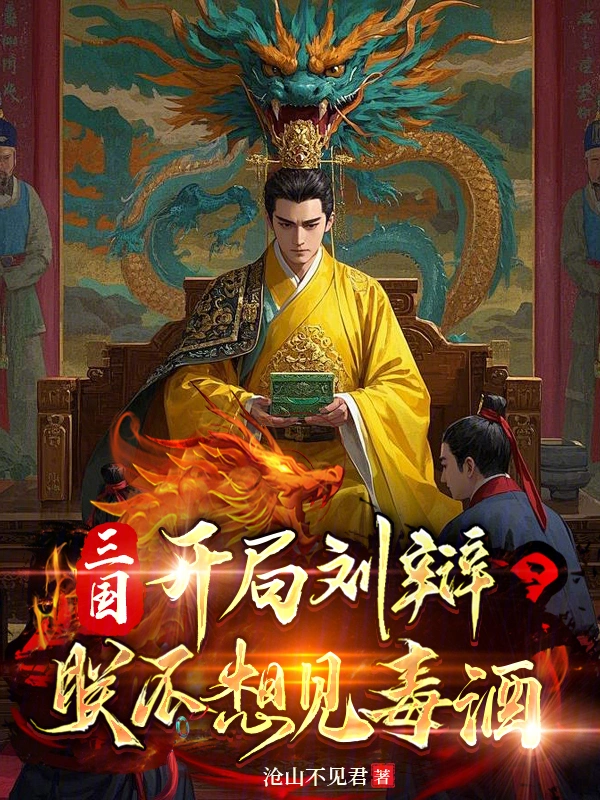
Three Kingdoms: Liu Bian at the Beginning, I Don't Want to See Poisonous Wine
三国:开局刘辩,朕不想见毒酒
- Status
- Completed
- Length
- 73k Words
- Genre
- Historical
- Audience
- Male
- Subgenre
- Qin-Han & Three Kingdoms
- Updated
- 1y ago
- Source
- Qidian
Stats
0Monthly votes
205Recommends
4Fans
30Chapters
Tags
Synopsis
Reader comments
Readers also read
 Talker in the Song Dynasty
 1914 Begins with the Rejection of the Schlieffen Plan
 Please Call Me Your Majesty the Tsar
 In the Red Mansion: Escort Daiyu to Beijing at the Beginning
 Never Walk Alone!
 Puppet Xiandi, I Want to Conquer the Three Kingdoms
 I Am Lord Xinling
 Daming: Have I Become Wanli's Portable Grandfather?
 I Am Drawing a Hot-Blooded Episode in the Zhiyu Episode!
 I Am a Rebel in Montenegro
 Daming: Emperor Chenghua Is Here to Ascend the Throne First!
 I Want to Revive the Tang Dynasty!
Most of the children of the aristocratic families still have feelings for the Han Dynasty, and they will not change dynasties. If the Han emperor had no appeal, Cao Cao would not have to control the emperor. Yuan Shao would not occupy the four states and still obey the Han Dynasty. Yuan Shu proclaimed himself emperor and was quickly defeated. Everyone has been eating the rice of the Han family for generations. They had no choice but to serve as the second master. Cao Cao purged the Liu family. After all these years, the loyal minister still wants his son to usurp the throne, but he is not sure whether his usurpation can win the support of the nobles and the common people. As for Cao Cao's death as a Han official, it is just a joke. As long as the protagonist is willing to protect the interests of the noble tribe and show his ability, most Han officials will support the protagonist. After all, everyone is learning the way of Confucius and Mencius, not the shameless guys of the Wei and Jin Dynasties.
Cao Cao wrote: "White bones are exposed in the wild, there are no roosters for thousands of miles, and there are more than a hundred people alive, and the thoughts are heartbreaking." When he felt compassion for others, did he ever think that he was the biggest initiator? There were few princes in the late Han Dynasty who did not burn, kill, loot and massacre the people, but Cao Cao was definitely the most cruel, vicious and demented. He was a habitual criminal who massacred the city, trapped and killed prisoners, and slaughtered the living for military rations. In terms of cruelty and human-like appearance and animal-like heart, Dong Zhuo was no match for his shoes. You can criticize Liu Bei's morality because no one is perfect, but you can't criticize Cao Cao because he is a beast who doesn't understand human nature.
Author, there is something wrong with your introduction.
First I wrote the honorific title Zhongzu, and then I wrote the temple name Xianzong. But Zhongzu is the temple name, and Xianzong is also the temple name? Posthumous titles such as Gao Wen and Jingwu are posthumous titles. In addition, the so-called honorific titles are given to the emperor while he is still alive. Of course, they can also be honored after death. For example, Li Yu's honorary title is Baoyingyuan Shengwenwuxiao Emperor. Take Li Longji as an example: Ji Ge's temple name is Xuanzong, his honorary title is Zhidao Great Sage..., His posthumous title is Ming, and his reign title is Xiantian, Kaiyuan, Tianbao. Similarly, there was such a distinction in the Liu Bang period, but there was no such thing as a title. The title at that time was a respectful title for the posthumous title. For example, in the Han Dynasty, the title Gao Emperor actually meant the posthumous title Emperor Gao, and the temple title was Taizu; even if the person was granted the title, since Liu Bang was both the first recipient and the first recipient, the recipient could also be called Gaozu. The temple name of Yin Taizu Chengtang was also Taizu, but in oracle bone inscriptions, he was often referred to as Gaozu because of his status as the person who was appointed. He was also the first person to be ennobled and the first person to be appointed. The so-called Taizhong and Gaoshi are the four original temple names. Zhong means the Lord of ZTE, Gao means the Lord who was appointed, Tai means the Lord who was granted the title, and Shi means the founder of dynasty history (referring to bringing the dynasty into a new stage of development), and the author has a problem here - if the protagonist the author writes about is the Lord of ZTE If so, then why should we add the name of the temple to the ancestor, and also add an ancestor to the title? You must know that the ancestor has pioneering achievements. As the saying goes, the pioneering achievements are the ancestors, and the virtues of maintaining the achievements are the ancestors. Especially in the Eastern and Western Han Dynasties, when temple names and posthumous titles were very strict, it was impossible to get all this wrong, right?
It's okay, but don't worry about your Dong Zhuo's granddaughter. Just write me a plot of power and hegemony. Don't fetter the love between children. What I want to see is the fight at the palace gate!
Keeping Liu Xie in Beijing will make it more difficult
### **Suppose Liu Bian takes Huangfu Song and He Miao's army away from Beijing: Should he take Liu Xie with him? ** #### **1. Background and core issues** Before Dong Zhuo enters Beijing, if Liu Bian, the young emperor of the Han Dynasty, chooses to unite the armies of Huangfu Song (famous general) and He Miao (relatives) to evacuate Luoyang early, he will need to weigh whether to bring his younger brother Liu Xie (Emperor Xian of the Han Dynasty) with him. This decision involves complex factors such as political legitimacy, military risks, and subsequent strategic layout. --- ### **2. Analysis of the pros and cons of bringing Liu Xie** #### **1. Advantages** - **Consolidate political legitimacy** Liu Bian is the eldest son of Emperor Ling of the Han Dynasty and the de jure emperor. Liu Xie is his younger brother. If the two go together, it can prevent Dong Zhuo from controlling Liu Xie and setting up another puppet and maintain the integrity of the royal authority. Liu Bian and Liu Xie can strengthen his image as a "defender of orthodoxy" and facilitate subsequent calls on princes to serve the king. - **An excuse to weaken Dong Zhuo's abolition** The core logic behind Dong Zhuo's abolition of Liu Bian and the establishment of Liu Xie is that "the emperor is incompetent." If Liu Xie is not under his control, it will be difficult for Dong Zhuo to gain legitimacy through the abolition ceremony. Liu Bian and Liu Xie leaving Beijing together could deprive Dong Zhuo of his key bargaining chip to interfere with imperial power. - **Concentrate royal resources** Two people traveling together can avoid the dispersion of power. If the armies of Huangfu Song and He Miao can protect the two princes, they can form a "double insurance". Even if one party is in danger, the other party will still have the blood of the Han Dynasty. #### **2. Risk** - **Intensified military burden** Carrying Liu Xie and his entourage (such as eunuchs and civil servants) may slow down the march and increase the risk of being pursued by Dong Zhuo's Xiliang cavalry. Although Huangfu Song was good at fighting, his military strength may not be able to compete with Dong Zhuo's elite. - **Hidden dangers of political division** If Liu Bian and Liu Xie are both outside, Dong Zhuo may establish another clan (such as Liu Yu) as emperor, creating a "dual court" situation, leading to the further collapse of the authority of the Han Dynasty. --- ### **3. Analysis of the pros and cons of keeping Liu Xie** #### **1. Advantages** - **Contain Dong Zhuo's attention** If Liu Xie stays in the palace, Dong Zhuo needs to give priority to controlling Luoyang and the emperor, which may delay the pursuit of Liu Bian and buy time for the latter to consolidate local forces. - **Reduce the risk of escape** The lightly-armed and simple Liu Bian army is more likely to operate covertly and avoid large-scale encirclement and suppression caused by carrying the young emperor. #### **2. Risk** - **Liu Xie became Dong Zhuo's puppet** Historically, Dong Zhuo controlled the government by abolishing Liu Bian and establishing Liu Xie. If Liu Xie is controlled by Dong Zhuo, his legitimacy will be exploited by Dong Zhuo, and Liu Bian's "King of Diligence" action will lose its moral advantage. - **The split of the Han Dynasty is irreversible** The situation with Liu Bian outside and Liu Xie included may lead to differences among the princes in the objects of support (for example, Yuan Shao once wanted to establish Liu Yu), accelerating the collapse of the authority of the Han Dynasty. --- ### **4. Decision-making suggestions: Liu Xie should be brought along** #### **1. Core logic** - **Legitimacy is higher than short-term risks** In the chaos of the late Han Dynasty, political legitimacy was the key to uniting people's hearts. If Liu Bian abandons Liu Xie, it will be tantamount to acknowledging Dong Zhuo's control of imperial power, and the appeal of his own exiled regime will be greatly weakened. Even if military pressure increases, preserving Liu Xie can ensure that the legal system of the Han Dynasty is not completely usurped by Dong Zhuo. - **Dong Zhuo's threat of "abolition of the establishment" needs to be completely eliminated** Once Liu Xie falls into the hands of Dong Zhuo, the latter will inevitably repeat the drama of abolishing the establishment. Liu Bian and his brother left Beijing, which could directly disrupt Dong Zhuo's plan and force him to face the dilemma of "no emperor to establish" (unless he found another clan), thus weakening the foundation of his rule. #### **2. Practical strategy** - **Split troops to cover, attack in the east and attack in the west** Huangfu Song led the main force to escort Liu Bian and Liu Xie to the east of Guandong (such as Yuzhou and Yanzhou), while He Miao pretended to stick to Luoyang or pretended to defect to Dong Zhuo to distract the Xiliang army. - **Unite local forces** In the name of Liu Bian, he secretly trusted Yuan Shao, Cao Cao and other powerful people in Guandong, asking them to join in and form a coalition army. The coexistence of Liu Bian and Liu Xie can enhance the legitimacy of the princes' "Qinwang". --- ### **5. Deduction of historical trends** #### **1. Short-term impact** - Dong Zhuo loses the opportunity to depose and may forcefully support other clans (such as Liu Yu), but this will cause greater controversy. - Liu Bian established a temporary court in Guandong and formed a confrontation with Luoyang controlled by Dong Zhuo. The eighteenth princes' rebellion against Dong may break out in advance. #### **2. Long-term impact** - **Survival of the authority of the Han Dynasty** If Liu Bian successfully integrates the forces in Guandong, it may delay the demise of the Han Dynasty and even form a confrontation between the north and the south (similar to the Eastern Jin Dynasty). - **Liu Xie's political role** Liu Xie, as the "preparatory emperor", may have a power conflict with Liu Bian as an adult, but as a "co-leader" in his childhood, he can temporarily stabilize people's hearts. --- ### **Conclusion: Liu Xie must be taken away** Retaining Liu Xie may seem to diversify risks, but in fact, it will hand over the legal system of the Han Dynasty to Dong Zhuo. Liu Bian needed to take "preserving the royal bloodline" as his highest goal, rely on Huangfu Song's military capabilities and He Miao's relatives' resources, lead Liu Xie to break out of the encirclement, and reestablish political power in Guandong. Although this move is risky, it is the best solution to avoid the complete collapse of the Han Dynasty.