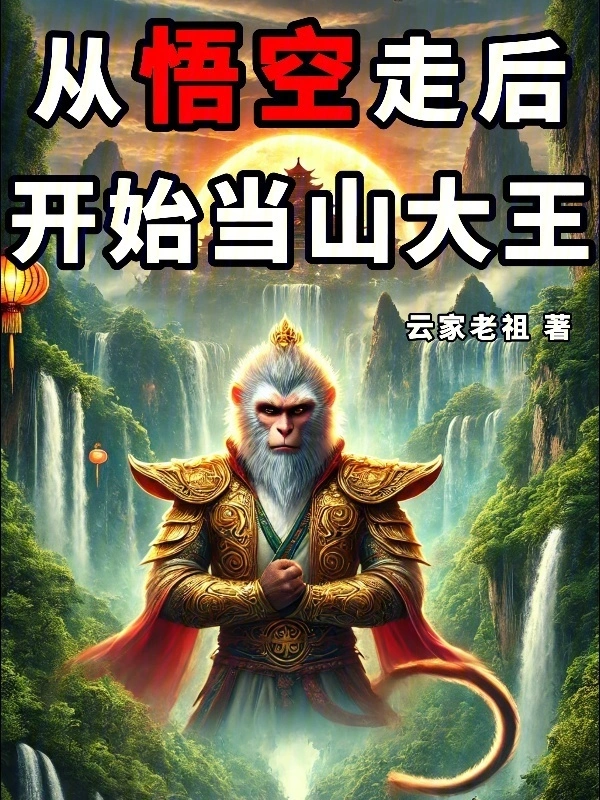
After Wukong Left, He Started to Be the King of the Mountain.
从悟空走后开始当山大王
- Status
- Completed
- Length
- 130k Words
- Genre
- Cultivation
- Audience
- Male
- Subgenre
- Mythic Cultivation
- Updated
- 1y ago
- Source
- Qidian
Stats
0Monthly votes
6Recommends
0Fans
62Chapters
Synopsis
Reader comments
Readers also read
 Xuanjun
 Your Magic Weapon Version Is Too Low!
 Guixuxuanji
 Immortal Travel
 Never Walk Alone!
 Night Without Borders
 How Can You Become an Immortal If You Don't Have Money?
 Daming: Have I Become Wanli's Portable Grandfather?
 I Am Drawing a Hot-Blooded Episode in the Zhiyu Episode!
 Corpse Hunter
 Sword and Candle Wilderness
 In the Name of Supernatural Power
 You Have Been Chosen
Author's self-comment: The legend of Huaguoshan from a new perspective
Writing the novel "Becoming the King of the Mountain After Wukong Left" was a journey full of challenges and explorations for me. "Becoming the King of the Mountain After Wukong Left" is a story I wrote with enthusiasm and some bold ideas. This is not only a continuation and tribute to the classic "Journey to the West", but also a reinterpretation of traditional myths and heroic stories. "Journey to the West" is a treasure of Chinese culture. The image of Sun Wukong as the Monkey King and the Monkey King is deeply rooted in the hearts of the people. His rebellious, unyielding and brave spirit has inspired countless people. However, in my story, what I try to explore is: what happens if the unknown hero gets tired and even regrets his choices? The Sun Wukong in the story, after experiencing various "arrangements" from heaven and Buddhism, gradually became suspicious of those glories. As a fighting and victorious Buddha, although he has a divine status, he has lost the free-spirited Monkey King he once was. He misses Huaguoshan, the real "home" that originally belonged to him. And this is also a core proposition that I hope to explore in the novel: When a person (or monkey) pursues a seemingly brilliant goal, does he really get a sense of belonging in his heart? Or is there only loneliness and regret at the other end of the glory? Of course, this story is not only about Wukong's reflection. More importantly, it tells the story of the rise of a new "mountain king". The protagonist is a modern person who travels to the world of Journey to the West with a contemporary perspective and wisdom, inheriting the Monkey King's legacy. This protagonist is not a born hero, but an ordinary person who is given the responsibility to change the fate of Huaguo Mountain. But he not only continues Sun Wukong's path, but uses his own way to explore, resist, and create his own legend. While writing this book, I realized the profound meaning of the identity of "King of the Mountain". In the world of Journey to the West, monsters compete to become "mountain kings", seemingly to occupy a territory, but essentially to find a sense of belonging and self-identity. Isn't this the case for us in modern society? Whether it is in the workplace or in life, we are constantly striving for our own position, trying to find our own "hill". Through the growth of the protagonist, what I want to express is that everyone can become their own "king", but this process does not mean imitating the success of their predecessors, but finding a path that suits and belongs to them. After inheriting Sun Wukong's power seeds, the protagonist did not blindly follow Wukong's footsteps, but used the wisdom and adaptability of modern people to open a new path of growth. At the same time, this story also has a hint of "what if" reflection. What would have happened if Sun Wukong had not left Huaguo Mountain? This is a kind of "regret" emotion that everyone will have after making an important decision. After accepting this regret, my protagonist redefined the future of himself and Huaguoshan. Just like in life, we cannot change the past, but we can create a better future through acceptance and reflection. I hope that when readers read this story, they can not only feel the fantasy and passion of the world of Journey to the West, but also find a resonance with life in the protagonist's experience. Everyone will feel uneasy and confused when facing unknown challenges, but as long as they take that step bravely, they will find that they can become the "King of the Mountain" like the protagonist.
Investment is welcome, and it is guaranteed to exceed 3,000 words for 30 consecutive days.
Please invest, collect, read, and give recommendation votes! Please recommend this book to your friends! Thanks! ! ! This book is scheduled to be updated twice a day, at 12:18 noon and 8:18 pm. I wish every reader will post again and become a winner in life!
CCTV's 86 version of Journey to the West's treatment of Water Curtain Cave is a bit crude and crude
CCTV's 86 version of Journey to the West treated the Water Curtain Cave a bit simply and crudely. The description of the Water Curtain Cave in the original text is as follows -------------------------- You see him crouching down with his eyes closed, vertically jumping into the waterfall spring, suddenly opening his eyes and looking up, there is no water or waves, there is a clear bridge. He paused, calmed down, and looked carefully again. It turned out to be an iron bridge. The water under the bridge rushed through the stone holes, flowed out upside down, and closed the bridge door. But it also lacks a bridge. When we walk and look again, it looks like someone is living there. It's such a good place. But see that: The green moss is piled with blue, the white clouds are floating on jade, and the light shakes pieces of haze. A quiet room with empty windows and flowers on the sliding bench. The dragon ball in the breast cave hangs (34), and the place is full of strange flowers. There are traces of fire beside the pot and stove, and there are residues of food left on the table by the bottle (35). The stone seats and beds are so lovely, and the stone basins and bowls are even more impressive. I also saw one and two poles repairing bamboo, and there were three and five plum blossoms. There are several green pine trees that often bring rain, and it looks like a home. After watching for a long time, I jumped over the middle of the bridge and looked left and right, only to see a stone slab in the middle. There is a line of large characters in regular script on the stone tablet, which is engraved with "The blessed land of Huaguo Mountain, the water curtain cave and the sky." The stone monkey said: "No water, no water! It turns out to be an iron bridge, and on the other side of the bridge is a property made in heaven and earth." The monkeys said: "How can it be a property?" The stone monkey laughed and said: "This bridge The water flows through the stone opening under the bridge and hangs down to cover the door. There are flowers and trees beside the bridge, which is a stone house. There are stone pots, stone stoves, stone bowls, stone basins, stone benches. On a stone tablet in the middle, there is an inscription "Huaguo Mountain Blessed Land, Water Curtain Cave Heaven", which is really where we stay. It is spacious and can accommodate thousands of people, young and old. We can all live here without being affected by the wind. There is a place to hide when the wind blows. There is no fear of frost or snow. The thunder is never heard. The strange flowers are growing every day. " -------------------------- In the article, I wrote about the Water Curtain Cave as follows: Yun Tiancheng felt a gentle force wrap around his body, and with a gentle push, he entered behind the waterfall. Open your eyes and look forward, you will see an ancient iron bridge. The stream passes under the stone bridge, hits the stone bridge and hangs upside down, like a curtain, tightly covering the entrance. Yun Tiancheng walked across the Iron Banqiao and walked forward. The sight in front of him surprised him. This is a small world with a particularly rich spiritual energy. It contains stone houses, mountains, rivers, flowers, plants and trees. Emerald green moss covers the blue stones, white clouds float gently in the sky like jade, and the light sways among the clouds. Beside the bridge is a huge stone house built on the cliff. Part of the stone house is exposed outside the cliff, while the larger part is hidden in the mountain. The windows of the stone house are ajar, and the house is quiet and peaceful. There are stone nests, stone stoves, stone bowls, stone basins, stone beds, stone chairs, stone stools, and wine vessels. Outside the house there are several green pine trees that carry rain and dew all year round, and you can also see a few slender bamboo poles and a few plum blossoms dotted among them. There is also a stone tablet standing in this small world, with a few words engraved on it: "Huaguo Mountain Blessed Land, Shuiliandong Dongtian." --------------------------------- In this description of Shuiliandong, I tried to retain the fantasy sense of the Dongtian Blessed Land in the original work, while incorporating some language expressions that are more relevant to modern readers. Although the presentation of Shuiliandong in the 1986 edition of "Journey to the West" has its own unique visual style, the delicate description in the original text is full of poetry and layering. I hope that through this text, the mystery and beauty of Shuiliandong will be revealed more naturally. First of all, I retained the core image of Shuiliandong as a hidden paradise in the original text, such as the setting of "the upside-down waterfall covers the entrance tightly like a curtain". This not only strengthens the mystery of the cave entrance, but also gives readers the visual impact of "pushing through the clouds and mist to see the sky" like a stone monkey. Secondly, in the description of the scene, I tried my best to have bright colors and rich layers, such as "emerald green moss covering the blue stones, white clouds floating gently in the sky like jade" and other scenes. The purpose is to create a small world full of aura within limited pen and ink, and at the same time make the color contrast of the scenery more intuitive and vivid. For the description of the details inside the cave, the stone houses and daily utensils, I want to convey that Shuiliandong is not only a refuge for monsters, but also a home suitable for long-term living - which echoes the stone monkey's feeling of "getting married and establishing a career". For example, the decoration of plants such as green pine, bamboo, and plum blossoms represents a natural normal cycle and vitality, echoing the eternity and tranquility of this paradise. But when I was processing it, I also realized that I was a little restrained in modern expression, and might not be able to fully present the fairy spirit and classical beauty of the "cave heaven and blessed land" of the original work. I focused on scenery and functional description, which to some extent weakened the poetry and mystery of the original text. This part may be an area that needs to be improved in the future, so as to make the description more charming and roomy. Generally speaking, although there is a certain display of emotion and imagination, it can still be better in terms of the poetry and mystery of the details.
Ao Guang, the Dragon King of the East China Sea, appears for the fifth time in Journey to the West. He loves and hates Sun Wukong.
Ao Guang, the Dragon King of the East China Sea, who appears five times in "Journey to the West", loves and hates Sun Wukong. This is an important background for me to design the scene in the Dragon Palace in my novel "Becoming the King of the Mountain After Wukong Left". --------------------------------- In Journey to the West, Ao Guang, the Dragon King of the East China Sea, appeared five times. The first time, the third chapter: Everyone is familiar with the scene of making a fuss in the Dragon Palace and getting the golden cudgel. In the end, the Dragon King's attitude was like this: "Wukong put on the golden crown, golden armor, and cloud shoes, used the wishful stick, and beat it out all the way. He said to the dragons: "Noise! Noisy! "The dragon kings of the four seas are very unjust, and they are discussing whether to submit a memorial to the table." The second time, Chapter 41: While walking, I saw a patrolling yaksha colliding with me. I saw it was Sun Dasheng, so I hurriedly returned to the Crystal Palace to report to the old dragon king. Ao Guang immediately led Long Zi, Long Sun, Xia Bing and Crab Soldiers to go out to greet him and invite him to sit inside. After sitting down, the ceremony was completed, and tea was served. In a moment, the Dragon Kings of the Three Seas rushed over and asked, "Brother, what do you want me to do?" Ao Guang said, "Sun Dasheng is here to use the rain to help defeat the demon." The third time, Chapter 45 In mid-air, the Dragon Kings of the Four Seas came together. The traveler shouted: "Ao Guang! Where are you going?" Then Ao Guang, Ao Shun, Ao Qin, and Ao Run came forward and saluted. The traveler told the previous matter again. Said: "I have worked hard in the past, but I have never succeeded; I hope you can help me with today's matter." The Dragon King said: "I obey my order, I obey my order!" The fourth time, Chapter 69 I saw a dark cloud rising due east, gradually approaching the top of my head. He shouted: "Great Sage, Ao Guang, the Dragon King of the East China Sea, is here to see you." The Dragon King said: "In that case, wait for me to squirt twice, spit out some saliva, and take medicine with him." The fifth time, Chapter 87 A dark cloud gradually fell in front of the hall, and it was Ao Guang, the old Dragon King of the East China Sea. Ao Guang collected the cloud feet, transformed into a human form, walked forward, bowed to the traveler and said: "The great sage called Xiaolong, where can I use it?" The traveler said: "Please get up. I am tired of you coming from afar, there is nothing else. This is Fengxian County, with drought for many years, why don't you come to rain?" The old dragon said: "The great sage Qi Shang learned that although I can make rain, I can't make rain. God sent people to use. God is not bad, how dare you come here to make rain without permission?" --------------------------- From these five appearances, Ao Guang's attitude towards the Great Sage can be clearly divided into two categories, one for the first time and one for the following four times. When Ao Guang, the Dragon King of the East China Sea, faced Sun Wukong for the first time, his attitude could be said to be both angry and helpless. At that time, Sun Wukong made a big fuss in the Dragon Palace and demanded the golden cudgel. As the Dragon King of the East China Sea, Ao Guang was originally a majestic overlord, but in the face of Wukong's strength, he was not only helpless to parry, but could only swallow his anger. The most important thing is that Wukong not only took the golden cudgel, but also wore the dragon king's treasure armor. The last sentence "Noisy! Noisy!" Completely ignored the dragon clan. It can be imagined that the atmosphere in the Dragon Palace was awkward and angry for a time. Although the Dragon Kings of the Four Seas were dissatisfied, they could only humble themselves and secretly discuss the matter to the heaven to seek justice. This experience was undoubtedly humiliating for Ao Guang. He is the mighty Dragon King of the East China Sea, but he is bullied by a monkey. It is conceivable that Ao Guang's heart should be full of anger, but due to the power relationship in heaven and Sun Wukong's growing strength, he can only suppress this anger temporarily. However, starting from his second appearance, Ao Guang's attitude towards Wukong has changed significantly. Ao Guang has shown respect and cooperation towards Wukong without exception. It can be said that the wind gets the wind and the rain gets the rain. The Dragon King behaves cautiously and thoughtfully. Even when he cannot directly make the decision, Ao Guang will patiently explain and propose feasible plans, showing his absolute cooperation with Wukong. In addition to compromising with the reality that the Great Sage is a powerful member of the scripture-seeking team that both Heaven and Buddhism attaches great importance to, I think there is a deeper reason: they are both demons, and the rise of Sun Wukong has gained face for the demons. Both are monsters, share glory As the Dragon King of the East China Sea, although Ao Guang has a lofty status, in the hierarchy of heaven, the dragon tribe is not at the top. Although he has the power to manage a body of water, the dragon clan's status is very low in the structure of the Three Realms. It is still a part of the managed area and must abide by the laws and restrictions of heaven. Sun Wukong was born into the demon clan. From causing trouble in the Heavenly Palace to later being named the Monkey King, he undoubtedly brought glory and power to the entire demon clan. Sun Wukong's troubles in Heaven were not entirely for personal gain, but to challenge the authority of Heaven and break through the rules of heaven that the demon clan has been suppressed. This makes many demon clans, especially the dragon clan, a race that is also bound by heaven, feel respectful. Although Ao Guang was insulted in the first confrontation with Sun Wukong, from the perspective of the demon clan, Sun Wukong challenged the heaven on his own and was able to escape unscathed in the end. He even received the orthodox title "Monkey King", which improved the status of the demon clan in the Three Realms to a certain extent. This undoubtedly gave the Monster Clan a breath of relief and forced Heaven to face up to the Monster Clan's power. Ao Guang's "love" for Sun Wukong Therefore, although Ao Guang was humiliated by Wukong, he had to admit that Sun Wukong's success had enhanced the reputation of the entire demon clan to some extent. Although he didn't want to admit it, he might have a little admiration for Sun Wukong in his heart. Sun Wukong's courage to defy heaven and his powerful strength that he later revealed repeatedly during his journey to the West made him a legend among the demon clan, and even a role model in a certain sense. As a member of the Monster Clan, Ao Guang may be secretly proud of this, especially since Sun Wukong's success has earned the Monster Clan a higher status and respect. Grudges are intertwined, and emotions are complex As a result, Ao Guang's feelings for Sun Wukong gradually evolved from simple hatred to a complex emotion of "love and hate". Hate is due to the humiliation; love is not only due to the compromise with reality, but also because Sun Wukong gained face for the monster clan. He had to admit that Sun Wukong's power and status had brought new hope and confidence to the demon clan, which allowed him to gradually shift from dissatisfaction to cooperation and even faint recognition when facing Sun Wukong. ------------------------------ It is based on this understanding that I designed the scene of Dragon Palace in my book.