


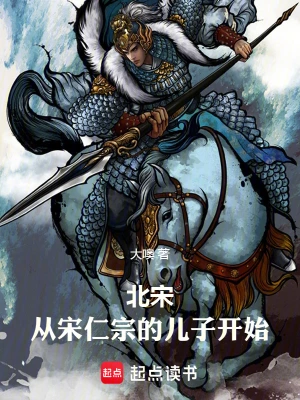
Northern Song: Starting as Emperor Renzong's Son
北宋:从宋仁宗的儿子开始
- Status
- Completed
- Length
- 1.1M Words
- Genre
- Historical
- Subgenre
- Song-Yuan-Ming Dynasties
- Updated
- 1y ago
- Source
- Qidian
Stats
393Chapters
0Votes
14.3kRecs
153.9kFans
Tags
Synopsis
More by this author
In booklists 3



Mark
None
78Books0Follows1yUpdated

The Rings of Time Are So Sleep-Inducing
I like humor, wit, and wild imagination.
43Books24Follows1yUpdated



Readers in a Slump, Come On In: Books for Seasoned Readers
An old web-novel addict who began reading online fiction in 2003. My tastes are demanding, and there are not many novels I enjoy. Below are the books I am following, shared with everyone. If you are suffering from a reading drought, why not take a look! Reading web novels is a way to relax and cultivate one's mood in one's spare time. I hope all fellow readers cherish and enjoy their time, and that my recommendations let you experience another life from the perspective of the protagonists while
10Books13Follows2yUpdated
Readers also read
 My Only Method: I Will Add More Points to Become Stronger at the End of Ming Dynasty
 A Guide to Building Civilization in a Primitive Tribe
 Daming: Asking for the Throne at the Beginning, Lao Zhule Went Crazy
 My Father Is Wen Tianxiang, and We Win the Battle of Yashan from the Start
 A Record of a Mortal's Journey to Immortality: I Earn Immortality by Grinding Achievements for Rewards
 In the Hongwu Era, Starting Out as a Rebel
 Is the Son of Heaven Born to Rule?
 Lord Evolution
 A Record of a Mortal's Journey to Immortality: Choosing Hextech in the Chaotic Star Sea
 The Ming Dynasty's First Brother-in-Law
 Emperor of the Great Song: 1066
 The Fierce Minister of the Great Song
 The Ming Dynasty's First Female Novelist
Reader comments 30
Google Translate
Song Renzong could be called a benevolent king, but he could not be called a wise king. He was a mess in martial arts. Spending money to buy peace was the fault of him and his father, which caused the whole country to lose its blood from top to bottom. Li Shimin spends money to buy peace, but will destroy you in a few years. This is the right thing to do, instead of being like an ostrich, burying your head in the soil and not seeing the danger. The so-called benevolence is more about having no opinion. As a leader of a country, it is terrible to have no opinion.
Do you really want to marry Gao Taotao? Gao Taotao was not only jealous and strong-willed, but also interfered in the government affairs, abolished Wang Anshi's new law, and supported Sima Guang in giving away the four states close to Xixia. This woman also had a share of the credit for the unending party struggle in the Northern Song Dynasty. The author must not marry her
The progress of the little brat part is faster, and the reader has a poor sense of immersion.
The Song Dynasty could have been saved before the end of the Southern Song Dynasty! The key is that there are people with money and people, but I don't know why they just can't help me.
Brother Xiaozi's writing is quite interesting, but it's just not enough to read.
Talk about Han Qi
To be honest, in the history books of the Northern Song Dynasty, Han Qi is always an unavoidable topic when writing about the two dynasties of Renzong and Shenzong. He supported the second emperor and supported the three emperors, and his political talents were extremely good. I saw a message in the comment area about Han Qi's military problems. The Battle of Haoshuichuan was indeed the shame of Han Qi's life. After Han Qi's defeat, it was rare to see people crying and summoning their souls along the way. But this does not mean that Han Qi is not good. This is not the first time that Han Qi and Ren Fu have cooperated. Before Haoshuichuan, Han Qi commanded Ren Fu to win a battle. In the defeat of Haoshuichuan, as the coach, he could not control his generals, which was indeed a problem. However, in the "History of Song Dynasty: Biography of Ren Fu", it is recorded that Han Qi specifically warned Ren Fu before the expedition. The original text is quoted below. Qi Jiefu and others joined forces and rushed from Huaiyuan City to Shengsheng Village to Yangmulong City, after leaving the enemy. The villages are only forty miles apart, and the roads are close to food and wages. If the situation is not ready to be fought, we will set up ambushes according to the danger and wait for them to return and attack them. This point is clear. Han Qi told Ren Fu not to underestimate the enemy and advance rashly, but Ren Fu didn't listen. The original text in "The Biography of Ren Fu" is also quoted below. Fu led thousands of Qingqi to Huaiyuan City to suppress Longchuan. He met the Zhenrong Army on the west road to inspect Chang Ding and Liu Su. They fought with the enemy in the south of Zhangjiabao and beheaded hundreds of people. The Xia people abandoned their horses, sheep, and camels and wandered north. They encouraged their cavalry to follow them, and Fu followed them. The spy reports that the enemy has few soldiers, so it is quite easy for him to defeat the enemy. In the evening, he and his army were stationed at Shuichuan, while Guan and Ying were stationed at Longluochuan. They were five miles away from each other in the mountains, and they planned to meet at the mouth of Sichuan the next day. The road is far away, and the money has been lost. The soldiers and horses have been without food for three days. After chasing to the north of Langgan City, they met the Xia army, followed the river, and came out from the foot of Liupan Mountain. They formed a formation five miles away from Yangmulong City. Needless to say, in the Battle of Haoshuichuan, Ren Fu's main force was completely wiped out. However, despite being ambushed and short of water and food, the Song army still maintained a one-to-one exchange ratio. It is said that Sima Guang, who was also a famous official in the Northern Song Dynasty, was a staunch advocate of war when he entered the official position. However, after a defeat, he asked his teacher Pang Ji to protect him from being dismissed from office, and he immediately became a leader of peace. Han Qi was able to realize his shame and then be brave. Later, he jointly proposed the Hengshan strategy with Fan Zhongyan and established the Song Dynasty's main battle strategy against Xixia. As for Han Qi and Di Qing, the relationship between the two was extremely good. After Di Qing passed away, Han Qi even wrote a eulogy for Di Qing, "In Memory of Di Xiangwen" "Mo Ji" is an unofficial history written purely for the purpose of blackmailing Di Qing. It records that Han Qi said to Di Qing that the person who sang the first prize outside the Donghua Gate was Nai Hao'er, but was cut off by the marketing account and became the person who sang the number one outside the Donghua Gate. Moreover, Han Qi killed Jiao Yong on the charge of deducting military pay. He was a warrior who drank the blood of soldiers. What was wrong with Han Qi killing him? The original meaning of "Mo Ji" is that Han Qi had legitimate reasons to kill. Not only should you, Di Qing, not plead for mercy, but you should also support it. It's Di Qing's fault that you begged for mercy. After all, you are known for your strict military management, but you have such a man under your command. You don't kill him but you still plead for him. It seems that you are just touting him. To sum up, I personally think it's okay to blame Han Qi. After all, that historical figure has more or less black spots. As far as Han Qi is concerned, you can say that he was the most tactful politician in the Qingli New Deal, you can say that he was dishonest to his friends (referring to Fu Bi), you can say that he insulted Shenzong based on his seniority, and you can say that he neglected politics in his later years. But if you want to criticize him, you must at least say it in a meaningful way. You cannot accuse the enemy in vain, or even compare him to the famous minister Qin Hui.
At such a young age, he has the qualifications of Emperor Taizong of the Tang Dynasty. This son must not be retained.
You want to be Emperor Taizong of the Tang Dynasty, but we don't want to be Wei Zheng. Let's bribe the palace officials and kill you with drugs while you are still young. This will save you the trouble. How can the military generals regain their power? On the contrary, Zhao Zhen will die in old age and his son will die. One more of you will not be much.
When the Jurchens of the Jin Kingdom raised an army with only 2,500 people, how did they defeat the two great empires of the Liao Dynasty and the Northern Song Dynasty?
When the Jurchens of the Jin Kingdom first launched their army and founded the country, they had only 2,500 people. These strong men who had been fighting wild beasts for many years in the primitive jungles of Northeast Asia, and who could fight bears, spines, and tigers with their own hands, quickly formed a heavy armored cavalry regiment after being lucky enough to seize the arsenal accumulated by the Liao Kingdom for hundreds of years. At that time, a thousand Jurchen troops dared to face the Liao army's 200,000 elite cavalry in a frontal attack. They even charged back and forth nine times with men, horses and armor. With such a powerful impact, no matter how strong the enemy formation was, they could be defeated by them. It can be called an unprecedented tiger and wolf army in the thousands of years of history of the Northeast Asian continent. Annihilating 200,000 of the most elite cavalry of the Liao Dynasty in one day, Wanyan Aguda, the founding emperor of the Jin Kingdom, was also a military genius with excellent tactical ability. He led his troops to offer sacrifices to the heavens and raised troops. When faced with the Liao army, one defeated a hundred. Wanyan Zongwang (桡利不) (??~1127): He is resourceful and brave, and is good at using troops according to the situation. When he was ordered to pursue Emperor Tianzuo of the Liao Kingdom, he suddenly encountered a hundred thousand Liao cavalry coming to fight. Wanyan Zongwang led only a thousand men and marched his army directly towards the Liao Emperor's headquarters, and actually defeated the Liao army and beheaded 80,000 Liao army cavalry After that, he killed Liao general Zhang Jue in the battle to the east of Yanjing City. In the Battle of Baihe, the Song general Guo Yaoshi's 70,000-strong army was defeated, forcing him to surrender. This allowed the Jin Kingdom to collect all the Yanshan Prefecture's army, including 10,000 horses, 50,000 pieces of armor, and 70,000 elite soldiers. After that, Wanyan Zongwang led the Jin army on the east route southward, defeated Zhending, conquered Xinde, captured Handan, occupied many strategic places in Hebei, and approached Bianjing. When the Jin army on the west route crossed the Yellow River, Wanyan Zonghan only ordered to beat the war drums all night, which frightened the 130,000 Song troops guarding the river and fled. In the first Bianjing defense battle, there were more than 400,000 soldiers of the Song Army gathered under the city. However, they were helpless against the 60,000 Jin troops of Wanyan Zonghan and Wanyan Zongwang. They did not dare to fight with them in the field, and only dared to defend with the city. The Song army finally launched a large-scale night attack with a sense of luck, and was easily defeated by the Jin army. The general Yao Pingzhong was so courageous that he abandoned the army and fled. Wanyan Zongwang defeated 100,000 Song troops in the Battle of Xiongzhou and killed more than 30,000 people. He defeated Song general Zhong Shimin's 70,000 troops in the Battle of Jingxing. After that, he reunited with Wanyan Zonghan at the foot of Bianjing City. Song Qinzong, who completely lost his will to resist, was forced to surrender and was captured together with Song Huizong, which was the "shame of Jingkang". Wanyan Zonghan (Nianhan) (1080~1137): In the battle of Daru Ancient City, he followed Aguda to defeat 270,000 Liao troops with more than 10,000 troops. He led his partial troops towards Bei'an Prefecture, and joined forces with Wanyan Lou's family to defeat King Xi and return to Libao. With 6,000 elite troops, he defeated the Liao Emperor's 50,000 elite cavalry, captured the West Road Prefecture and County of the Liao Kingdom, and combined their forces to capture Yanjing, forcing Xixia to defeat and surrender. Subsequently, with the assistance of two capable generals, Wanyan Loushi and Wanyan Yinshuke, Wanyan Zonghan led a 30,000-strong Jin army. In the Battle of Taiyuan, he constantly encircled and mobilized for reinforcements. Using the so-called "Mopan tactics", he annihilated the main force of the elite Western Army of the Song Dynasty, a total of 250,000. He killed the famous Song army general Zhong Shizhong and captured various state capitals in the strategically important Hedong and Hezhong areas. In the Battle of Qianqiu Town, 200,000 Western troops were arrayed outside the city. Wanyan Zonghan sent two capable generals, Wanyan Loushi and Wanyan Yinshuke, to lead more than 10,000 cavalry to attack. In half a day, they defeated the most elite Western troops in the Song Dynasty and beheaded 100,000 people
The peasant uprising in the Song Dynasty is at best a rumor. In fact, it is because the era is relatively recent, there are many historical materials, and most of them are just the level of gathering people to make trouble, and there is no such level as the Yellow Turbans and King Chuang. In terms of quantity, there were hundreds in the Hongwu period alone, but they were not serious.
In the Northern Song Dynasty, the Jin State besieged Tokyo twice in a row. The second time Song Weizong and others surrendered and announced the demise of the Northern Song Dynasty. To be honest, the demise of the Northern Song Dynasty is very funny. The soldiers and people below resisted to the death and pushed back the Jin soldiers. The emperor took the lead After surrendering, Zhao Gou went even further and killed all the generals who had won the battle such as Yue Fei. What a weird behavior. It was the same with the Jin Kingdom. Wan Yanliang killed the meritorious generals of the Jingkang Jin Kingdom. What a weird behavior.