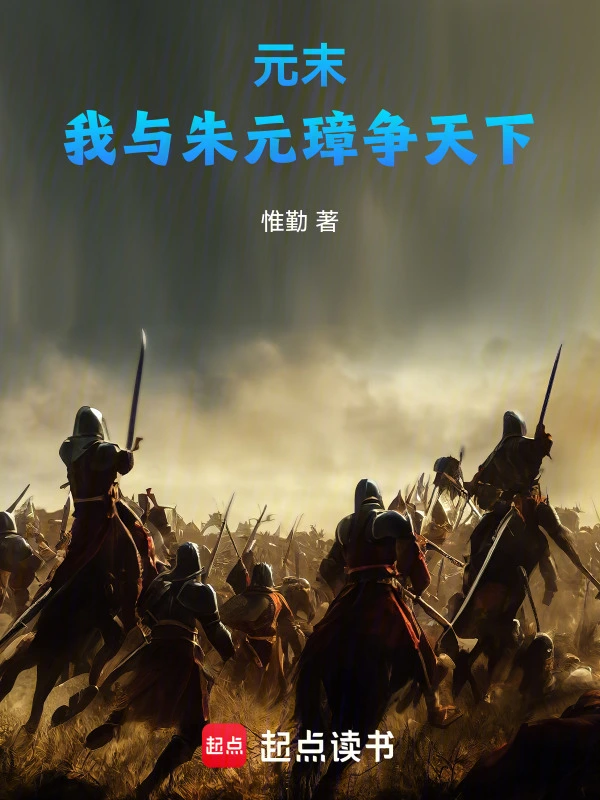
At the End of the Yuan Dynasty: Zhu Yuanzhang and I Compete for the World!
元末:我与朱元璋争天下!
- Status
- Ongoing
- Length
- 1.2M Words
- Genre
- Historical
- Audience
- Male
- Subgenre
- Song-Yuan-Ming Dynasties
- Updated
- 20h ago
- Source
- Qidian
Stats
6Monthly votes
1.8kRecommends
3.6kFans
489Chapters
Tags
Synopsis
Reader comments
Readers also read
 Corpse Disaster 1916
 Chronicles of the Red Mansion
 An Important Town in the Residual Tang Dynasty
 In the Ming Dynasty, the Days When the Cows and Horses Turned Over
 LOL: I Just Started Playing Professionally, and You Said the League Is in Trouble
 Gou Qin
 Anti-Qing: Start by Kidnapping Shi Dakai!
 Simultaneous Time Travel: Become a Legend Before the Plot Begins
 Start by Saving Manchester United
 I Am a Great Power
 Late Jin Dynasty: from Two-Legged Sheep to Human Emperor
 Ming Dynasty959
The reasonable party can gather here!
I have a problem with reading books. I like to consider rationality within my own cognitive scope. Whether it is a time-traveling historical genre or a fantasy cultivation, at least don't be ignorant in a large area. Then what I say is that I think the book I wrote talks about the brain, which is more reasonable. So I will check the information. Some of the information is directly grafted into the novel. I don't know if it is very blunt. But after all, with limited energy and knowledge, it is impossible to write a very professional technical explanatory text. Also, this is my first time writing a novel, so please forgive me for my poor writing style.
As an enemy of Zhu Yuanzhang, we cannot fail. Failure means that we will all be demoted to low status. It would be too miserable for hundreds of years.
The one-eyed dragon who competes in the world is Li Zicheng. I'm showing off today. You can't wear something like a one-eyed dragon, and you're a short-lived ghost. Is this causing trouble for readers?
Is it so funny? A one-eyed dragon conquers the world
Finally there is a novel about Zhu Yuanzhang competing for the world
In the troubled times at the end of the Yuan Dynasty, it was Xiao Ming Wang, Chen Youliang, Zhang Shicheng and others who mainly resisted the Yuan Dynasty, while the rebel army led by Zhu Chongba grew slowly behind. Bei Yuan fought with them like snipe and clam, and most of them were destroyed. Then he brought people to fishermen to make a profit, and finally liquidated Chen Youliang and others who had lost both sides with Bei Yuan and were anti-Yuan heroes. In the first year of Zhishun in the Yuan Dynasty, the measured territory was 13.72 Million square kilometers, starting from Dongyinghai in the east, Nanhai in the south, Tianshan in the west, and Hanhai in the north. In the Hongwu period, the land area was more than 4.5 Million square kilometers. Land was the basis of survival. Compare it. How big is the difference between the two?
When Zhu Yuanzhang first founded the country, the "people" of the Ming Dynasty also included farmers and grassroots military officers. However, as time went on, the dividends from the victory in the war and economic recovery at the beginning of the founding of the country were exhausted. However, the upper limit of the productivity level was placed here. If no more wealth could be created to be divided, what should we do? Is it possible that the ruling class should be collectively regarded as saints, and no one should eat more and take more? The only way is to eat up the two-legged beast and then start eating at the bottom of the ruling class. The gentry discriminated against poor families, the Song Dynasty annexed and annexed land to small landowners, and the Qing Dynasty kicked the New Han Army out of the Eight Banners. This is the reason. When a situation occurs like the new army in the late Qing Dynasty that turned into a stronghold of rebels, and during the Republic of China, even the sons of the gentry turned red in large numbers, the regime is not far from being over. So if we want to have a long-lasting political power, we still have to focus on industry. If we cannot create a surplus beyond agriculture, and without the distribution of new social wealth brought about by increased productivity, we will have no future if we just try to create "new farmland" and "new military households" in the agricultural economy.
There is no plug-in, how can you fight with Zhu Yuanzhang? Too much nonsense
"Research on the Military System of the Early Ming Dynasty" discusses Zhu Ming's founding of the country.
From the outbreak of war at the end of the Yuan Dynasty to the time Zhu Yuanzhang proclaimed himself emperor, it was only a short period of sixteen years. Zhu Yuanzhang's Red Army was originally a newcomer. After crossing the river, it occupied the metropolis of Jiankang. It was protected by the Longfeng regime in the north of the Yangtze River. It seized the abundant manpower and material resources in eastern Zhejiang between the Tianwan Red Army and Zhang Shicheng's forces, and became an important warlord in the south. In the war against Chen Youliang, despite the embarrassment of approaching the city and the danger of a bloody battle at Poyang Lake, he achieved a complete victory. The war against Zhang Shicheng was carried out steadily, completely taking over the western Zhejiang region, which is the center of the country's population and economy. In this process, the Red Army, which was born in the grasslands of Huaixi, decided life and death purely by its own force. It never suffered serious setbacks, and it never had any comprehensive compromise or cooperation with other separatist forces or the bureaucratic scholar-bureaucrat class. After Zhu Yuanzhang proclaimed himself emperor, the warlords in the north coincided with a melee. The Ming army made a northern expedition to the Central Plains, raided most of the capital, and was defeated by Timur. It took just over two years to achieve the unification of the Han Dynasty. This process of quick victory cannot be compared to the three generations of Liu Bang, Li Shimin, and Nurhachi who also "conquered the world with martial arts." The Ming Dynasty relied purely on force to build its country. It had nothing to rely on and few setbacks to win quickly. The construction of its political power was rushed and did not go through a long-term forging and improvement process. In fact, the monarchs and ministers of the early Ming Dynasty lacked the experience accumulation and knowledge level to build a government and manage the country. The Red Army in the south of the Yangtze River established provinces according to the dragon and phoenix political system, and even later became king and founded the country, all of which indirectly and directly imitated the local and central systems of the Yuan Dynasty. Although the Eastern Zhejiang scribes group cultivated their literary and military skills, made plans and even participated in battles, Liu Ji, who had the most "world exposure" among them, only had experience of serving at the provincial level in the Yuan Dynasty. The well-established institutions at all levels of the provincial government of the Red Army were actually produced by Zhang Chang, a central official of the Yuan Dynasty who was detained by the Red Army. The rapid victory of the unification war and the rapid expansion of its territory forced the Ming Dynasty to accept a large number of Yuan Dynasty officials and scholars, and to inherit various systems in the north that were different from the Yuan Dynasty and the south. Under this situation, the system of the Yuan Dynasty naturally became the source of the system of the Ming Dynasty. The monarchs and ministers of the early Ming Dynasty may not be willing to admit this, or they may not realize how deeply this seemingly brand-new dynasty was actually based on the previous dynasty. The Ming Dynasty used the expulsion of foreign rule and the restoration of China as an important source of its own legitimacy. The "Legal Body of Han and Tang Dynasties" should have drawn a clear line with the Mongolian and Yuan systems. However, the dynastic orthodoxy of the early Ming Dynasty coexisted with the Huayi distinction. Zhu Yuanzhang and other founding emperors and ministers from the lower class of society always had simple feelings towards the Yuan Dynasty, and held a reciprocal attitude toward the Bei Yuan Dynasty. They even respected Fu Shou and Yu Que who sacrificed their lives for the Yuan Dynasty, appreciated the Ming Dynasty's most powerful enemy, Timur, and returned the captured Prince of the Bei Yuan Dynasty. In the melee between warlords in the south, Zhu Yuanzhang did not form a deep hatred against the Yuan army. On the contrary, he deeply hated Chen Youliang, a powerful enemy who once threatened his own survival. He was also resentful of the people of Jiangnan who did not forget Zhang Shicheng's benevolent rule. He claimed that the world came from the heroes rather than fighting for the Yuan Dynasty. What's more important is that the Longfeng regime called for countering the Yuan and restoring the Song Dynasty, while the Ming Dynasty needed to cover up the fact that they were born in Longfeng. Naturally, they took the inheritance of orthodoxy as their own responsibility and downplayed the slogan of restoring China. All this made the emperors and ministers of the early Ming Dynasty really hate the name of the Yuan Dynasty, and did not deliberately reject the institutional system left by the Yuan Dynasty. Zhu Yuanzhang did not hold any official position in the Yuan Dynasty, did not enjoy any salary and fame, and had no "historical burden". He started from the bottom of society and created the first unified Han dynasty in history that overthrew foreign rule and rebuilt it. This was an unparalleled achievement in the eyes of people at the time and in his own mind. Therefore, Zhu Yuanzhang's high prestige and power surpassed that of ordinary founding monarchs. In political life, he was not satisfied with just exercising the power of life and death over everyone, but wanted to create legislation and set an example for future generations. Throughout the Hongwu period, Zhu Yuanzhang showed an extremely strong interest in system construction. In addition to trying his best to reshape the old system or conduct repeated innovation experiments in essence, he was more concerned about controlling everyone and incorporating all aspects of personal life into the country's service system, which not only improved the efficiency of the country in extracting people's power, but also strengthened the operational order of the country and society. ———— In the Bingshen year (1356), before Zhu Yuanzhang took the post of Pingzhang of Jiangnan Province, he served as governor and general manager from a personal soldier, while Marshal Zuo, Marshal Yi, and colleagues in the Privy Council were all just ordinary generals in the Red Army. After the Bingshen year (1356), he was promoted to the prime minister of the province from Pingzhang, and was granted the title of Duke of Wu. Until the Guimao year (1363), he became the right prime minister of the Zhongshu Province. Although he was a very popular minister, he was still a minister of the Longfeng regime. In the Jiachen year (1364), Zhu Yuanzhang proclaimed himself King of Wu, and then killed King Xiao Ming. In the first year of Wu (1367), he changed his reign name. At the end of the year, he changed "Wu Wang's decree" to "Wu Wang's imperial edict", and finally eliminated the connection with the Longfeng regime. ———— The Jiawu Year (1354) was a key moment for Zhu Yuanzhang's early success. Zhu Yuanzhang recalled: "I advocated farmers to join the army, and their career was kuang. They gathered in crowds within a month, with red flags covering the fields and filling the hills. They led the clear streams and guarded Chuyang." Later he recalled: "Lead the twenty-four sharp men to travel south to Ding. Suddenly there were three thousand soldiers returning from the army. In June, they captured Hengjian Mountain and captured more than 20,000 soldiers. They marched into Chuyang and defended the city. Zhu Yuanzhang took a considerable portion of the 3,000 and 20,000 soldiers and marched south to Chuzhou alone. A core group including Xu Da and other new members was formed. Soon, superior generals came to Chuzhou one after another. Zhu Yuanzhang was suspected and weakened, but his personal team was not broken up, and he accepted Deng Yu, Chang Yuchun and others as leaders of a certain unit of the Red Army. In the summer of the Yiwei year (1355), the Haozhou Red Army accepted the appointment of the Longfeng regime. Zhu Yuanzhang ranked third in the army. It was after this that the Chaohu navy came to surrender. The Chaohu naval force was strong, and it was this Red Army that defected to the Red Army instead of Zhu Yuanzhang. At this time, it was impossible for the two parties to establish a personal relationship. After Zhu Yuanzhang seized the leadership of the entire army in the Bingshen year (1356), other old Haozhou generals, Chaohu naval forces and even new surrenderers, no matter how wholeheartedly they supported him, had no time to establish a personal relationship with him. Therefore, the key to "the old people crossing the river" is not "crossing the river", but the "old people", that is, the "following the dragon" relationship when Zhu Yuanzhang was not famous. The Red Army was able to cross the river because of the intervention of the Chaohu Navy in the spring of Year Yiwei. Compared with small forces such as Chang Yuchun and Feng Sheng, the Chaohu navy had many generals and generals, who had occupied high positions for a long time and played key roles many times in the founding of the country. However, none of the generals in Chaohu became a duke. Among the last fourteen, only four were Zhao Yong, Liao Yongzhong, Yu Tongyuan and Hua Gao. ———— The Wei Shou Book mentions the way to join the Red Army before the founding of the Ming Dynasty. There are terms such as "join the army", "submit" and "submit and join the army". "Submit and join the army" is still considered "submit". Many soldiers joined the army after the establishment of the Ming Dynasty and are considered "joined the army". Some who joined before crossing the river are still considered "submitted". The key lies not in whether he joined the army sooner or later, but in his identity before joining the Red Army. Whether he was a civilian, an anti-Yuan self-reliant person, or a soldier belonging to another camp. The origins of honorable nobles are also strictly divided into "joining the army" and "submitting". After Chang Yuchun defected to Zhu Yuanzhang, he was quite suspicious and neglected at first. However, he came from a group of thieves and almost came alone to establish a personal affiliation with Zhu Yuanzhang. Ding Dexing and Wu Fu, who led a large number of troops to surrender as rebel generals, were subject to "chaqidili" scrutiny. Even if they wholeheartedly recognized Zhu Yuanzhang's authority, their personal relationships were not as good as those of attendants and confidants. Therefore,the difference between "joining the army" and "submitting" is still affected by the personal relationship with Zhu Yuanzhang. ———— The sooner or later the master-slave relationship is established with Zhu Yuanzhang is the main indicator that determines the ranking of nobles. The "military" among the "old people crossing the river" formed the first circle of people who had the closest relationship with Zhu Yuanzhang. They may be collectively referred to as the "Haozhou military conscripts", including Chang Yuchun, who joined the army due to his personal connections and outstanding military exploits. Among the "old people crossing the river", those who "submit" are generally not from Haosi, and their personal affiliation with Zhu Yuanzhang is not obvious. They were suppressed when they were awarded rewards in the third year of Hongwu (1370), forming a second circle, which can be called "subjects to Jiangbei". The generals who surrendered after crossing the river could occupy a place among the nobles of the early Ming Dynasty, either by virtue of their military exploits or by leading a large group of troops to surrender. They were classified as "submitters" and had a weak personal relationship with Zhu Yuanzhang. They constituted the third circle, which can be called "submitters after crossing the river". Within the Xungui Group during the Hongwu period, there existed a Haozhou Congjun Group based on their close relationship with Zhu Yuanzhang. When the guard station was founded in the Jiachen year, there were three major forces in the army: the Haozhou Red Army, the Chaohu Navy, and those who surrendered after crossing the river. By the time he was granted the title of Duke in the third year of Hongwu (1370), the conquerors and surrenderers from Haozhou each accounted for half of the country. In the 13th year of Hongwu, the guard posts belonging to Zhu Yuanzhang's former direct line were still stationed in Beijing and had to be strengthened, while even the guard posts belonging to the generals from Jiangbei were basically transferred out or deleted. Correspondingly, the previous massacres of nobles during the Hongwu period seemed to be indiscriminate and "equal", but in fact they first focused on the Chaohu navy, those who crossed the river and later surrendered, and then focused on the older generation of nobles. By the end of the Hongwu period, the remaining nobles were basically composed of the Haozhou army group.
Situation map
!
Can a person with facial imperfections become emperor? Anyway, I feel like it was a bit confusing in ancient times.
"Scholars and Local Society in the Yuan Dynasty" discusses the "dating" system in the referee system of the Mongolian and Yuan Dynasties
A major feature of the rule of the Yuan Dynasty was that "everyone followed his own customs", and the specific practice was the "appointment system". Disputes between people belonging to different ethnic groups were negotiated and adjudicated by representatives of both parties.
Friends, are there any people who are against the Ming Dynasty? The Ming Dynasty was terrible. If you don't want to see time travelers licking the pig's stinky feet, do you have any anti-Ming novels?
At first it was a bit confusing and dry, just like a subtitle and outline, without much flesh and blood details, but now I feel better after 40 chapters.
A required course for rulers.
The reason why the ruler of a country can maintain his rule lies in handling two things well. The first thing is to develop production so that the people can see hope. The second thing is to reasonably distribute social wealth so that workers can receive rewards. The Yuan Dynasty was neither willing to develop production nor reasonably distribute social wealth. It blindly allowed the nobles to enclose land and raise horses, and allowed the gentry to plunder people's wealth. Therefore, it triggered violent resistance from the people.
I thought there would be no more eunuchs, but suddenly they came to life again 😃
It's very interesting. It's really good that a historical article can be written so well. 😜😜😜 I wrote this book first.
Boss, is the protagonist so awesome? Get pregnant overnight
This is a story about a 22-year-old protagonist who is unified and has his son to show off his muscles. His son will be the prince for 30-50 years, 66666, and with such a strong gene, if you can win it in one go, don't you have to watch sibling cannibalism. Author, I have read Chapter 16. Your description of the protagonist and the heroine really seems to go through it in one step. In Chapter 16, I really don't like the protagonist at all. It is very vague and has no flesh and blood. The heroine is directly inferior to that kind of female supporting role. You can see for yourself. The character description is really poor. It feels like you are writing a running account. You can read it yourself. Your protagonist and heroine are in sharp contrast. How do you ask readers to like the protagonist? It is difficult to have a sense of immersion. I believe that the author actually writes novels, so he should also read novels. Read your own novel. Do you think you can like the protagonist? The heroine has no sense of existence 😁, writing about women disappears overnight, 666
The expansion of the Xu and Song regime
Screenshot from up Qingchuan Yihe Yuanmo series video
The writing is just okay. But the novel has no structure at all. The first few dozen chapters of Volume 2 are all about Zhu Yuanzhang, and I can't figure out the priority. There is also the strategy, it is still the same old method in history to capture Bashu. If not at this time there are no people in Bashu, how can it be the foundation of the emperor? After traveling several years in advance, Zhu Yuanzhang was still begging, so he had to let Zhu Yuanzhang develop according to the historical path and then compete with him. It's simply baffling
Original chemical industry chain (Sichuan)
A system, or something similar to an industrial chain, was established patchwork with steps such as using cattle in salt wells, selling cattle for meat, killing cattle to collect blood, burning dye with blood, making alkali from salt, bleaching waste gas, and oxidizing raw materials. Sichuan well salt relies on cows to pull the brine bucket. One pulley requires five or six cows, but it is also tiring to work with a flesh and blood body, and the cows have to chew the cud. In fact, twenty cows are needed. Five or six oxen must be used to carry out three draws and one move. Calcining and filtering plant ash and ox blood can produce potassium ferrous amygdala; reacting high-grade hematite with acid can produce ferric iron. The combination of the two is a dye called Prussian blue, which can be used to dye cloth. Rely on saltpeter as a strong oxidant and burn with sulfur to produce sulfuric acid. At the beginning, you can use the simplest lead chamber method. If that doesn't work, you can also learn the vat kiln method in the big ravines, train a large number of people, accumulate and improve the technology, and then slowly progress to pyrite combustion. Sulfuric acid can be heated with table salt to produce sodium sulfate, and then sodium sulfate and charcoal lime can be used to produce sodium carbonate. The exhaust gas of coal carbonization coke can be passed through water to produce crude ammonia water, which can produce a small amount of ammonia or ammonium salt. When there is too little chemical fertilizer, it is enough for silver mirror reaction and can monopolize the mirror-making industry. The by-products of the original alkali-making industry and the acid-making industry can be used to bleach and pickle some fabrics, making the colors whiter and brighter, and promoting competition in the textile industry. The generated hydrogen chloride tail gas can be collected and hydrolyzed with hydrochloric acid to produce chemical soy sauce. Although the taste is not as good as pure fermentation, the cost is low and the hydrolysis rate is extremely high. It can monopolize the low-grade soy sauce industry. Stearic acid can be obtained by hydrolyzing butter with dilute sulfuric acid. This substance can be used with glycerin to make simple cream, which should occupy a certain market. Incidentally, you can also use saponification to produce glycerin. At the expense of human life and time, sulfuric acid can be heated with saltpeter to produce nitric acid. Glycerin is temporarily unavailable, so nitric acid and cinnabar can be used to produce mercury nitrate; nitric acid can be reacted with silver to produce silver nitrate. If after decades of development, pyrite acid production evolves from a vat kiln to a lead chamber and then to a tower method, and the sulfuric acid production increases, concentrated sulfuric acid and apatite can be used to generate some phosphate as the original chemical phosphate fertilizer. Putting the waste gas produced by the original alkali production method through a hot pipeline containing copper oxide and pyrolusite as a catalyst can produce part of the chlorine gas, and a part of the chlorine gas can be collected after passing through the hydrochloric acid solution. Chlorine can be used to make bleaching powder, and can also be used to oxidize ferrous iron to provide raw materials for Prussian blue. At the same time, chlorine gas can also be used to react with salt or pass through saturated potassium salt ore to produce potassium chlorate. Potassium chlorate can be used to throw cannons, so naturally it can also be used in war. In addition, potassium chlorate can be used to make match heads, and white phosphorus can be turned into red phosphorus as match skins. A simple, handmade, highly toxic, and high-mortality match factory can be created. Once the scale is slightly established in twenty years, this will be a huge industrial chain. In addition to accumulating chemical industry foundation, it can in turn promote the removal of various original mechanical equipment, ventilation equipment, phosphorus and sulfur in steel smelting.
Where did Zhu Yuanzhang get sulfur and saltpeter when he was King of Wu?
Dear book lovers, is there anyone who can answer this question? Before the Battle of Poyang Lake, Zhu Yuanzhang's territory seemed not to produce sulfur and saltpeter. Especially sulfur, is it imported from Japan? Zhang Shicheng did not lose unjustly.
Yesterday, I looked at the buildings of the Great Buddha Temple that were faintly visible under the bridge of the Great Buddha Temple. I thought of Ming Yuzhen. His regime had no great ambitions, but it did not harm the people. This was something that no other regime at that time had done. Most of his subordinates were incompetent and lacked the ability and virtue to govern, but they basically maintained their loyalty to him and basically did not surrender. Even if the emperor was gone, after they handed over their troops and rights, they sank the ship and died together. It is a government worthy of praise.
This book will be on the shelves on August 1st. If you haven't invested yet, you can invest and make a guaranteed profit of ten points.
As title. Mosquito legs are also meat.
Author, why is your writing so high and low? When writing about other characters, it's okay. When writing about the protagonist group, except for the development of science and technology, the dialogue in most chapters is awkward. It's understandable if you don't know how to write about military affairs. As a result, when the protagonist group talks, they have wisdom, courage and determination, and they are not playing Dragon Quest. Why are the dialogues between the protagonist group so awkward? When writing about Jun's Parade and Zhu From Yuan Zhang's perspective, the dialogue was okay. Why did I feel that when writing the dialogue between the protagonist group, there was a romance and Xiaobai wind. When the protagonist group started their three-way southward expedition, this kind of problem began to appear. It was okay before. Also, there was no description of how Tang Qing and Ming Yuzhen met. It appeared very suddenly. Although there were comments, you can't just not write about how it appeared.