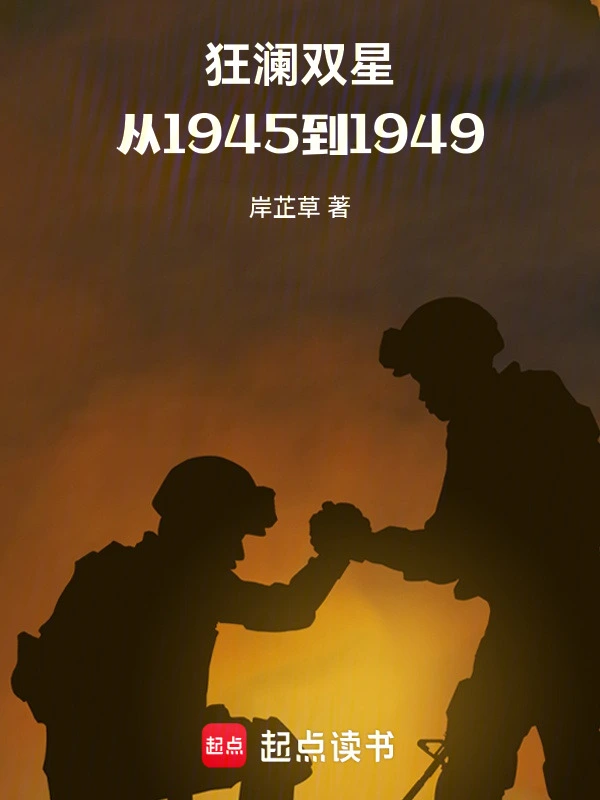
Twin Stars: from 1945 to 1949
狂澜双星:从1945到1949
- Status
- Ongoing
- Length
- 376k Words
- Genre
- Military
- Audience
- Male
- Subgenre
- Military Life
- Updated
- 9mo ago
- Source
- Qidian
Stats
0Monthly votes
78Recommends
0Fans
87Chapters
Synopsis
Reader comments
Readers also read
 What the Hell Is a Bloody Battle at Hacksaw Ridge When Someone Is in the Special Forces?
 Bright Sword: Play the Entire Game Starting from Northwest Shanxi
 I Traveled Through Liangjian and Copied Equipment at Changjin Lake
 War of Resistance: the Roar of the King of War
 If You Are Already an Adventurer, Who Should Work Hard on Your Own?
 Start Integrating All Beasts by Extracting Characteristics
 When Nao's Flowers Fall
 The Artist Begins in Prison
 Traveling at the Same Time: Great Love to the Heavens
 Gao Wu: Is This Hex System Serious?
 Death Rewind: from Death to Invincibility
 I'm a Professional Player. It's Reasonable to Answer Questions Quickly by 100 Million Points.
Cover
Used as the cover of this novel.
Another cover
Another cover.
The simple wishes of ordinary people all over the world, there is nothing more joyful than having a whole family.
It is really a storm that is about to come.
This is a background of the Anti-Japanese War. The five-year life journey of the two protagonists was carried out against the backdrop of the Anti-Japanese War. These anti-war backgrounds include replays of the protagonist's anti-war experience over and over again.
The glimmer of light at the crossroads of fate - Comment on the scene of Teng Chai's reunion
The glimmer of light at the intersection of fate - Comment on the scene of Teng Chai's reunion This description of the reunion of two comrades in troubled times can be called one of the most tense and affectionate chapters in the entire work. The author uses extremely delicate brushstrokes to outline the glimmer of life that bursts out at the intersection of fate between two little people who were swept away by the torrent of the times. The reunion between Teng Zhoujian and Chai Hongyuan was arranged in a very symbolic scene - the noisy and chaotic streets of the market. This setting is extremely clever: surrounded by rickshaw drivers numbly waiting for business, Chai Hongyuan stands out with a weird, almost ritualistic behavior. His mouthwash ritual of "sucking up the wind and clouds" is not only a helpless response to toothache, but is it also a stubborn resistance to the suffering life? This detail suddenly separates the character from the rest of the world and gives it a unique vitality. The process of the two getting to know each other was written extremely wonderfully. From unfamiliarity to familiarity, from confusion to surprise, the emotional transition is natural and smooth. Chai Hongyuan's exclamation of "Oh, why are you back?" Contained too many unfinished words - surprise, joy, and a momentary look back at the past years. And Teng Zhoujian's series of questions: "How did you... Start pulling carts? You also left the army? How did you leave the army?" This quickly brought the joy of reunion back to the cruel reality, leading to the thrilling escape story that followed. Chai Hongyuan's story about escaping from the army is the highlight of this chapter. The author uses language like a movie lens to take readers back to that stormy autumn night. Cold rain, roaring rivers, and searchlights piercing the night sky like bones—these images together create a depressing and dangerous atmosphere. Every detail of Chai Hongyuan's process of forging a suicide scene is extremely precise: unloading the magazine, leaving a bullet, shooting at the rock, hiding the gun and stuffing clothes... These descriptions of actions not only reflect the reality of military life, but also vividly show the despair and determination of a man who is forced into a desperate situation. The most touching thing is that after experiencing such hardship, Chai Hongyuan did not become a cynic. He makes a living by pulling carts and lives in an abandoned house, but still maintains his love and curiosity about life. His confession that "pulling a trolley is a career tailor-made for me" and his description of "living a fulfilling life" show a rare open-mindedness and resilience. This spirit of still looking up at the stars in the mud is the most shining point of this character. The dialogue between the two comrades contains profound marks of the times and reflections on human nature. Teng Zhoujian's experiences (his father died of illness and he was ostracized by evildoers) and Chai Hongyuan's experiences mirror each other, and together they depict the living plight of ordinary people in war-torn times. And their promise to support each other: "In this troubled world, we little people have to help each other survive", which expresses the simplest and most precious true feelings in the world. At the end, Chai Hongyuan continued to use his strange way to relieve toothache, while Teng Zhoujian watched silently. This scene has a profound meaning - everyone is fighting the hardships of life in their own way and looking for the courage to move on. Under the dim kerosene lamp, the two figures sat opposite each other, as if the weight of the entire era was weighing on this dilapidated hut, but it no longer seemed so scary because of the warmth of friendship. This chapter is not only the advancement of the plot, but also an affectionate tribute to the resilience of human nature. In the corners that are often ignored by grand historical narratives, it is these small and tenacious vitality that supports a nation through its darkest years. The author uses the pen of a novelist to write biographies of those little people forgotten by history, so that future generations can have a glimpse of the light of ordinary people of that era - it is not the dazzling light of heroism, but the weak but persistent light of life like a firefly.
A good character is inseparable from family education
May everyone move forward together
Witnessing growth in the smoke and remembrance - Comment on "I Believe a Small Tree Can Grow into a Big Tree"
Witnessing growth in the smoke and remembrance - Comment on "I Believe a Small Tree Can Grow into a Big Tree" With a deep and restrained writing style, this chapter shuttles between memories and reality, tragedy and hope, and brilliantly constructs an emotional and far-reaching story fragment. It is not only a snapshot of war history, but also a deep elegy and sonorous hymn about friendship, sacrifice, memory and growth. 1. Exquisite structure, narrative charm of interweaving time and space The narrative structure of the chapters is quite original. It does not use a straightforward narrative, but uses the protagonist Chai Hongyuan's walking memorial journey as the main line of reality, and his memories and thoughts as the emotional sub-line, with the two lines intertwined and advancing layer by layer. The opening decision to walk immediately sets a heavy and sincere tone. The "red maple leaves, yellow reeds, and a bleak scene" along the way are not only a true description of the scenery, but also a projection of the characters' mood, a blend of scenes. On the way to the hot water pit, the image of Zhang Ergun naturally appeared in Chai Hongyuan's mind. Through flashbacks, the reader is seamlessly brought into those war-torn years. From the banter in the training class to the tragic sacrifice in the Battle of Hot Water Pit, the memories are complete and touching, forming the main body and climax of the article. Finally, the plot cleverly brings back to reality. The encounter with Mr. Fu and the new appointment lead the story in a new direction, forming a unity of closed loop and openness of the narrative. This structure not only avoids monotony, but also makes the brewing and explosion of emotions highly layered, making Zhang Ergun's sacrifice appear more tragic in memories, and also giving Chai Hongyuan's final "growth" a solid foundation. 2. The characters are vivid and the spirit can be seen in the details The characterization of the article is extremely successful, especially the portrayal of the character Zhang Ergun. Although it is not long, it is full of flesh and blood and is unforgettable. Zhang Ergun: He is a three-dimensional and multi-faceted hero. The author did not portray him as a tall and comprehensive symbol, but through a large number of vivid details: his "jokes", his tactical suggestions, his "little finger" right hand, his "understatement" tone, his calm command on the battlefield, his resolute decision-making, and the heroism of firing the grenade in the end, step by step outlining the image of a flesh-and-blood, amiable and respectable warrior. He was brave yet wise, humorous yet steady, and his sacrifice was therefore particularly impactful and contagious. Chai Hongyuan: As a carrier of narrative perspective and a witness of growth, his image is equally clear. His emphasis on love and righteousness (walking to pay homage, carefully searching for names, using cigarettes instead of wine), his humility and introspection (recalling embarrassing events), his sense of responsibility and a little anxiety (worrying about living up to expectations) all make this character real and believable. He is both a participant in the story and an emotional resonance body. Readers see through his eyes and feel through his heart. Master Fu: Although he appeared late, he has a distinctive personality. His straightforwardness, knowledge of people, love for talents, as well as the majesty and kindness of a general in charge are all reflected on the page through a few dialogues and actions. His interaction with Chai Hongyuan not only promoted the plot, but also added a touch of warmth and humor to the article, adjusting the overly heavy atmosphere. 3. The theme is profound, the eternal dialogue between sacrifice and inheritance The core theme of the chapter is profound and moving. The title "I believe a small tree can grow into a big tree" is a powerful metaphor that is used throughout. The sacrifice of the "little tree": Zhang Ergun and his comrades were the "little trees" who resolutely sacrificed their lives to protect their homeland. Their sacrifices were tragic and specific ("only fifteen of the forty people left", "covered in blood", "the fuse was pulled"), and the article does not shy away from the cruelty of war. It is this cruelty that reflects the greatness and tragedy of sacrifice. The growth and inheritance of "Big Tree": This growth is twofold. First, in the physical sense, Chai Hongyuan looked at the newly planted saplings in the Martyrs Cemetery, hoping that they "will grow into towering trees." This symbolizes the continuation of life and hope, and the blood of the martyrs watered the shade of the future. The second is spiritual and career. Chai Hongyuan himself is a growing "tree". From a platoon leader who graduated from the training class to accepting the important task of divisional adjutant, his growth path is exactly the path that countless "little trees" like Zhang Ergun paid for with their lives and can continue to move forward. Mr. Fu's words illustrate the theme: "For a small tree to grow into a towering tree, it must go through some wind and rain." This wind and rain is not only the baptism of war, but also the tempering of responsibility. Chai Hongyuan's promise to "walk side by side with Master wherever he is" signifies that he will inherit the legacy of the deceased and continue to move forward. In addition, the emphasis on memory and remembrance is another theme. Chai Hongyuan's copying of the elegiac couplet, searching for his name, offering cigarettes as a memorial, and finally Zhang Ergun's real name being remembered. All these details show that remembering is the best comfort. The establishment of the Martyrs Cemetery is itself a kind of national memory and tribute, ensuring the immortality of loyal souls and lasting spirit. 4. The language is vivid, the emotions are sincere and restrained The language style of the article is calm and expressive. The scenery is concise and expressive ("charcoal car", "rolling black smoke", "long yellow dragon"); the battle scenes are intense and intense, with a strong visual sense; the emotions are deep and restrained, mostly conveyed by movements and details, rather than straightforward lyricism (such as "put your finger lightly under the name", "light a cigarette"). This restraint makes the emotions more sincere and moving. The dialogue description is consistent with the identity of the characters, and the crispness, humor and heroism of the soldiers are fully displayed. In summary, this chapter is an excellent narrative work. It successfully tells a touching story about war, sacrifice, friendship and growth through exquisite structure, vivid characters, profound themes and vivid language. It allows us to see that an individual life may be as fragile and fragile as a "small tree", but the spirit it represents and the cause it strives for will surely live on in the soil of history like a "towering tree". This is a deep memory of a hero and an affectionate hymn to the tenacious growth of life.
Salute to the great anti-Japanese heroes!