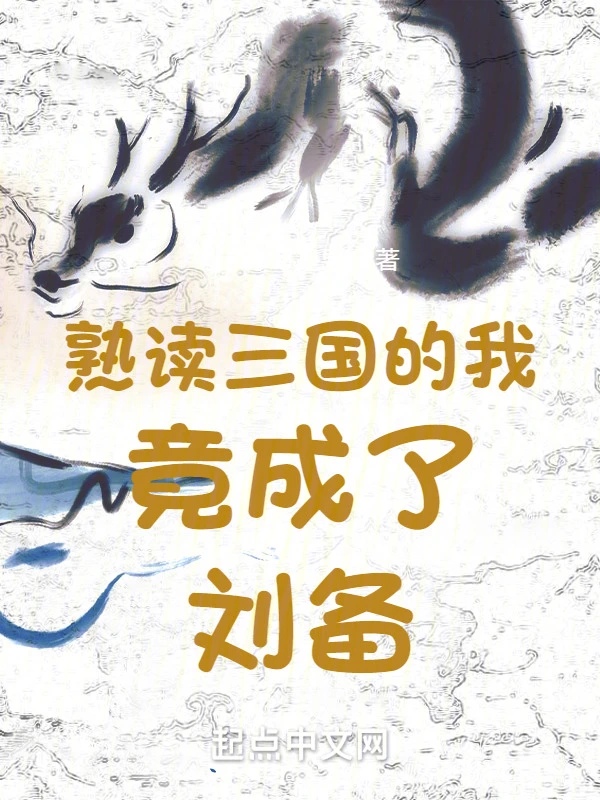
Being Familiar with the Three Kingdoms, I Became Liu Bei
熟读三国的我竟成了刘备
- Status
- Completed
- Length
- 1.2M Words
- Genre
- Historical
- Audience
- Male
- Subgenre
- Qin-Han & Three Kingdoms
- Updated
- 2y ago
- Source
- Qidian
Stats
0Monthly votes
9.4kRecommends
29.5kFans
383Chapters
Tags
Synopsis
Reader comments
In booklists 1


Readers also read
 Please Call Me Your Majesty the Tsar
 In the Red Mansion: Escort Daiyu to Beijing at the Beginning
 1914 Begins with the Rejection of the Schlieffen Plan
 Talker in the Song Dynasty
 Never Walk Alone!
 Emperor Zhaolie at the End of Han Dynasty: Starting from Western Liaoning
 Recasting the Three Kingdoms: the Headwind Situation Is What Makes It Interesting
 Daming: Have I Become Wanli's Portable Grandfather?
 I Am Drawing a Hot-Blooded Episode in the Zhiyu Episode!
 Zhao Lie Xing at the End of Han Dynasty
 The King of the Late Han Dynasty Did Not Have a Stable Career
 Late Han Dynasty: Han Zuo Buqin
 Proving the Tao and the Martial Saint, Starting from the Republic of China
 Three Kingdoms: Investing in Liu Xuande, the First Person to Achieve Great Achievements
It made me happy to see Cao Cao massacre Xuzhou. I've seen people overwhelm the protagonist, but it's rare to overwhelm the protagonist's IQ. When Dong Zhuo came to Beijing, the protagonist directly killed Dong Zhuo, saying that he wanted to protect the people of Luoyang from being poisoned, and then he had a father on his head and could not do anything. After Cao Cao started to rise, it was obviously the best time to suppress Cao Cao. It would be too boring to confidently say that there is no opponent in the world. Later, beating Yuan Shao and Chunyu Qiong delayed the protagonist for several months. Then now Cao Cao raises troops to massacre Xuzhou. Not to mention that Cao Cao managed to recruit 50,000 people in half a year with half of Yanzhou, and if he still had to keep people to guard his home, it would be even more. This force even surpasses the protagonist who occupies half of the state, and then the protagonist's first thought when he sees these 50,000 people is that he is intimidated? Afraid of Cao Cao's revenge? Let's not talk about occupying the other half of Yanzhou and just let Cao Cao go there to massacre Xuzhou. When Luoyang left Luoyang for himself, he had to kill Dong Zhuo. Now that he can get Xuzhou, let Cao Cao massacre his own territory? You really have it, and there is also Chen Gong in Yanzhou who can stab Cao Cao in the back. Stealing Cao Cao's house yourself is the best chance to kill Cao Cao. It feels like now we are trying to forcibly reconcile the original world line of the Three Kingdoms. Even if Cao Cao may be attacked by Yuan Shao, he must kill Liu Bei first to prevent him from gaining a foothold. As a result, Liu Bei is letting Cao Cao develop here. It feels like his IQ has been overdrawn during the Yellow Turbans.
Let's talk about the advantages first. It can be seen that the author has considered the background of the times. Although I think it is a bit shallow, as a novel, there is no need to be too serious as long as the meaning is achieved. The character dialogue is also more in line with the story of the Three Kingdoms as we understand it. This is really good. The story outlines in some novels are good, but the character dialogue is too full of modern vocabulary and has no sense of substitution at all. Let's talk about the shortcomings. The more obvious one is the description of the Yellow Turban Rebellion. Many parts that have little or no connection with the protagonist are described. It feels like a part of the Romance of the Three Kingdoms has been moved over. The pace is a little faster. Now that the Yellow Turban Rebellion has passed, I don't know what happened or what the protagonist's role was in it. I know that the protagonist was made a prefect at the end. The third problem is that there are too few details in all aspects. Guan Yu and Zhang Fei, two such important figures, were sworn to each other just like the Taoyuan Three. Daily communication is basically zero, and relationships are cultivated. Kowtow and share life and death is what the Hong Kong community does. Zhao Yun and others joined the team relatively hastily. In the political environment at that time, if you accept the leader or serve as an aide, you cannot betray easily, otherwise you will be politically dead, and no one will want you. Therefore, Zhao Yun and others made their choices very carefully. The description of this point is really sloppy. I hope the author slows down the pace and writes the rest of the story well.
I have only read a few chapters, and I feel a little uncomfortable and have a bad premonition. Logically speaking, as a Shu Han party, any Shu Han novel above the passing line should be encouraged, but I saw the author mention Han Xin several times, and his tone revealed extreme blind worship, and he kept repeating the now criticized fallacy that "Liu Bang is a military waste and he relies on Han Xin to conquer the world." I don't want to argue about the issue of Liu Bang and Han Xin here. I just want to say that if a writer's understanding of Han Xin in ancient military affairs is still limited to "building plank roads in the open and secretly hiding in Chen Cang", "fighting the last ditch", and "surviving after death" ", "Han Xin commanded to pacify the Three Qin Dynasties", "Han Xin pacified the North alone", "Han Xin was besieged on all sides and defeated Xiang Yu" and other stages, then let me tell readers in advance here - don't have any expectations for the author's description of military wars. Although I basically have no expectations for the description of military wars in the novels of the Three Kingdoms, I think there is still a passing grade. I suggest the author to read "Three Kingdoms Riding and Cutting", "The Remaining Smoke of the Han Dynasty", and "The Rise of the Han Dynasty" (I only mention these books because I have read them recently). The descriptions of military wars are all above the passing grade, and they are more realistic. Speaking of truth, let me say one more thing: Whether it is true or not does not depend at all on whether duels appear in your book, because in ancient wars, there were many scenes of duels (or duels between small and elite troops). They were originally called "Zhishi". If you look through the biographies of military generals in the past dynasties, you will know that many of them have been recorded in history books. The most unrealistic typical plot: a few counselors stay behind the scenes, talking about conspiracies and shocking conspiracies, treating their own generals as puppets and treating the enemy as fools and manipulated at will - this is not war, this is just child's play.
I have tried my best to give up my mind and read it, but you are a bit insulting to my intelligence by raising Cao Cao so bluntly. I have lost the twenty yuan, so I leave.
It's still a bit shallow. It seems that the author mainly relies on romance. Romance novels have become less popular in recent years, and historical texts have gradually evolved from shallow to profound, which increasingly requires a test of the writer's skills.
Zhuge Liang is far more powerful than in the novel. In the novel, borrowing arrows from a straw boat and setting fire to Red Cliff can be described in just a few words. Real war requires understanding the geography of mountains and rivers, training and commanding troops, and there are countless details. Zhuge Liang was named Marquis of Wu, and even after the death of the Shu Han Dynasty, Zhuge Liang's opponent Sima Jin did not deny Zhuge Liang's qualification to be called Marquis of Wu. The posthumous titles of Marquis Wu, Emperor Wu, and Wu are so awesome that it goes without saying. Shu and Wei have only one continent, and the other has nine states. Needless to say, hard power. As a result, Zhuge Liang beat Sima Yi five times in a row from a blitzkrieg player to a coward who could only defend and avoid battles. Needless to say, the number of battles the Wei army fought did not need to be said, but in the later period, the Wei army was afraid of the Han army. When Zhuge Liang was alive, Sima Yi was cowardly and Cao Rui was frugal. When Zhuge Liang died, Sima Yi couldn't believe it at first, and didn't dare to move for several months. Finally, he attacked, and when he saw Jiang Wei and the Han army, he immediately withdrew. Only after Jiang Wei died and these Han troops retreated could Jin dare to destroy the Han. As soon as Zhuge Liang died, Cao Rui immediately started building construction and enjoying himself. These few points alone show how powerful Zhuge Liang is. Someone is definitely going to argue with the Chronicle of the Three Kingdoms. The Chronicle of the Three Kingdoms was written by Chen Shou after he joined the Jin Dynasty. Does he dare to write it truthfully? Chen Shou must be flattering Sima Yi. In this regard, Chen Shou wrote: If Jingzhou had not been lost, it would have been difficult to recover without the help of the people. It means that Zhuge Liang's intelligence is monstrous. Everyone in the Sima family admitted this. Moreover, historians have unearthed a large amount of information over the years, and historians have unanimously determined that Zhuge Liang should be called the Marquis of Wu.
What about money and food issues?
I don't understand why the protagonist just sets up some workshops and does some business, so he doesn't lack money and food when he farms some fields? The money and food accumulated by a wealthy family for several generations is unreasonable. I think the productivity in the late Eastern Han Dynasty was at a low level. The farmers' risk resistance was very low. Coupled with natural and man-made disasters, the people were in dire straits. In the late Eastern Han Dynasty, not only the common people had nothing to eat, but the landlords and warlords were also short of food. Otherwise, how could we use human flesh to make good food? I heard that during the tragedy, even the rich and powerful Yuan Shu's army had to eat mulberry trees to satisfy their hunger. How could Cao Cao's army be short of money and food? How many years has he been here? You will not be short in one year. There are still natural disasters, but the drought is gone in one year. As for the plague, I also like Liu Bei. The development is so good and smooth. I don't know, I thought it was Yuan Shao. With just one sentence, Lu Zhi's disciples will be unimpeded. Maybe he is like Liu Bei. There were so many registered disciples named Lu Zhi that I didn't even know him. I felt that social interaction in that era really wasn't about ability. Otherwise, Yuan Shao, who had the idea of recruiting Dong Zhuo to the capital, could have overwhelmed Cao Cao. Such a powerful person could only be created with real swords and guns. How could Liu Bei be so stupid?
The cunning Liu Bei is no longer Liu Bei
Liu Bei changed his eldest brother several times, but no one ever questioned his character. Gongsun Zan, Yuan Shao, Tao Qian, Cao Cao, and Liu Biao all saw that Liu Bei had extraordinary ambitions, but he never harmed him, gave away soldiers, horses, or territories. Even though he was displaced, many people were still willing to follow him. This is the charm. He is kind-hearted and heroic, and he can be called a true hero. The time traveler used the prophet to change Liu Bei. Even if he achieved something, it would be nothing. There are too many such heroes in history, and such Liu Bei would no longer be Liu Bei.
I have finished reading it. It should be said that it is very good. I used historical knowledge to complete the strategic layout of the Yellow Turban Rebellion in advance. It has generals and counselors, large-scale troops, and stable base areas and financial resources. If I want to say the flaw, I think it is the Taoyuan sworn alliance. In this life, Liu Bei has already been a county magistrate + famous. After so many civil and military affairs, he has sworn alliances with Guan and Zhang alone. It is too deliberate. However, the entire novel is definitely rated 85 out of 100.
Is this also called familiarity with the Three Kingdoms? I really didn't see what the protagonist understood.
The protagonist is not as good as Liu Bei, but you are still reborn as Liu Bei, and you have failed. It's better to go directly to Liu Bei of the Three Kingdoms.
The protagonist does not look like a modern person, but more like an ancient person with some romance and modern values. When he traveled back in time, he never thought about climbing a technological tree to increase his strength. In the late Han Dynasty, when food production was insufficient, his first idea was not to use chemical fertilizers to increase production, but to promote military settlements to reclaim wasteland. Cao Cao's military garrison is not a fun thing. He purely treats people as slaves. You say the protagonist has modern knowledge. The technology tree is not climbing at all. You say he has no modern knowledge. He can also use the principle of leverage to give you the entire trebuchet. If the siege fails, the first thought of breaking the city is not explosives but trebuchets. It feels very strange. You said that the protagonist is just an ordinary person who does not know the specific content, but as a modern person who has completed education, the general direction should be clear. Even if it is just black powder and you don't know the specific ratio, you can let others try the best ratio. As long as you point out the direction and let the people below try, you can get a rough idea. The protagonist traveled back in time and said he wanted to change the future, and now he is almost 30. He has not climbed the technology tree at all. Although Cao Cao and Yuan Shao's development has been suppressed, they can still survive smoothly. The current historical direction has not changed except for killing Dong Zhuo in advance. Qingzhou is already considered a relatively wealthy state, and then half of Xiliang can Raise 200,000 soldiers and horses, and the protagonist can only raise 50,000 soldiers and horses in Qingzhou, so whether it is based on romance or official history. The jade seal is still in the hands of the emperor, and Yuan Shu will not be emperor in the future. If Liu Bei still wants the banner of justice, then he cannot take the initiative to send troops. Are you really going to wait until 5 or 60 with others to start the reform of being a powerful minister? You can hold a state's troops and horses in your hand, but you can't defeat Yuan Shao, who has just started his career and has few troops. As a time traveler, it's really too much. Except for knowing the historical trend in advance, the protagonist has no bright spots. I won't say much about character creation, which is a test of writing skills. The plot direction should still want the protagonist to take the path of fighting for hegemony, which is Cao Cao's script. It's hard to say how it is, but the protagonist feels too mediocre. Apart from the "heroic" and lack of airs that other characters evaluate, there is no advantage.
I'm 26 and I'm not married yet…
Liu Bei wasted more than twenty years, which was purely his own. It further illustrates a problem. If he doesn't study hard, he will know how it feels to be beaten when he gets to society. Liu Bei first apprenticed with Lu Zhi, who was the same disciple as Gongsun Zan, but he didn't study hard. After he left school, he didn't promote filial piety and integrity. He went to his hometown to sell shoes. Compared with Gongsun Zan, he was simply too inferior.
Is the protagonist planning to become an unmarried person? Even though he has become a county guard, he still doesn't seem to think about life-long matters at all, and there are elders in the family, so the protagonist's mother has never thought about her son at all? Don't you understand the reason why in ancient times someone could call himself an old man at the age of thirty? Especially for kings in ancient times, heirs were a very important factor, which was related to the stability of the team. I quickly skimmed through this book chapter by chapter, feeling that there was no need for me to read it in detail.
It's not interesting. The children of the aristocratic family are indeed capable, but I just can't stand it. All the Three Kingdoms texts are collected over and over again by Mingren
One problem is that the Han Dynasty was actually very strict about the military. Although powerful people would have private soldiers, for example, if you went to Fanyang to suppress bandits, it was a cross-regional transfer without any advance notice. Applying for it was a serious crime. To put it bluntly, it was almost treated as a rebellion. Secondly, as the county captain of Zhuozhou, the number of soldiers you can recruit is limited. Once the number is full, you cannot expand the number of soldiers. And you only manage the soldiers in the county. You have to take them away and turn them into civilians before they can be your private soldiers. Many plots do not seem to be logical. It is clear that the Ling Emperor is not dead yet and the world is not in chaos. It seems that the world is already in chaos and no one cares about it...
Come on Guodong!
Hello Guodongda. I couldn't put it down when I saw this book. It took me 4 days to read more than 200 chapters in one go, so I want to share some of my understanding of this book, my favorite points and suggestions. I think what attracts me the most is that Guo Dongda writes about the simplest hope of readers like me for the Three Kingdoms, which is to help Liu Bei "rebuild the Han Dynasty" so that the loyalists and loyal ministers can have a better ending. By creating a parallel world, Guodong Dayou helped the people of the Shu and Han Dynasties in the Three Kingdoms resolve the regrets of their unfinished business. I believe that Liu Bei's own regret is that he cannot fulfill his filial piety and cannot repay his kindness. When I see that little characters such as Liu's mother, Liu Yuanqi, Su Shuang, and Zhang Shiping can develop better in Da Da's writing, I feel very warm in my heart. I feel that Da Da has really brought myself into Liu Bei to consider and organize these large and small matters, and do my best to help Liu Bei realize his dream, and don't miss out on giving back to anyone who has helped Liu Bei in history. Guo Dongda must be a gentle person in reality. Secondly, I really like that DaDa can use different angles to interpret the logic behind the Three Kingdoms' struggle for hegemony, that is, setting it as a battle between the big families and local powerful people behind each force. This logic is not clearly stated in the Romance or the Three Kingdoms. Regardless of whether it is right or not, such a different approach can also prompt me to think about this period of history from a different perspective, which is of great benefit to the direction of the book. The direction of each force can be deduced based on this basic logic. Thirdly, I think it is reasonable for Liu Bei to currently have the power of two and a half states. Although I feel that Liu Bei stationed in the capital and defeated Dong Zhuo and then returned to the local area is a bit far-fetched, and the development is slightly faster. I feel that there will be no opportunity for Zhuge Liang and Zhou Yu to take on important responsibilities as adults. But who doesn't want Liu Bei to pacify the country as soon as possible and then quickly turn to fight against foreigners? Cao Cao, Sun Quan, and Liu Bei failed to unify despite all their efforts, so Liu Bei, now 36, had to step up. Who asked him to shoulder a task that was already more difficult than the original Liu Bei? Fourth, setting the tone is an extension based on the Romance of the Three Kingdoms, interspersed with a lot of knowledge not mentioned in the romance. My impression is still very good. I believe that I also consulted a lot of information when writing. If I have some knowledge as the foundation of the book, I think it can distance it from the other books that are generally easy to do. Fifth, the growth of the subjects is mentioned. This is the reason why the subjects will not betray, and the subjects can have greater growth than in the original work. This has been mentioned in many books. I hope that Guodong University will have the opportunity to deepen some ways to improve his civil and military skills. Sixth, the excitement of battles is increased. War areas are conquered on a county-by-county basis, and the number of battles is greatly increased. There are different decisive factors such as water and fire tactics, weapons and training level, reconnaissance, terrain, ambushes, formations, siege weapons, and troop matching. There is a gap to achieve victory. It is no longer a simple duel or the use of strange tactics to advance the battle like in the romance. If you like it, you will have suggestions. This is completely nonsense based on my own preferences. I dare not make any criticism, because if I write it according to my own ideas, I am afraid it will only make a mess. It's just that it would be my honor if my superficial suggestions could fit in with the context of the following book. Firstly, although it is a refreshing article, as a reborn person who has learned from history, his predecessors have helped him overcome many thunderstorms, and of course he will stand at a higher height. But it is still too smooth at the moment, and I think failure is inevitable on the road to hegemony. Different from Liu Bei in history, this is also the protagonist's "own challenge". I think the design idea is for many things. We knew it would go this way, and we have been preventing it from happening like this, but in the end it inevitably happened. Such a sense of powerlessness, and finally understanding that the "stupid actions" made by the heroes in the Three Kingdoms were actually the wisest choices under the circumstances. The self-righteous and smart-minded chagrin when one's originally kind-hearted "little cleverness" led to greater losses, I think is the most despairing. This can happen when Liu Bei is in middle age. First, the protagonist is definitely not as good as Liu Bei in civil and military skills in the early stage. If he makes one mistake, it will be over. Only in middle age will he have the capital to make mistakes. Second, the powerlessness and failure of the mid-life crisis can resonate with more people. How to make up for the losses later, how to punish and forgive others will be the points that the protagonist struggles with. As for specific examples, I think Guodong University actually already has many lines to choose from, and it only needs to be deepened. For example, Gongsun Zan may be on the same line. Gongsun Zan was a tiger and wolf in his later period and had a suspicious character. He could be second to others for a while, but if he could not meet his needs for a long time, he might feel unbalanced. Although he had developed as the governor of Gunzhou for so many years, his own troops were still very small, only 20,000 so far. His desire to fight Wuhuan and Xianbei was not satisfied, which may be the origin of the disaster. Another way of thinking is that Guan Yu's pride and Liu Bei and Zhang Fei's natural trust in him will cause Guan Yu to be squeezed out by other interest groups. This is another hidden danger that Liu Bei will start to form a faction. Just imagine now with Guan Yu's arrogance, will he think that Gongsun Zan, Liu Dai and others in Gunzhou are just like local chickens and dogs? Of course, I also understand that Guo Dongda hopes that Gongsun Zan will eventually become the number one hero who can drive out foreign enemies, but Gongsun Zan can be said to be the most likely lead to cause internal conflicts. The second thing is that I think Liu Bei is too modest and kind, and he is more kind than powerful. In fact, Corporal Li Xian is not difficult to learn. If Liu Bei can do it, why can't I, Gongsun Zan? Besides, not all of Liu Bei's subordinates are Liu Bei's former subordinates. How can Liu Bei suppress ambitious political veterans like Hua Xin and Wang Lang who might ride on his head? Xu Huang, Zhang Liao, Qian Zhao, Tian Yu, etc. Will all get better situations and meritorious service than before. You must know that the person in charge of Cao Cao's military region is still a relative of Cao Cao. Now Liu Bei "employs people without doubt" and lets them all dispatch their own troops outside. Naturally, their mood will be different when they become high-ranking officials. Even Liu Bei's own adopted son Liu Feng will not save Guan Yu in order to preserve his strength. The book mentions Boss Cao's transformation from an ideal general to conquer the west to a powerful hero. Then Liu Bei will also face changes in the thinking of these highly accomplished generals under his command. Will they still obey Liu Bei by then? Will we use Guan Yu's suppression? Will it cause factional problems? Therefore, it is impossible for our protagonist to reach the original height of Liu Bei. The method of serving as a subordinate is to be courteous and corporal - to hire under special circumstances - to treat each other with sincerity - to help improve - and to employ people without suspicion. Such a trick, which has been popular all over the world, is definitely not enough. Our protagonist needs to break through the original Liu Bei, and even become the "Boss Liu" he once hated as a social beast. It may be more realistic to beat, intimidate, accompany the emperor like a tiger, praise and flatter sincerely, and treat his subjects in a thousand-faced manner. From this, we can understand how Cao Cao and Sun Quan were suspicious and unpredictable, which led to pressure on others. For details, you may also refer to the assessment of Li Jing when Li Shimin died. Thirdly, the repetition of events with the original trend of the Three Kingdoms can be omitted as appropriate. To be honest, the dialogues and events in the chapters that follow the same direction as the original Three Kingdoms are all skipped. After all, everyone is "familiar with the Three Kingdoms." In addition, it can be seen that the author struggled a lot when bringing history back to its original trajectory, and spent a lot of time writing about the development of other princes at the same time, so as to prevent readers from feeling abrupt when they see the leaping development of other princes in the later period. But writing this way will also limit Guo Dongda's own performance, giving it a sense of historical fatalism. For example, take Sun Jian. Guodong spent a lot of effort to break it up and reconstruct the grudge between Liu Biao and Sun Jian, which ultimately contributed to Sun Jian's death. When I read these chapters, I can really imagine you, Mr. Guo Dong, scratching your head. But this time Sun Jian was in a very different situation when he challenged Dong. First, the conflict of interests between Liu Biao and Liu Biao was not as big as in the Romance of the Three Kingdoms because he did not get the jade seal. Second, Sun Jian did not fall into the ambush this time and suffered very little loss of troops, and Zu Mao did not die! So can Zu Mao's ability prevent Liu Biao from killing Sun Jian in an ambush? If Sun Jian is not dead, then after Yuan Shu dies in the later period, Sun Jian can make an alliance with Liu Biao when he plots Jiangdong. Then he will be a very big opponent of Liu Bei in the future. But now that Sun Jian has been killed, if the plot develops later and it is felt that it would be more appropriate for Sun Jian to be alive, he will no longer be able to use this character. Therefore, I think that since the Sun family line has little to do with Liu Bei at present, we can refer to the writing method of the Romance of the Three Kingdoms and wait until the two lines intersect to make up for the development of this branch line. This is the case for Sun Jian, and the same is true for Liu Biao, Liu Yan, Zhang Ji, and Ma Teng. Who are the opponents Liu Bei will face when this line of work advances, and why the relationship between them will naturally develop naturally, so that the writing flexibility can be greater. One last little point. When the author wants to write "fortunately", he usually writes "simply". You can pay attention to it next time. Immature opinions, please forgive me if I am wrong.
Going to Luoyang to kill Dong Zhuo was a big mistake. Without Dong Zhuo's chaos, there would be no princes to challenge Dong, and without Dong Zhuo's westward movement to Chang'an, how would there be a group of heroes fighting for hegemony? Now I see that Yuan Shao won Jizhou, but I haven't seen it later. Mustn't the premise of this mutual attack be that the imperial court is in name only? Based on what the author wrote, the situation has obviously not reached that point. Shouldn't the best result be for Dong Zhuo to reduce the majesty of the court to a minimum, so that no one listens to the court's words, and then plot the world? The imperial court was saved by you. What is the difference between Yuan Shao's actions and rebellion? Is this kind of early overlord so brainless? What is written here?
Are you reading "Three Kingdoms" or "Three Kingdoms"? Many things inside have developed differently.
If I am familiar with Liu Bei, I will go to the Three Kingdoms 😌
After reading dozens of pictures, I discovered a problem. In ancient times, recruiting soldiers privately was a way of entertainment for the nine tribes. How dare Liu Bei? Without the emperor's imperial edict, he would be accurate as soon as he reported it
Three sentences are inseparable from each other: talking and smiling
I hope the protagonist will accept Zhen Mi and Xiao Qiao
My name is Belak, and I am a mortal. I saw Nurgle spreading the plague, I saw Khorne killing wantonly, I saw Tzeentch playing tricks, I saw the slayer trembling on the bodies of the gods... Mortals indeed have limits, and so do the gods... I originally thought I would die bravely like a hero, but I never expected I gave up, I knelt down and surrendered, voluntarily becoming a demon. I prayed devoutly to the Four Evil Gods and vowed to become their first mortal believer in the world. So, I became a devil's chosen one. ................................. The four evil gods were overjoyed to receive the support of the new race. In order to compete for my allegiance, they continued to bless me and even gave me part of their divinity to control. So I obtained the plague of Nurgle, the blood madness of Khorne, the magic of Tzeentch, and the perversion of Lust... I used the power of the four gods to conquer countless ethnic groups, build huge palaces, let mortals respect me as a god, and build huge statues. I originally thought that I would be promoted to the world's first demon prince, below the four gods and above ten thousand people, and fight forever. But I never expected The four evil gods were jealous of each other, and in order to monopolize my faith, a scuffle broke out. They finally asked me to choose one of four options. So, I thought, since I am so strong, what else do I need these four old men to do? I choose, want them all! .................. My name is Belak, and I am a Shadow Father. The four evil gods were shocked by my heroism. They made a temporary truce and jointly took away all the blessings from me, shattered my material body, and imprisoned me in the Shadow Realm forever, never to come to the mortal world. I thought I would never choose and sink forever. But I never expected Tzeentch interceded for me and allowed me to come to the mortal world once every hundred years to crown their new eternal choice! And act as his little brother to drive at will. Is this grace? No, this is humiliating! So, I designed to kill the first 12 Eternal Chosen ones, and now it's the turn of the 13th one. This child Archaon is my heir, and he is the vessel I chose for myself! I originally thought that I would successfully seize the body, escape from the shadows, continue to rule the world, and take revenge on the four gods. But I never expected A guy with a warhammer would run into the medieval world and kill, destroying everything! ............. My name is Bilak, and I am a poor man. Actually, I am not dead. I have 30,000 tons of gold and 30 million magic soldiers sealed in Cathay. Now I only need to click, collect, and read to unblock it! Believe me, when I unblock you, I will pay you back a hundredfold. The devil has no jokes! Only lies (delete this sentence and don't post it)
After the crusade against Dong Zhuo, we can no longer watch it. We might as well just settle down and become a local emperor.
[The big boss's ten thousand orders! Using precious land to promote his own work "Xie Ming"! The book has a million words. Readers, if you have free time, you are welcome to take a look! Introduction: At the end of the Ming Dynasty, on the eve of Li Zicheng's invasion of Beijing... The guerrilla general Xiao Jingchuan of the Shenji Camp in Beijing fled with the prince! Go all the way into the mountains and forests, pass through the south of Ji, recruit troops and horses, and go south to ascend the throne! But there are slaves from outside entering the pass, and the rogue bandits are in trouble! The four towns in the north of the Yangtze River cannot be defeated internally. The DPRK and Chinese parties are fighting against each other, and internal strife will continue! How to break the chaos in the late Ming Dynasty? The Ming Dynasty is exhausted, don't be afraid! The winner can also be someone else! Involving: [Official career] [Conquest] [Proclaiming emperor] [New Dynasty] [Destroying the Qing Dynasty] [Internal affairs] [Harem] [Reorganizing the mountains and rivers] [Opening up the territory and expanding the territory] This book is also known as: "Seizing the Ming Dynasty and Resisting the Qing Dynasty" "Jing at the end of the Ming Dynasty" "Early" [Book Club: 484093009]
Brothers, please keep reading. It is very important to keep reading because I didn't pass the second round of recommendations. I have to wait for next week's airborne recommendations. Then the word count will be up and it will be on the shelves. If you have good grades in pursuing studies, you can put it on the shelves in advance. I hope brothers will support 😄🥺