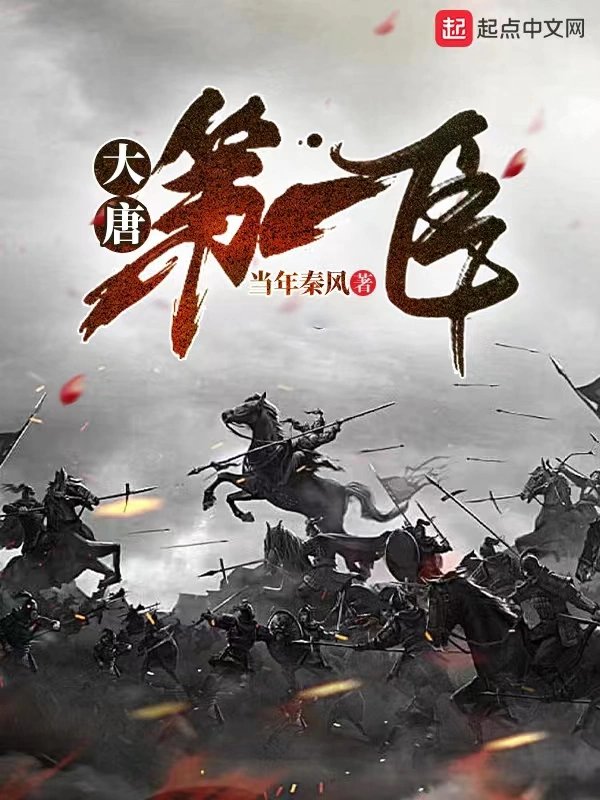
The First Minister of the Tang Dynasty
大唐第一臣
- Status
- Completed
- Length
- 1.7M Words
- Genre
- Historical
- Audience
- Male
- Subgenre
- Jin-Sui-Tang Dynasties
- Updated
- 2y ago
- Source
- Qidian
Stats
0Monthly votes
18.2kRecommends
59kFans
647Chapters
Tags
Synopsis
Reader comments
In booklists 1


Readers also read
 Please Call Me Your Majesty the Tsar
 1914 Begins with the Rejection of the Schlieffen Plan
 In the Red Mansion: Escort Daiyu to Beijing at the Beginning
 Talker in the Song Dynasty
 Never Walk Alone!
 Ten Kingdoms Week
 When I Was in Hongwu, I Started by Rebelling Against the Party.
 Daming: Have I Become Wanli's Portable Grandfather?
 I Am Drawing a Hot-Blooded Episode in the Zhiyu Episode!
 Recasting the Three Kingdoms: the Headwind Situation Is What Makes It Interesting
 Golden Family, I Will Lead the Mongolian Cavalry Across Asia and Europe
 The Unparalleled Scholars of the Northern Song Dynasty
 Tang People
Is there a book club? The author's writing style and ideas are really good, and the logic is very good. I have an online IQ of 666. I haven't seen such high-quality writing on Qidian for a long time. And the rhythm is very good. It's not like a novice novel. From the beginning, it's like a time traveler. This is what it feels like for a capable and courageous modern person to travel back in time.
Can you update it earlier? It's always so late.
It really felt quite outrageous, and I was puzzled. It was quite outrageous to just complain about the protagonist's character and his behavior, but to directly want the author to change the genre of the novel according to his own preferences. There are so many novels of all kinds in the online literature world. There are so many online articles about auxiliary articles, hegemony articles, court articles, aristocratic families and princes. I have been reading novels for many years, but this was the first time I came across the genre of trolling novels, which gave me a lot of experience. Some people asked the protagonist why he did not fight for hegemony, and the answer was: because this is a supporting article. Isn't this reason enough? When did traveling through troubled times to help others become original sin? This seems to be saying, why doesn't the protagonist of the novel about cultivating immortals practice martial arts? Why doesn't the protagonist of the Honghuangliu novel open up all the worlds? Why can't the protagonist of martial arts novels enter Taoism through martial arts? Why didn't the protagonist in the text "Dynasty Struggle for Hegemony" just overthrow the dynasty and establish a country with a modern system? If you really like to read Zhenghe articles, go to the Zhenghe article section🙄 You can read whatever articles you like, but if that doesn't work for you, can you spend money to have it customized by a master? This author is no more able to endure hardships than those famous star writers.
Reposting a comment from Zhihu boss Qiu Ju Luoying: Why did Li Shimin dare to rebel against Li Yuan? Yes, you read that right, it's because of the military system. (This article mainly answers the first half of the question. If you are not particularly familiar with the Ming Dynasty, I will not talk about it.) I know that many people will be surprised after reading the beginning: Isn't the Fubing System the most important "institutional contribution" that allowed the "Guanlong Group" to suddenly emerge in the late Southern and Northern Dynasties to reunify the world, and even laid the foundation for the later Tang Dynasty? However, I wonder if anyone has ever thought about it: It was also during the period of the military system that almost the most frequent dynasty changes in Chinese history took place. So, many people's so-called "institutional view of history" only gives themselves a veneer of being reasonable. In essence, it still subverts the mainstream eye-catching formula: It is clear that the Northern Zhou usurped the Western Wei, the Sui usurped the Northern Zhou Dynasty, and the Tang Dynasty and the Sui Dynasty all happened in the Fubing era. However, the "system" The "Du Party" never seemed to think that the government military system should bear "institutional responsibility" for the frequent lapses in imperial power, and then when the Zhenguan Tang army massacred all parties, they collectively came out to grab credit... Forgive me to be blunt again, this is not called materialism, this is called overturning the doctrine. Let's go a little further and go back to the topic at the beginning - what is the biggest feature of the Fubing system? I believe that many people have read various popular science articles on this question: Is it the integration of soldiers and farmers, integrating soldiers with farmers, and eliminating the need for the court to spend extra money to support the army, which greatly reduces the financial burden? Is it that soldiers and generals are separated in peacetime and organized into armies in wartime, so that generals are separated from the private military system and unable to have exclusive power? Or should the peasants be tied to national interests, so that the "soldiers of good families" will have more motivation and better discipline to fight? The above can be seen in common articles introducing the Fubing system, and each has its own truth, but in my opinion, the biggest feature of the Fubing system is actually: The Forbidden Army and the Field Army are not divided into families. I know that some people may have understood it at this point, but the point has not been reached yet, and we must continue to talk. (If you are too lazy to read the following paragraph, you can skip it and jump directly to the position where the picture appears) According to the mainstream view in historical circles, the government army system was formed during the Western Wei Dynasty when Yuwentai was in power. It was marked by the establishment of a new army command system and a corresponding soldier recruitment system. The military command system established the organizational and command system of "eight pillar states (actually six pillar states), twelve great generals, and twenty-four generals" under the leadership of the supreme ruler of the Yuwen clan. Generals "Each general oversees two government offices, and each has twenty-four members and is divided into regiments to lead the twenty-fourth army."[1] The recruitment system for soldiers incorporated the strong armed forces of the Han nationality in Guanzhong and local rural soldiers into the government army system, and repeatedly recruited "those with financial resources from the people to serve as government soldiers." Subsequently, in the tenth year after the founding of the Emperor, Emperor Wen of the Sui Dynasty changed the system of "military and civilian registration with different registrations" since the late Han Dynasty to "unification of soldiers and peasants", turning the original "military households" that had served for generations into "civilian households" with both military status and household registration. The original "military government" also changed from a military institution to a "local reserve management agency." In the tenth year of Zhenguan, Emperor Taizong of the Tang Dynasty divided the country into 634 military mansions (i. E. Zhechong mansion), which were managed by the "Twelve Guard Generals" of the central court. The Zhechong Mansion has regiments, brigades, teams, fire and other establishments. It is responsible for the statistics, training, horse and equipment management of the soldiers in peacetime, and plays the role of providing soldiers when they are on guard or going on an expedition. If the whole government goes on an expedition, the captain of the military mansion, Captain Zhechong and Captain Guoyi, will also accompany him [2]. The above is a basic introduction to the military system (all fans of Sui and Tang history are probably familiar with it, so here is a brief introduction). It can be seen that the government military system as a system has undergone many reforms with the changes of the times, from the separation of soldiers and civilians to the integration of soldiers and farmers, from regiment-style management to bureaucratization, from the semi-autonomy of local heroes to the appointment system of chief officers. However, no matter how it changes, the "separate control of forbidden brigades" and "shangbansuwei" as one of the core responsibilities of the government soldiers have never changed. The "Fubing System" in most people's minds is like this: I'm sorry to say that someone made a computer diagram for me before, but I thought about it and felt that hand-drawn drawings can better express the creative intention... This picture Some areas are not very accurate. For example, there is a Turpan document study that states that the "junfu"-level government soldiers were not drawn from the entire army when they participated in the expedition, and the government soldiers commanded by the imperial generals when they went on expeditions were not limited to their own guards. However, these are minor issues, and it is best to understand them so as not to affect the overall situation. However, the "Mansion Army System" during the Wude period of Emperor Gaozu of the Tang Dynasty looked like this: Each [color] represents a battle (it has nothing to do with the writing position of "Battle n"). The drawing, art and photography skills are poor, please forgive me! It's the same old saying: I wonder if it's funny? In fact, this picture is more suitable for answering another (common) question: Why did Li Xiaogong and Li Jing, who unified the southern half of the country, seem to have far less influence on the political situation of the early Tang Dynasty in the history books than the King of Qin, Li Shimin? The answer is simple: because the southern soldiers do not participate in the Suwei. So it is a good thing to "read history with your own thinking", but this kind of thinking should be based on questions and looking for answers in the political system, social structure and event development process at that time, rather than acquiescing that history books are all made up from the very beginning. "Forced absolute egalitarianism" is also a form of extreme idealism. But having said that, although Li Yuan was not worried about Li Xiaogong and Li Jing's "usurping the throne", he was worried about their "self-reliance", so in the seventh year of Wude, Li Xiaogong built a palace city in Yangzhou (then located in Jiangning County, south of the Yangtze River). Li Yuan immediately summoned him back to Beijing for treason. Then in the eighth to ninth year of Wude, he ordered Li Shenfu, king of Xiangyi, to move the residents across the river and move the city to what is now Jiangdu District of Yangzhou City[3]. Okay, let's go back and look at Chang'an's Forbidden Army Guards - there is now such a system, and its operating system follows the following rules: The generals and soldiers who serve in the palace guard system are the same group of people as the field army. Meritorious officers can obtain different positions such as captain, brigade commander, and general of the Forbidden Army, and can also be promoted to local military generals. At the same time, the military government must take turns to "serve" as a guard; Due to the uncertain war, some generals and soldiers, with the attributes of "semi-professional soldiers", work in the Forbidden Army for training so that they can assemble quickly when a war occurs (this will be discussed in detail later). I believe that more people will understand this: According to this "algorithm", a situation similar to [winner takes all] will almost inevitably occur in the end, that is, the military commander with a stronger field record will have a greater influence in the Forbidden Army, which will ultimately affect the political situation. Some people may say that the soldiers of the government are transferred to the guard "in the form of transfers rather than in the form of a full-scale system", and they are also managed by the twelve guards. Can they restrict each other and prevent cliques? ——But what kind of deployment method can prevent the situation where "everyone including the generals has fought with the King of Qin"? ? ? You must know that the Fubing System is a wartime system. The Western Wei-Northern Zhou Group with Yuwentai as the core created it in order to integrate war resources and compete with the sworn enemies in the east. To paraphrase a popular saying, the imperial military system has been bleeding with the blood of expansion since its birth. How can we expect it to serve as an "institutional barrier" to protect a stay-at-home emperor who stays in the rear? For example, the most famous Chang He is generally believed by academic circles and online literary circles to have "played the most critical role in the Xuanwu Gate that day." However, how did he become the general of the North Gate? Emperor Taizong Wen went out to conquer the Eastern Capital, with the Duke as his left and right cavalry... He bravely marched the three armies, his voice was superior to seven talents, his mediocrity was better than that of Jia Ling, and Ji Mao was outstanding in Diao Ge. As a gift to two people, eight hundred pieces of objects and fifty pieces of treasure. In peacetime, Derui was in the Wei tribe, and he was famous in Yuchen County. He rewarded twelve people, three fine horses, and two hundred utensils. ... Prince Congyin was ordered to bring peace to Hebei. He also pursued Yuan Lang with Cao Gong Li Qiong. The thieves were defeated and the town was left in Weizhou. ... In the seventh year, he was ordered by Emperor Taizong to pursue him to the capital. He was given a golden knife, which was made of thirty pieces of gold, and he was ordered to lead the young master at the north gate. Still using dozens of gold knives to entrust Gong Xi's brave husband. On June 4, 1999, the order was sent to the north gate. ——"The former envoy of the Tang Dynasty, Governor Qian Sifei and other military governors of the sixteen states, presented the Monument to General Zuo Wuwei to the founder of Bo Changfu in Wushui County of the State of Shangzhu" Pay attention to the sentence in bold: In fact, I have always been very confused about why it is clearly written in the same sentence. Some people can only see "gold knife", and "(Wude) In the seventh year, he pursued the capital by Taizong's order." Turning a blind eye - Of course I don't deny Li Shimin's wooing of Chang He, but if it weren't for the system of "the Forbidden Army Field Army does not separate families", how could Chang He suddenly change from the head of the Henan militia to a central guard? (In addition, I also saw someone say, "Li Shimin gave Chang He gold to prove that Chang He is not one of his own. If he is one of his own, there is no need to pay for it." I suspect that this kind of person has never lived in a real society for a day...) A few words: Tombstones and epitaphs are different. Tombstones should be classified as "historical materials handed down from ancient times" according to their nature. Burying and destroying tombstones is equivalent to the loss of historical materials handed down from ancient times. It can even be said that before movable type printing became popular, inscriptions on tablets were a more "publicity-promoting" method than books. Otherwise, "Xiping Stone Classic" would not have caused such a big sensation. From the fact that Chen was able to find a rubbing of Chang He's tombstone in the Dunhuang suicide note, it can be seen that the Tang Dynasty did not prohibit the circulation of rubbings from this stele. In addition, during the reign of Emperor Gaozong of the Tang Dynasty, he organized and compiled the "Wen Guan Ci Lin", which included the inscriptions of many figures in the early Tang Dynasty and spread in Japan. Therefore, "Modern people discovered Chang He's inscription after digging up the Dunhuang posthumous documents" does not mean that "Chang He's role was deliberately buried." And, judging from the inscriptions, Chang He at that time was just the "Beimen Jian'er Changshang" (captain of the guard), and the so-called "Zhonglang General" was a rumor of his position in the fourth year of Zhenguan. In short, the historical Chang He was just one of the roles placed by Li Shimin in the Forbidden Army. Whether he was an important role or not is a question mark. Like Chang He, there are people who were "transferred into the Forbidden Army because of King Qin Li Shimin": No.2 Wang Jun was shocked: With the beginning of martial virtue, he led the gate, was awarded the title of general, and also led the school captain. At that time, the war was in the Chen Dynasty, and the clouds and thunder were just beginning. In the fields of the Three Jin Dynasties, the teeth are crying; in the land of two weeks, there are bronze-headed fan stems. The emperor used to live in Fenshan, and he was appointed to conduct special expeditions. When Duke Jiazhong arrived, he went to the shogunate. The sweepers and gangsters captured Fenhu, and most of them were beheaded; Jing Xiaojing came to Yi*, and Maogong was the leader, and he went to worship the Shangzhu Kingdom. Continuing with the Qing Dynasty in the south of Zhangnan, the horse climbed up first; in the north of Jibei, the atmosphere was heavy, and the murderers were all over the place. For his merits, he awarded the special general of Xuanzhen Prefecture, the title of Founding Marquis of Xinxing County, and the move to Zuoyi Wei Zhonglang General. Your majesty's halberd will be long, and your military column will be heavy. ——"The epitaph of Prince Xing, the former governor of Youzhou in the Tang Dynasty" Wang Junxing came from a wealthy family in Hebei and was one of the heroes buried with Zhaoling. During the chaos at the end of the Sui Dynasty, Wang Junxin persuaded the bandit commander Wang Junkuo to take Jingxing first, and then defected to Tang Gaozu Li Yuan together with him. Later, Wang Junxin joined Li Shimin's command and participated in the battle to pacify Liu Wuzhou, Wang Shichong, Dou Jiande, Liu Heitai, and Xu Yuanlang. Due to his meritorious service, he was promoted to General Zuo Yiwei Zhonglang, one of the "Three Internal Guards" (Yiwei, Xunwei, and Personal Guards) - this is a representative of the founding heroes who became generals of the Forbidden Army due to their military exploits. No.3 Cao Qin: In the first year of Wude, he returned from Xue Ju and paid homage to the official Zhengyi. He immediately went up to the north gate. Liu Wu and Zhou supported the Jin River and caused chaos in Xia Ting. Taizong came to support Sanhe and proposed the Sixth Expedition. The public attacked Yanghub (Valley) and fell into the strong city for the first time. ... Wang Chong forced him to move to Zong'er and recommended Yizhen as his food... Jiande granted tens of thousands of flocks of pigeons, but they were still like white horses. ... Worship the general with merit. Outside Taizong Daoning's area, in front of the cave machine, they chatted about the hero of Chen Mingzi to prevent the palace armor from happening. I took the public to the left and right of the pavilion, and I slept with you in the same room, and sent them under the deep awning. It is difficult for a family to conquer the Qing Dynasty, but it has its own strength. I will give you three thousand pieces of gifts and a gold belt, and pay homage to the general of Xincheng Prefecture. ——"Preface to the epitaph of Cao Fujun, the founder of Yunzhong County in Shangzhu State, the great general Zuo Xiaowei of the Tang Dynasty" This Cao Qin (Cao Sanliang) appeared once in the history book when "Tang Taizong personally conquered Korea". According to the detailed life recorded in the epitaph, it was from Xue Ju's subordinates returned to the Tang Dynasty and were appointed as the commander of the North Gate. He followed Li Shimin to participate in almost all unification wars (including pacifying Hebei and fighting against the Turks), and then used his many years of experience in the Forbidden Army to assist Li Shimin in completing the mutiny and seizing power. No.4 Zhang Cong: Now that the auspicious white clouds have fallen in the Jinye, and the map of red jade has opened in Qinchuan... Emperor Dawu, the great ancestor, ruled the sky from the purple pole, and ruled the land from the Yuan Dynasty... Select the talents and divide the weapons, measure the weapons and assign officials. In addition to the public hussar general, he added Kaifukou... He was awarded the title of Zuowei Zhonglang general. Liu Wuzhou called the city of soldiers and horses, joined forces with Longcheng, brought trouble to Fenyin, and connected Henghe Shuo. Today, mouth, mouth, mouth, mouth. The public servant joined the army and was awarded the title of third steward from the left. ... Except for the long history of Zuo Wei, the general Lang remains the same. Wang Shichong kept talking about ruthlessness, but he never had the heart of a diligent king... Dou Jiande joined forces with evil, and they were the same horns... Liu Heitai was a remnant of Jiande, but he still had the heart of a wolf. It was difficult to support the troops of Zhao Wei and go to Zhanggan... So Ji Tianxi took a breath, flew to the mountains and kouchen, drank to Ce Xun, was granted the title of Shangzhu Kingdom, and was granted the title of Marquis of the Founding of Nan'an County, with a settlement of 700 households. He also inspected the school and joined the flag army as deputy, inspected the left leader and the left and right Zhonglang general, inspected the school and the right guard of the East Palace, and appointed the ministers to serve as righteous men, and the minions as Xinlu. In the first year of Zhenguan, he was awarded the title of Prince Zuowei Lian, Jianxiao Youwuwei General, and Zuo Lingjun General. ——"Nan'an Yigong (Zhang Cong) Monument" This Zhang Cong is Li Shimin's cousin and brother-in-law (his mother is Dou, and his eldest wife is Sun). He served as the Zhonglang General of the Zuowei at the beginning of the founding of the Tang Dynasty, and then followed Li Shimin in all the unification wars. During the war, "except for the Zuowei Chief, the Zhonglang General remained the same". Later, he also served as a member of the flag army of the Twelve Guanzhong Army. These two men are representatives of semi-professional soldiers who "participated in field battles and concurrently served as forbidden troops" during the founding period of the Tang Dynasty. No.5 Liu Bie Belonging to the Sui Dynasty, Bandang, the sea collapsed... At the end of the first year of Yining in the Tang Dynasty, he took his father's shadow and granted him the title of Zuo Qianwei. Later, he managed the Eastern Capital from the Qin Mansion and took the lead in conquering the evil and ugly people. The honorary class reward was awarded with the same ceremony. In the first year of Taketori's reign, the left guard force was briefly drawn up. In the fourth year, he defeated Liu Wu and Zhou bandits from the Qin Mansion in Jiezhou, and was awarded the title of General. Within five years, he defeated Dou De and Wang Chong, and was awarded the title of Shangzhu Kingdom. During his years, he had accumulated numerous honors and was granted the title of Founding Man of Changping County, with a settlement of 300 households. ——"Preface to the epitaph of Liu Jun, the founding man of Changping County, Changping County, the former governor of Rongzhou in the Tang Dynasty" Liu Pi'e served as the left guard in the early Tang Dynasty, and was immediately promoted to captain. Then he followed Qin King Li Shimin to defeat Liu Wuzhou, killed Dou Jiande and Wang Shichong, and was awarded the title with honors.
As a latecomer, the Guandong family did not have an advantage over Kansai in most of the Tang Dynasty. The reason why Anlushan and Shi Siming had been wreaking havoc for many years was because of the imbalance in the distribution of regional interests. Some powerful Guandong families and Hebei powerful families defected to them, which led to The Tang Dynasty was unable to solve the problem of the three towns in Heshuo, and even made the warlord separatism intensify. If the Tang Dynasty wanted to avoid the Anshi Rebellion and the Huangchao Rebellion, it had to achieve a good geographical balance when the feudal towns became bigger, and strengthen the immigration to the border while suppressing the traditional clans in Kanto. In addition, promoting military generals from the Wagang line, increasing the imperial examination quota in the Kanto region, and improving the status of poor and wealthy families can effectively prevent problems that will arise later. We must also respect the traditional families who are loyal to the imperial court. The traditional clans are even more fragmented and disintegrated. After all, the trees are big and have deep roots. Instead of drinking poison to quench thirst like Wu Zetian and Tang Xuanzong, it is better to prepare in advance. In addition, the imperial examination system of the Song Dynasty was different from that of the Tang Dynasty. The imperial examination system of the Song Dynasty seemed more fair and just, confusing the name system. However, Song Taizong excessively increased the number of imperial examinations to bribe scholar-bureaucrats. He also implemented a recommendation system to give bureaucrats the privilege of inspecting examinations, expanded the ranks of civil servants, and formed a family of imperial examinations. It formed the political basis for the nobles and the lowly to suppress the warriors, which destroyed the tradition, took Chinese politics to a bad extreme, over-expanded the power of the civilized people, and was not conducive to the strength of the country.
I directly killed the Li family and changed history. Let's see what history can become.
Why didn't the protagonist kill Li Yuan? He obviously had a chance, but he had to become a minister. Wouldn't it be nice to be an emperor?
The evolution of military system and military power in the Tang Dynasty
Teacher Yu Gengzhe said: First, the economic foundation has changed. The government and military system that used to be owned by the central government collapsed due to land annexation. The professional recruitment system resulted in Jieduzhi controlling local military and financial power. The central government of the Tang Dynasty never had a main central army similar to the Northern and Southern Army of the Han Dynasty. Second, the containment-type vassal towns in the mainland of the Central Plains have little strength and are not good enough. During the Tianbao period, the containment vassal towns mainly failed to attack Nanzhao, which made careerists like An Lushan see clearly the emptiness of the central government. Thirdly, in his later years, Li Longji was full of internal strife and improper employment. He allowed Anlushan to concurrently serve as the governor of several towns and gave him the Longxi Racecourse of the Northwest Army. Anlushan's strength was overwhelming compared with the Central Plains Fangqifan Town. Li Longji was eager for success and sent people to kill Feng Changqing and Gao Xianzhi. He forced Ge Shuhan to leave Tongguan and fight Anlushan, which led to a huge defeat on the frontal battlefield.
Isn't Li Shimin worthy of assistance? There is only one emperor through the ages. I think it is good to be a minister.
About the so-called food leftovers from the Sui Dynasty!
In the eleventh year of Zhenguan (637), Ma Zhou, the censor of the Sui Dynasty, once said: "The Sui family preserved Luokou, and Li Mi followed it; the Xijing treasury was also used by the country and has not been exhausted to this day." Many people interpret this record as indicating that the Sui Dynasty's Xijing treasury has sufficient reserves, which have been used until the Zhenguan period. But in fact, as early as the Daye period of the Sui Dynasty, the treasury had been exhausted. "Tongjian" records that in the twelfth year of the Sui Dynasty (616), "the world was flooded with food, and there were no warehouses to eat. They only plundered the wild resources, and often suffered hardships without giving them." In order to solve the food problem, Li Mi sent troops to conquer Xingluo Cang and Luodong Cang in the Sui Dynasty, "opening the warehouses and letting the people take what they want." Wang Shichong, who occupied the eastern capital at that time, also seized these two granaries due to lack of food. Years of tug-of-war eventually led to the depletion of food. Looking at the situation of the Tang army again, the "Old Book of Tang" records that Li Yuan entered Chang'an, the capital of Xijing, and "exhausted the palace treasures to bestow honors on people, but the state supplies were insufficient." It can be seen that the treasury left by the Sui Dynasty was already empty at this time. In the second year of Zhenguan, Shangshu Zuocheng Daizhou also said: "In the middle age of Daye, the state supplies were insufficient, and the items in the social warehouses were borrowed to cover official expenses. Therefore, at the end of the year, there was no money to pay. After the chaos, the household registration was withered, and the rent was paid every year, and the warehouses were not consolidated." He also suggested setting up warehouses in various places to store grain. Then why did Ma Zhou say that the Xijing treasury was used until the Zhenguan period? Because the Tang Dynasty had been storing food in the treasury. "Tongdian" makes it very clear: "Taizong worked hard for principles, and in the eighth or ninth year, he would achieve abundant harvests." Our current grain storage period is 4-5 years, because beyond this period, the grain will become moldy and cause poisoning. If the Sui Dynasty really had such a huge amount of grain reserves left to the Tang Dynasty, how could these grains be well preserved after decades of war (during which there were wars)?
It is undeniable that Li Shimin is powerful, but fundamentally speaking, Guanlong Group just chose the Li family. Yang Guang was not mentally retarded, but under the circumstances, the family was too powerful. Yang Guang was too confident in himself and felt that he could weaken the family with his own strength, so he chose the easiest way to go to war with other countries. As a result, the world was greatly pushed back. The family sold Yang Guang's own power several times, so Yang Guang's failure was natural. Besides, Li Mi, the first-generation spokesperson for Guanlong, when the family supported it, Wagang Village would destroy anyone who saw it. When the family did not support it, it fell apart. The speed was unimaginably fast. Li Shimin received most of the inheritance of Wagang Village, so he succeeded. The imperial examination system weakened the aristocratic families to a certain extent and caused them to fall apart. From five families to many, the really powerful ones were Li Zhi and Wu Zetian. It was the aristocratic families that were really weakened when they were in power, so don't be too mythical about him. You can look at history's evaluation of Li Jiancheng. Li Jiancheng was not necessarily worse than Li Shimin when he came to power.
Let's talk about Yang Guang's construction of the Grand Canal here.
The opening of the Sui-Tang Grand Canal was formed on the basis of local canals. Without the excavation of local canals, there was no foundation to open the Sui-Tang Grand Canal. During the split period, the local government dug some local canals for Dadu. Objectively speaking, these canals prepared the Sui and Tang Dynasties for the Grand Canal. The Guangtong Canal (also known as Fumin Canal and Yongji Canal) opened by Emperor Wen of the Sui Dynasty was actually a dredging of the Han Dynasty canal. In the fourth year of Emperor Kaihuang's reign (584), Emperor Wen of the Sui Dynasty took advantage of the canals dug by the Han Dynasty and ordered Yu Wenkai to lead hydraulic engineers to build Guangtong Canal (also known as Fumin Canal and Yongji Canal) south of the Weishui River, east of Nanshan Mountain, and connected to the Yellow River at Tongguan. In the seventh year of Emperor Kaihuang's reign (587), Emperor Wen of the Sui Dynasty ordered the opening of Shanyangdu, which was the old road of Hangou in the state of Wu. Emperor Yang of the Sui Dynasty built the Grand Canal of the Sui Dynasty and divided it into four: Tongji Canal, Hangou Canal, Yongji Canal and Jiangnan Canal. Tongji Canal diverts water from the Yellow River from Banzhu to the Huaihe River. In March of the first year of Daye (605), more than one million men and women were sent to various counties in Henan to open the Jiqu. The Tongji Canal is divided into three sections: the western section starts from Xiyuan, Luoyang, the eastern capital, and diverts Gushui and Luoshui. The eastern section follows the old route of Yang Canal and flows from Luoshui into the Yellow River; the middle section runs from Luokou to Banzhu, which utilizes the natural river of the Yellow River; and the eastern section starts from Banzhu, diverts the Yellow River water through the old route of the Bian Canal, and injects into the Huaihe River. The route along the eastern section of Tongji Canal is to divert water from the Yellow River along the old path of Bianshui River, into Sishui River, and into the Huaihe River. Zhu Xie wrote in his "Selected Historical Materials on China's Canals" (page 17): "Su Shi's "Shu Zhuan" said: 'From Huai and Si to the river, it must pass through Bian... It also shows that Qin, Han, Wei and Jin all had this waterway. It was not the creation of Emperor Yang. Su Shi cited the gap between Chu and Han (approximately) that divided the world from the Book of Han, the stalemate between Cao Cao and Yuan Shao at Guandu in the late Han Dynasty, and Wang Jun's advance letter to attack Wu Du mentioned that "the road is to take Moling..." From the river into the Huaihe River, beyond Sibian, and upstream, Zhenlu returned to the capital to prove that this waterway had been there since the Qin, Han, Wei, and Jin Dynasties and was not newly dug by Emperor Yang of the Sui Dynasty. Tongji Canal originated from Yongshui in "Yugong". It was called Yeshui in the Spring and Autumn Period, and Honggou in the Qin and Han Dynasties. Later it was called "Langdang Canal" (which means Langdang Canal), and it was also called Bianqu in "Yuanhe County Map" Volume 8 "Henan Road IV". "Yangwu County" records: "Bianqu, also known as Langdaqu, is now called Tongji Canal." The Tongji Canal opened by Emperor Yang of the Sui Dynasty was opened by using the river channel of Bianqu (Laodang Canal). The main channel of Tongji Canal was diverted from Xiyuan to Luo Ershui. From the south and east of Yangcheng City, it enters the Yellow River through Luokou of Yanshi County and Gong County. This section of the river is the old Yang Channel. The upper section of Tongji Canal is connected to the Yellow River by dredging the old Yang Canal channel dug in the Eastern Han Dynasty. Then it follows the natural channel of the Yellow River to Banzhu and diverts the Yellow River water into the Bian Canal. Huai. The Hangou is connected to the Jiqu Canal and the Jiangnan Canal. In the fourth year of Daye (608), Emperor Yang of the Sui Dynasty ordered millions of men and women from all counties in Hebei to open the Yongji Canal to divert the Qinshui River to the south and to Zhuo County in the north. The Yongji Canal was also dredged by using the canals and natural waterways dug by the previous dynasty. It has been in Wushe, Henan Province. The section to Ji County is formed by dredging Qinshui and Qingshui (i. E. Wei River); the section from Ji County to Guantao is basically formed by using Cao Cao to control Qi water into Baigou, the ancient Yellow River route; the section between Guantao and Cangzhou is formed by partially utilizing the Tunshi River of the Han Dynasty and the ancient rivers of the Western Han Dynasty; Cangzhou As far as Zhuojun, the Zhangshui River was partially used. When it reached Duliukou, a new road was separated from Zhangshui and connected with Luoshui. It reached Zhuojun through Luoshui. In the sixth year of Daye (610), Emperor Yang of the Sui Dynasty ordered the construction of the Jiangnan Canal. However, the construction of the Jiangnan Canal also failed. It began in the Sui Dynasty. The history of canals in the south of the Yangtze River can be traced back to the Spring and Autumn Period. The State of Wu opened a canal from present-day Jiangsu to the Yangtze River. It starts from the north gate of Suzhou, goes northwest through Caohu Lake, passes through Taibodu and the Jiangnan Canal, then goes northward through Yanghu Lake and enters the ancient Furong Lake. Then it entered the Yangtze River from Ligang and reached Yangzhou; the Qin Dynasty dug Dantu Qu'a and built a canal from present-day Zhenjiang to Danyang, which is what "Dantu Waterway leads to Wu and Hui" as stated in "Nan Qi Shu" Volume 14. The Jiangnan Canal had begun to take shape during the reign of Emperor Qin Shihuang. During the reign of Emperor Wu of the Western Han Dynasty, a river was opened in the swampy areas of the north and south of the Wujiang River, and it was connected to the Hangjia Canal in the south, basically connecting the transportation route from Suzhou to Jiaxing. In the Six Dynasties, when Nanjing was established as the capital, canals and weirs were also built and built in the early years of the Eastern Jin Dynasty because the water in the canal near Zhenjiang was shallow. The Dingmaodai flat water weir was built to balance the water level. In order to avoid the danger of the Yangtze River waves, Sun Wu dug the Pogangdu to Xiaoliang, and the Pogangdu was abandoned. The other branch was opened to Rongdu, five miles southeast of Jurong County, and divided at the top. The first source flows 30 miles southeast to the Yanling boundary; the other source flows southwest for 25 miles to the Jurong boundary. On the west, it flows into Jiangning (now Nanjing) and Qinhuai River. "In Chen Shi, the ruins were repaired again. The Jiangnan Canal in the Sui Dynasty was only dredged on the basis of the Jiangnan Canal constructed since the Six Dynasties. It was not started until Emperor Yang of the Sui Dynasty. At the end of the Sui Dynasty, the section of the Yongji Canal that diverted Qinshui River to Qingshui River was blocked. The Tang Dynasty carried out arduous dredging, repairing and digging of the Sui-Tang Grand Canal. The main projects are: fourth dredging of Bian Canal, fifth dredging of Shan Yangdu (Hangou), third dredging of Jiangnan Canal, second dredging of Danba Waterway, third dredging of Baoxie Channel, dredging of the old water channel of Jialing River, management of Ling Canal, Yellow River Fen Waterway (the number of dredging and renovations mentioned here is only an approximation. In fact, the canal was sometimes blocked and dredging and renovation work was carried out frequently). Great efforts were made to dredge and collect water. Through long-term construction and management, the main rivers and tributaries of water transportation were able to flow smoothly, and a prosperous water transportation industry emerged. So Emperor Yang of the Sui Dynasty had achievements in building the Grand Canal, but the achievements were not that great. There is really no need to say what other achievements were made in the future. The Sui and Tang Grand Canals were easy to carry out. It was easy to destroy the dams, and even the dams were flush with the shore. In the Tang, Later Zhou and Northern Song Dynasties, regular excavation, dredging, and repairs were needed to make the Sui-Tang Grand Canal continue to be used. Could it be said that Emperor Yang of the Sui Dynasty had made great achievements in building the Grand Canal, but the work of the Tang, Zhou and Song Dynasties was not considered to be a great achievement?
I really admire it. The author writes about the first minister of the Tang Dynasty. The introduction is also clear. Li Shimin is also mentioned among the characters. Some people come in and say why not do it yourself. Read it if you want to read it. If you don't want to read it, read other things. Aren't there not enough novels for you? You have to come here to find a sense of presence.
Ten years ago, I really liked novels about being a courtier or taking the imperial examination to become an official. But now, after being severely beaten by society, I realize that there is no future in being a subordinate. No matter how good you are, your superiors may slap you because you are in a bad mood. To sum up, if you don't have the ability, just be submissive. If you have the opportunity, you must climb up instead of listening to others' orders.
The poor monk Qin Wangdang, Li Erfan, assisted Lao Liu, Lao Cao and Lao Zhu. It's just what I want to assist Lao Li. 🤪🤪
Discussion on what the Sui Dynasty left to the Tang Dynasty
Let's talk about the population first. Judging from the population size, the geography of "Sui Shu" records: "(In the fifth year of Emperor Kaihuang's reign), Dafan had 190 counties, 1,255 counties, 8,907,546 households, and 46,199,956 people. There were 55,854,441 hectares of cultivated land." In the fifth year of Emperor Yang's great cause in the Sui Dynasty, there were more than 9.07 Million households in the country and a population of more than 48.65 Million. According to the "Tongdian. Shihuo" compiled by Du You of the Tang Dynasty, in the early years of Emperor Wude of the Tang Dynasty, the population of the Tang Dynasty was "more than two million households in Wude", while "the number of Zhenguan households in the Tang Dynasty was less than three million." That is to say, during the period of Emperor Gaozu of the Tang Dynasty, the population within the jurisdiction was only a little more than 10 million. In summary, what Emperor Yang of the Sui Dynasty left behind was a troubled world with many separate regimes and powerful foreign enemies. The achievements of the Tang Dynasty were the result of the struggle of generations of emperors, officials, and people. As for the Grand Canal, Emperor Yang of the Sui Dynasty connected the canals built and dug by the previous dynasties. However, at the end of the Sui Dynasty, the world was in chaos. The Grand Canal was not maintained all year round and was blocked by silt. Therefore, the Tang Dynasty successively carried out renovations to the Grand Canal. More than 20 large-scale dredging, repairs and excavations were carried out. It can be said that Emperor Yang of the Sui Dynasty did contribute to the construction and connection of the Grand Canal, but it would be a joke to say that the entire canal was dug and dredged under the orders of Emperor Yang of the Sui Dynasty. Let's talk about Tuyuhun. In 608, Emperor Yang of the Sui Dynasty attacked Tuyuhun and established several counties. Then they were quickly lost again. Fuyun, the Khan of Tuyuhun, regained the old territory and even invaded Hexi. The Sui Dynasty achieved nothing except consuming a lot of people, soldiers and material resources. It was the Zhenguan Dynasty of Emperor Taizong of the Tang Dynasty that finally pacified Tuyuhun, and Tuyuhun, a small political power that relied on the Tang Dynasty and was unable to recover, eventually perished at the hands of Tubo. As for the Silk Road, during the peak period of the Sui Dynasty, even Gaochang was not occupied. There were Turks in the north and Tuyuhun in the south. It was impossible to expand the Silk Road by relying solely on the Hexi Corridor. The most prosperous period of the Silk Road was the Tang Dynasty. Because the Tang Dynasty went west to the Western Regions, sent troops out of Central Asia, and built several governor's mansions and governor's mansions. With enough troops to intimidate and protect them, business and trade developed. Finally, let's talk about the imperial examination. The imperial examination system of the Sui Dynasty is completely different from the imperial examination system we know. The Sui Dynasty still implemented the inspection system since the Han Dynasty. In the third year of Daye (607), Emperor Yang of the Sui Dynasty issued an edict to recommend people, divided into ten subjects. In the fifth year of Daye (609), the states were ordered to recommend people, divided into four subjects. However, whether it is ten subjects or four subjects, there are no Jinshi and Mingjing, the two most important examinations in the imperial examination system of later generations. The real rise and initial improvement of the imperial examination system still had to wait until the Tang Dynasty. Because the wealthy families since the Han Dynasty have seriously affected the rule of the Tang Dynasty. Therefore, Emperor Taizong of the Tang Dynasty re-edited the "Chronicles of the Clan", on the one hand, in order to suppress the aristocratic families, and at the same time, he launched the imperial examination to attack the control of the aristocratic families on the right to read, interpret classics, and hold office. The imperial examinations in the Tang Dynasty were divided into two types: formal subjects and regular subjects. They included more than 100 subjects. Talents from all walks of life could pass the imperial examinations to become officials. It also pioneered the martial arts examinations. The subjects were open to the whole society, not just limited to aristocratic families, regardless of their family origin. Emperor Sui Yang or the Sui Dynasty did have certain positive factors, but it would be a big joke to say that the Sui Dynasty laid the foundation for the Tang Dynasty's strength. If the Sui Dynasty was really so powerful and perfect, why did it die in two generations and only exist for more than 30 years?
I have never understood why the Tang Dynasty was obviously founded by Li Yuan, why do they still claim that it was Li Shimin? It is said that without Li Shimin, there would be no Tang Dynasty.
To be honest, I think the author's plot arrangement is unreasonable and some parts are toxic. It's understandable that I don't like the plot description and the writing style, but I really can't stand it when I directly complain about the genre of the novel. Internet novels include both hegemony stories and auxiliary stories, and there are even novels in which the protagonist retreats from the world after completing his great cause... The protagonist is criticized for being a slave to Li Shimin, and he should not submit to Li Shimin... This is a auxiliary story. If he doesn't assist Li Shimin, who can he assist? Li Shimin was one of the few heroes in history. He was outstanding in both civil and martial arts. He never killed ministers and heroes indiscriminately. He could be said to be an excellent assistant... Do some people really think that they could kill everyone if they traveled back in time to ancient times? To be honest, most people are destined to become cannon fodder...
People who serve as courtiers in time-travel literature usually do so in prosperous times. This is your first time meeting a courtier in troubled times. The author commented that ordinary people who traveled through ancient times cannot defeat historical celebrities. Let's not talk about this for now. You have to remember that this is a novel. Who can really time-travel? They always bring real-life issues into novels and lead to dead ends. According to what you said, there shouldn't be novels about hegemony at the beginning, because those people definitely can't defeat historical celebrities. For example, in some novels, Shao thief can't defeat Zhu Wen, and Fan thief Zhang can't defeat the Khitan people. Let alone being a younger brother, they should wait to die if they travel to the past. Let's talk about historical celebrities whether they can do it or not. Let's not talk about the protagonist having thousands of years of knowledge. Could it be that the protagonist cannot make progress and can only stand still? Did those historical celebrities know astronomy and geography from their mother's womb, and were familiar with conspiracy and conspiracy? Isn't there still a growth process? What I say so much is just to tell the author not to bring reality into the novel. There must be basic logic, but not to write everything according to reality. That is not writing a novel, that is called documentary.
There is controversy in history circles about the time when the imperial examination system was first established. There are various theories including Han Dynasty, Sui Dynasty and Tang Dynasty. Some historians believe that the imperial examination system began in the Sui Dynasty on the grounds that the Sui Dynasty was divided into imperial examination candidates and Jinshi subjects. Some historians have proved through research that the imperial examination system began in the Han Dynasty, proving that the Han Dynasty not only had people who took the imperial examination and people who passed the imperial examination, but also used examinations in the Han Dynasty. There is no reliable evidence that the Sui Dynasty had a Jinshi subject. Some historians have proved through research that the essence of the imperial examination system was the Tang Dynasty when the imperial examination system began in the Tang Dynasty. Some historians have verified that the imperial examination system originated in the Han Dynasty, Xu Lianda , Lou Jin pointed out that people who believe that the imperial examination began in the Sui Dynasty often take the Sui Dynasty's edict of "the imperial officials of the fifth rank and above, the general manager, the governor, and the two imperial examiners of Zhixing Xiujin and Qingping Qianji" as the beginning of the imperial examination. The edicts of "three persons above the rank of official, ministers above, and foreign officials and governors" are basically the same, and are exactly the same as the edicts of all dynasties since the edict of the virtuous and upright people in the second year of Emperor Wen of the Western Han Dynasty (178 B. C.). Some people say that the imperial examination system began in the Sui Dynasty, saying that Emperor Yang of the Sui Dynasty established the Jinshi Department as one of the various subjects. However, those who believe that the imperial examination system began in the Han Dynasty point out that the imperial examination system is a set of systems that "divide the candidates into the imperial examination and use them after examination." The Han Dynasty had many subjects such as scholar (maocai), Ming Jing, Ming Fa, virtuous and upright, and filial piety. The countermeasures and examination of Jing in the Han Dynasty were examinations. Therefore, some scholars believe that the imperial examination system began in the Han Dynasty. As for the Jinshi department newly added in the Sui and Tang Dynasties, its name originally came from the "Li" of Zhou. People in the Han and Wei dynasties had the habit of comparing filial piety and integrity who paid tribute to the court to "Jinshi". Therefore, when the Sui Dynasty established the Jinshi Department, it was just a list of subject names based on the ancient system to identify scholars. It was completely subordinate to the entire subject system since the Han Dynasty, and had the same name as scholars and virtuous people. Documents from the Tang and Five Dynasties recorded that there were 6 Sui Jinshi including Yang Zuan. However, after research, except for Yang Zuan's status as a Jinshi, which could not be verified due to the lack of documents, the other five people either had no solid evidence or compared the current system with the ancient system. Zhou Gucheng said in the twenty-eighth year of the Republic of China (1939): "The imperial examination system means to select scholars according to subjects. This system was founded in the era of Emperor Yang of the Sui Dynasty." Guan Luquan said: "The imperial examination means to select talents according to the imperial examination." However, other historians pointed out that the Han Dynasty had already selected scholars according to subjects and selected talents according to the imperial examination. Some people regard the establishment of the Jinshi Section in the Sui Dynasty as the beginning of the imperial examination system. In the third year of Daye (607), Emperor Yang of the Sui Dynasty selected ten candidates for the imperial examination. Among them, there was a subject of "beautiful literary talents", and the Jinshi Section was immediately established... This was the beginning of the imperial examination (mainly the Jinshi Section) system. At the beginning, the emergence of the Jinshi Section was regarded as a symbol of the origin of the imperial examination system. Some people who hold the theory of the emergence of the Sui Dynasty believe that the establishment of the Jinshi Section was in the Daye Period (605-618), and some believe that it was in the seventh year of the founding of the Emperor (587). However, historian He Zhongli denies the theory that there were Jinshi and Jinshi subjects in the Sui Dynasty for two reasons: First, a thorough examination of the "Book of Sui" and Sui Dynasty documents shows that although many names of subjects mentioned in the founding of the emperor and the great cause are recorded, However, there is no name of the Jinshi subject, nor the actual examination of the Jinshi subject; secondly, the Sui Jinshi recorded in the Tang and Five Dynasties documents include Fang Xuanling, Wen Yanbo, Hou Junsu, Sun Fuga, Zhang Suzhi, Yang Zuan and other six people. After textual research, except for Yang Zuan's status as a Jinshi, which cannot be verified due to lack of documents, the other five people either have no solid evidence, or they compare the current system with the ancient system, and think that in the Sui Dynasty, scholars and Ming Jingke were promoted as officials. Compared with Fu Cheng Jin Shi Ke, although there are records in the Tang Dynasty that the Jin Shi Ke was founded in the Sui Dynasty, there are also records that the Jin Shi Ke was founded in the Tang Dynasty. Therefore, he believes that the Sui Dynasty still implemented the examination and examination system, and the Jin Shi Ke Ke also originated in the Tang Dynasty. The imperial examination originated in the Northern and Southern Dynasties, and it took shape in the Tang Dynasty. The method of selecting officials in the Sui Dynasty was inherited from the method of conducting separate scientific inspections in the Han Dynasty. In the 18th year of Emperor Kaihuang's reign (598), Emperor Wen of the Sui Dynasty issued an order to recommend scholars from all the prefectures who had paid tribute according to their ambitions, Xiujin, and Qingping, Ganji. In the fifth year of Daye (609), the states were ordered to recommend people, divided into four subjects. In the Sui Dynasty, there was no way to ask for help. Although there is a saying that "Emperor Yang first established the Jinshi Department", and in the Sui Dynasty, "the two departments of Jinshi and Mingjing were established". However, according to historical data, Emperor Wen of the Sui Dynasty and Emperor Yang of the Sui Dynasty recorded in their imperial edicts the subjects of Jinshi and Mingjing among the two subjects, the ten subjects, and the four subjects of Emperor Yang of the Sui Dynasty. As for the method of recommending candidates by subject, it did not begin in the Sui Dynasty. In the Han Dynasty, the examination and examination system was divided into subjects and examinations were planned. What's more, even if subjects equivalent to Jinshi did appear in the Sui Dynasty, it cannot be said that this was the imperial examination system. Because, compared with the previous official selection system, the most important characteristics of the imperial examination system are: 1. Responding to the ultimatum, scholars can register for the examination on their own, and there is no need to be recommended by officials first; 2. The examination is held regularly; 3. Strict examination. The official selection system of the Sui Dynasty did not have the above three characteristics. The edicts of Emperor Wen of the Sui Dynasty and Emperor Yang of the Sui Dynasty both stated that scholars who participated in the selection of officials still had to be recommended by senior officials first, and the system did not give them the right to submit ultimatums. There were three branch elections in the Sui Dynasty, and they were all held by temporary edicts issued by the emperor. There was no institutional requirement for regular holding. As for the edict issued in the seventh year of Kaihuang's reign (587) regarding the annual tribute of three people from various states, it was the same as the state and county's annual tribute to the court during the Han Dynasty. The number of people was small and the examination was not important. It was different from the national examinations held regularly in the Tang and Song Dynasties. If the above three points are not regarded as the hallmark of the imperial examination system, then the imperial examination system in the Han Dynasty is also an imperial examination system. Therefore, it can only be confirmed that the imperial examination system came into being in the Tang Dynasty, not the Sui Dynasty. The Sui Dynasty failed to provide any groundbreaking regulations and systems in terms of talent selection. The emperors of the Sui Dynasty were all jealous of talents. Emperor Wen of the Sui Dynasty issued an edict to abolish schools in the capital and local prefectures and counties. Emperor Yang of the Sui Dynasty did not have the magnanimity of Cao Cao and Cao Pi to love the talented and look after the virtuous. The famous poet Xue Daoheng wrote a poem "Salt in the Past", in which "cobwebs hang in the dark roof, and mud falls in the empty beams" which was widely recited by people at that time. Emperor Yang of the Sui Dynasty was so jealous that he even accused Xue Daoheng of killing him. When he was about to be executed, he said to him, "Can he be more like a 'empty beam and swallows fall on the mud'?" Historians Yu Gangzhang, Tang Changru, He Zhongli, Jin Zheng and others believe that the Tang Dynasty pioneered the imperial examination. Yu Doutiao is quite doubtful about the Sui Dynasty's establishment of Jinshi subjects. He said: "If we say that the method of detecting and promoting countermeasures has become a gestalt examination system, then it should be traced back to the Han Dynasty as the authority. If it is called the imperial court, it opens subjects and treats people, and scholars submit ultimatums. Self-examination can be said to be a gestalt examination system, and it should be said that it started in the Tang Dynasty, and it cannot be said that it was based on the Sui Dynasty and was determined in the Tang Dynasty." This is a very valuable insight that scholars' "self-examination" is the main symbol of the origin of the imperial examination system. Tang Changru put forward a view similar to that of Yu Gang. He believed that an important feature of the imperial examination system in the Tang Dynasty was whether it was "allowed to self-examine with an ultimatum." In the late Southern and Northern Dynasties, there were already cases of scholars "self-examing with an ultimatum", which reflected that the imperial examination system was in its infancy at that time. In the 1980s, some scholars wrote articles and pointed out: To determine when the imperial examination system originated, we must first grasp the special nature that distinguishes it from other official selection systems, that is, to solve the problem of what the imperial examination system is. He Zhongli pointed out in the article "Analysis of the Origin of the Imperial Examination System—Also on the Inception of the Jinshi Examination in the Tang Dynasty" that when examining the entire imperial examination system in feudal society, the following three characteristics can be basically summarized: First, in principle, scholars are allowed to "throw in an ultimatum and advance on their own" without having to be specially recommended by ministers or governors of prefectures and counties. This should be the most important feature of the imperial examination system and the most fundamental difference from the imperial examination system; second, "everything is based on Cheng Wen", in other words, the selection or dismissal of candidates must be determined through strict examinations; third, the Jinshi subject is the main subject for selecting scholars, and scholars take the examination regularly. Through various arguments, it is believed that although the above-mentioned characteristics of "self-advancement by surrendering ultimatums" and the examination and dismissal method have shown their signs in the late Northern and Southern Dynasties, they officially appeared in the Tang Dynasty. Although the nine-rank Zhongzheng system was abolished in the Sui Dynasty, the examination and examination system was still implemented. As for the statement in the history books that there was a Jinshi branch in the Sui Dynasty, there is no solid evidence. Therefore, the imperial examination system was formally formed not in the Sui Dynasty but in the Tang Dynasty. In the fourth year of Wude (621), Emperor Gaozu of the Tang Dynasty issued an edict: "Those who have learned the classics as early as possible, as well as scholars, handsome men, and Jinshi, who are knowledgeable in theory and body, and are known in the countryside, will be appointed to the county examination, and the governor will repeat it, and whoever passes it will be selected. , Pay tribute with things every October", proposed the regular schedule of going to the court to take the exam "every October", and clarified the state and county local preliminary exams, which were equivalent to the "rural exams" in later generations, and did not need to be recommended by the government like in the Sui Dynasty. In the fifth year of Takeori (622), the Tang Dynasty's edict clarified that scholars could "recommend their own advice", and that lower-class scholars who could not be recommended should "recommend themselves". The edict issued in the fifth year of Wude (622) by Emperor Gaozu of the Tang Dynasty marked the birth of the imperial examination system characterized by self-responsive examinations.
It has to be said that modern netizens are indeed very trusting. In modern times, if an ordinary person traveled through the late Sui Dynasty, he would dare to compete for supremacy. How much do you know about the art of military formation? Are you skilled in horseback riding and archery? How much does Nong Sang know about household registration? You don't think that relying on modern knowledge can attract ancient people to worship you, do you?
At the end of a dynasty, there is no ambition to fight for hegemony, but to assist? !
Tang Taizong Li Shimin
Tang Taizong Li Shimin Drawed by Jack Huang (Huang Guzhong), an external painter.
Licking Tang, not liking Li Er, lying on the merit list of Yang Guang and his son and feeling complacent!
After reading more than a dozen chapters, I felt at one point that the author has a strong historical background, and it looks a bit like "Residing in the Tang Dynasty" in terms of conquering Guanzhong. Come on
I don't like the Sui and Tang Dynasties. The foreign rebels were described in righteous and stern terms. How bad could it be for Yang Guang to be emperor? ? Haha, the most despised ones are Li Yuan and Li Shimin of the Tang Dynasty... Tui
I don't understand what it means "You have made such a great contribution this time, you deserve even the title of Duke, but you are young after all. Out of complete consideration, the saint will not give you a heavy reward, so you should be the title of Duke. You need to calm down and don't feel resentful. Why are you always suppressing the protagonist? It's really disgusting to watch.
It's rare to give me a guide to a good book🤣
In fact, it was also thanks to Qin Qiong, Cheng Yaojin, and Luo Cheng that the Wagang Group took refuge with Li Shimin and strengthened the Military Group. Otherwise, Li Shimin would not have had the ability to confront the forces represented by Li Jiancheng.
Correct typos
A little suggestion: The author should check for typos before uploading... It will affect the reading fluency too much. There will be a typo in at least every two chapters.