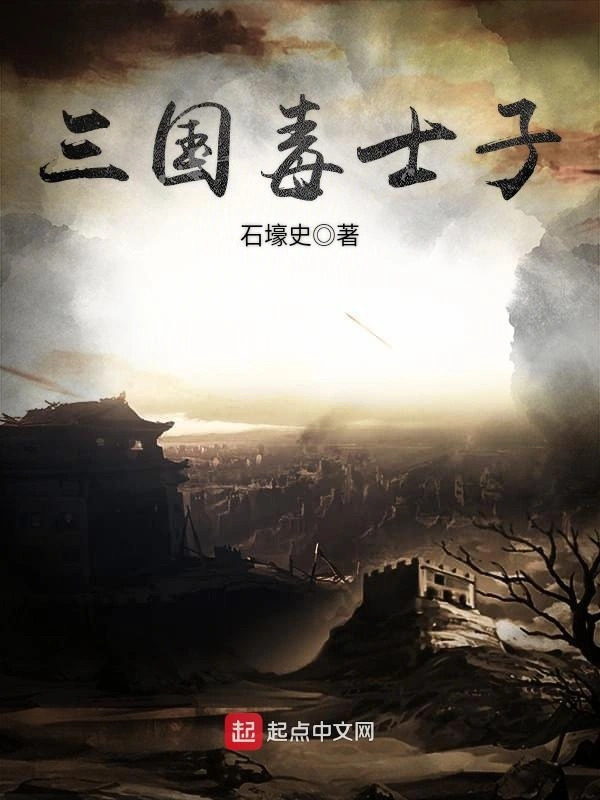
Poisonous Scholars of the Three Kingdoms
三国毒士子
- Status
- Ongoing
- Length
- 390k Words
- Genre
- Historical
- Audience
- Male
- Subgenre
- Alternate History
- Updated
- 6y ago
- Source
- Qidian
Stats
0Monthly votes
1.8kRecommends
3.5kFans
120Chapters
Tags
Synopsis
Reader comments
Readers also read
 Red Mansion: Start Escaping and Farming from the Equipment Bar
 After Lying in Bed for Three Years, He Was Forced to Help the Han Dynasty
 Northern Qi, Sage Khan
 Fu Ming 1627
 Tokyo Criminal 1962
 Strategies for Revitalizing the Northern Song Dynasty
 Invincible Righteousness
 Three Kingdoms: My Father Xuande, the King of Guanzhong Is Here
 Vampires Don't Suck Blood, What the Hell Is a Cultural Invasion!
 My Eldest Brother's Name Is Zhu Chongba
 The Age of Huangtian
 Picked up a Copy of Chronicles of the Three Kingdoms
Push it first
Poison Scholars of the Three Kingdoms, as the name suggests, the background is the Three Kingdoms at the end of the Han Dynasty, the character "Poison Scholar" Jia Xu and his sons. It's exciting to think about it. What kind of sparks can a collision between a pervert who studies psychology and an old poisoner who is the best at understanding people's hearts in the Three Kingdoms happen? A kind father and a filial son, or a vicious father and a cruel son? It's hard, it's hard! The concept of this book is difficult to read at first glance, and it is difficult to write. Everyone must have a different Jia Xu in their hearts. The author just waits to be criticized! Hahaha! There is no need to worry about writing. I tried the poison myself and survived by luck.
Very well written. Anyone who likes the history of the Three Kingdoms knows that there were several major contradictions during the Three Kingdoms period, between aristocratic families and poor families, Shandong and Guanxi, and the imperial court and Liangzhou. Among them, Dong Zhuo, who caused the chaos of the Eastern Han Dynasty, and the Xiliang forces in the post-Dong Zhuo period are undoubtedly the top priority. The emergence of Dong Zhuo gave the princes of Shandong an opportunity to rise, and also gave the Liangzhou forces a last chance to reach the pinnacle of Han politics. However, due to the failure of Dong Zhuo's cooperation with the Guandong family, he died and his army was scattered. Then Wang Yun and other Guandong families came to power and were destroyed by the remnants of Xiliang. Then the Xiliang army destroyed Guanzhong and fought among themselves. From then on, Bingzhou, Yongzhou, and Liangzhou became desolate places. The Guanxi family could only go eastward, and the last glory of the military generals, Ma Chao and Jiang Wei, also went to Sichuan and Shu. From now on, the essence of Northwest is no longer there. The next time Guanxi will appear on the political stage will have to wait until hundreds of years later in the Liang Kingdom, when Yang Jian usurps the Northern Zhou Dynasty and makes the capital prosperous. After that, Li Tang prospered by relying on Longyou, Li Zhi, Wu Zhao controlled Guanxi with Shandong, Zhu Wen destroyed the Tang Dynasty and moved the capital to Kaifeng. Since then, thousands of years later, the northwest has never prospered again. This is the biggest tragedy in Chinese history. China has prospered in Guanxi since the Zhou, Qin, and Han dynasties, and the later Han, Jin, and Tang Dynasties perished in Guanxi. The spiritual hometown of Chinese people can only be visited briefly in Luoyang and Xi'an when traveling. The source of all this is the troubled times of the Eastern Han Dynasty and the early Three Kingdoms period. I hope the author can persevere and change the fate of the Xiliang army, the Guanxi family, and the entire Later Han Dynasty.
The title of your book is not historical enough. I suggest changing it to "The Poisonous Scholars of the Three Kingdoms". I hope it will be adopted.
Talk about what kind of person do you think Jia Xu should be?
Jia Xu (xǔ, 147-August 11, 223), courtesy name Wenhe, was born in Guzang, Liangzhou (now Liangzhou District, Wuwei City, Gansu Province). From the end of the Eastern Han Dynasty to the beginning of the Three Kingdoms, he was a famous counselor and military strategist, and the founding hero of Cao Wei. He was originally a general under Dong Zhuo. After Dong Zhuo's death, he offered Li Jue and Guo Si a plan to counterattack Chang'an. After Li Jue and others failed, he became Zhang Xiu's adviser. Zhang Xiu used his tactics to defeat Cao Cao twice. Before the Battle of Guandu, he persuaded Zhang Xiu to surrender to Cao Cao. During the Battle of Guandu, Jia Xu advocated a decisive battle with Yuan Shao. Before the Battle of Chibi, Cao Cao believed that the people should be appeased rather than mobilize troops to attack Jiangdong. Cao Cao refused to listen and suffered a serious defeat. When Cao Cao and the allied forces in Guanzhong were in a stalemate in Weinan, Jia Xu used a divisive plan to disrupt Ma Chao and Han Sui, allowing Cao Cao to pacify Guanzhong in one fell swoop. In determining Cao Cao's successor, Jia Xu used Yuan Shao and Liu Biao as examples, implying that Cao Cao could not abolish the elder and establish the younger, thus secretly helping Cao Pi become the heir apparent. In the first year of Huangchu (220 years), Cao Pi proclaimed himself emperor, worshiped him as Taiwei, and granted him the title of Marquis of Wei Shouxiang. Cao Pi once asked Jia Xu whether he should destroy Shu or Wu first. Jia Xu suggested that the country should be governed first before using force. Cao Pi refused to listen, and he returned to conquer Wu without success. In the fourth year of Huangchu (223), Jia Xu died at the age of seventy-seven, and his posthumous title was Suhou. "Tang Huiyao" respects him as the first of the eight gentlemen of the Wei and Jin Dynasties. Jia Xu was proficient in the art of war. He wrote a volume called "Chao Sunzi's Art of War" and edited and annotated "Wu Qi's Art of War". Jia Xu's life was bright and legendary. Some people say that he: 1. The "poisonous scholar" in the late Han Dynasty made it difficult to recover the Eastern Han Dynasty. 2. Just to protect themselves, they attacked Chang'an and surrendered to Cao Cao, all in accordance with the current situation. 3. He is the best counselor in the Three Kingdoms.
Invest and recommend!
The contract status has been changed! You can continue to invest in the future, friends who have not invested, come on! New book issue, we need your recommendation votes and collection support! Come with me quickly and make a call!
After reading the latest 53 chapters of "Exchanging Flying Bears", I personally guessed the author's thoughts on the next struggle for hegemony. In Chapter 53, the protagonist has already obtained elite soldiers and generals through the mediation of various forces, and has the backup of Tongguan. He has kicked out Guo Si and Li Jue. What is missing is a basic plan and a clear direction of development. It goes without saying that the basic market is Guanzhong, but there are four development directions. The first is to go north to Shuofang to absorb the Xiongnu, then go east to merge with the state to gain the mountains and rivers outside and inside, then go north to conquer Xianbei to see Youyan, or go east to Taihang, take over Heishan, and plan for Hebei. The second is to connect with Liangzhou in the west to stabilize the rear, then accept the Qiang people in Qingtang for Chineseization, and then communicate with the Western Regions Protectorate, making the countries in the Western Regions once again become China's inexhaustible gold and silver mountains. The third is to go south to Hanzhong to defeat Zhang Lu, communicate with the Dongzhou faction and control Bashu, and then to Nanping to defeat the barbarians and gain strong troops in the mountains. At this time, sitting in the Kingdom of Tianfu, there are soldiers who have crossed the mountains and ridges, and come down the river, and attack Liu Biao with Zhang Xiu, and easily capture Jingzhou across a hundred thousand mountains. The fourth one is very cliche. It is nothing more than an old story from the pre-Qin and Han Dynasties. Yonghanyao came out of the world, but the emperor's handling method and the existence of Cao Cao were very troublesome. In general, the protagonist's current goal is to unify Liangzhou's civil and military forces, develop agriculture, industry and commerce in Guanzhong, rectify the management system and grassroots officials that have been suppressed for a long time, recruit a large number of refugees from Guandong, and preferably recruit Hua Tuo Zhangji. While building the existing foundation, we must also consider the next ten years. The rest is to see what idea the author wants to take. I am also very curious. Is the author planning to go north to Hetao and sing songs about the Central Plains with bows and strings, or to dredge the Silk Road and use gold and silver to show his pride, or to write a story about sitting in the heaven and traveling to the Shu-Han Dynasty, or to go out to the Guandong and imitate the kingly spirit of the Qin and Han Dynasties?
Available on December 1st
This book is tentatively scheduled to be put on the shelves on December 1st. I would like to thank my book friends for their support along the way. At that time, I also hope that book friends who have the conditions, please support the first order, thank you.
Lily Army sign-in area
The writing is indeed good, save it first and keep it Hold on, don't be sucked to death!
The author writes well. It seems that he writes carefully. He has consulted some literature. The plot development and plot conception are a test for the author. You can write slower and steady! Don't waste time! The writing is okay! Already chasing 10,000, I'm optimistic about you!
Looks very good, already invested.
Is this book about becoming an emperor or about assisting others?
The late emperor died half way through his career, but now we have the virtuous prime minister Dong Zhuo, the virtuous wife Cai Shi, the filial son Lu Bu, the loyal minister Sima Yi, the great general He Jin, the generals Xing Daorong and Pan Feng, the powerful general Liu Sandao, the divine general Xia Houjie, the divine military strategist Ma Su, the divine grain transport officer Gou An, the grain guard general Chunyu Qiong, and the city guard general Fu Shiren. There is no need to worry about the failure of the hegemony. Han thieves do not stand in harmony, and the king's industry does not take sides.
Yang Xiu (AD 175-AD 219), courtesy name Dezu, was born in Huayin (now Huayin, Shaanxi Province), Hongnong County, Silibu. He was born in a family of hairpins for generations. He was the son of Taiwei Yang Biao and was a great writer in ancient China.
It's said that Jia Mu and Jia Xu have seven-point portraits, so Jia Xu's picture should also be acceptable.
There is nothing to say in this book. Now that I see it, I feel that everything is so natural and not awkward at all. It is very enjoyable. If you keep at it, you will succeed.
The conclusion of the case at the beginning is a little unbearable. The author's writing is good, but if you write the conclusion of the case during the troubled times of the Three Kingdoms, the plot is not very good.
Recommend a brain-burning Three Kingdoms novel
Ha! First order is supported! Is it possible for Cai Yan to accept it? I like Zhao Ji the most!
Let me summarize my personal thoughts on Jia Mu's character reflected in his battle with Guanzhong and his rivalry with Fazheng in the recent chapters. All the founding monarchs in history have something in common. Some are like Liu Ji, who is thick-faced and dark-hearted, some are like Li Er, who is brave and cruel, some are like Zhao Da, who is unscrupulous, some are like Lao Zhu, who is shrewd and despicable, and some are like Sun Cao and Liu, as well as those from the previous and later Tang Dynasties. Regardless of whether history has derogated or praised them, criticized or criticized them, the core reason why these monarchs were able to succeed is that they only have the goal in their eyes, to rule the world. Apart from this goal, other benevolence, justice, integrity, chastity and morality, and parents and children can be abandoned and used at any time. They have only one goal in mind. Generally speaking, we call it dragon nature. And our protagonist is undoubtedly constantly incubating his dragon nature. Sometimes he can be a gentleman, sometimes a filial son, sometimes ruthless, sometimes vicious, sometimes kind, sometimes despicable. We can see that as the plot progresses, the protagonist becomes more and more like a dragon, but he is still missing the most important thing. It is the goal, or ambition. Many hegemony novels always ignore this point. After shaping the protagonist into a dragon, he is more guided by the situation and history rather than purposefully changing everything. If you are just chasing profits for the sake of profit, expanding your territory for the sake of territory, and you can only decide your behavior by looking at the gaps in the general trend of the world, then even if you have dragon nature, you are essentially just a wild dog waiting to pick up bones to feed yourself. No matter how cunning and shameless, just to eat one more bite of meat in front of you, there is no doubt about it. I believe that the author arranges for the protagonist to settle down in Guanzhong, and after contacting the emperor's line, the protagonist will sprout his own goals and leap over the dragon gate in one go, worthy of his name and reality.
I am also a loyal fan of Xu Song