Library
Browse and search novels
25,832 novels found
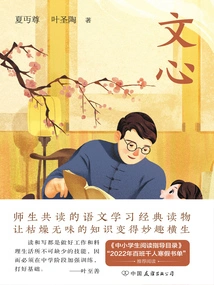
Wen Xin (new Version)
Literature文心(新版)
Xia Chuzun Ye Shengtao
Rhetoric, grammar, reading, writing, poetry, novels, diaries, literary history... How can children fall in love with learning with such rigid knowledge? If there is such a book, which is as easy to read as a novel and allows you to learn a wealth of knowledge from an interesting story, it will definitely be very popular. In order to better guide children in language learning, Chinese masters Xia Chuzun and Ye Shengtao jointly wrote this book "Wenxin". Through 32 interconnected short stories, it connects abstract knowledge with concrete learning and life scenes, integrates knowledge into stories, and uses stories to convey knowledge. It is vivid and thoughtful, and explains the profound things in simple terms, so that children can understand and absorb knowledge through easy reading.
Rhetoric, grammar, reading, writing, poetry, novels, diaries, literary history... How can children fall in love with learning with such rigid knowledge? If there is such a book, which is as easy to read as a novel and allows you to learn a wealth of knowledge from an interesting story, it will definitely be very popular. In order to better guide children in language learning, Chinese masters Xia Chuzun and Ye Shengtao jointly wrote this book "Wenxin". Through 32 interconnected short stories, it connects abstract knowledge with concrete learning and life scenes, integrates knowledge into stories, and uses stories to convey knowledge. It is vivid and thoughtful, and explains the profound things in simple terms, so that children can understand and absorb knowledge through easy reading.
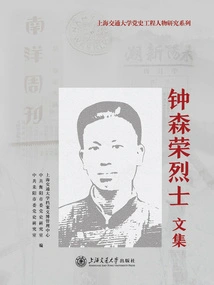
钟森荣烈士文集
Edited by Shanghai Jiao Tong University Archives and Museum Management Center, Communist Party of China Hengyang Municipal Committee Party History Research Office, and Communist Party of China Lianyuan Municipal Committee Party History Research Office
Zhong Senrong (1896-1928), courtesy name Xianxu, pen names Xiu'an and Rongsen, was born in Lianyuan, Hunan. He graduated from the 1925 class of the Electrical Engineering department of Shanghai Jiao Tong University. Zhong served as the editor-in-chief of the university's newspaper, the Shanghai Student Union's executive committee chairman, a member of the National Student Union, the secretary of the Lianyuan County Soviet government, the logistics director of the Fourth Army of the Chinese Workers and Peasants Red Army, and the secretary of the Hunan Special Committee of the Communist Party of China. His contributions to the early student movements, labor movements, national revolution, and armed struggles in Shanghai, Guangzhou, Jiangxi, and Hunan are invaluable. This book is divided into three sections: a brief biography, essays and writings, and historical records, along with a timeline of his life and rare historical images. It presents a comprehensive picture of Zhong's revolutionary life, thoughts, and spirit, and his transformation from a young intellectual to a distinguished revolutionary leader. The publication of this book will greatly enrich the research on the early history of the Communist Party in Shanghai Jiao Tong University, student movements, local revolutionary history, and military history.
Zhong Senrong (1896-1928), courtesy name Xianxu, pen names Xiu'an and Rongsen, was born in Lianyuan, Hunan. He graduated from the 1925 class of the Electrical Engineering department of Shanghai Jiao Tong University. Zhong served as the editor-in-chief of the university's newspaper, the Shanghai Student Union's executive committee chairman, a member of the National Student Union, the secretary of the Lianyuan County Soviet government, the logistics director of the Fourth Army of the Chinese Workers and Peasants Red Army, and the secretary of the Hunan Special Committee of the Communist Party of China. His contributions to the early student movements, labor movements, national revolution, and armed struggles in Shanghai, Guangzhou, Jiangxi, and Hunan are invaluable. This book is divided into three sections: a brief biography, essays and writings, and historical records, along with a timeline of his life and rare historical images. It presents a comprehensive picture of Zhong's revolutionary life, thoughts, and spirit, and his transformation from a young intellectual to a distinguished revolutionary leader. The publication of this book will greatly enrich the research on the early history of the Communist Party in Shanghai Jiao Tong University, student movements, local revolutionary history, and military history.
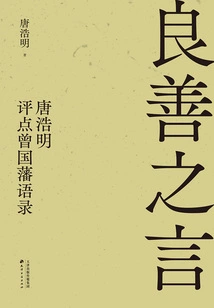
良善之言:唐浩明评点曾国藩语录
Tang Haoming
Understanding the sage Zeng Guofan is better than reading thousands of mediocre works. Zeng left tens of millions of words in ink in voluminous volumes with mixed contents. Where should we start to imitate him as a teacher and general, and learn from his meritorious deeds and virtues? Tang Haoming, an expert on Zeng Guofan, spent many years of hard work and published a six-volume series of "Tang Haoming Comments on Zeng Guofan". He selected Zeng Guofan's family letters, letters, memorials, quotations, poems, and diaries and commented on them, leading readers to get to know a Zeng Guofan who could be felt, lamented, and learned. "Good Words: Comments on Zeng Guofan's Quotations by Tang Haoming" selects a total of 269 maxims written by Zeng Guofan in various articles such as letters, family letters, and notes. It is divided into six chapters: "cultivation", "education", "organizing the family", "conduct", "politics" and "ruling the army". It reflects the essence of Zeng's wisdom in personal cultivation, family harmony, study and administration, military and military affairs, etc. It can also reflect Zeng's own self-requirements and expectations for reversing the degenerate atmosphere at that time and restoring the path of righteousness. It also reveals his personal charm that continues to this day.
Understanding the sage Zeng Guofan is better than reading thousands of mediocre works. Zeng left tens of millions of words in ink in voluminous volumes with mixed contents. Where should we start to imitate him as a teacher and general, and learn from his meritorious deeds and virtues? Tang Haoming, an expert on Zeng Guofan, spent many years of hard work and published a six-volume series of "Tang Haoming Comments on Zeng Guofan". He selected Zeng Guofan's family letters, letters, memorials, quotations, poems, and diaries and commented on them, leading readers to get to know a Zeng Guofan who could be felt, lamented, and learned. "Good Words: Comments on Zeng Guofan's Quotations by Tang Haoming" selects a total of 269 maxims written by Zeng Guofan in various articles such as letters, family letters, and notes. It is divided into six chapters: "cultivation", "education", "organizing the family", "conduct", "politics" and "ruling the army". It reflects the essence of Zeng's wisdom in personal cultivation, family harmony, study and administration, military and military affairs, etc. It can also reflect Zeng's own self-requirements and expectations for reversing the degenerate atmosphere at that time and restoring the path of righteousness. It also reveals his personal charm that continues to this day.
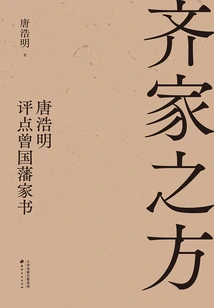
The Recipe for Harmonizing the Family: Tang Haoming Comments on Zeng Guofan's Family Letters
Literature齐家之方:唐浩明评点曾国藩家书
Tang Haoming
Understanding the sage Zeng Guofan is better than reading thousands of mediocre works. Zeng left tens of millions of words in ink in voluminous volumes with mixed contents. Where should we start to imitate him as a teacher and general, and learn from his meritorious deeds and virtues? Tang Haoming, an expert on Zeng Guofan, spent many years of hard work and published a six-volume series of "Tang Haoming Comments on Zeng Guofan". He selected Zeng Guofan's family letters, letters, memorials, quotations, poems, and diaries and commented on them, leading readers to get to know a Zeng Guofan who could be felt, lamented, and learned. "Recipes for Harmonizing the Family: Tang Haoming Comments on Zeng Guofan's Family Letters" selects 128 letters from the Zeng family letters that have survived for more than a thousand times for translation and commentary. Vertically, these more than 100 family letters run through Zeng's life; horizontally, the perspectives of comments are three-dimensional and diverse, involving many aspects such as Zeng's family background, education, personal connections, and historical background. The content is mainly comments, with the original text of the family letter attached. Each letter home touches on a topic and is a fresh way to understand Zeng. Family, society, workplace and officialdom, life and work, Zeng's lifelong wisdom is all there.
Understanding the sage Zeng Guofan is better than reading thousands of mediocre works. Zeng left tens of millions of words in ink in voluminous volumes with mixed contents. Where should we start to imitate him as a teacher and general, and learn from his meritorious deeds and virtues? Tang Haoming, an expert on Zeng Guofan, spent many years of hard work and published a six-volume series of "Tang Haoming Comments on Zeng Guofan". He selected Zeng Guofan's family letters, letters, memorials, quotations, poems, and diaries and commented on them, leading readers to get to know a Zeng Guofan who could be felt, lamented, and learned. "Recipes for Harmonizing the Family: Tang Haoming Comments on Zeng Guofan's Family Letters" selects 128 letters from the Zeng family letters that have survived for more than a thousand times for translation and commentary. Vertically, these more than 100 family letters run through Zeng's life; horizontally, the perspectives of comments are three-dimensional and diverse, involving many aspects such as Zeng's family background, education, personal connections, and historical background. The content is mainly comments, with the original text of the family letter attached. Each letter home touches on a topic and is a fresh way to understand Zeng. Family, society, workplace and officialdom, life and work, Zeng's lifelong wisdom is all there.
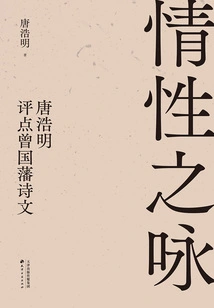
情性之咏:唐浩明评点曾国藩诗文
Tang Haoming
The value of Zeng Guofan's works is self-evident, but for today's readers, it is very difficult to read because of its large volume, complex content, and the writing is not in today's vernacular. In order to allow today's public readers to approach Zeng Guofan in an easy way, Tang Haoming wrote and published a series of books "Tang Haoming Comments on Zeng Guofan". There are six volumes in this series, including family letters, memorials, diaries, poems, letters and quotations. In each volume, Tang Haoming selects a part of the text for translation and commentary, helping readers to understand Zeng Guofan and the Wan Qing Dynasty from a close perspective, and to understand the living traditional Chinese culture. "Ode to Emotional Nature: Tang Haoming's Comments on Zeng Guofan's Essays" is one of them. The author selects 135 poems, two lines of words, 44 couplets, and 47 articles from the new edition of Zeng's complete collection, focusing on the writing background and the author's own understanding, and gives readers some comments, hoping to help readers read and appreciate Zeng's poems.
The value of Zeng Guofan's works is self-evident, but for today's readers, it is very difficult to read because of its large volume, complex content, and the writing is not in today's vernacular. In order to allow today's public readers to approach Zeng Guofan in an easy way, Tang Haoming wrote and published a series of books "Tang Haoming Comments on Zeng Guofan". There are six volumes in this series, including family letters, memorials, diaries, poems, letters and quotations. In each volume, Tang Haoming selects a part of the text for translation and commentary, helping readers to understand Zeng Guofan and the Wan Qing Dynasty from a close perspective, and to understand the living traditional Chinese culture. "Ode to Emotional Nature: Tang Haoming's Comments on Zeng Guofan's Essays" is one of them. The author selects 135 poems, two lines of words, 44 couplets, and 47 articles from the new edition of Zeng's complete collection, focusing on the writing background and the author's own understanding, and gives readers some comments, hoping to help readers read and appreciate Zeng's poems.
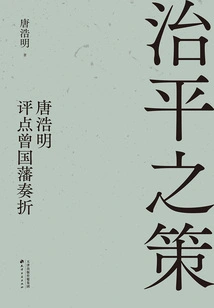
治平之策:唐浩明评点曾国藩奏折
Tang Haoming
Understanding the sage Zeng Guofan is better than reading thousands of mediocre works. Zeng left tens of millions of words in ink in voluminous volumes with mixed contents. Where should we start to imitate him as a teacher and general, and learn from his meritorious deeds and virtues? Tang Haoming, an expert on Zeng Guofan, spent many years of hard work and published a six-volume series of "Tang Haoming Comments on Zeng Guofan". He selected Zeng Guofan's family letters, letters, memorials, quotations, poems, and diaries and commented on them, leading readers to get to know a Zeng Guofan who could be felt, lamented, and learned. "Strategies for Peace: Tang Haoming Comments on Zeng Guofan's Memorials" selected 44 of the more than 2,000 memorials that have survived for translation and commentary. A memorial is a report written to the central government. Zeng Guofan, as an important minister in the late Qing Dynasty and a master of writing in the late Qing Dynasty, was in charge of military and political affairs. His memorial was so extraordinary that it was once hailed as the best memorial in the world. As a Han Chinese, the Zeng family was entrusted with important responsibilities by the Qing court in times of crisis; the Zeng family made immortal contributions in the desperate situation of the declining dynasty, and was finally able to retire with success. From this, we can see the complexity of the power system, and more importantly, Zeng's ingenious wisdom in dealing with people in a complex environment.
Understanding the sage Zeng Guofan is better than reading thousands of mediocre works. Zeng left tens of millions of words in ink in voluminous volumes with mixed contents. Where should we start to imitate him as a teacher and general, and learn from his meritorious deeds and virtues? Tang Haoming, an expert on Zeng Guofan, spent many years of hard work and published a six-volume series of "Tang Haoming Comments on Zeng Guofan". He selected Zeng Guofan's family letters, letters, memorials, quotations, poems, and diaries and commented on them, leading readers to get to know a Zeng Guofan who could be felt, lamented, and learned. "Strategies for Peace: Tang Haoming Comments on Zeng Guofan's Memorials" selected 44 of the more than 2,000 memorials that have survived for translation and commentary. A memorial is a report written to the central government. Zeng Guofan, as an important minister in the late Qing Dynasty and a master of writing in the late Qing Dynasty, was in charge of military and political affairs. His memorial was so extraordinary that it was once hailed as the best memorial in the world. As a Han Chinese, the Zeng family was entrusted with important responsibilities by the Qing court in times of crisis; the Zeng family made immortal contributions in the desperate situation of the declining dynasty, and was finally able to retire with success. From this, we can see the complexity of the power system, and more importantly, Zeng's ingenious wisdom in dealing with people in a complex environment.
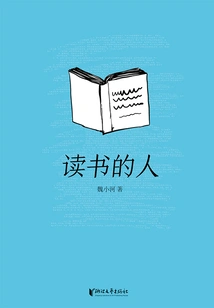
Person Who Reads
Literature读书的人
Wei Xiaohe
"The Reader" is the latest collection of works by Wei Xiaohe, a young book critic born in the 1990s. It is also a journey along with the book. This book is divided into four series: "Star Moments", "Possibilities of Multiple Worlds", "A Style of Chinese" and "Living Elsewhere", and contains a total of 34 articles. Starting from the cracked winter land to the fall of Xiao Hong, Zhang Ailing ushered in the prelude of the times in the cramped first half of her life. The entire starry moment was the life of an ordinary person; open a science fiction novel or a moral novel, touch the struggle of free will and love, the pull of leaving and staying, and feel the possibilities and possibilities of a diverse world. A kind of demeanor in the Chinese language; what readers need most is the enthusiasm to plunge into the world and the courage to change the world. At the end of the journey, we enter the world of wanderers - there are endless lists of travels, magical experiences deep into the hinterlands of Africa and Central Asia, and the empirical observations of British folk living in 8 square meters in Tokyo.
"The Reader" is the latest collection of works by Wei Xiaohe, a young book critic born in the 1990s. It is also a journey along with the book. This book is divided into four series: "Star Moments", "Possibilities of Multiple Worlds", "A Style of Chinese" and "Living Elsewhere", and contains a total of 34 articles. Starting from the cracked winter land to the fall of Xiao Hong, Zhang Ailing ushered in the prelude of the times in the cramped first half of her life. The entire starry moment was the life of an ordinary person; open a science fiction novel or a moral novel, touch the struggle of free will and love, the pull of leaving and staying, and feel the possibilities and possibilities of a diverse world. A kind of demeanor in the Chinese language; what readers need most is the enthusiasm to plunge into the world and the courage to change the world. At the end of the journey, we enter the world of wanderers - there are endless lists of travels, magical experiences deep into the hinterlands of Africa and Central Asia, and the empirical observations of British folk living in 8 square meters in Tokyo.
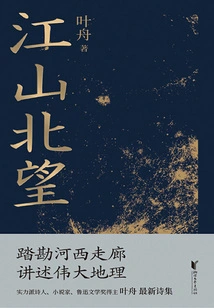
Looking North to the Country
Literature江山北望
Ye Zhou
"Looking North of the Country" is the latest poetry collection by Ye Zhou, winner of the Lu Xun Literature Prize. It includes powerful, vivid and lovely works such as "Hexi Corridor", "Reminiscences", "On the Road", "Leave Chang'an", "Asking for Water in Gaochang Kingdom", "Oh, Qiuci". Ye Zhou was an explorer of the Hexi Corridor and a writer of great geography. From the gentle ringing of camel bells in the Qilian Mountains to the leisurely flutes in Liangzhou, from the wisdom of Kumarajiva to the joys and sorrows of the horse traders, every line of Ye Zhou's poems is asking questions, handing in papers, and joining the chorus of all living beings.
"Looking North of the Country" is the latest poetry collection by Ye Zhou, winner of the Lu Xun Literature Prize. It includes powerful, vivid and lovely works such as "Hexi Corridor", "Reminiscences", "On the Road", "Leave Chang'an", "Asking for Water in Gaochang Kingdom", "Oh, Qiuci". Ye Zhou was an explorer of the Hexi Corridor and a writer of great geography. From the gentle ringing of camel bells in the Qilian Mountains to the leisurely flutes in Liangzhou, from the wisdom of Kumarajiva to the joys and sorrows of the horse traders, every line of Ye Zhou's poems is asking questions, handing in papers, and joining the chorus of all living beings.
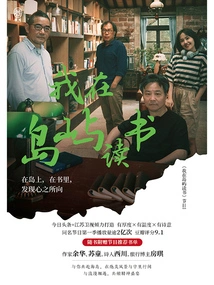
I Study on an Island
Literature我在岛屿读书
"i'm Studying On An Island" Program Group
This book is derived from the variety show "I Read on an Island". It is divided into 12 chapters and printed in full color. In addition to retaining the beautiful scenery and poetry, it purifies the topic and goes straight to the essence of reading. Along with the sunshine and sea breeze, the talk of the host and guests, you can enter the charming world of books, see yourself, see the world, and see all living beings.
This book is derived from the variety show "I Read on an Island". It is divided into 12 chapters and printed in full color. In addition to retaining the beautiful scenery and poetry, it purifies the topic and goes straight to the essence of reading. Along with the sunshine and sea breeze, the talk of the host and guests, you can enter the charming world of books, see yourself, see the world, and see all living beings.
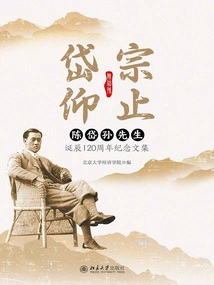
岱宗仰止:陈岱孙先生诞辰120周年纪念文集
Peking University School Of Economics
It contains articles recalling Mr. Chen Daisun from dozens of relatives, friends, and students, including famous alumni such as Li Yining, Zhang Youren, Wang Mengkui, and Liu Wei. The collection is of special significance to the study of early economics education in China, and contains dozens of precious photos of Mr. Chen Daisun, which has high documentary and historical value. 2020 Is the 120th anniversary of the birth of Mr. Chen Daisun. Based on the first edition, "Daizong Yangzhi - Collected Works to Commemorate the 120th Anniversary of the Birth of Mr. Chen Daisun" adds 20 sincere memorial articles and several previously unpublished photos, which more comprehensively displays all aspects of Mr. Chen Daisun.
It contains articles recalling Mr. Chen Daisun from dozens of relatives, friends, and students, including famous alumni such as Li Yining, Zhang Youren, Wang Mengkui, and Liu Wei. The collection is of special significance to the study of early economics education in China, and contains dozens of precious photos of Mr. Chen Daisun, which has high documentary and historical value. 2020 Is the 120th anniversary of the birth of Mr. Chen Daisun. Based on the first edition, "Daizong Yangzhi - Collected Works to Commemorate the 120th Anniversary of the Birth of Mr. Chen Daisun" adds 20 sincere memorial articles and several previously unpublished photos, which more comprehensively displays all aspects of Mr. Chen Daisun.
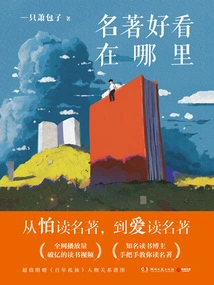
Where Are the Masterpieces?
Literature名著好看在哪里
A Xiao Baozi
From being afraid of reading classics to loving reading classics, this book will teach you how to get started with reading classics! The well-known reading blogger "Yiyi Xiaobaozi" with 4 million+ fans on the entire network will teach you how to read classics step by step! The series of reading programs has more than 200 million video views on the entire network, and the essence is condensed! The "One Hundred Years of Solitude" Interpretation, which has been viewed over 10 million times across the entire network, has been reorganized and detailed character appearances have been added, allowing you to understand "One Hundred Years of Solitude" in one night. The content is detailed and covers Chinese and foreign classics. This book provides a detailed interpretation of 8 Chinese and foreign classics, including "One Hundred Years of Solitude", "Love in the Time of Cholera", "The Count of Monte Cristo", "Don Quixote", "1984", "The Outsider", "White Deer Plain" and "The Three-Body Problem". Not only that, the author also carefully sorts out the reading methods and teaches readers how to read a book systematically. After reading it, everyone will become a reading expert. The writing style is humorous and full of details, starting the reading journey in a relaxed atmosphere. 1-Sentence summary + story line extraction + golden quotes + character appearance pictures + humorous cartoon illustrations. The author uses humorous language to explain the details of the classic and the historical background of the author's creation in detail, creating a relaxed reading environment. If you also have a "masterpiece" that you have put on the shelf, you might as well read this book first. It will definitely make you fall in love with the masterpiece easily!
From being afraid of reading classics to loving reading classics, this book will teach you how to get started with reading classics! The well-known reading blogger "Yiyi Xiaobaozi" with 4 million+ fans on the entire network will teach you how to read classics step by step! The series of reading programs has more than 200 million video views on the entire network, and the essence is condensed! The "One Hundred Years of Solitude" Interpretation, which has been viewed over 10 million times across the entire network, has been reorganized and detailed character appearances have been added, allowing you to understand "One Hundred Years of Solitude" in one night. The content is detailed and covers Chinese and foreign classics. This book provides a detailed interpretation of 8 Chinese and foreign classics, including "One Hundred Years of Solitude", "Love in the Time of Cholera", "The Count of Monte Cristo", "Don Quixote", "1984", "The Outsider", "White Deer Plain" and "The Three-Body Problem". Not only that, the author also carefully sorts out the reading methods and teaches readers how to read a book systematically. After reading it, everyone will become a reading expert. The writing style is humorous and full of details, starting the reading journey in a relaxed atmosphere. 1-Sentence summary + story line extraction + golden quotes + character appearance pictures + humorous cartoon illustrations. The author uses humorous language to explain the details of the classic and the historical background of the author's creation in detail, creating a relaxed reading environment. If you also have a "masterpiece" that you have put on the shelf, you might as well read this book first. It will definitely make you fall in love with the masterpiece easily!
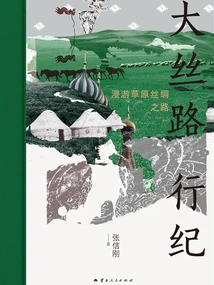
大丝路行纪:漫游草原丝绸之路
Zhang Xingang
This book is the first volume in Zhang Xingang's "Travel on the Great Silk Road" series, focusing on the Prairie Silk Road, a long-standing civilization channel. The Grassland Silk Road is connected by the prairie that runs through northern Eurasia, starting from the Greater Khingan Mountains and Hulunbuir Grassland in the east, and ending in the lower reaches of the Dnieper River that flows into the Black Sea in the west. This vast prairie has given birth to a unique civilization landscape in the history of Eurasia. This book mainly relies on the author's more than 40 years of travel and research, covering tens of thousands of kilometers and covering the cultural characteristics and historical anecdotes of various places along the Prairie Silk Road. From Inner Mongolia to Ningxia, from Lake Baikal to the Altai Mountains, from the Kazakh grasslands to the Black Sea-Caspian Sea grasslands... The author is deeply touched by the diverse customs and geographical features along the Prairie Silk Road. He uses his lens to record the changes of the times over the past few decades. He observes the past and present with profound writing skills, combs through the inextricable historical origins of different civilizations, and connects a vast and mobile map of grassland civilization.
This book is the first volume in Zhang Xingang's "Travel on the Great Silk Road" series, focusing on the Prairie Silk Road, a long-standing civilization channel. The Grassland Silk Road is connected by the prairie that runs through northern Eurasia, starting from the Greater Khingan Mountains and Hulunbuir Grassland in the east, and ending in the lower reaches of the Dnieper River that flows into the Black Sea in the west. This vast prairie has given birth to a unique civilization landscape in the history of Eurasia. This book mainly relies on the author's more than 40 years of travel and research, covering tens of thousands of kilometers and covering the cultural characteristics and historical anecdotes of various places along the Prairie Silk Road. From Inner Mongolia to Ningxia, from Lake Baikal to the Altai Mountains, from the Kazakh grasslands to the Black Sea-Caspian Sea grasslands... The author is deeply touched by the diverse customs and geographical features along the Prairie Silk Road. He uses his lens to record the changes of the times over the past few decades. He observes the past and present with profound writing skills, combs through the inextricable historical origins of different civilizations, and connects a vast and mobile map of grassland civilization.
你若幸福,春暖花开
Compiled By Li Jinping
Family love is like water, which makes the complicated become pure after being filtered; family love is like fire, which makes the plain become sharper by calcining; family love is poetry, which makes boring become a kind of artistic conception through modification. Family love is the eternal driving force of life. This book selects touching articles about parents nurturing and nurturing their children, and children's filial piety to their parents. Through different characters' memories of their parents' nurturing and nurturing themselves, it expresses the feelings of being grateful to parents and praising their parents. It inspires us to learn to be grateful, filial, give back, and be a good person.
Family love is like water, which makes the complicated become pure after being filtered; family love is like fire, which makes the plain become sharper by calcining; family love is poetry, which makes boring become a kind of artistic conception through modification. Family love is the eternal driving force of life. This book selects touching articles about parents nurturing and nurturing their children, and children's filial piety to their parents. Through different characters' memories of their parents' nurturing and nurturing themselves, it expresses the feelings of being grateful to parents and praising their parents. It inspires us to learn to be grateful, filial, give back, and be a good person.
中国现代文学的历史还原和视域拓展
Zhang Zhongliang
This book is a representative selection of the author's academic achievements over more than 40 years. This book believes that the discipline of modern Chinese literature has the intersection of historical research and literary research. The ups and downs in the development of the discipline have led to a lack of history, and the lack of history is detrimental to academic vitality and hinders the healthy development of the discipline. This book aims to make a convincing historical restoration of modern literature in the spirit of seeking truth from facts and historicism.
This book is a representative selection of the author's academic achievements over more than 40 years. This book believes that the discipline of modern Chinese literature has the intersection of historical research and literary research. The ups and downs in the development of the discipline have led to a lack of history, and the lack of history is detrimental to academic vitality and hinders the healthy development of the discipline. This book aims to make a convincing historical restoration of modern literature in the spirit of seeking truth from facts and historicism.
Faust (part 1)
Literature浮士德(第一部)
(germany) Goethe
"Faust (Part 1)" has a total of 4612 lines of poetry and 60 lines of prose. The entire book was first published in 1808, and the writing process took nearly 40 years. The first part is mainly composed of two parts, one is the scholar's play, and the other is Gretchen's play. The scholar's play not only embodies the satire of scholars and academics, but also foreshadows the trends and problems of modern natural science. The Gretchen play staged Faust's emotional experience in the small world. Specifically, it was the "love tragedy" between Faust, an aristocratic young man, and the common girl Gretchen: Faust's temptation led the innocent girl Gretchen to commit a crime and suffer the disaster of "extermination." Annotations are added to the translation, mainly intellectual explanations, divided into marginal notes and footnotes; each scene is preceded by a brief "explanation", which is an explanation of the title, and a brief explanation of the written history, plot, poetry and drama form; "Brief Commentary" is dealt with when necessary, summarizing the issues involved and adding additional comments.
"Faust (Part 1)" has a total of 4612 lines of poetry and 60 lines of prose. The entire book was first published in 1808, and the writing process took nearly 40 years. The first part is mainly composed of two parts, one is the scholar's play, and the other is Gretchen's play. The scholar's play not only embodies the satire of scholars and academics, but also foreshadows the trends and problems of modern natural science. The Gretchen play staged Faust's emotional experience in the small world. Specifically, it was the "love tragedy" between Faust, an aristocratic young man, and the common girl Gretchen: Faust's temptation led the innocent girl Gretchen to commit a crime and suffer the disaster of "extermination." Annotations are added to the translation, mainly intellectual explanations, divided into marginal notes and footnotes; each scene is preceded by a brief "explanation", which is an explanation of the title, and a brief explanation of the written history, plot, poetry and drama form; "Brief Commentary" is dealt with when necessary, summarizing the issues involved and adding additional comments.
J
LiteratureJ
H
In French biographical literature, Rousseau left three works that will be passed down to future generations: "Confessions", "Dialogues" and "Dream of a Lonely Walker"; three works, three genres, and three styles of writing; if "Confessions" is a chronicle and "Dialogues" is a psychological analysis novel, then the last "Dream" is a prose poem. When writing this work, Rousseau was already in his twilight years. He had completely given up the futile efforts of dealing with the enemy and fighting against fate, and resigned himself to everything. Therefore, he was in a comfortable and leisurely mood. Writing the article was like walking and chanting, and he wrote ten "Walks" into ten beautiful prose poems. In terms of nature, these ten articles are literary works, but in terms of content, they are indispensable books for studying Rousseau's life behavior and ideological development trajectory.
In French biographical literature, Rousseau left three works that will be passed down to future generations: "Confessions", "Dialogues" and "Dream of a Lonely Walker"; three works, three genres, and three styles of writing; if "Confessions" is a chronicle and "Dialogues" is a psychological analysis novel, then the last "Dream" is a prose poem. When writing this work, Rousseau was already in his twilight years. He had completely given up the futile efforts of dealing with the enemy and fighting against fate, and resigned himself to everything. Therefore, he was in a comfortable and leisurely mood. Writing the article was like walking and chanting, and he wrote ten "Walks" into ten beautiful prose poems. In terms of nature, these ten articles are literary works, but in terms of content, they are indispensable books for studying Rousseau's life behavior and ideological development trajectory.
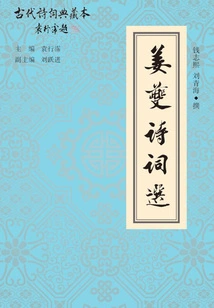
Selected Poems of Jiang Kui
Literature姜夔诗词选
Qian Zhixi Liu Qinghai
Jiang Kui was an important poet in the Southern Song Dynasty and a representative of the elegant school of literati poetry. His lyrics aim to be pure and elegant, rich in the beauty of music and show his extremely high artistic taste. In the history of Ci, Jiang Ci not only directly affected the history of Ci in the late Southern Song Dynasty, but also had a great influence on the Western Zhejiang Ci School in the Qing Dynasty. Jiang also has high achievements in poetry creation, especially his Qijue style, which is fresh and subtle, and his words are spiritual and purposeful. This book contains about 200,000 words, and selects 68 representative poems by Jiang Kui, including 24 poems and 44 lyrics, which relatively completely displays the overall achievements of Jiang Kui's poems. There is an "Introduction" at the front of the book, which is divided into three parts: "Jiang Kui's career and era", "Interpretation of the title of the collection "Songs of Taoist Baishi"" and "Jiang Kui's Poetry". It discusses Jiang Kui's life experience and achievements in poetry creation, which helps readers to fully understand Jiang Kui as a person and his works. As for the evaluation of specific works, it follows the style of the series and is divided into two parts: annotation and appreciation. The annotation part explains the creative background of the work, explains difficult words, reveals the source of the dictionary and the related allusions. It should be complicated when it is necessary, and it should be simple when it is suitable. The appraisal part is a relatively in-depth and detailed analysis of the meaning, structure, and artistic techniques of the work, and there are many interesting comments. In particular, the author's discussion on the melody of Baishi's poems is very enlightening. There is also an article "Baishi Ci Theory" at the back of the book for readers' reference.
Jiang Kui was an important poet in the Southern Song Dynasty and a representative of the elegant school of literati poetry. His lyrics aim to be pure and elegant, rich in the beauty of music and show his extremely high artistic taste. In the history of Ci, Jiang Ci not only directly affected the history of Ci in the late Southern Song Dynasty, but also had a great influence on the Western Zhejiang Ci School in the Qing Dynasty. Jiang also has high achievements in poetry creation, especially his Qijue style, which is fresh and subtle, and his words are spiritual and purposeful. This book contains about 200,000 words, and selects 68 representative poems by Jiang Kui, including 24 poems and 44 lyrics, which relatively completely displays the overall achievements of Jiang Kui's poems. There is an "Introduction" at the front of the book, which is divided into three parts: "Jiang Kui's career and era", "Interpretation of the title of the collection "Songs of Taoist Baishi"" and "Jiang Kui's Poetry". It discusses Jiang Kui's life experience and achievements in poetry creation, which helps readers to fully understand Jiang Kui as a person and his works. As for the evaluation of specific works, it follows the style of the series and is divided into two parts: annotation and appreciation. The annotation part explains the creative background of the work, explains difficult words, reveals the source of the dictionary and the related allusions. It should be complicated when it is necessary, and it should be simple when it is suitable. The appraisal part is a relatively in-depth and detailed analysis of the meaning, structure, and artistic techniques of the work, and there are many interesting comments. In particular, the author's discussion on the melody of Baishi's poems is very enlightening. There is also an article "Baishi Ci Theory" at the back of the book for readers' reference.
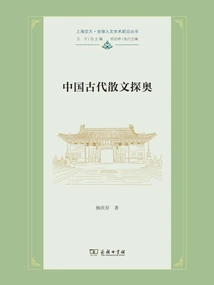
中国古代散文探奥
Yang Qingcun
"Exploring the Mysteries of Ancient Chinese Prose" is a self-selected collection of academic papers studying the development of ancient Chinese prose. Most of the 25 selected results were published in journals such as Chinese Social Sciences, Literary Review, and Literary Heritage, or were keynote speeches at international academic seminars. The book covers the origin and evolution of prose, basic theories, historical facts of creation, classic writers, national characteristics, etc. It profoundly reveals the breadth, depth and artistic creation of ancient Chinese prose, thereby proposing a series of new insights. The author examines in detail the emergence of prose not later than poetry. The concept of prose is widely used in the classics of the Southern Song Dynasty and is not a "random product". He proposes to use musicality as a demarcation to establish the scope of prose research and demonstrates that both prose and parallel prose belong to the category of prose. Most prose classics are closely related to the mainstream culture of the Chinese nation, Confucianism. The development of ancient Chinese prose presents nine distinctive stages. He believes that the Song Dynasty was the peak period of prose creation. The author focuses on the prosperous landscape of prose in the Song Dynasty with the evolution model of style schools and the profound humanistic heritage of "people-oriented". He deeply analyzes the development and innovation of prose genres in the Song Dynasty, the genres and development of prose in the early Northern Song Dynasty, and discusses in depth the emergence of Ouyang Xiuwen's Taoism and his "unparalleled" creative practice, and Su Shi's Confucian thought. The concept of "merging power with heaven and earth" and the prose wonders of "the source of ten thousand dendrobiums" are examined in detail, Huang Tingjian "uses poetry as prose" to incorporate poetic sentiment into prose creation, Li Qingzhao creates the profound artistic conception of prose with his affectionate and delicate lyrics and rigorous and meticulous structure, and Xin Qiji "uses the art of war as grammar" to create a new realm of majestic prose with a broad vision. The book also discusses the excavation and application of ancient Chinese prose historical materials and documents, as well as the value guidance and expansion trends of prose research.
"Exploring the Mysteries of Ancient Chinese Prose" is a self-selected collection of academic papers studying the development of ancient Chinese prose. Most of the 25 selected results were published in journals such as Chinese Social Sciences, Literary Review, and Literary Heritage, or were keynote speeches at international academic seminars. The book covers the origin and evolution of prose, basic theories, historical facts of creation, classic writers, national characteristics, etc. It profoundly reveals the breadth, depth and artistic creation of ancient Chinese prose, thereby proposing a series of new insights. The author examines in detail the emergence of prose not later than poetry. The concept of prose is widely used in the classics of the Southern Song Dynasty and is not a "random product". He proposes to use musicality as a demarcation to establish the scope of prose research and demonstrates that both prose and parallel prose belong to the category of prose. Most prose classics are closely related to the mainstream culture of the Chinese nation, Confucianism. The development of ancient Chinese prose presents nine distinctive stages. He believes that the Song Dynasty was the peak period of prose creation. The author focuses on the prosperous landscape of prose in the Song Dynasty with the evolution model of style schools and the profound humanistic heritage of "people-oriented". He deeply analyzes the development and innovation of prose genres in the Song Dynasty, the genres and development of prose in the early Northern Song Dynasty, and discusses in depth the emergence of Ouyang Xiuwen's Taoism and his "unparalleled" creative practice, and Su Shi's Confucian thought. The concept of "merging power with heaven and earth" and the prose wonders of "the source of ten thousand dendrobiums" are examined in detail, Huang Tingjian "uses poetry as prose" to incorporate poetic sentiment into prose creation, Li Qingzhao creates the profound artistic conception of prose with his affectionate and delicate lyrics and rigorous and meticulous structure, and Xin Qiji "uses the art of war as grammar" to create a new realm of majestic prose with a broad vision. The book also discusses the excavation and application of ancient Chinese prose historical materials and documents, as well as the value guidance and expansion trends of prose research.
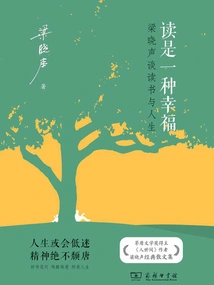
读是一种幸福:梁晓声谈读书与人生
Liang Xiaosheng
"Liang Xiaosheng Talks about Reading and Life" brings together the essence of Liang Xiaosheng's prose about reading and life. The writing is sincere, simple, humorous, sober and warm. The book has three volumes. The first volume is "Time is Long in Books", which focuses on the writer's thoughts on reading and his insights on writing. You can get a glimpse of what are the methods of reading, what are the "tips" and "rules" of writing; the second part is "Settle the Heart", how teenagers and middle-aged people can settle the heart, how the author faces difficulties, how to live a positive life, and look at the lives of others Viewing is also about finding the true self inwardly; the third volume is "Love in the World". The author's deep love for relatives, friends and neighbors, and strangers, as well as thoughts about fathers and sons, love and marriage, anxiety and loneliness, and the emotions and mind immersed in the fireworks of the world are particularly touching.
"Liang Xiaosheng Talks about Reading and Life" brings together the essence of Liang Xiaosheng's prose about reading and life. The writing is sincere, simple, humorous, sober and warm. The book has three volumes. The first volume is "Time is Long in Books", which focuses on the writer's thoughts on reading and his insights on writing. You can get a glimpse of what are the methods of reading, what are the "tips" and "rules" of writing; the second part is "Settle the Heart", how teenagers and middle-aged people can settle the heart, how the author faces difficulties, how to live a positive life, and look at the lives of others Viewing is also about finding the true self inwardly; the third volume is "Love in the World". The author's deep love for relatives, friends and neighbors, and strangers, as well as thoughts about fathers and sons, love and marriage, anxiety and loneliness, and the emotions and mind immersed in the fireworks of the world are particularly touching.
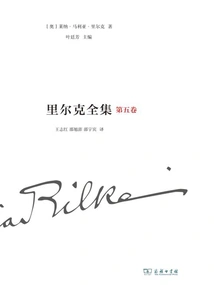
里尔克全集(第五卷):诗集、组诗和诗(1894—1902)
Q
"The Complete Works of Rilke" is translated based on the 12-volume "The Complete Works of Rilke" (Rainer Maira Rilke. S? Mtliche Werke in zw? Lf B? Nden) published by Island Publishing House in 1975. The Chinese version has 11 volumes in total. This volume collects works created by Rilke from 1894 to 1902. There are works published by the poet at his own expense, as well as original manuscripts, which were not officially published during the poet's lifetime. Among them are "Life and Song", which he later completely denied, and the poem "Chicory" The compilation of songs also includes "The Eleven Visions of Christ" and "Celebration of You", which he cherishes. The former was hidden by him because of its religious attitude, while the latter was specially composed for his lover Salome. According to Salome's wishes, it was not known to outsiders during his lifetime. In addition, there are all his poetic dramas, which are short in length and basically only construct a scene with few characters, either monologues or dialogues. Some of the poet's important works at this stage, such as "Celebrate Me", "The Marquise in White", "Flagbearer" and "Prayer", all have first drafts and revised drafts respectively. The time span between the first draft and the revised draft varies. These first drafts are also included in this volume. The final drafts of these works are arranged in the first volume of the complete collection. Therefore, if readers want to understand the overall picture of Rilke's early poetry creation, they may wish to read the first volume together with this volume.
"The Complete Works of Rilke" is translated based on the 12-volume "The Complete Works of Rilke" (Rainer Maira Rilke. S? Mtliche Werke in zw? Lf B? Nden) published by Island Publishing House in 1975. The Chinese version has 11 volumes in total. This volume collects works created by Rilke from 1894 to 1902. There are works published by the poet at his own expense, as well as original manuscripts, which were not officially published during the poet's lifetime. Among them are "Life and Song", which he later completely denied, and the poem "Chicory" The compilation of songs also includes "The Eleven Visions of Christ" and "Celebration of You", which he cherishes. The former was hidden by him because of its religious attitude, while the latter was specially composed for his lover Salome. According to Salome's wishes, it was not known to outsiders during his lifetime. In addition, there are all his poetic dramas, which are short in length and basically only construct a scene with few characters, either monologues or dialogues. Some of the poet's important works at this stage, such as "Celebrate Me", "The Marquise in White", "Flagbearer" and "Prayer", all have first drafts and revised drafts respectively. The time span between the first draft and the revised draft varies. These first drafts are also included in this volume. The final drafts of these works are arranged in the first volume of the complete collection. Therefore, if readers want to understand the overall picture of Rilke's early poetry creation, they may wish to read the first volume together with this volume.
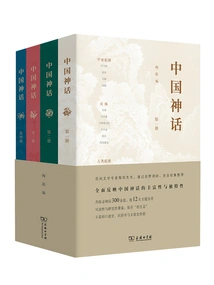
Chinese Mythology (four Volumes)
Literature中国神话(全四册)
Edited By Tao Yang
This is a mythology book with adults as its main readership, and can also be used as extracurricular reading for middle school students. The four volumes of the book total about 1.28 Million words: the first volume mainly contains myths and legends about the origin of heaven, earth and man, about 380,000 words; the second volume mainly contains myths and legends about human ancestors and the origin of various Chinese nations, about 450,000 words; the third volume contains myths and legends about human life and death, love and hate and other folk culture-related myths and legends, about 270,000 words; the fourth volume mainly contains myths and legends about ghosts and monsters, about 230,000 words. There are more than 300 mythological stories in the book, covering the oral living myths and legends of 56 ethnic groups in my country. The author has selected the best, which not only provides reliable works that are helpful for cultural exchanges, but also provides a Chinese mythology masterpiece that is not inferior to ancient Greek mythology, Egyptian mythology, Roman mythology, Hebrew mythology, and Indian mythology and has a complete range of varieties. The book has a beautiful narrative and contains rich cultural and historical value. It is also a beautiful literary and artistic reading material that can be enjoyed by both refined and popular people, and is suitable for all ages.
This is a mythology book with adults as its main readership, and can also be used as extracurricular reading for middle school students. The four volumes of the book total about 1.28 Million words: the first volume mainly contains myths and legends about the origin of heaven, earth and man, about 380,000 words; the second volume mainly contains myths and legends about human ancestors and the origin of various Chinese nations, about 450,000 words; the third volume contains myths and legends about human life and death, love and hate and other folk culture-related myths and legends, about 270,000 words; the fourth volume mainly contains myths and legends about ghosts and monsters, about 230,000 words. There are more than 300 mythological stories in the book, covering the oral living myths and legends of 56 ethnic groups in my country. The author has selected the best, which not only provides reliable works that are helpful for cultural exchanges, but also provides a Chinese mythology masterpiece that is not inferior to ancient Greek mythology, Egyptian mythology, Roman mythology, Hebrew mythology, and Indian mythology and has a complete range of varieties. The book has a beautiful narrative and contains rich cultural and historical value. It is also a beautiful literary and artistic reading material that can be enjoyed by both refined and popular people, and is suitable for all ages.
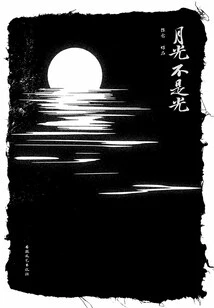
Moonlight is Not Light
Literature月光不是光
Chen Cang
"Moonlight Is Not Light" is Chen Cang's latest collection of essays, which includes seven large essays, including "I Have a Tree", "Father's Love Affair", "Brother's Legacy", "Moonlight Is Not Light", etc. The work describes the various complexes that the urban and rural changes since the reform and opening up have brought to the protagonists, including nostalgia, family affection, attachment to the past life, and fear and adaptation to the ever-changing life today. Among them, "I Have a Tree" tells the story of the fateful entanglement between a farmer, a village and various trees; "Father's Love" depicts a ridiculous story that happened after a farmer's father entered the city; "The Magpie is Back" It tells the story of a humble and helpless descendant of a farmer who is looking for his missing uncle, that is, a source of support; "Moonlight Is Not Light" tells the story of migrant workers who return to their hometown with their children to find their roots and find that the countryside has become a hometown that they cannot return to. The work reflects the psychological shock that the tremendous changes in the countryside have brought to people who are far away from and returning to their hometowns during the journey of poverty alleviation.
"Moonlight Is Not Light" is Chen Cang's latest collection of essays, which includes seven large essays, including "I Have a Tree", "Father's Love Affair", "Brother's Legacy", "Moonlight Is Not Light", etc. The work describes the various complexes that the urban and rural changes since the reform and opening up have brought to the protagonists, including nostalgia, family affection, attachment to the past life, and fear and adaptation to the ever-changing life today. Among them, "I Have a Tree" tells the story of the fateful entanglement between a farmer, a village and various trees; "Father's Love" depicts a ridiculous story that happened after a farmer's father entered the city; "The Magpie is Back" It tells the story of a humble and helpless descendant of a farmer who is looking for his missing uncle, that is, a source of support; "Moonlight Is Not Light" tells the story of migrant workers who return to their hometown with their children to find their roots and find that the countryside has become a hometown that they cannot return to. The work reflects the psychological shock that the tremendous changes in the countryside have brought to people who are far away from and returning to their hometowns during the journey of poverty alleviation.
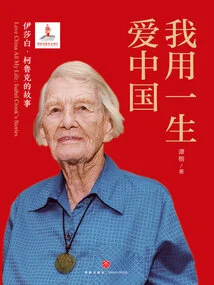
我用一生爱中国:伊莎白·柯鲁克的故事
Tan Kai
"I Love China All My Life: The Story of Elizabeth Crook" is a reportage that reflects the century-old life of Elizabeth Crook, a recipient of the "Medal of Friendship" of the People's Republic of China, an international communist, and a centenarian. Elizabeth Crook was born in Chengdu, China, in 1915. She has personally experienced the great changes in China's history for more than a century, and witnessed the great journey of the Communist Party of China from its founding to its continuous development and growth over the past century, seeking happiness for the Chinese people and rejuvenation for the Chinese nation. The author Tan Kai spent three years, through a large number of interviews and field investigations, using more than 300,000 words and some precious historical pictures, to tell the story of Elizabeth Crook's growth in Huaxiba, Chengdu, China, engaged in anthropological research in Sichuan, Chongqing and other places, went to the UK with her husband David Crook to participate in the anti-fascist war and joined the Communist Party of Britain, and then returned to China's liberated areas for inspection. After the founding of New China, she devoted herself to teaching English and promoting friendly exchanges with foreign countries. As an anthropologist, international communist, educator, and pioneer of English teaching in New China, Elizabeth Crook breathed and shared the fate of the Chinese people, devoted herself to the great cause of building New China, and made outstanding contributions to China's education and friendly exchanges with foreign countries. She spent her life "showing a true and vivid China to the world and spreading the voice of peace and beauty of China."
"I Love China All My Life: The Story of Elizabeth Crook" is a reportage that reflects the century-old life of Elizabeth Crook, a recipient of the "Medal of Friendship" of the People's Republic of China, an international communist, and a centenarian. Elizabeth Crook was born in Chengdu, China, in 1915. She has personally experienced the great changes in China's history for more than a century, and witnessed the great journey of the Communist Party of China from its founding to its continuous development and growth over the past century, seeking happiness for the Chinese people and rejuvenation for the Chinese nation. The author Tan Kai spent three years, through a large number of interviews and field investigations, using more than 300,000 words and some precious historical pictures, to tell the story of Elizabeth Crook's growth in Huaxiba, Chengdu, China, engaged in anthropological research in Sichuan, Chongqing and other places, went to the UK with her husband David Crook to participate in the anti-fascist war and joined the Communist Party of Britain, and then returned to China's liberated areas for inspection. After the founding of New China, she devoted herself to teaching English and promoting friendly exchanges with foreign countries. As an anthropologist, international communist, educator, and pioneer of English teaching in New China, Elizabeth Crook breathed and shared the fate of the Chinese people, devoted herself to the great cause of building New China, and made outstanding contributions to China's education and friendly exchanges with foreign countries. She spent her life "showing a true and vivid China to the world and spreading the voice of peace and beauty of China."
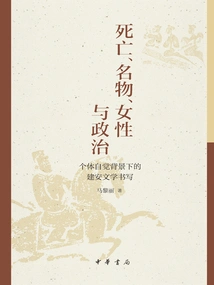
死亡、名物、女性与政治:个体自觉背景下的建安文学书写
Ma Lili
Resetting Jian'an literature under the conceptual background of "individual consciousness", this book uses a thematic breakthrough writing method to study the changes brought by the concept of individual consciousness to the life attitude, aesthetic attitude and political attitude of Jian'an writers from four aspects: death writing, famous writing, women's writing, and political writing, as well as the impact of this change on literary writing attitudes, techniques and creations. Influenced by style, it is believed that the fundamental motivation of Jian'an literati's creation is to contend with the fear of death. By revealing the material-self relationship and the relationship between men and women in Jian'an writers' attitude towards releasing desires and enjoying this world, it explains the deep reasons why they had a flexible outlook on life and a dual mentality of independent personality in the process of devoting themselves to politics and pursuing achievements.
Resetting Jian'an literature under the conceptual background of "individual consciousness", this book uses a thematic breakthrough writing method to study the changes brought by the concept of individual consciousness to the life attitude, aesthetic attitude and political attitude of Jian'an writers from four aspects: death writing, famous writing, women's writing, and political writing, as well as the impact of this change on literary writing attitudes, techniques and creations. Influenced by style, it is believed that the fundamental motivation of Jian'an literati's creation is to contend with the fear of death. By revealing the material-self relationship and the relationship between men and women in Jian'an writers' attitude towards releasing desires and enjoying this world, it explains the deep reasons why they had a flexible outlook on life and a dual mentality of independent personality in the process of devoting themselves to politics and pursuing achievements.
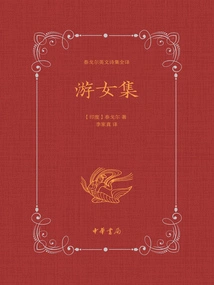
The Collection of Wandering Women (complete Translation of Rabindranath Tagore's English Poems)
Literature游女集(泰戈尔英文诗集全译)
H
"The Collection of Wandering Girls" is a poem by the Indian literary giant Rabindranath Tagore. It contains 94 poems with diverse themes and is as mellow as his representative works "New Moon Collection", "Wandering Birds Collection", "Song Collection" and so on. In this collection of poems, the poet wrote: "The poems I wrote have made their flowers extraordinarily beautiful; my love for the world has made them love the world even more."
"The Collection of Wandering Girls" is a poem by the Indian literary giant Rabindranath Tagore. It contains 94 poems with diverse themes and is as mellow as his representative works "New Moon Collection", "Wandering Birds Collection", "Song Collection" and so on. In this collection of poems, the poet wrote: "The poems I wrote have made their flowers extraordinarily beautiful; my love for the world has made them love the world even more."
师友集(中央文史研究馆馆员文丛)
Li Qiankuan
Li Qiankuan, born in January 1941, is from Penglai, Shandong. Librarian of the Central Research Institute of Literature and History, member of the Democratic Progressive Party, and president of the China Film Foundation. He once served as Chairman of the China Film Association, Vice Chairman of the Jilin Provincial Federation of Literary and Art Circles, Member of the Standing Committee of the Central Committee for the Advancement of Democracy, and Chief Director of Changchun Film Studio. This book records the author's artistic life in the form of a memoir, including descriptions of the creative pursuits and behind-the-scenes stories of "The Founding Ceremony of the People's Republic of China", "Chongqing Incident", and "Resisting U. S. Aggression and Aid Korea". These films all played an important role in the author's artistic career.
Li Qiankuan, born in January 1941, is from Penglai, Shandong. Librarian of the Central Research Institute of Literature and History, member of the Democratic Progressive Party, and president of the China Film Foundation. He once served as Chairman of the China Film Association, Vice Chairman of the Jilin Provincial Federation of Literary and Art Circles, Member of the Standing Committee of the Central Committee for the Advancement of Democracy, and Chief Director of Changchun Film Studio. This book records the author's artistic life in the form of a memoir, including descriptions of the creative pursuits and behind-the-scenes stories of "The Founding Ceremony of the People's Republic of China", "Chongqing Incident", and "Resisting U. S. Aggression and Aid Korea". These films all played an important role in the author's artistic career.
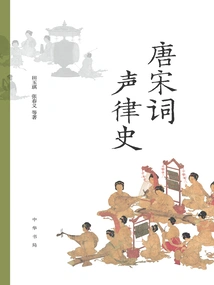
唐宋词声律史
Tian Yuqi Zhang Chunyi Et Al.
My country's rhyme literature developed to the Tang and Song Dynasties, and its rhythmic form has reached its peak. It has both stable patterns and complex changes, which is far from comparable to the poetry of previous generations. It is really colorful and spectacular. This book strives to open up the research on literature, linguistics and musicology, discusses it from the perspective of "musical style", "style" and the combination of the two, and three-dimensionally examines the occurrence and development history of Tang and Song poetry as music literature. In terms of "Music Style", it mainly discusses the connection and influence between Qing Dynasty Shang music, Fa Qu, Hu Buyan music, Song Dynasty court drum music, Dasheng music, etc. And Tang and Song poetry and music, focusing on the excavation and combing of historical materials of music literature; in terms of the coordination of poetry and music, it mainly focuses on Ricun dance Taking the composition "Zhangzhong Yaolu" as an example, we will discuss it from the aspects of tune, dance structure, sentence rhythm, etc.; In terms of "style", we will conduct a comprehensive review and historical investigation of the rhyme usage of Tang and Song poetry, and conduct a comprehensive investigation of the rhythm style of Tang and Song poetry from the perspectives of rhyme, sentence rhythm, and word sounds.
My country's rhyme literature developed to the Tang and Song Dynasties, and its rhythmic form has reached its peak. It has both stable patterns and complex changes, which is far from comparable to the poetry of previous generations. It is really colorful and spectacular. This book strives to open up the research on literature, linguistics and musicology, discusses it from the perspective of "musical style", "style" and the combination of the two, and three-dimensionally examines the occurrence and development history of Tang and Song poetry as music literature. In terms of "Music Style", it mainly discusses the connection and influence between Qing Dynasty Shang music, Fa Qu, Hu Buyan music, Song Dynasty court drum music, Dasheng music, etc. And Tang and Song poetry and music, focusing on the excavation and combing of historical materials of music literature; in terms of the coordination of poetry and music, it mainly focuses on Ricun dance Taking the composition "Zhangzhong Yaolu" as an example, we will discuss it from the aspects of tune, dance structure, sentence rhythm, etc.; In terms of "style", we will conduct a comprehensive review and historical investigation of the rhyme usage of Tang and Song poetry, and conduct a comprehensive investigation of the rhythm style of Tang and Song poetry from the perspectives of rhyme, sentence rhythm, and word sounds.
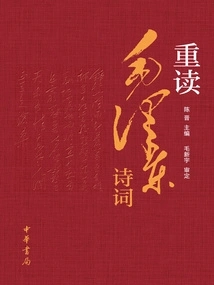
Rereading Mao Zedong's Poems
Literature重读毛泽东诗词
Editor-in-chief Chen Jin
"Rereading Mao Zedong's Poems" is edited by Chen Jin, president of the China Mao Zedong Poetry Research Association, and approved by Mao Xinyu. There are a total of 67 Mao Zedong's poems selected in the book, which is a new selection of 78 widely circulated editions of Mao Zedong's poems. As an important carrier of Mao Zedong Thought, Mao Zedong's poetry not only demonstrates a strong sense of responsibility for the times and a distinct spirit of the times, but also provides ideological support and spiritual strength for the realization of the Chinese dream of the great rejuvenation of the Chinese nation. In terms of appreciation materials, the original texts related to poetry have been comprehensively organized; in terms of poetry creation background, new theoretical research results have been combined to further enrich the historical and literary materials of poetry creation; in terms of self-note and self-explanation, the content of the author's first-person narrative has been reorganized (answers to reporters' questions, correspondence, corrections and errors, etc.), Striving to be well-founded and with reliable sources; in terms of poetry appreciation, Mao Zedong's poetry has been used as the main line to condense and explain the revolutionary development history of the Communist Party of China. In addition, three generations of domestic broadcasting and hosting experts, old, middle and young, have given their voices and recited Mao Zedong's poems with great enthusiasm, hoping that readers can more vividly experience the majestic and heroic connotations of Mao Zedong's poems.
"Rereading Mao Zedong's Poems" is edited by Chen Jin, president of the China Mao Zedong Poetry Research Association, and approved by Mao Xinyu. There are a total of 67 Mao Zedong's poems selected in the book, which is a new selection of 78 widely circulated editions of Mao Zedong's poems. As an important carrier of Mao Zedong Thought, Mao Zedong's poetry not only demonstrates a strong sense of responsibility for the times and a distinct spirit of the times, but also provides ideological support and spiritual strength for the realization of the Chinese dream of the great rejuvenation of the Chinese nation. In terms of appreciation materials, the original texts related to poetry have been comprehensively organized; in terms of poetry creation background, new theoretical research results have been combined to further enrich the historical and literary materials of poetry creation; in terms of self-note and self-explanation, the content of the author's first-person narrative has been reorganized (answers to reporters' questions, correspondence, corrections and errors, etc.), Striving to be well-founded and with reliable sources; in terms of poetry appreciation, Mao Zedong's poetry has been used as the main line to condense and explain the revolutionary development history of the Communist Party of China. In addition, three generations of domestic broadcasting and hosting experts, old, middle and young, have given their voices and recited Mao Zedong's poems with great enthusiasm, hoping that readers can more vividly experience the majestic and heroic connotations of Mao Zedong's poems.
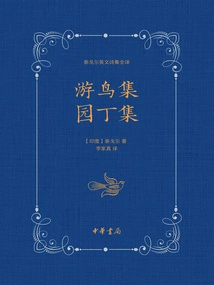
游鸟集 园丁集(泰戈尔英文诗集全译)
(india) Rabindranath Tagore
"The Birds" (originally translated as "The Birds") is one of the masterpieces of the Indian writer Rabindranath Tagore and is famous all over the world. This poetry collection contains 326 beautiful poems. Birds, streams, stars, autumn fireflies, mountains, flowers... Everything in the world exudes unique charm under the poet's pen. The poet expressed the profound philosophy of life in short and concise sentences, leading the world to explore the source of truth and wisdom. Reading these poems for the first time is like opening the bedroom window on an early summer morning after a storm and seeing a clean and bright world. Everything is so fresh and pleasant. "The Gardener's Collection" contains 85 poems and is another important collection of poems by Rabindranath Tagore. This collection of poems is "poems about love and life". It is fresh, beautiful, profound and touching, and also contains profound philosophical thoughts. As the Nobel Prize speech commented on this collection: "From it we see another side of his personality - sometimes surrendering to the intertwined joys and sorrows of youthful love, sometimes indulging in the anxiety and joy caused by the prosperity of life; at the same time, all these experiences are accompanied by thoughts about the extraordinary world."
"The Birds" (originally translated as "The Birds") is one of the masterpieces of the Indian writer Rabindranath Tagore and is famous all over the world. This poetry collection contains 326 beautiful poems. Birds, streams, stars, autumn fireflies, mountains, flowers... Everything in the world exudes unique charm under the poet's pen. The poet expressed the profound philosophy of life in short and concise sentences, leading the world to explore the source of truth and wisdom. Reading these poems for the first time is like opening the bedroom window on an early summer morning after a storm and seeing a clean and bright world. Everything is so fresh and pleasant. "The Gardener's Collection" contains 85 poems and is another important collection of poems by Rabindranath Tagore. This collection of poems is "poems about love and life". It is fresh, beautiful, profound and touching, and also contains profound philosophical thoughts. As the Nobel Prize speech commented on this collection: "From it we see another side of his personality - sometimes surrendering to the intertwined joys and sorrows of youthful love, sometimes indulging in the anxiety and joy caused by the prosperity of life; at the same time, all these experiences are accompanied by thoughts about the extraordinary world."
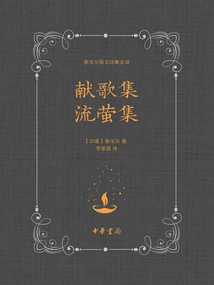
献歌集 流萤集(泰戈尔英文诗集全译)
(india) Rabindranath Tagore
"Song Collection" (old translation "Gitanjali") is one of Tagore's most representative collections of poetry and the main work that won him the Nobel Prize for Literature in 1913. "Song Collection" contains 103 prose poems, which are "fragrant flowers and fruits dedicated to the gods". In his poems, Tagore jumped out of the framework of traditional religion and regarded gods as a universal spiritual force, closely connected with all things in the universe and human life. This collection of poems also includes an introduction written by Yeats, another Nobel Prize winner, the famous Irish poet, the 1913 Nobel Prize for Literature award speech and the dinner speech. "The Collection of Flowing Fireflies" contains 258 short poems, and together with "The Collection of Wandering Birds" is known as the two short poems in Rabindranath Tagore's poetry collection. "The Collection of Flowing Fireflies" originated from Tagore's trip to Japan and China. The poems in it were creatively influenced by Japanese haiku and Chinese quatrains. They are short and readable yet have long meanings, and are full of the poet's profound perception of life.
"Song Collection" (old translation "Gitanjali") is one of Tagore's most representative collections of poetry and the main work that won him the Nobel Prize for Literature in 1913. "Song Collection" contains 103 prose poems, which are "fragrant flowers and fruits dedicated to the gods". In his poems, Tagore jumped out of the framework of traditional religion and regarded gods as a universal spiritual force, closely connected with all things in the universe and human life. This collection of poems also includes an introduction written by Yeats, another Nobel Prize winner, the famous Irish poet, the 1913 Nobel Prize for Literature award speech and the dinner speech. "The Collection of Flowing Fireflies" contains 258 short poems, and together with "The Collection of Wandering Birds" is known as the two short poems in Rabindranath Tagore's poetry collection. "The Collection of Flowing Fireflies" originated from Tagore's trip to Japan and China. The poems in it were creatively influenced by Japanese haiku and Chinese quatrains. They are short and readable yet have long meanings, and are full of the poet's profound perception of life.
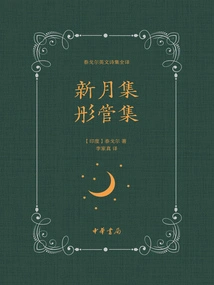
新月集 彤管集(泰戈尔英文诗集全译)
H
"New Moon Collection" is one of the representative works of Indian writer Rabindranath Tagore. It contains 40 poems with the theme of children's life and interests. In the collection of poems, the poet looks at the world from a child's perspective, vividly depicts children's games, and skillfully expresses children's psychology and their lively imagination. This collection of poems has timeless artistic charm, brings us to a pure and innocent world of children, and evokes our beautiful memories of childhood life. "Tongguan Collection" is a collection of poems by Indian writer Rabindranath Tagore, which contains 60 prose poems. In this collection of poems, the poet eulogizes the charm and immortality of love, and shows the fleeting but meaningful moments in life.
"New Moon Collection" is one of the representative works of Indian writer Rabindranath Tagore. It contains 40 poems with the theme of children's life and interests. In the collection of poems, the poet looks at the world from a child's perspective, vividly depicts children's games, and skillfully expresses children's psychology and their lively imagination. This collection of poems has timeless artistic charm, brings us to a pure and innocent world of children, and evokes our beautiful memories of childhood life. "Tongguan Collection" is a collection of poems by Indian writer Rabindranath Tagore, which contains 60 prose poems. In this collection of poems, the poet eulogizes the charm and immortality of love, and shows the fleeting but meaningful moments in life.
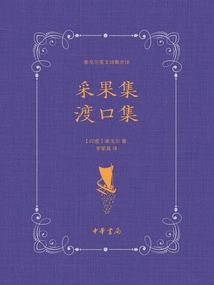
采果集 渡口集(泰戈尔英文诗集全译)
H
"Fruit Collection" contains 86 prose poems by the Indian literary giant Rabindranath Tagore, which can be called the sequel to "Song Collection". Tagore used poetic language to capture spiritual thoughts and ponder the essence of life, leaving us with this moving collection of poems. Every flower, every tree, every grass, every dust, in the poet's writing are all beautiful words and lively thoughts - "All things show their true colors there, as if facing the eyes of the Creator." "The Ferry Collection" contains 78 prose poems by Indian writer Rabindranath Tagore. The poet uses extraordinary brushwork to "meditate on the eternity on the other side", which is full of optimistic and positive emotions and vitality.
"Fruit Collection" contains 86 prose poems by the Indian literary giant Rabindranath Tagore, which can be called the sequel to "Song Collection". Tagore used poetic language to capture spiritual thoughts and ponder the essence of life, leaving us with this moving collection of poems. Every flower, every tree, every grass, every dust, in the poet's writing are all beautiful words and lively thoughts - "All things show their true colors there, as if facing the eyes of the Creator." "The Ferry Collection" contains 78 prose poems by Indian writer Rabindranath Tagore. The poet uses extraordinary brushwork to "meditate on the eternity on the other side", which is full of optimistic and positive emotions and vitality.
Pilgrimage to Tinker Creek (new Version)
Literature听客溪的朝圣(新装版)
(us) Annie Dillard
The flight of a bird is casual and spontaneous, like the curling of a stem or the lightening of a star. "Pilgrimage to Tinker Creek" can be called a model of contemporary nature literature. The world has taken on a new look because of its words, making readers "cannot bear to finish reading it." It has been widely selected as a textbook for American universities and middle schools. Critics believe that this book is better than Thoreau's "Walden Pond", while others say it is comparable to Fabre's "Insects". For Dillard, this is her twenty-seven-year-old young and unrestrained soul, freely and boldly confronting the world's greatest themes of life and death.
The flight of a bird is casual and spontaneous, like the curling of a stem or the lightening of a star. "Pilgrimage to Tinker Creek" can be called a model of contemporary nature literature. The world has taken on a new look because of its words, making readers "cannot bear to finish reading it." It has been widely selected as a textbook for American universities and middle schools. Critics believe that this book is better than Thoreau's "Walden Pond", while others say it is comparable to Fabre's "Insects". For Dillard, this is her twenty-seven-year-old young and unrestrained soul, freely and boldly confronting the world's greatest themes of life and death.
笔补造化:中唐至宋末诗歌叙事传统研究
Yang Wanli Zhou Jianzhi
This book is one of the "Research Series on Chinese Poetry Narrative Tradition" project of the National Publishing Fund, that is, the research results from the mid-Tang Dynasty to the late Song Dynasty. Clarify the concepts of "narrator" and "narrative perspective", and summarize the occurrence of Chinese poetic narrative tradition and its evolution and development in various dynasties. The nine chapters of the main text include a special chapter on characters (Du Fu, Li He) and a special chapter on poetry (Yuanhe style) to explore the narrative elements in Tang poetry; it also discusses the narrative style of Tang and Song Dynasties; then it uses biographical poems, travel poems, dream poems, chronicle poems and other types of poems in the Song Dynasty to explain the narrative characteristics of Song poetry; finally, it conducts a narrative study of poem titles, poem prefaces, and poem notes in Tang and Song poems.
This book is one of the "Research Series on Chinese Poetry Narrative Tradition" project of the National Publishing Fund, that is, the research results from the mid-Tang Dynasty to the late Song Dynasty. Clarify the concepts of "narrator" and "narrative perspective", and summarize the occurrence of Chinese poetic narrative tradition and its evolution and development in various dynasties. The nine chapters of the main text include a special chapter on characters (Du Fu, Li He) and a special chapter on poetry (Yuanhe style) to explore the narrative elements in Tang poetry; it also discusses the narrative style of Tang and Song Dynasties; then it uses biographical poems, travel poems, dream poems, chronicle poems and other types of poems in the Song Dynasty to explain the narrative characteristics of Song poetry; finally, it conducts a narrative study of poem titles, poem prefaces, and poem notes in Tang and Song poems.
赋比且兴:先秦两汉诗歌叙事传统研究
Yang Xiuli Shi Qiang Lu Shuming Wang Shichong
The book "Fu Bi and Xing: Research on the Narrative Tradition of Poetry in Pre-Qin and Han Dynasties" is the pre-Qin and Han volumes of the "Research on Narrative Tradition in Chinese Poetry" series funded by the National Publishing Fund. It is the result of teamwork led by Yang Xiuli, associate professor of the School of Liberal Arts of Shanghai University. It is divided into the following four parts: the budding of ancient songs and poetic narrative tradition in the Zhouyi, the foundation of the Book of Songs and the narrative tradition of poetry, the evolution of the Songs of Chu and the narrative tradition of poetry, and the inheritance and new changes of the Qin and Han Dynasties and the narrative tradition of poetry.
The book "Fu Bi and Xing: Research on the Narrative Tradition of Poetry in Pre-Qin and Han Dynasties" is the pre-Qin and Han volumes of the "Research on Narrative Tradition in Chinese Poetry" series funded by the National Publishing Fund. It is the result of teamwork led by Yang Xiuli, associate professor of the School of Liberal Arts of Shanghai University. It is divided into the following four parts: the budding of ancient songs and poetic narrative tradition in the Zhouyi, the foundation of the Book of Songs and the narrative tradition of poetry, the evolution of the Songs of Chu and the narrative tradition of poetry, and the inheritance and new changes of the Qin and Han Dynasties and the narrative tradition of poetry.
语体新变:中国诗歌叙事传统的近代转型
Yang Xurong Chao Dongmei Dong Naibin Li Han
This book elaborates on the inheritance, evolution and development of narrative poetry in the modern Chinese poetry tradition. It analyzes in detail the impact of social, historical, and cultural changes on the development and creation of Chinese narrative poetry. It analyzes modern Chinese narrative poetry from multiple angles and levels, and provides a good summary of the modern transformation of the narrative tradition of Chinese poetry.
This book elaborates on the inheritance, evolution and development of narrative poetry in the modern Chinese poetry tradition. It analyzes in detail the impact of social, historical, and cultural changes on the development and creation of Chinese narrative poetry. It analyzes modern Chinese narrative poetry from multiple angles and levels, and provides a good summary of the modern transformation of the narrative tradition of Chinese poetry.
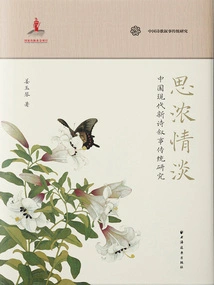
思浓情淡:中国现代新诗叙事传统研究
Jiang Yuqin
This book combs the growth and evolution of the lyric and narrative traditions in Chinese poetry creation since the "May 4th" New Culture Movement. It focuses on the new poetry theory and creation of representative poets Hu Shi, Li Jinfa, Mu Dan, and Yuan Kejia who emphasize narrative reasoning. It analyzes the trend of modern new poetry toward "narrativeness" as an inherent requirement for the development of poetry. It also explores the implicit tradition of "narrativeness" in traditional old poetry. This book also focuses on the controversial and important issue of whether Hu Shi or Guo Moruo was the origin of new poetry. This book is suitable for readers who are interested in poetry.
This book combs the growth and evolution of the lyric and narrative traditions in Chinese poetry creation since the "May 4th" New Culture Movement. It focuses on the new poetry theory and creation of representative poets Hu Shi, Li Jinfa, Mu Dan, and Yuan Kejia who emphasize narrative reasoning. It analyzes the trend of modern new poetry toward "narrativeness" as an inherent requirement for the development of poetry. It also explores the implicit tradition of "narrativeness" in traditional old poetry. This book also focuses on the controversial and important issue of whether Hu Shi or Guo Moruo was the origin of new poetry. This book is suitable for readers who are interested in poetry.
Take Poetry to the Streets
Literature带着诗歌上街去
The Man Separated From The Flower
The book has a total of 4 chapters, including 171 poems + 171 photos of life carriers. From nature to the streets, from freedom to oneself, use improvisation to record the eternal moments in life. Before humans appeared, there were naturally no tall buildings. Between the tall buildings are the streets. Streets are divided left and right, and the forest has no gender. Is slowness an expression of time? It's still a nice day. Let's dry the corner of the street to reveal the poetry. The Flower Girl uses her unique perspective and language to tell the poetry of life.
The book has a total of 4 chapters, including 171 poems + 171 photos of life carriers. From nature to the streets, from freedom to oneself, use improvisation to record the eternal moments in life. Before humans appeared, there were naturally no tall buildings. Between the tall buildings are the streets. Streets are divided left and right, and the forest has no gender. Is slowness an expression of time? It's still a nice day. Let's dry the corner of the street to reveal the poetry. The Flower Girl uses her unique perspective and language to tell the poetry of life.
Chestnuts in the Night
Literature深夜中的栗子
H
[Best-selling author Ogawa Ito returns with heart-warming following "Camellia Stationery" and "Sands Day at the Lion House"] In spring, feel the warmth from the heart, stand under the blooming cherry blossoms, and be a serious flower viewer. On a hot summer day, the sun shines on the lake, putting peaches into the cool lake water. Thousands of light and shadows soothe people's hearts. In the season of falling leaves, make your favorite pastries with your own hands, stay in the kitchen all day, and enjoy a pleasant cooking time. The breath of winter is coming, brew a pot of hot tea, and use chestnuts in the middle of the night to eliminate all mediocrity and fatigue. The bits and pieces that are repeated, repeated, repeated, repeated constitute life itself. It is in this daily life that I write one story after another and listen to them fall to the ground.
[Best-selling author Ogawa Ito returns with heart-warming following "Camellia Stationery" and "Sands Day at the Lion House"] In spring, feel the warmth from the heart, stand under the blooming cherry blossoms, and be a serious flower viewer. On a hot summer day, the sun shines on the lake, putting peaches into the cool lake water. Thousands of light and shadows soothe people's hearts. In the season of falling leaves, make your favorite pastries with your own hands, stay in the kitchen all day, and enjoy a pleasant cooking time. The breath of winter is coming, brew a pot of hot tea, and use chestnuts in the middle of the night to eliminate all mediocrity and fatigue. The bits and pieces that are repeated, repeated, repeated, repeated constitute life itself. It is in this daily life that I write one story after another and listen to them fall to the ground.
Spring in Altay
Literature阿勒泰的春天
Qi Zhou
[A collection of works by Dark Horse author Qi Zhou. The four seasons begin with warm spring and end with cold winter. Use the beauty of the northern border to sing the song of life. The train bound for Altay speeds through the wilderness, chasing the sunset. When a tree grows strong in the wind and snow, the next stop is the never-ending spring. ]The breeze is blowing, the moonlight is on the forest tops, and the inscription of spring is used to record every touch of stunning beauty. The heat is steaming, everything is in bloom, and the world is bright, sighing at the hustle and bustle of summer. The fallen leaves are bleak, the autumn moss grows quietly, the rain is cold and the nights are cool, and the autumn days are better than the spring days. The white fog is biting, the snow is falling in the cold winter, the night lights are dim, and the warmth lingers in my heart. Whether life is mediocre or brilliant, like vines in the forest, just let your life bloom as much as possible in the short or long years.
[A collection of works by Dark Horse author Qi Zhou. The four seasons begin with warm spring and end with cold winter. Use the beauty of the northern border to sing the song of life. The train bound for Altay speeds through the wilderness, chasing the sunset. When a tree grows strong in the wind and snow, the next stop is the never-ending spring. ]The breeze is blowing, the moonlight is on the forest tops, and the inscription of spring is used to record every touch of stunning beauty. The heat is steaming, everything is in bloom, and the world is bright, sighing at the hustle and bustle of summer. The fallen leaves are bleak, the autumn moss grows quietly, the rain is cold and the nights are cool, and the autumn days are better than the spring days. The white fog is biting, the snow is falling in the cold winter, the night lights are dim, and the warmth lingers in my heart. Whether life is mediocre or brilliant, like vines in the forest, just let your life bloom as much as possible in the short or long years.
Crazy Bone Collection
Literature疯骨集
Muchi Mountain
"Crazy Bone Collection" contains more than 80 emotional essays, each with a poem at the end. The works are written with love and true feelings, and the words are full of pride. My love is only a small part among the thousands of people in the world. It is ordinary and vulgar, common and simple. It was magnificent when I met you. But I have my own pride. Even if I am covered with thorns because of you, my soul will never bow. May you grow as much as you want and live like crazy. I respect you that life is like the moon, only bright and clear, regardless of the roundness or imperfection.
"Crazy Bone Collection" contains more than 80 emotional essays, each with a poem at the end. The works are written with love and true feelings, and the words are full of pride. My love is only a small part among the thousands of people in the world. It is ordinary and vulgar, common and simple. It was magnificent when I met you. But I have my own pride. Even if I am covered with thorns because of you, my soul will never bow. May you grow as much as you want and live like crazy. I respect you that life is like the moon, only bright and clear, regardless of the roundness or imperfection.
A Room of Your Own
Literature一间只属于自己的房间
(british) Virginia Woolf
[The masterpiece of feminist pioneer Woolf. Kafka, Mu Xin and Yang Lan praised it highly. "A Room of One's Own" is one of Virginia Woolf's masterpieces. It was written based on the "Women and Novel" lecture she gave at two British universities in 1928 and published in 1929. The author's writing is delicate, funny and full of wisdom, and he puts forward a series of feminist viewpoints with his profound insight and unique literary style. She used "five hundred pounds and a room of her own" as a metaphor, pointing out that economic freedom is the prerequisite for women to be able to create freely, which has had a profound impact on feminist thought and literary creation.
[The masterpiece of feminist pioneer Woolf. Kafka, Mu Xin and Yang Lan praised it highly. "A Room of One's Own" is one of Virginia Woolf's masterpieces. It was written based on the "Women and Novel" lecture she gave at two British universities in 1928 and published in 1929. The author's writing is delicate, funny and full of wisdom, and he puts forward a series of feminist viewpoints with his profound insight and unique literary style. She used "five hundred pounds and a room of her own" as a metaphor, pointing out that economic freedom is the prerequisite for women to be able to create freely, which has had a profound impact on feminist thought and literary creation.
Self-adult Room
Literature自成人间
Ji Xianlin
Mr. Ji Xianlin has been in the long river of life and has experienced strong winds and waves, but he still remains calm in every situation; he is still calm and calm despite all the troubles in his heart; he always sticks to his spiritual world in the ups and downs of the world, and is not arrogant in good times and not afraid of adversity. This book aims to explain Ji Xianlin's philosophy of life and life wisdom. The article covers all aspects of Mr. Ji's life. It is a microcosm of his life experience and an inexhaustible spiritual treasure trove for future generations.
Mr. Ji Xianlin has been in the long river of life and has experienced strong winds and waves, but he still remains calm in every situation; he is still calm and calm despite all the troubles in his heart; he always sticks to his spiritual world in the ups and downs of the world, and is not arrogant in good times and not afraid of adversity. This book aims to explain Ji Xianlin's philosophy of life and life wisdom. The article covers all aspects of Mr. Ji's life. It is a microcosm of his life experience and an inexhaustible spiritual treasure trove for future generations.
Story Rhythm
Literature故事的节奏
L
What determines the life or death of a novel? In the process of writing eight novels, the author found the answer: structure, and the rhythm of the story determined by the structure. Only by deeply understanding the story structure can the writer grasp the order and timing of various plots and freely control the rhythm of the story. The author combines concepts such as three-act structure and plot pain points to explain in detail the principles of story operation and plot arrangement methods. Through in-depth interpretation of four case works such as "Pride and Prejudice", the author demonstrates the various possibilities of story structure and plot shaping. As long as you control the rhythm of the story well, you can mobilize all the potential of the story and make the readers' hearts beat with the rhythm of the novel.
What determines the life or death of a novel? In the process of writing eight novels, the author found the answer: structure, and the rhythm of the story determined by the structure. Only by deeply understanding the story structure can the writer grasp the order and timing of various plots and freely control the rhythm of the story. The author combines concepts such as three-act structure and plot pain points to explain in detail the principles of story operation and plot arrangement methods. Through in-depth interpretation of four case works such as "Pride and Prejudice", the author demonstrates the various possibilities of story structure and plot shaping. As long as you control the rhythm of the story well, you can mobilize all the potential of the story and make the readers' hearts beat with the rhythm of the novel.
独自上路:一个九岁男孩的边境历险
(sa)javier Zamora
This book is the author Javier's recollection of his real experience when he was nine years old. When Javier was one year old, his parents fled El Salvador and immigrated to the United States due to the U. S.-Sponsored civil war in El Salvador (1980-1992). Zamora was helped raised by his grandparents until he was nine years old. In order to reunite with his parents, he left his beloved aunt and grandparents behind and went through an arduous journey. Javier's "adventure" is a 3,000-mile journey that starts in a small town in El Salvador, passes through Guatemala and Mexico, and finally crosses the U. S. Border. I thought it would only take two weeks, but I did not expect to encounter dangerous boat trips, ruthless desert treks, sharp gunpoints, arrests and deceptions. In addition to a group of strangers and the "smugglers" hired to lead them to safety, I also encountered various people on the immigration road. The author of this book is a poet, and his language is very beautiful when he writes this book. The stories he tells can make people understand the innocence of a child in the most difficult environment. What makes this memoir special is not just the story and language, but the amazing way he overcame obstacles with humor, innocence, confidence, courage, gratitude, resilience, and most importantly: hope.
This book is the author Javier's recollection of his real experience when he was nine years old. When Javier was one year old, his parents fled El Salvador and immigrated to the United States due to the U. S.-Sponsored civil war in El Salvador (1980-1992). Zamora was helped raised by his grandparents until he was nine years old. In order to reunite with his parents, he left his beloved aunt and grandparents behind and went through an arduous journey. Javier's "adventure" is a 3,000-mile journey that starts in a small town in El Salvador, passes through Guatemala and Mexico, and finally crosses the U. S. Border. I thought it would only take two weeks, but I did not expect to encounter dangerous boat trips, ruthless desert treks, sharp gunpoints, arrests and deceptions. In addition to a group of strangers and the "smugglers" hired to lead them to safety, I also encountered various people on the immigration road. The author of this book is a poet, and his language is very beautiful when he writes this book. The stories he tells can make people understand the innocence of a child in the most difficult environment. What makes this memoir special is not just the story and language, but the amazing way he overcame obstacles with humor, innocence, confidence, courage, gratitude, resilience, and most importantly: hope.
No Other Life
Literature没有另外的生活
Gao Yan
"No Other Life" is a collection of essays by the author Gao Yan, divided into five volumes. From his hometown to a foreign land, due to accidental life changes, the author traveled from the northeast to the south of the Yangtze River. Time and space have passed. What remains unchanged is the author's attitude of getting close, exploring, and touching. He uses his pen to find his spiritual destination. He uses his own body temperature, emotional presentation, and cultural care to discover the many possibilities behind the depth of life and years, as well as the richness behind the words. From "Heilongjiang" and "My Northland" to "Earthly Chengdu", "One Person, One City" and "Thousand Years of Reading", in this way, whether it is a foreign land here or a distant homeland, it is still close to you if you experience it personally. Even if you cannot completely reach it, after all the search, there is still a cloud.
"No Other Life" is a collection of essays by the author Gao Yan, divided into five volumes. From his hometown to a foreign land, due to accidental life changes, the author traveled from the northeast to the south of the Yangtze River. Time and space have passed. What remains unchanged is the author's attitude of getting close, exploring, and touching. He uses his pen to find his spiritual destination. He uses his own body temperature, emotional presentation, and cultural care to discover the many possibilities behind the depth of life and years, as well as the richness behind the words. From "Heilongjiang" and "My Northland" to "Earthly Chengdu", "One Person, One City" and "Thousand Years of Reading", in this way, whether it is a foreign land here or a distant homeland, it is still close to you if you experience it personally. Even if you cannot completely reach it, after all the search, there is still a cloud.
傅惟慈译丹东之死
(germany) Georg Büchner Et Al.
Fu Weici is an outstanding Chinese translator who has made outstanding contributions in the translation and introduction of English literature and German literature. His representative translations include Büchner's "The Death of Danton", Thomas Mann's "Budenbrooks", Heinrich Mann's "The Servant", Maugham's "The Moon and Sixpence", Graham Greene's "The Power and the Glory", Drew Dolf Rocker's "Six Men", etc. This book intends to select classics translated by Mr. Fu Weici such as "The Death of Dandong". "The Death of Danton" is a play by the German writer Büchner. It depicts the tragedy of the revolutionary Danton against the background of the turbulent French Revolution. It has a profound influence on later generations of German literature and is also regarded as the forerunner of modern drama.
Fu Weici is an outstanding Chinese translator who has made outstanding contributions in the translation and introduction of English literature and German literature. His representative translations include Büchner's "The Death of Danton", Thomas Mann's "Budenbrooks", Heinrich Mann's "The Servant", Maugham's "The Moon and Sixpence", Graham Greene's "The Power and the Glory", Drew Dolf Rocker's "Six Men", etc. This book intends to select classics translated by Mr. Fu Weici such as "The Death of Dandong". "The Death of Danton" is a play by the German writer Büchner. It depicts the tragedy of the revolutionary Danton against the background of the turbulent French Revolution. It has a profound influence on later generations of German literature and is also regarded as the forerunner of modern drama.
Schubert Bandage
Literature舒伯特绷带
(france) Claire Opel
The author, Claire Oppert, is a cellist who was born into a family of doctors in France. She graduated from the Moscow Tchaikovsky Conservatory of Music in 1993. She also holds a degree in philosophy from the Sorbonne in Paris and received education in art therapy from the Faculty of Medicine at the University of Tours in France. Claire Opel has been performing for special groups such as autistic children, elderly people with dementia, and terminally ill patients since the 1990s. She plays classical music, as well as jazz, tango, pop songs, and ethnic music from around the world. She often observed that the sound of the piano could reach the hearts of these patients who often cannot communicate through words and bring them happiness. One day in 2012, Opel encountered a tense scene while waiting for the elevator in a nursing home for the elderly with dementia. Two nurses were about to change the bandage of a patient with a suppurating wound. Out of fear and pain, the patient screamed and began to attack the nurse who approached her. Opel took out her piano and played Schubert's music without thinking. A miracle happened. The old man stopped shouting and the waving arms softened. The nurses were able to successfully change her dressing. They jokingly called the sound of Opel's piano "Schubert's bandage." Inspired by this story, in 2013, Opel, who had just obtained a diploma in art therapy, collaborated with the palliative care department of a public hospital to start the "Schubert Bandage" research project to study the analgesic effect of live music, which attracted the attention of the medical community. This book won the 2021 French Musician Literary Award and has been translated into English, German, Italian, and Japanese and published in many countries.
The author, Claire Oppert, is a cellist who was born into a family of doctors in France. She graduated from the Moscow Tchaikovsky Conservatory of Music in 1993. She also holds a degree in philosophy from the Sorbonne in Paris and received education in art therapy from the Faculty of Medicine at the University of Tours in France. Claire Opel has been performing for special groups such as autistic children, elderly people with dementia, and terminally ill patients since the 1990s. She plays classical music, as well as jazz, tango, pop songs, and ethnic music from around the world. She often observed that the sound of the piano could reach the hearts of these patients who often cannot communicate through words and bring them happiness. One day in 2012, Opel encountered a tense scene while waiting for the elevator in a nursing home for the elderly with dementia. Two nurses were about to change the bandage of a patient with a suppurating wound. Out of fear and pain, the patient screamed and began to attack the nurse who approached her. Opel took out her piano and played Schubert's music without thinking. A miracle happened. The old man stopped shouting and the waving arms softened. The nurses were able to successfully change her dressing. They jokingly called the sound of Opel's piano "Schubert's bandage." Inspired by this story, in 2013, Opel, who had just obtained a diploma in art therapy, collaborated with the palliative care department of a public hospital to start the "Schubert Bandage" research project to study the analgesic effect of live music, which attracted the attention of the medical community. This book won the 2021 French Musician Literary Award and has been translated into English, German, Italian, and Japanese and published in many countries.
Living Has Meaning
Literature活着活着就有了意义
Wang Zengqi
Wang Zengqi's new collection of essays, learn modern Chinese with Mr. Wang, and get "Interesting Life"! The fireworks in the world are the most soothing to mortal hearts. When you feel tired and working hard, why not listen to Wang Zengqi talk about life. Don't be anxious, life is just like life. When you are young, you are understanding the text, and when you grow up, you are understanding life. The book contains 27 classic articles selected as Chinese textbooks and after-school readings. Those ignorant words in your youth will eventually be soothed by the power of Wang Zengqi's articles when you grow up and experience the hardships of life. Every generation of young people is reading Wang Zengqi. Mr. Wang's words remind you that you are still treated tenderly by the world. With the theme of "interest", this book is divided into three parts: plants in the world, taste in the world, and interesting things in the world. It presents the fun and beauty of the world from three parts: plants, food, and old stories about old friends, and shows Mr. Wang Zengqi's interest in life and attitude towards life. His prose contains culture in its leisure, and is sweet and heavy in its own way. The human heart of plants and trees is made by nature; the most sincere, most sincere, most sincere.
Wang Zengqi's new collection of essays, learn modern Chinese with Mr. Wang, and get "Interesting Life"! The fireworks in the world are the most soothing to mortal hearts. When you feel tired and working hard, why not listen to Wang Zengqi talk about life. Don't be anxious, life is just like life. When you are young, you are understanding the text, and when you grow up, you are understanding life. The book contains 27 classic articles selected as Chinese textbooks and after-school readings. Those ignorant words in your youth will eventually be soothed by the power of Wang Zengqi's articles when you grow up and experience the hardships of life. Every generation of young people is reading Wang Zengqi. Mr. Wang's words remind you that you are still treated tenderly by the world. With the theme of "interest", this book is divided into three parts: plants in the world, taste in the world, and interesting things in the world. It presents the fun and beauty of the world from three parts: plants, food, and old stories about old friends, and shows Mr. Wang Zengqi's interest in life and attitude towards life. His prose contains culture in its leisure, and is sweet and heavy in its own way. The human heart of plants and trees is made by nature; the most sincere, most sincere, most sincere.
Miluo River: a River of Poetry
Literature汨罗江:一条诗歌的河流
Liu Yanghe
Miluo River, a river of poetry. Miluo, because of the poet's sacrifice for his country, became the source of the Dragon Boat Festival and the hometown of dragon boats. It was praised by later generations as "the upper reaches of blue ink and the holy land of cultural people". This is the birthplace of Huxiang culture, a place where poets are most respected and poets in distress are given the highest courtesy. This book is a collection of poems with the theme of the Miluo River in Hunan. It is divided into five series: the first series is "White Moon and Clear Wind", the second series is "Searching Far Away", the third series is "Years of Mountains and Rivers", the fourth series is "Worldly Affairs and Human Feelings", and the fifth series is "The Coast of Tinglan". The author is a local who grew up on the banks of the Miluo River. His recitation of this river not only has a historical and cultural perspective, but also is filled with the deep love of the riverside people for this poetic river that accompanies them day and night.
Miluo River, a river of poetry. Miluo, because of the poet's sacrifice for his country, became the source of the Dragon Boat Festival and the hometown of dragon boats. It was praised by later generations as "the upper reaches of blue ink and the holy land of cultural people". This is the birthplace of Huxiang culture, a place where poets are most respected and poets in distress are given the highest courtesy. This book is a collection of poems with the theme of the Miluo River in Hunan. It is divided into five series: the first series is "White Moon and Clear Wind", the second series is "Searching Far Away", the third series is "Years of Mountains and Rivers", the fourth series is "Worldly Affairs and Human Feelings", and the fifth series is "The Coast of Tinglan". The author is a local who grew up on the banks of the Miluo River. His recitation of this river not only has a historical and cultural perspective, but also is filled with the deep love of the riverside people for this poetic river that accompanies them day and night.