Library
Browse and search books
2 novels found

Nature of War
Military战争的本质
(english) A. C. Grayling
Will we encounter World War III in our lifetime? Starting from the nature of war, explore whether we will encounter war in the future and what kind of war we will encounter! Why do wars happen? What will the future of war look like? When war is inevitable, what else can we do? Master the essence of war and explore the future of war. A masterpiece by a British philosopher, professor at the University of London, and winner of both the Fokage Prize and the Russell Prize! It is rich in historical facts and combines famous wars from ancient and modern times at home and abroad: the Crusades, Genghis Khan's conquests, the Napoleonic Wars, World War I, World War II, the Cold War, the Iraq War... It has both the profundity of thought and the readability of the text. Explore the nature of war and answer its core questions.
Will we encounter World War III in our lifetime? Starting from the nature of war, explore whether we will encounter war in the future and what kind of war we will encounter! Why do wars happen? What will the future of war look like? When war is inevitable, what else can we do? Master the essence of war and explore the future of war. A masterpiece by a British philosopher, professor at the University of London, and winner of both the Fokage Prize and the Russell Prize! It is rich in historical facts and combines famous wars from ancient and modern times at home and abroad: the Crusades, Genghis Khan's conquests, the Napoleonic Wars, World War I, World War II, the Cold War, the Iraq War... It has both the profundity of thought and the readability of the text. Explore the nature of war and answer its core questions.
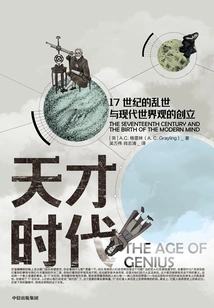
The Age of Genius: Troubled Times in the 17th Century and the Creation of the Modern World View
History天才时代:17世纪的乱世与现代世界观的创立
(english) A. C. Grayling
The 17th century in Europe can be called a century of wars. There were only three years without war in 100 years. The social landscape of Europe underwent drastic changes. At the same time, this was also a century of great creativity. European scholars made brilliant achievements in the field of thought, and a large number of scientific and ideological giants such as Galileo, Descartes, Newton, Boyle, Hobbes, and John Locke emerged. It was the great changes of this century that pushed Western civilization to the center of the stage of human history. "The Age of Genius" explores the connection between social changes and intellectual progress in 17th-century Europe. The brutal Thirty Years' War dealt a heavy blow to the ideological monopoly of the Catholic Church, allowing faith and thought to gradually gain freedom. Because of this, the 17th century also became an era of mixed thoughts and ideas. This era not only had meticulous scientific exploration, but also had a strong enthusiasm for supernatural powers, and an obsession with alchemy, occultism, astrology, and magic; even the founders of new world views such as Newton and Descartes had inexplicable connections with them. But the noise will gradually end, and scientific thinking will finally emerge from the fog to form the cornerstone of modern thought.
The 17th century in Europe can be called a century of wars. There were only three years without war in 100 years. The social landscape of Europe underwent drastic changes. At the same time, this was also a century of great creativity. European scholars made brilliant achievements in the field of thought, and a large number of scientific and ideological giants such as Galileo, Descartes, Newton, Boyle, Hobbes, and John Locke emerged. It was the great changes of this century that pushed Western civilization to the center of the stage of human history. "The Age of Genius" explores the connection between social changes and intellectual progress in 17th-century Europe. The brutal Thirty Years' War dealt a heavy blow to the ideological monopoly of the Catholic Church, allowing faith and thought to gradually gain freedom. Because of this, the 17th century also became an era of mixed thoughts and ideas. This era not only had meticulous scientific exploration, but also had a strong enthusiasm for supernatural powers, and an obsession with alchemy, occultism, astrology, and magic; even the founders of new world views such as Newton and Descartes had inexplicable connections with them. But the noise will gradually end, and scientific thinking will finally emerge from the fog to form the cornerstone of modern thought.