A sky screen appeared in the air. Some rejoiced, while others worried.
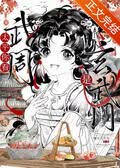
[From ruling the empire to the destruction of her family: A review of Empress Lu's life]
Empress Lu: My son is nothing like his father or his mother. Liu Ying is a blockhead. I might as well take the throne myself.
[Restoring fallen states and continuing broken lineages: Empress Deng Sui, the crown of empresses]
Liu Bang, Liu Che, and the other Liu emperors: Good, good, good! This is the ideal example for an empress of the Great Han.
After watching the sky screen, Deng Sui resolved to institute a system of dual rule: I will not disappoint the hopes of my ancestors!
[Liu E: From orphaned street performer to empress of the Great Song, she got the script of an inspirational female lead!]
Liu E: I have to wear the dragon robe, and it has to be welded to my body.
[Wu Zetian, the empress of an era: Sun and moon in the sky, the Mandate of Heaven rests with Emperor Wu. Let history judge my merits and faults.]
Li Shimin: Li Zhi! This is your empress?
Li Zhi: Father, listen to my explanation...
Wu Zhao: Let me think about how to extend the Zhou of Wu.
Empress Lu/Deng Sui/Liu E: Respect to Emperor Wu!
[The political power of women in the Tang court: ambition, schemes, and a lament for the age of rouge and beauty]
Empress Wei/Princess Anle/Shangguan Wan'er/Princess Taiping: Got it! Li Sanlang can't be allowed to live!
Li Longji: The sky screen has ruined me!
Reading notes:
1. This is a parallel timeline. The characters do not affect one another. This is for entertainment only.
2. Includes both official and unofficial history.
[Next book, please add it to your collection]
After opening her eyes, Jiang Yuanzheng transmigrated to an unfamiliar dynasty:
Her mother was the empress dowager, ruling from behind the throne and holding power over the realm. Though her maternal family was an imperial clan, they had risen through military merit, campaigning across the battlefield and winning countless victories. She was a princess with a generous fief and the authority to take part in political affairs.
With such an excellent start, Jiang Yuanzheng thought she'd received a script with limitless prospects.
But when the book-transmigration System came online, she learned that she'd transmigrated into a book.
In the story, after her mother died, she tried to use her authority to continue participating in politics and fought the original male lead to the death. In the end, she lost, was demoted to commoner, and met a tragic end alongside her entire maternal family.
Jiang Yuanzheng made her decision at once: Under the circumstances, the best plan is for me to ascend the throne myself!
·
The road to a princess becoming emperor is not an easy one. Jiang Yuanzheng has to keep busy salting food, making sugar, smelting iron, and building infrastructure, all while outsmarting the people who try to stop her.
The book's male lead, who loves scheming, is sent off to marry into a foreign court.
The Northern Di prince, who tries to take advantage of the chaos, is dragged into the harem to dance.
The obstinate ministers, who drone on about the Three Bonds and condemn women ruling over men, are packed off.
On the day of her enthronement, Jiang Yuanzheng sat high in the great hall and looked down at the assembled ministers. "What say you, my ministers?"
The ministers cried out together, their voices shaking the heavens: "The Mandate of Heaven rests with the princess!"
Jiang Yuanzheng was satisfied. Approaching power and becoming power had been her goal since the first day she arrived. The Mandate of Heaven should belong to her.
Theme: Use history as a mirror to depict life.

















I really like to read some novels about my mother's family that are set in the Tang and Song dynasties, but the comment section of historical articles on male videos always mentions Emperor Wu as "the powerful old lady who heads the family must become an emperor before she dies", comparing Emperor Wu to the old lady of a rich country man or Cixi, without talking about his political methods, ignoring his achievements, let alone discussing his historical inevitability, just like Emperor Wu was just like a mediocre person who only wanted to spend money to build spectacles and listen to praise and appoint sycophants and cruel officials to rule violently. The stench of everyone who stepped on Emperor Wu and beeped a few words as if they were so awesome that they could trick Emperor Wu into being one of the harems was really making me physically uncomfortable, so I no longer read any Tang and Song Dynasty historical texts, and kept repeating the same routines over and over again.
Power is only responsible for the source of power. Of course, male emperors will not pay attention to women's rights. Even the suppression of women is carried out in all aspects. For example, Liu Bang and Lu Pheasant both made women marquises, but those people only scolded Lu Pheasant. Because even if power is given to women, it can only be given by men and cannot be passed on to women. I think the Wu Zetian period was the best and most suitable period. There were Princess Taiping, Princess Anle... Even Princess Anle was more rare than Princess Taiping, because she had her own goals and ambitions early on. If Princess Anle had been in Princess Taiping's position and was trained by Emperor Wu, she would have been the third emperor of Wu Zhou... Many times, ambition is more important than ability. When you are hesitant and entangled, you have actually given up your right to choose and make decisions in life. Even Princess Hezheng in the back is pretty good - what a pity
Having experienced the reign of the empress from the Wu Zhou Dynasty, the common people and the powerful would not be unable to accept another empress taking the throne, provided that the successor had her own power. You must have military power that can suppress dissatisfied dignitaries and kill them all. You must also have your own talent reserve. You must be able to kill the opposition at any time and then insert your own people into and outside the court to stabilize the social situation and ensure the smooth transfer of power. These are all things that women in the red makeup era lacked. Although they were brought to the pinnacle of power from the imperial palace by Emperor Wu, they failed to take down the power of female officials to middle-level officials, the army, and the people. As a result, when Emperor Wu stepped down, the opportunity for women to stand up and show off their intelligence disappeared.
Li Dan was directly deposed as a commoner, and Li Longji was designated as a rebellious sinner. In the name of justice, he would start first, then arrest and then kill, so that there would not be so many people supporting him.
Forging iron requires oneself to be strong. No way, looking at the historical records, it seems that Empress Wu's hope for the early Taiping period was to choose a good husband for her daughter and live a peaceful and prosperous life with the United States and the United States. During the Emperor Wu period, Taiping may have started to strive for power and profit because her consort was involved in the conspiracy case, and her vision was no longer limited to the back house. However, she did not have relevant education or hands-on government affairs, and did not know enough about political struggles, so she was successfully counterattacked by her nephew Li Longji.
My personal impression of Li Longji is similar to that of Wang Mang and Yang Guang. Before he reveals his true nature and indulges his desires, he is very good at pretending. But just like a spring, when a sage or a sage is not equipped with a spring, he will act as he pleases and ignore it.
I have read many fan stories that Princess Taiping always wanted to be the princess of Li Tang, not the princess of Wu Zhou. I am afraid she has forgotten how Li Shimin's daughter was sent to be married.
Let's talk about how the Anshi Rebellion caused by Li Longji's laissez-faire brought the Tang Dynasty into a ditch, so that those who still want to support Li Longji have to think about the future for their own families, not just for themselves.
It's on fire, Li Sanlang can't stay
What Emperor Wu needed was "ancient evidence" from historical research to establish norms and institutionalize the name for his daughter, Princess Taiping, to succeed to the throne in the future. Therefore, directly looking at the archaeological discoveries in our country, we have excavated various sites of matrilineal clan societies, such as the Shanding Cave Man, Yangshao and Hemudu cultures. Even in the Yin and Shang Dynasty, a patriarchal society, Wu Ding's queen still led troops in foreign wars, took charge of domestic sacrifices, actively participated in domestic affairs, and even had real leaders in her own territory, so it was absolutely no problem for women to succeed to the throne.