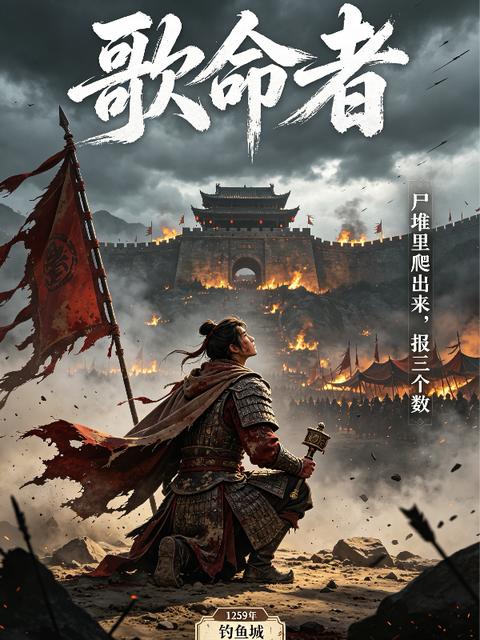
In 1259, Mongke was gravely wounded, and the Mongol army was about to retreat north.
Steel magnate Zhao Weiguo drank himself unconscious at a KTV. When he opened his eyes again, someone was treating him like a corpse and throwing him off a cliff. He had become Zhao Chengyuan, a hereditary military officer and garrison commander of the Southern Song's Diaoyu Fortress. His father and brothers had died in battle, and he had fewer than six hundred men under his command.
He had no System and no pocket dimension. He had only two skills.
The first was accounting. When others asked, "How many men?" he asked for three figures: the highest estimate, the lowest estimate, and the number of squads in total. He asked the same question with a knife at the throat of a Mongol officer, and uncovered the real gap in a force of three thousand five hundred. Later, this became an ironclad rule throughout the army: when reporting numbers, never give the average.
The second was singing. Before he transmigrated, he had belted out "The Internationale" at a KTV. In the Southern Song, he fitted new lyrics to the tune and taught illiterate soldiers to sing, then taught farmers who had just received their land. The lyrics were rough and the rhymes uneven, but the people revised them themselves, until they were singing them on field ridges, at docks, and in bridal sedan chairs.
He smelted steel, reclaimed farmland, and divided the region into counties, turning an empty city into the toughest stronghold in Sichuan. He also suffered defeat, because he could calculate the ratio of casualties, but not how much his opponent was willing to spend to deceive him.
He never wanted to be a savior. He only wanted to figure this out: if people are given back what they are owed, will those who stand back up bend again?