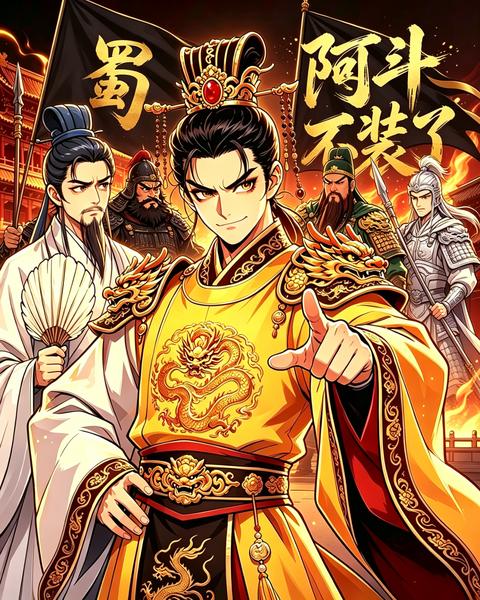
Chen Ye, an employee in the county government office, died suddenly from overwork. When he opened his eyes again, he had become Liu Shan, the last ruler of Shu Han.
Before him was the mourning hall at Wuzhang Plains. The chancellor had just breathed his last, and Yang Yi and Wei Yan were each leading troops. All it would take was a spark for them to clash. A line of text appeared in his mind: Han fortunes: -2000; 29 years until the kingdom falls.
Twenty-nine years later, he was supposed to surrender with his coffin and leave behind the words “So happy here, I’ve forgotten Shu” in Luoyang.
To hell with that.
In court, he asked Yang Yi: You say Wei Yan has a traitor’s bone at the back of his head. Is it round or flat? Have you felt it yourself? Then he handed the ceremonial axe and authority to a veteran who had been kneeling in the mud, waiting to die.
From then on, His Majesty stopped pretending.
The entire court pressed him to appoint a chancellor. He told the ministers to nominate one themselves. It turned into a public slanging match as they aired each other’s dirty laundry, and then he overturned the whole thing with one word: No.
A noble clan concealed thirty-seven thousand mu of farmland. He sent an eighth-rank guard to measure it. The guard came back with fifty heads and records of 220,000 extra people.
Qiao Zhou wrote On the Enemy State to urge surrender. At the gates of the Imperial University, Liu Shan set up a platform and calculated three accounts in front of twenty thousand commoners, then announced four predictions: Cao Rui would launch massive construction projects next year; Liaodong would rebel in two years; Cao Rui would die in four; and the Gaoping Tombs Incident would happen in fourteen.
Sima Yi sent people to drive up the price of brocade. Liu Shan let the enemy stockpile twenty thousand bolts, then opened the storehouses and sold each one for three thousand. The price was cut in half overnight.
He taught the old craftsman Pu Yuan the steelmaking method and took ten years off his life. Then he taught his son to make double stirrups and took another three years. He went white overnight, but gained a blade that could cleave through three layers of Wei armor and eight hundred black-armored troops who could breach a wall in ten breaths.
He shackled himself, established a review system, and kept a daily record of his conduct, devoted to noting his own mistakes.
Twenty-nine years is too long?
Then he would cleave apart Heaven’s Mandate, one strike at a time, and forge it anew.