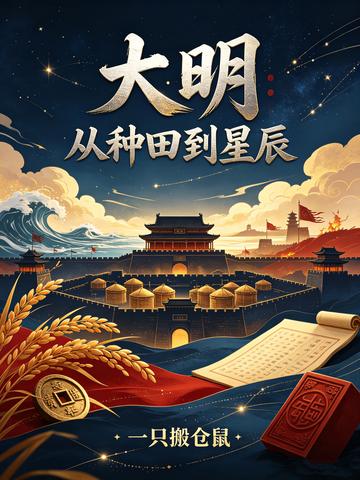
This is a slow-paced farming novel that respects history and includes historical notes.
Lin Chen, an architect who worked overtime through the night, suddenly dies at his desk. When he wakes up, he has transmigrated to the end of the Yuan dynasty and become Liu Bowen, a former official who has returned to his hometown.
The land is tossed about by the storms of a chaotic age. Taxes and protection fees pile up, squeezing the people at every turn. With winter approaching, Nan Tian Village faces a widespread food shortage.
The System he's bound to is even more absurd: it provides neither food nor soldiers, and only audits and verifies the results of his efforts to keep people alive. Every achievement must translate into real food and warmth for living people. His only reward is a slight improvement to his physical condition.
The deadline is one hundred days. The goal: reduce the number of households in Nan Tian Village facing winter famine by thirty percent.
Simply handing out food will only breed trouble. Liu Ji visits every household and revises the village rules, trading work for grain. He clears the mountains and builds irrigation channels, repeatedly testing compost to improve the soil.
But beneath the peaceful countryside, undercurrents run deep. Forged grain requisition notices stir up panic. Anonymous notes, scraps of old paper from the county granary, and half of a copper seabird token: behind each piece of evidence lies a scheme by local powerful families to stir up trouble.
He relies not on divine foresight, but on field investigations, account books, and physical evidence to cut through the fog, struggling to survive one step at a time amid competing forces.
Even after surviving the harsh winter famine, the crisis is far from over. Sun Yan, an envoy from Chuzhou, has already crossed the mountains and knocked on the courtyard gate with an invitation from Zhu Yuanzhang.
The struggle to survive by farming in the mountains cannot ultimately escape the flames of war engulfing the realm.
If you are interested in the Ming Dynasty, start by reading novels and try the waters [awkward laughter]
Not bad, in line with historical documentary novels
A very good historical realistic novel
The writing style of a science student is not procrastinating and is quite nice.
Very good book with good logic
Very consistent with historical reality!
Nice new book