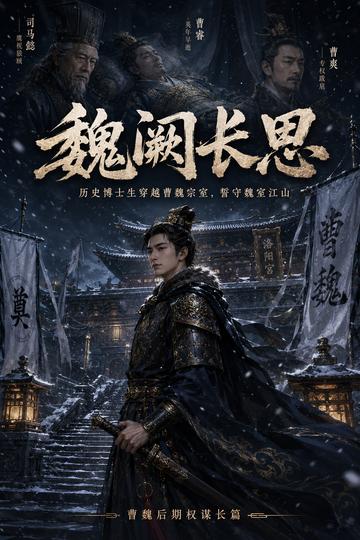
Lu Heng, a history PhD student, specializes in the political history of the Wei and Jin dynasties.
After staying up for days to revise his dissertation, “The Loss of Power by the Imperial Clan in Late Cao Wei and the Sima Clan's Usurpation of Wei,” he suddenly dies at his computer.
When he opens his eyes again, he has become Cao Zhao, a member of the Cao Wei imperial clan.
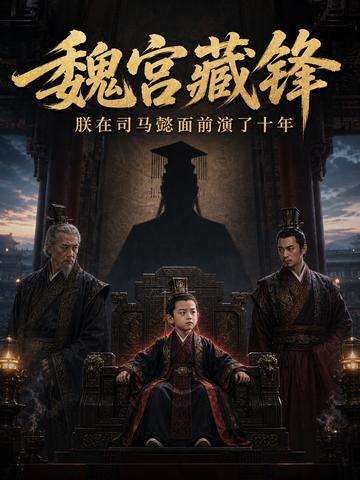
By then, Gongsun Yuan of Liaodong has been defeated, Zhuge Liang is dead, Shu Han is recuperating for the time being, and Sun Quan of Eastern Wu still holds Jiangdong. Emperor Ming of Wei, Cao Rui, is gravely ill, while the crown prince, Cao Fang, is still young. At court, Cao Shuang is about to be entrusted with the young emperor, and Sima Yi's prestige is growing by the day.
Lu Heng knows better than anyone that the Gaoping Tomb Incident will take place in ten years.
Cao Shuang will be destroyed, and the Sima clan will seize power.
After that, Cao Fang will be deposed, Cao Mao will be killed, and the Cao Wei ancestral temple will gradually become a stepping stone for the Sima clan's accession to the throne.
But in this life, now that he has become a kinsman of the Cao clan, he cannot let history repeat itself.
He will neither rush to kill Sima Yi nor rush to depose Cao Shuang.
His plan is to first ensure the imperial clan has a place in the struggle, then take command of the imperial guards, control Luoyang, suppress empty-headed extravagance, break up the factions, honor Sima Yi in name while taking away his power, and give Cao Shuang a lofty position while keeping his influence in check.
If Sima Yi can endure, then Cao Zhao will make him endure until he dies.
If Cao Shuang wants to monopolize power, then Cao Zhao will give him a title without real authority.
Shu Han launches northern campaigns, Eastern Wu eyes the Huai River, the great clans wait and see, and the imperial clan cowers.
Standing amid the snow in Luoyang's palace city, Cao Zhao says just one thing:
“Before the Cao Wei dynasty fell to the Sima clan, it had already fallen because the Cao clan failed to fight for it.”
Many years later, Shu falls, Wu is pacified, and the realm is united once more.
The ministers petition to establish a new ruler, and Cao Zhao ascends the altar in the southern outskirts.
Looking toward Cao Cao's old temple, he says slowly:
“Today, I am not usurping Wei.”
“I am restoring to the Cao clan the realm it lost.”


Is a work good? How many times have the proportions, story, content, and plot all been mentioned? The key is to have the correct three views. Once the background of the three views is determined and you have the attitude and spirit of historical materialism, then all choices will be logical and inevitable. Some differences under such common principles are understandable...
It does have an AI flavor, but it is much better than the inconsistencies and repetitions in the full text. You can take a look at it and you can see that the author has an outline and uses AI to polish it.
Very wonderful and detailed writing, very good
After reading more than ten chapters, I decided to come to the comment section to see if it was my imagination. Sure enough, someone commented that the AI felt too heavy 🤭
It must have taken a lot of effort to conceive of this novel. I feel that the suggestions in the article are quite difficult to think of👀👍
I hastily read Chapter 16 and was deeply absorbed in it. It is quite Ma Boyong's style, very similar to the book "The Wind Rises in Longxi". I'm going to deduct one point. There is a bug. Where did the "Old Events of Wei and Jin" come from? It traveled through time.
Cao Wei's version of the suspense novel 😎
Good! Excellent literary talent.
Very true and worth recommending