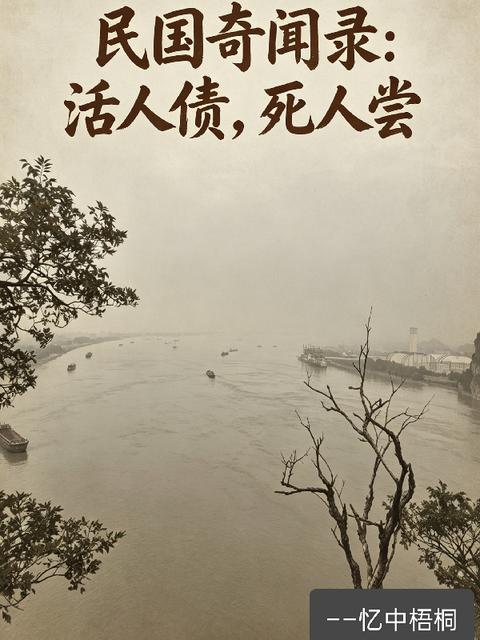
A white paper lantern hangs year-round in the teahouse at Kuliu Ferry.
Xiaoliang, a wandering storyteller, says he once sneaked aboard a ghost train with no tracks, where every passenger wore funeral clothes.
Danning, a down-and-out warlord, says his soldiers were swallowed by an old cannon one by one, their souls consumed because three hundred names of the wronged were carved inside its barrel.
Kang Cheng, the pawnshop owner's son, says his family's wealth came at the price of a "living pawn ticket" signed in blood...
Wutong, the listener, never speaks. He only writes line after line in a blue-covered notebook.
He thinks he is recording tales of demons and monsters, but in truth, he is sketching a map of blood and tears.
It turns out that in this world, those wearing human skin are more greedy and poisonous than those wearing ghost skin.
When the last story is told, Wutong closes his notebook and looks up at the thick fog over the ferry crossing.
Old Gou, the ferryman, is waiting to take him on his final journey.
[Author's Note] This novel borrows real place names from northern Anhui during the Republic of China era, including Guoyang, Bengbu, Suxian, and Zhoujiakou. Its historical backdrop draws on social conditions in northern Anhui between 1928 and 1929, including pawnshops, opium, and the Tianjin-Pukou Railway. The characters, plot, and the Kang family's marrow-extraction scheme are fictional, as are places such as Kuliu Ferry, Wild Fox Gully, and Blackstone Hollow.