Stats
955Reads
9.4Score
12Chapters
Tags
Synopsis
Reader comments
In booklists 5



A Book Where You Can Learn Real Skills
Any book will do
284.9MViews563Books19hUpdated


Life Skills, Useful Books
I would like to read a book similar to "Survival and Life Skills to Master for a Lifetime".
24MViews888Books1dUpdated





There Is a Shortage of Books, Please Give Me Books
Funny + single female protagonist + superpowers or systems, preferably if the male protagonist and female protagonist are childhood sweethearts, sweet. Please.
16.5MViews861Books12hUpdated





You Are Not an Outsider, Let Me See Your Collection of Books
The kind that can be rolled up into maggots under the quilt
3.2MViews554Books16hUpdated





I Have Been Short of Books for a Long Time and Need a Good Book
Dear gentlemen, can you give me a good book?
1.4MViews465Books3dUpdated
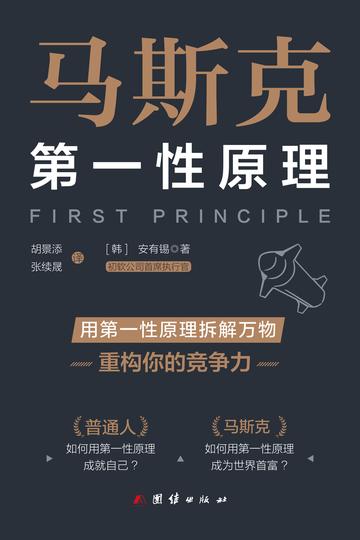
The cost of rocket launches has been reduced by 10 times, and electric vehicles have changed from luxury goods to mass consumer goods - these are not based on luck, but on the way of thinking. The whole book breaks down the four steps of "thinking back to zero - dismantling the essence - reconstruction and innovation". Whether you read it or not depends on how much you really want to understand the essence of things. The cost of rocket launches has been reduced by 10 times, and electric vehicles have changed from luxury goods to mass consumer goods - these are not based on luck, but on the way of thinking. The whole book breaks down the four steps of "thinking back to zero - dismantling the essence - reconstruction and innovation". Whether you read it or not depends on how much you really want to understand the essence of things.
Tomato also has such a high-quality book, I love it. My biggest feeling after reading this book is that we ordinary people love to think inertia too much. Whether it's work or life, I always feel that everyone does it and it's always been this way, so it's right by default. But the core of first principles is very simple, which is to ask more why. Musk's ability to do things that others think is impossible is not due to luck at all, but because he never blindly follows convention and only solves problems based on the fundamental nature of things.
This book is not about a mental model, but it is about proving one thing: the "impossibility" you are accustomed to is mostly just frightened by inertia. The cost of rocket launches can be reduced tenfold, and electric cars can be sold for cabbage prices - the answer does not lie in other people's success, but in first principles, that is, in your own simple questioning of "what is it".
I have always been curious about why Musk can always come up with operations that disrupt the industry. After reading this book, I finally figured out the way. The core is first principles. It puts aside the inertial thinking of following the trend and analogies, dismantles the essence of things from scratch step by step, and then re-optimizes and innovates. The book tells stories based on real experiences of Tesla, rocket recycling, Starlink, etc., Without piling up boring theories. The whole set of thinking methods of zeroing out, dismantling, reconstructing, and verifying is easy to understand. Whether you want to break through bottlenecks at work, start a business, or struggle with daily problems, you can use this set of ideas to solve problems. If you want to get out of the habitual thinking and improve your cognition, this book is worth reading slowly.
Many books on Musk on the market only pile up legendary stories, but this one focuses on the general thinking behind it. The author combs through examples of cost reductions for rockets and electric vehicles, and combines them with the business logic of Alibaba, IKEA and other companies. The content is not limited to entrepreneurship. When you are struggling with choices in life, the way of thinking of zeroing in and dismantling can help you avoid the judgment bias caused by following the herd.
This book is different from other books that talk about first principles. This book has many successful cases of using first principles. For example, Musk uses first principles to build rockets. It also teaches ordinary people how to use first principles in work and life. I recommend everyone to read it, it's really well written.
Dismantling the rocket into raw materials will reduce the cost from tens of millions to 2%. Musk doesn't have any superpowers, he just deletes the words "other people say" from his mind. Learning from him won't make you a genius, but at least it will save you some detours.
Why can he cross-border subversion? Because he does not ask "how others do it", but only "what is the essence of this matter". Be it rockets or electric cars, whatever is left after tearing off the industry wrapping paper. This book dismantles thinking, not technology.
Others focus on how their peers set prices, while he focuses on the lowest cost allowed by the laws of physics. If you take apart "impossible" and look at it, you will find that it is full of "dare not think". The first step in the five-step process is to question every requirement – who made it? Why? Anything beyond the derivation of physics is suggestion, not truth. "What you think is impossible is just that others haven't found a solution yet." This book explains a clear truth in vernacular: don't be kidnapped by experience and get to the essence of the matter directly. Ordinary people can also use it to reduce internal friction, follow the trend less, and at least live a clearer life.
There are few business thinking books that take into account both theory and ordinary people's daily lives. This book does not pile up obscure concepts, but organizes first principles into a four-step practical process. The book not only talks about Musk, but also collects cases from many entrepreneurs and scientists. I try to sort out the work problems using the idea of dismantling the essence, which indeed reduces a lot of ineffective internal friction. It is suitable for professionals to read casually.
In the workplace, it's easy to get stuck in a routine and not dare to try new ways. This set of thinking just breaks through this problem, advocating peeling off the appearance and getting straight to the core. Faced with project difficulties and complicated processes, we need to think outside the box and re-plan. After simplifying many complex tasks, it not only saves time, but also produces different results, which is extremely practical.
First principles, thinking strips away all empirical biases and goes straight to the underlying essence of things, reconstructing solutions from scratch to achieve disruptive breakthroughs. The author is not limited to business, and applies this set of thinking to ordinary people's daily lives.
This book breaks down Musk's "first principles" and summarizes them into a four-step closed loop of "return to zero - dismantling - reconstruction - verification". There are hard-core cases of Tesla and SpaceX, as well as comparisons of the thinking of Newton and Darwin. It is not boring to read. It turns mysterious philosophical concepts into tools that ordinary people can use. It is especially suitable for friends who want to improve their decision-making skills and find breakthrough points in the workplace or entrepreneurship. If you want to upgrade your way of thinking, this book is worth reading.
I used to think that first principles were complex thinking reserved only for big guys. After reading this book, I completely changed my mind. The language is very down-to-earth, there are no obscure terms at all, and it can be easily understood even with no basic knowledge. The author does not just talk about theories. He takes the real story of Musk building rockets and developing electric vehicle batteries as an example. The industry says that the cost of rocket batteries cannot be reduced. They directly dismantle the most basic raw materials, ignore industry practices and recalculate, and forcefully reduce the cost to an extremely low level. You can understand it at a glance. The most rare thing is that it not only talks about business, but also applies this set of thinking to ordinary people's lives when they are entangled in work, choose to make money, and deal with complex tasks. Many times, we feel that we have no solution and are just used to following other people's old paths. This book taught me to think outside the box The book is not long and can be read in a fraction of the time. After reading it, it is not just about filling you with chicken soup, it is about actually mastering a method of looking at problems. Regardless of whether you are an office worker or someone who wants to start a business, it is worth a look.
Abandon inertial analogies and return to the first principles of the origin of things, breaking the inherent thinking of the industry and deriving answers through underlying logic. This is also Musk's core thinking in continuously achieving cross-border breakthroughs.
Musk's First Principles, this book goes beyond the praise of success studies and clearly dismantles Musk's core thinking of subverting the industry. Most people rely on analogies and follow industry practices, and will only make small improvements. However, First Principles advocates stripping away all inherent experience, dismantling things to their underlying basic elements, and re-deriving the plan from its objective essence. The case of China-Israel rocket power battery cost reduction intuitively demonstrates the power of this set of thinking. It is not only a business tool, but also teaches us to break out of the shackles of inertia and get rid of inherent prejudices. After reading it, I understand that real breakthroughs are never based on imitation, but on returning to the origin and reconstructing logic. Only in this way can we break limitations and find new solutions.
Musk's first principles actually touched me quite a bit. When I was reading, I clearly felt that this principle is very different from the traditional principle. It can explain complex problems clearly from the underlying logic. It is for this reason that I quite liked this principle when I was reading.
The limitation of most of us is that we have always been like this and others are trapped in this way. The greatest value of this book is to break the inertia of thinking. Don't rush to refer to it when you encounter problems. Others first peel off all external prejudices, find the underlying essence of things, and then find solutions again.
Musk is someone I admire very much. He is extremely tenacious and will continue to do what he has determined to do. Don't care what others think. Always stick to your own ideas. It's not all smooth sailing for him, but he always chooses to be optimistic. Salute!
This book tells us not to be bound by industry rules and to return to basic analysis when encountering difficulties. There are many things that seem difficult to do, but people just keep using the old methods. Try to overthrow the inherent cognition and reorganize the logic. You can break through many stuck points in work and life. It is very suitable for people who want to improve the efficiency of work.
How to reduce the cost of rocket launch by 10 times, written in detail.
For a long time, we have relied on analogies and experience to judge things, and over time our thinking will become rigid. The thinking logic advocated in the book requires us to peel away the appearances layer by layer and get to the root of the problem. The real breakthrough is never to imitate others, but to recreate based on the essence. Once you understand this logic, your perspective on looking at the world and dealing with problems will change significantly.
Entrepreneurship and career advancement are all written in great detail.
I fell in love with this genre the first time I read it. It's very well written.
Think back to zero, dismantle the essence, reconstruct and innovate, and verify on the ground.
The experimental principles are written in great detail and I learned a lot.
Friends who need to study economics can read it.
It is worth reading again and again to improve your ability to think deeply.
Very good and makes sense.
This is my first time reading a book of this type. It's very interesting.