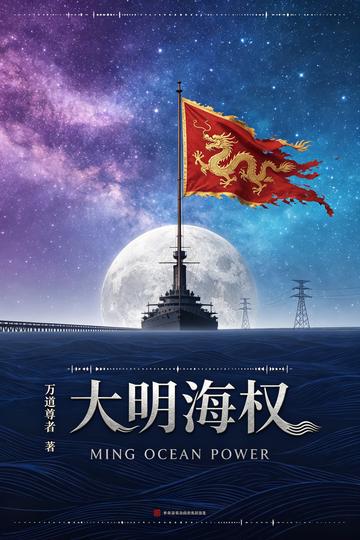
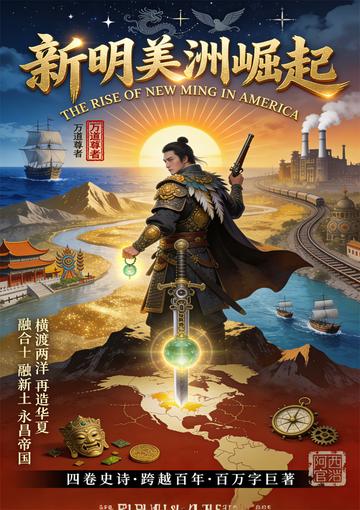
Chen Yuan, a modern naval strategy researcher, unexpectedly transmigrates into the newly enthroned Jianwen Emperor, Zhu Yunwen. Faced with the deadlock of stripping the vassal princes of their power, he abandons brute force and uses “buying back military authority, commercial privileges, and overseas fiefs” to gradually rein in the princes. He transforms the Prince of Yan, Zhu Di, into a pioneer of northern maritime expansion and resolves the Jingnan crisis without bloodshed.
Then, with remarkable foresight, he anchors the fate of the empire to the sea. He entrusts Zheng He with seven voyages across the Western Ocean and a circumnavigation of the globe, taking control of the sea lanes from Malacca to the Indian Ocean. He sends Zhu Di on an eastern campaign against Japan and north to explore Alaska, then establishes a “New Great Ming” on the west coast of the Americas. He develops Australia's gold and silver mines and colonizes the Southern Seas, creating a trading empire spanning the Pacific and Indian Oceans.
At home, he advances the study of science and technology, developing steam engines, telegraphs, railways, and firearms, and igniting the Industrial Revolution. In government, he establishes a legislative council and introduces constitutional monarchy, abolishes slavery, and grants women the right to vote, completing the transformation from an inland dynasty to a maritime empire.
Across the four reigns of Jianwen, Yonghe, Xuanhe, and Hongzhi, the Great Ming leads the world into the age of electricity, the information age, and the space age. Nuclear weapons, artificial satellites, moon landings, and the internet emerge one after another, bringing humanity to the threshold of an interstellar civilization.
Before his death, Zhu Yunwen leaves these instructions: “The Great Ming's path, from the ocean to the stars, has no end.” Four hundred years later, the treasure ship that once sailed from Nanjing has become a starship flying toward Mars. One transmigrator changed the course of an entire civilization.