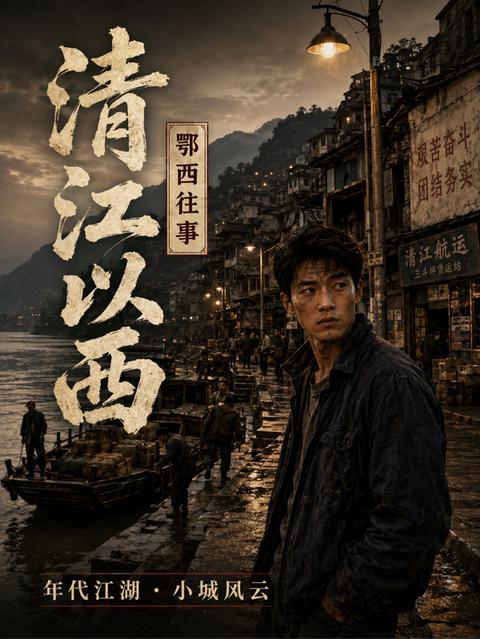
[Not a wish-fulfillment story] [The mark of an era] [Documentary style] [Period] These are the jianghu stories you have lived through, heard about, or witnessed.
In the summer of 1991, rain fell for a long time over Linjiang County in western Hubei.
Eighteen-year-old Xiang Changsheng came down from the mountains to Dock Three with nothing but a woven plastic sack, thirty yuan, and his mother's parting words: Don't show off, and don't get into fights.
But a dock is no place for reason.
Here, strength was worth nothing, and the rules weren't written down. Who could carry the cargo, who got to speak, who could stand tall, and who had to bow their head were all decided over a meal, a cigarette, or a single “brother.”
At first, Xiang Changsheng only wanted to earn money to support his family. But over the next thirty years, he watched Linjiang County transform from a small port town into a place where business revolved around construction, gravel, demolition, and tourism. He, too, slowly went from a young man from the mountains to “Boss Xiang,” as others called him.
But behind the glamour, old scores never disappeared.
In 2021, an old case was reopened. Former brothers, women, police officers, workers, and demolition-displaced residents each told their side of the story about Xiang Changsheng. Some said he was loyal, some said he was ruthless, and some said no one in that era had clean hands.
The river still flows, but the docks are long gone.
And west of the Qing River, the people and events once soaked by the rain finally resurfaced.