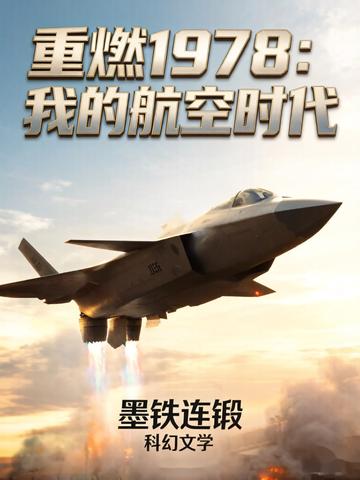
Lin Yan, a young military aviation enthusiast, stood before a retired J-7II fighter jet, his fingertips brushing its cold skin.
We once imported Spey engines, only to let them languish because of wavering decisions. We had an enormous industrial system, yet watched the semiconductor wave roar past our doorstep.
Decades later, as domestically developed fighter jets sliced through the sky like swords, and Taihang engines roared while phased-array radar lit up the heavens, Lin Yan was filled with complicated sighs.
History has no ifs, but regrets are always compelling. The technological bottlenecks we could have overcome sooner, the opportunities lost through misallocated resources, were like thorns lodged in the boundary between the best of times and the worst of times.
“What if... we’d taken a different path back then?”
He closed his eyes and pictured the road not taken.
When he opened them again, this time he was no longer a bystander.
With his left hand, he would take charge of aviation propulsion and rebuild the heart of China’s warplanes. With his right, he would command the electronics industry, planting a forest for the future in the semiconductor wasteland at the dawn of a new era.
Since he was back, he would bring regret to an end.
This time, he would watch with his own eyes as this giant ship stepped on its own feet and soared ninety thousand miles into the sky.
The Super 7 is a light aircraft and it is best not to use the belly air inlet. The heaviest auxiliary fuel tanks or heavy anti-ship missiles must be mounted under the belly (Pakistan, Argentina, South Africa and other countries require heavy-duty pylons). It is recommended to use air inlets on both sides, similar to the Galactic air inlet or the F15 air inlet. In this way, it can be considered to change to a dual-issue large version in the later stage, similar to the idea of upgrading the Mirage 2000 to the Mirage 4000, to meet the needs of some countries for heavy fighter jets. After the fighter plane is built, it can be sold to South Africa, and the Turbofan 9 engine can be sold to Iran and South Africa after it is built, preferably an upgraded version. Once the financial problem is solved, a market for the engine can be found. In the future, an F14 can be imported from Iran for imitation, and the imitation F14 fighter jet and accessories can be sold to Iran. The heavy-duty twin-engine Snapdragon can be sold to Iraq.
The ancients are ancient, not stupid. Why didn't the J-7 become the Super-7? One is that the positioning is different and the requirements of the times are different. The second is that the radar is too big and the technology is not yet mature! The reason why the MiG-21/J-7 used nose air intake when leaving the factory is because "it is a high-altitude, high-speed light fighter + combat within visual range + a small radar is sufficient"; it is not that "the radar is immature so I dare not do it", but "it is not needed at that time and cannot be put down"
The subject matter is good, and there is no trace of a time traveler in the protagonist. The protagonist knows the future, yet he is nervous and frowning every day.
The overall development of the story is natural and smooth, the characters' dialogues have online IQs, the tone and temperament are in line with the status and accomplishments, and there are no low-IQ plots such as slaps in the face and pretentiousness. The author has written it very well. I will put it on my bookshelf for long-term follow-up.
Kind of reminds me of Keshid's Eagle Aviation Industry
It's okay. It was written by a human. It's worth recommending.
To listen to it, to listen to it, to listen to it
Don't stop updating, damn it
If you like it, please update it and don't be a eunuch.
I like the writing style.