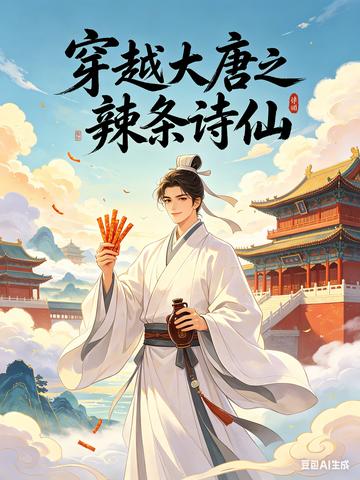
Li Xu is a twenty-first-century internet operations specialist, employee number 1047, known around the jianghu as “the last overworked grunt in Xierqi.” His hobby: writing poetry. His greatest poetic achievement: three likes on his Moments feed, two of them from himself.
He wakes up in the ninth year of the Zhenguan era, downgraded from “a walking corpse at his desk” to “a rent-defaulting shopkeeper with a shabby little shop in a corner of the Western Market.” He has no money, owes three taels, and owns exactly one asset: a wooden bed so hard it digs into his back.
Just as despair sets in, an unreliable dual-cultivation Food and Poetry System drops out of the sky and hits him with a soul-searching question: Want to open a shop? Write a poem first.
Through tears, Li Xu brings out a masterpiece on the theme of sorrow, something he'd spent three years laboring over on the subway. The System gives it a score of 68: barely a pass. His reward: a month of free rent, plus fifty packets of Weilong-style spicy strips.
From then on, Chang'an's whole vibe changes
The Crown Prince's attendants chew spicy strips as they write “Ode to Spicy Strips,” which spreads throughout the twin capitals;
Foreign merchants queue for three incense sticks just to buy “the Great Tang's Number One Snack”;
But what really drives Chang'an's literati wild is the poetry wall outside the spicy-strip shop, covered with all kinds of “spicy-strip poems” the System forces Li Xu to write. The lines range from “Spicy strips red as fire” to “A hundred flavors with every chew,” and their scores soar from 42 to 89.
Meanwhile, a young man from Bingzhou named Wang Bo receives a parcel of spicy strips and a copied poem from a friend, then sets off for Chang'an that very night. A young Lu Zhaolin squats outside the spicy-strip shop and refuses to leave, insisting that Li Xu teach him how to “write in contemporary vernacular.”
Every incident in the novel has a beginning and an end, and is resolved thoroughly without leaving the subject behind. It is very comfortable to read.
I particularly like this book. The good poems are all written by the author himself.