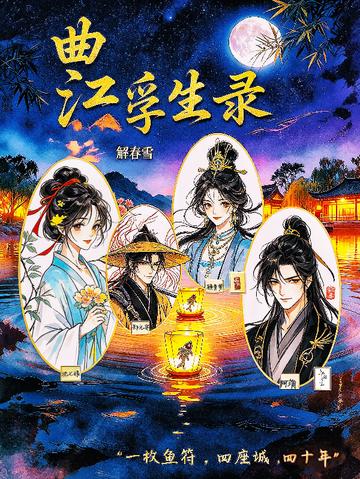
(The cover was AI-generated. It will be changed later.)
In the twenty-fifth year of the Kaiyuan era, Shen Qiniang, who sold sliced raw fish by Qujiang Pool, gave half a fish to a destitute scholar and received a gilt silver fish tally in return.
That scholar was Li Bai.
One fish tally, one promise spanning forty years. From Qujiang in Chang'an to the South Market in Luoyang, from the Grand Canal in Yangzhou to the Jin River in Chengdu, Shen Qiniang used her discerning palate to savor the delicacies of a golden age and the rough fare of troubled times, while guarding the secret fish soup recipe her father had passed down to her all her life.
She said, “A craft is meant to help people live, not to make money.”
In times of turmoil, she shared her recipes with fellow cooks, took in orphaned children, and kept a lamp burning in a tavern by the wharf for old friends torn from one another.
What became of them all?
Luoyang merchant Zheng Yuan'an remembered, thanks to a cookbook, that “being a good person matters more than doing business.” Yangzhou musician Gu Qingluo used her ears to help everyone remember the Chang'an they could never return to. Chengdu potter A Pu used his hands to fire a bowl with a little fish carved into its base, the only keepsake his master had left him.
Four people, four cities, forty years. The golden age blazed into chaos, scattering them apart, until at last they reunited by the Jin River.
That night, lanterns for the Shangyuan Festival filled the river. White-haired Qiniang placed the fish tally in a floating lantern and watched it drift downstream.
“Li Lang, you don't have to pay me back for the fish.”
She protected the Shen family's secret recipe, and something even more precious than the recipe.
One pot of fish soup, one pair of chopsticks, carrying her through the entire prosperous Tang dynasty.