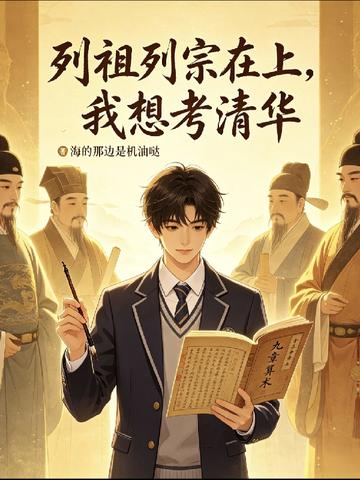
I was the class joke, a hopeless waste of space, until an entire China took up residence in my mind.
In his senior year of high school, Lin Zhou was the undisputed disgrace of Yude High School: 28 in math, 34 in geography, and 18 on his essay. His teacher humiliated him in front of everyone: “If you don’t work hard, this is what you’ll end up like.”
Then, one day in math class, the sound of an abacus rang through his mind.
Liu Hui, mathematician of the Wei and Jin dynasties, awakened.
Li Daoyuan, geographer of the Northern Wei, awakened.
Su Shi, literary giant of the Great Song, awakened.
Zhang Heng, astronomer of the Eastern Han, awakened.
The greatest minds in five thousand years of Chinese civilization began awakening one after another in the depths of his consciousness.
From the bottom of his class to the top scorer in the college entrance exam, from being reported for cheating to becoming the national champion, from Yude’s castoff to Qingyuan’s ace.
Everyone who had ever mocked him was eventually crushed beneath the wisdom of his ancestors.
A master of Japanese wasan mathematics crosses the ocean to challenge him?
“Tell him: the waters of The Nine Chapters on the Mathematical Art have never run dry.”
A Cambridge professor publicly claims that ancient Chinese mathematics isn’t real math?
“Please solve this original Wei-Jin problem using your own standards.”
When Li Bai recited in his mind, “One day I’ll ride the wind and cleave the waves,” and Sima Qian spoke through him of “exploring the relationship between Heaven and humanity,” he finally understood: what he had inherited wasn’t a golden finger, but a spark that had never gone out in five thousand years of Chinese civilization.
And the destiny of a spark was never to burn for just one person.
It was to be passed on.