An intellectual epic about reshaping Huaxia through institutions
What is Legalism? It is not harsh laws and severe punishments, nor political scheming. At its heart, it is about establishing a predictable order through clear rules.
From Guan Zhong laying the foundations for administrative grid systems with "dividing the state into three parts and its outskirts into five," to Shang Yang breaking hereditary privilege with a system of ranks based on military merit; from Han Fei bringing together the three pillars of law, statecraft, and power, to Li Si unifying Huaxia through the commandery-county system; from Sang Hongyang pioneering state intervention in the economy through monopolies on salt and iron, to Yang Yan completing a tax revolution with the Two-Tax Law; from Wang Anshi's fearless reforms, guided by the conviction that "natural changes are nothing to fear," to Zhang Juzheng's peak of performance-based governance with the Assessment Law: behind every resurgence after a time of chaos stands a Legalist logic.
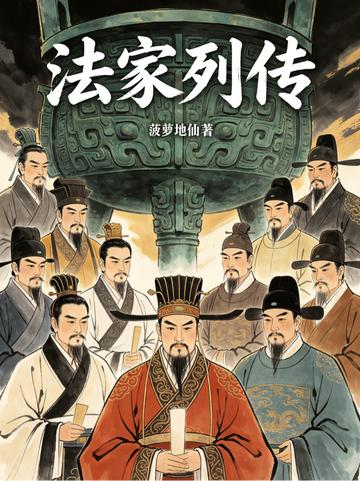
This book selects more than a dozen central figures in the Legalist tradition and uses the craft of historical fiction to tell the stories of their lives, institutions, and fates:
Guan Zhong, Zi Chan, Li Kui, Wu Qi, Shang Yang, Shen Buhai, Shen Dao, Zhao Wuling, Han Fei, Li Si, Wang Meng, Wang Anshi, Zhang Juzheng, Yongzheng...
Among them are theorists and practitioners, chief architects of empires and master strategists in chaotic times, reformers who gave their lives for their convictions and rulers who governed with an iron hand. Each, at a pivotal moment, offered an answer to the question: "How do you organize a large, complex society?"
Their answers shaped the institutional DNA of Huaxia civilization.
Dedicated to everyone who believes in the power of rules
Dedicated to this great nation in an age that needs order and efficiency










Very beautiful, super beautiful